Archive
Quia, centro student access problems
-

- cimg0172
-

- cimg0178
-
- cimg0177
-

- cimg0176
-
- cimg0175
-

- cimg0173
-

- cimg01721
-

- cimg0171
The new way of booking LRC rooms and equipment from Fall 2011: How?
- Read here why.
- You can book LRC resources like rooms, equipment, even tutor hours:
- as
- faculty & staff: from [MS-Outlook“(pretty much) whatever version”]:
- on the desktop Outlook 2007, Outlook 2010 or Outlook 2011 (preferred option for faculty & staff) – if you are familiar with Outlook Desktop, it is the recommended tool
- or at http://mail.uncc.edu, using Outlook Web Access (OWA) at http://mail.uncc.edu, in most browsers – we, however, decided to focus our training of new users on OWA.
- student: in Outlook Live (the only option for students) at Ninermail or http://outlook.com,
- faculty & staff: from [MS-Outlook“(pretty much) whatever version”]:
- through
- creating from menu:”new” a “meeting request”
 (for details see How to book an LRC resource)
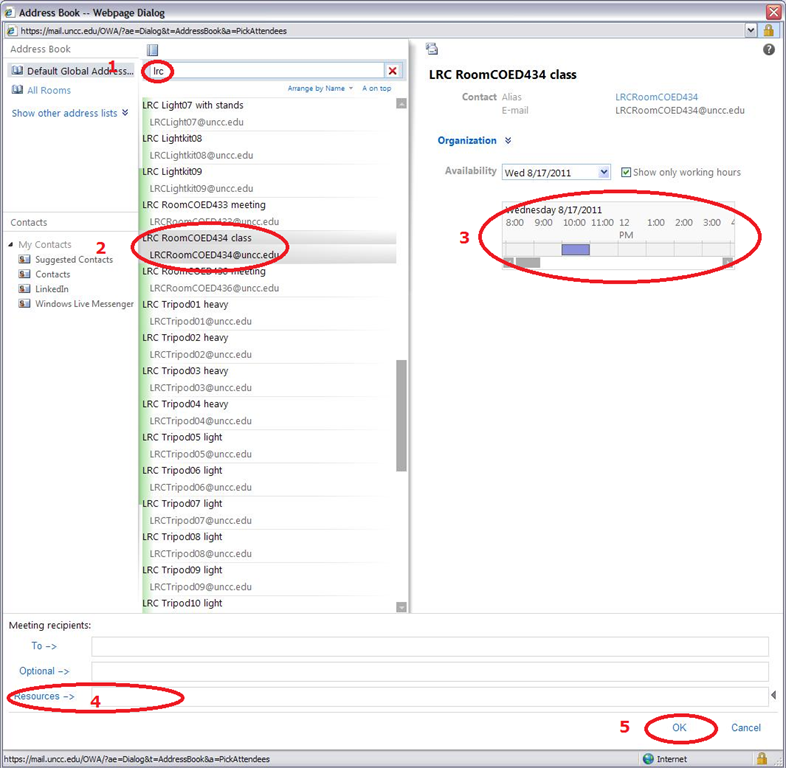
 - and adding a resource (or several: temporarily, to compare which one’s availability fits best into your own schedule; permanently, to book multiple items at once, as long as all start/end times are the same) by clicking on the “Resources”, like here

- all LRC resources names begin with “LRC” and will appear if your search the Global address list (GAL) for “LRC”; all bookable rooms and equipment have been given an email address listed here):
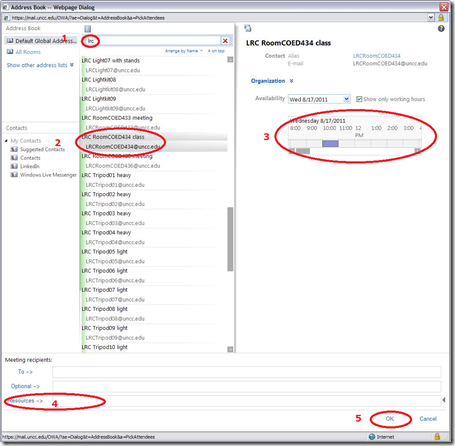
- e.g. to book the LRC main classroom, send to LRC RoomCOED434 class <LRCRoomCOED434@uncc.edu>
- all LRC resources names begin with “LRC” and will appear if your search the Global address list (GAL) for “LRC”; all bookable rooms and equipment have been given an email address listed here):
- and adding other meeting participants, e.g. co-teachers of your class, or LRC staff if you need more than routine support
- If you hold a class in the LRC, to remind students of the new location, teachers could also try and add your class, if you made a convenient group of all students in your class in Outlook.
- and, from the “scheduling assistant”, choosing a time when the room/equipment is free (= blank), not blocked (= solid or hatched) (and all participants),

- and adding a subject with class number and possibly special instructions:
- if you do not allow self-access students on free seats: *EMPTY ROOM*
- if you do not allow tutoring in corners: *NO TUTORING*:
- I will ask the LRC assistants (unfortunately we have large gaps in the schedule) and tutors to load and check the lrcroomcoed434@uncc.edu so that tutors can relocate with their students on time.
- and sending it (like email to a person) to the room or equipment
- What happens next?
- await responses: Read more in What happens after the meeting request.
- monitor calendars: you can link into your OWA the calendars of those resources that you use frequently (e.g. a piece of equipment, an LRC classroom or tutor office for the language you study). Read more in View Calendars.
- If you need to release the resource, i.e. to free up the room/equipment for others to use – esp. helpful when you have the LRC booked for your entire class, but won’t meet there this week), open the meeting form your calendar and click in the top menu the buttons cancel series, ”send update”
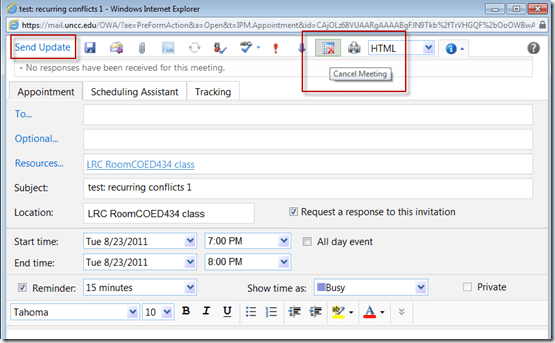 (for details see how to cancel a meeting request)
 - SummaryList of Links:
- this intro
- list of LRC resources that you can book or check out
- request resource meeting
- change meeting request
- cancel meeting resource
- resources in OWA’s Global Address List (GAL)
- scheduling assistant, avoiding scheduling conflicts
- resource responses
- resource calendars for staff, and for students
- equipment check-out/in
- why?
- For further reading: Microsoft explains Scheduling for Outlook Livein more detail here:




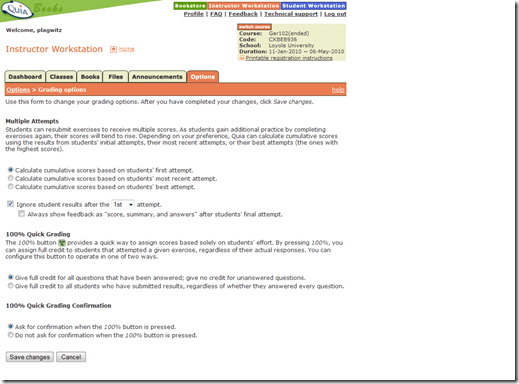
Quia Options for Grading in course or book or exercise
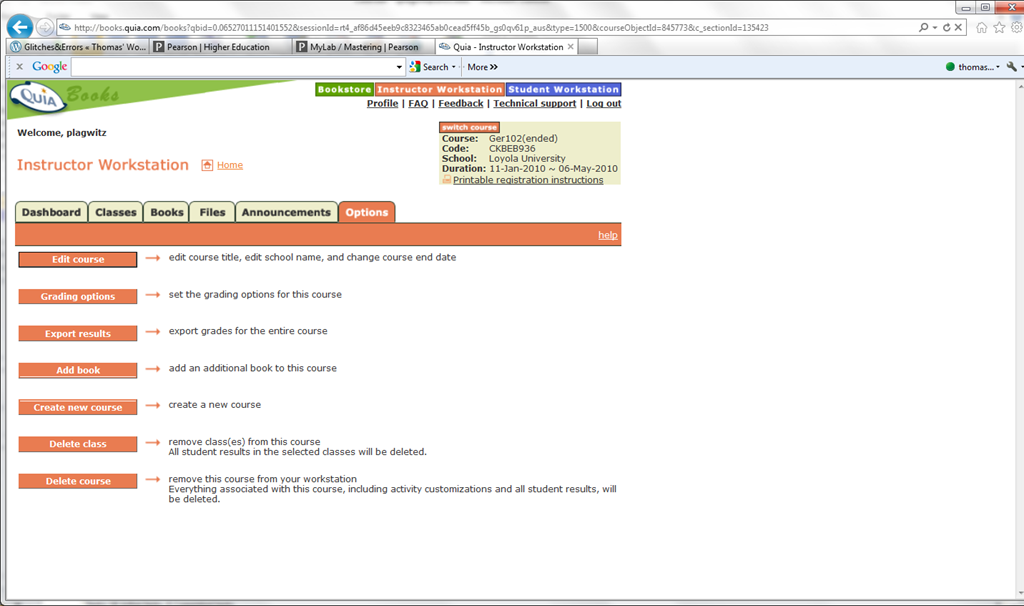
- The instructor workstation features prominently the tab : options.

- if you go into grading, you see that not all options can be changed from here.
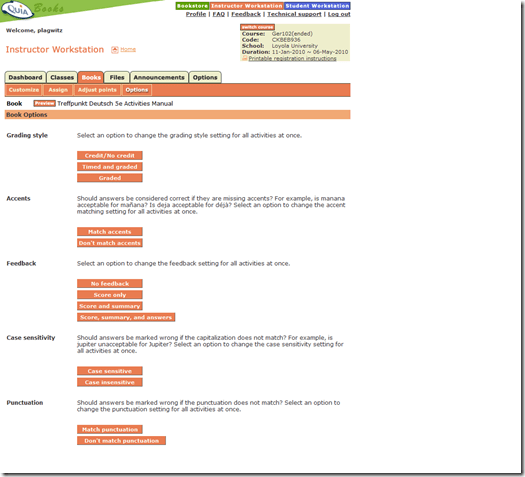
- However, when customizing your book, you may have already found the options next to each individual exercise that allow you to change Spelling/Case sensitivity

- However, if you go to the tab: book, you will find more options there, including how you can change Feedback and Spelling/Case sensitivity for the entire book instead of individual exercises:

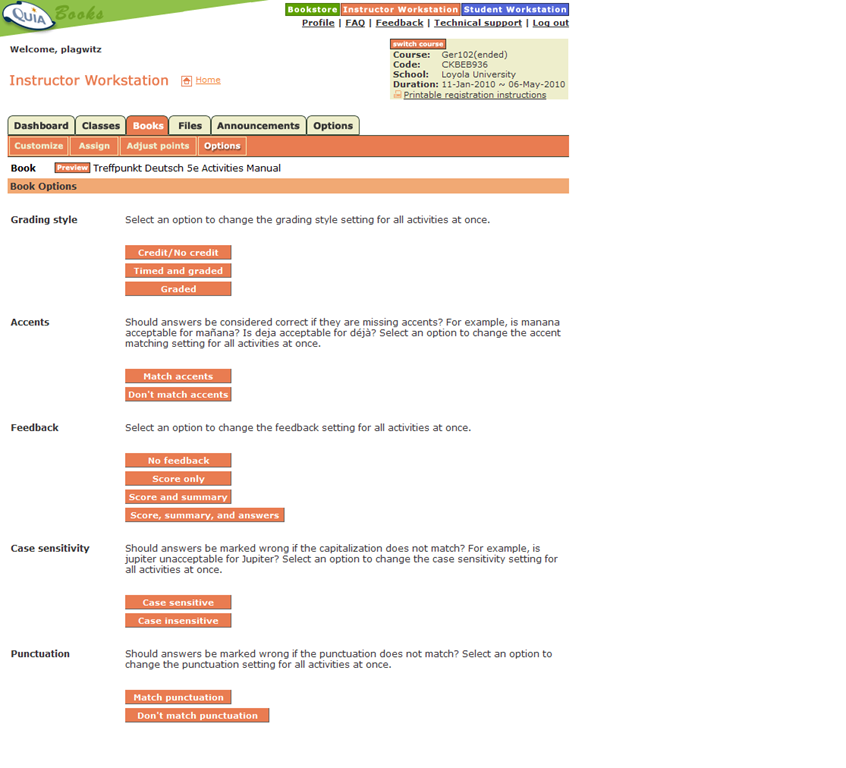
Centro/Quia student access problems at term start: What OneKey?
-
Our Pearson/Prentice Hall textbook comes with online component, access to which is purchased in the University bookstore.
-
The textbook comes with a setup brochure (OneKey, yellow) that states: “Go to www.prenhall.com/onekey, click OneKey for Students, then click Getting Started, and select CourseCompass. Follow the on-screen instructions to register for CourseCompass”.
-

-
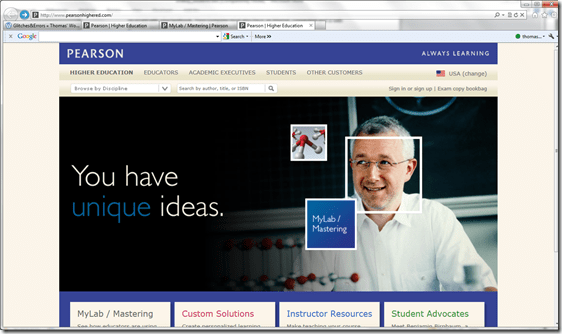
This page is unresponsive und forwards to http://www.pearsonhighered.com/
-
-
Cute but I have no idea how to continue from here.
-
if you try to enter the “CourseCompass Access Code” by browsing manually to www.coursecompass.com, you will read: “CourseCompass is now MyLab and Mastering If you had a CourseCompass account, it works with MyLab / Mastering. Sign in now.” Maybe this change broke the entire signup process?
- 100000s of these packages must have been sold by now, each costing 100s of dollars. Why do students and teachers have to waste entire class hours, each worth also 100s of dollars, on banging their head against this pay wall even after they paid?
- When reading the instructions, I found it necessary to highlight the steps our students need to take:
- CourseCompass Access Code
- CourseCompass Course ID
- Account username and password
- Quia Student Book Key
- Quia Course Code
- Wow! With my teacher login, I can see that the online content which is protected by this pay wall is still the same literally translated print lab manual/workbook material. Must be decades old now.


Moodle Metacourses, part III: The support workflow: File-renaming
We discussed file renaming utilities in an earlier post. Here are some more practical tips:
Limitations: While both utilities can accept Windows Search Result sets, drag-drop seems limited to fewer than 256 files at a time (on my Vista 64-bit – but that is not an OS limitation, since MS Expression Encoder can accept a drag-and-drop of all over 3.5k files that need reencoding).
Workaround: both utilities have a folder-select, and Renamer in addition accepts file masks, which can mimic some basic searches:
![image_thumb[2]](/Users/trp/AppData/Local/Temp/WindowsLiveWriter1286139640/supfilesB79F19A/image[6].png "image_thumb[2]")
Bulk Rename Issue: While it allows for “Select from Clipboard” which you can use with the Windows “Copy as Path”/”Send to Clipboard as Name” feature which works with search result sets. However, I could not get this feature to work (neither with the default “” around the path nor, after removing them manually, without).
Renamer, Issue: rule, clean up, strip-out-content-of-brackets-does-not-what-it-should:
Renamer-translit-anglicize-foreign-language-diacritics: unfortunately still recommended for technical reasons; Renamer has presets, e.g. German here: TBA
Only one preset can be inserted add a time (overwrites previous) – but you can build your list with copy/paste from/to this text box and persist it to disk to load it later, just like the search rules – an extremely handy feature.
Moodle Metacourses, part IV: The support workflow: Transcoding audio learning materials
The MS-WMA-Voice codec features very acceptable audio quality for spoken language learning materials in a highly compressed format. It allowed me to reduce our existing audio files collection size by about 50%.
Expression Encoder 3 crashed a few times during encoding this queue of 3.500 audio files. In addition, it took a long time to reload the .XEJ project files of such a size. It is, however, easy enough to inspect the XEJ in an XML editor:

And even easier to delete the finished media files form the queue using a text editor: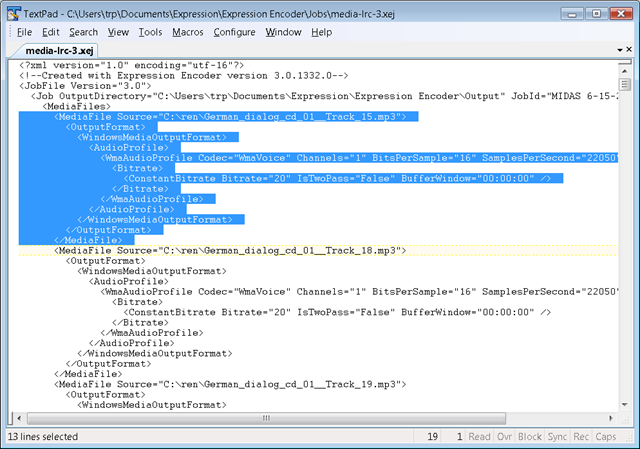
I am wondering whether this queuing could be streamlined (recovery automated, and the need for human interaction be reduced) using the PowerShell Module for Automating Expression-Encoder, but so far the process is good enough.
Sanako Study-1200 slow spanning 2 screens with different resolutions
- UPDATE2: 2013-09: apparently new video driver crashes with autoscan window, this time even on primary screen alone?
- UPDATE: 2011-01:Problem seems to have disappeared (windows update?)
- Symptom: This is on a Dell Optiplex 760 (B6CCLK1) which has no problems with Sanako’s screen sharing application, as long as you do not attempt to span the windows across two screens with different resolution which makes even the mouse jerky. Not sure, but do not remember having this problem across two screens with the same resolution. Actually, the Sanako subwindow (remote ctronl specifically) slows down the computer even if it is only on th secondary screen.
- Solution: Relatively easily fixed, if you can afford upgrading not only the screen, but also the LCD projector that hangs on one of the screens…
- Workaround: Do not span sub-windows of Sanako Study-1200 across screens. This problem can become so bad that the Sanako sub window becomes completely unresponsive and cannot be moved or closed (neither with the close button in the upper right nor with ALT-F4). Try CTRL-ALT-ESC then and kill the process. You could also try and upgrade the video card driver which may be the true culprit. However, on the Sanako sub windows seem to display the problem (screensharing with remote control, chat also). E.g. Internet Explorer windows do not have the same problem when spanned across screens.


Questions? Read the About. Or just ask me a quick Our Databases: Resources with calendars -- Language learning material Moodle Sites, multimedia files -- films


FAQs for LRC student staff or for students or for teachers. To search our FAQs, in the browser addressbar, add after "https://plagwitz.wordpress.com/feed/?tag=faqs+/" "+TAG1" (from tag cloud below) OR "https://plagwitz.wordpress.com/feed/tag=faqs
&category_name=" "CAT1" (from category hierarchy below). OR search both categories and tags, and multiple TAGs/CATs (connect with "," for OR-search, with "+" for AND-search), like so: https://plagwitz.wordpress.com/feed/?tag=TAG1+TAG2+...TAGn&category_name=CAT1
+CAT2+...CATn"
Other ways to find help
If you cannot find it here, look there: 5,500 Language-Learning Links and Programs for learning or teaching 150 languages
Shortcuts:Our Lists, Our Maps, LRC Staff Moodle Site,LRC Project Moodle Site, 49erexpress, UNCC Moodle, Student Recordings: s:claslcslrcsanakostudent
Learning usage samples: Sanako oral exam, Kaltura webcam presentation, Dictation with speech recognition, Sanako written exam, Chinese and Japanese interactive stroke-order practice
Test the Sanako Installer, Webbrowser Popup Konfigurator for XP, or Windows7, faster LRC TeacherPC Log-in Let MS facilitate diacritics writing by installing for you US-International keyboard layout
This is my personal blog (Google+). The views expressed on these pages are mine alone and not those of my employer. The information in this weblog is provided “AS IS” with no warranties, and confers no rights.

