Archive
Speaking/Listening Assessments and Oral Exams: A comparison what the LRC has to offer
- Moodle:
- I proposed for installing one of the free audio recorder plug-ins into our Moodle, but we are not there yet.
- However, we do have a new video recording assignment (which is based on Kaltura).
- Format: free form, according to your written instructions in the assignment. Students can review and repeat the recording as often as they wish.
- The video overhead is minimal since it is streamed, and video is better for authentic language assessments – unless you specifically prepare your students for phone interviews: then just have students step out of the viewing angle of the webcam).
- thanks to Moodle, the familiar interface and the underlying LMS support infrastructure, it is easy
- for the teacher
- to create and assign a video-assignment
- to grade it from the gradebook
- for the students to take it and submit it.
- for the teacher
- LRC Support:
- Since our PCs have no built-in or added webcam (proposed), we can currently only use our 5 iMacs for Moodle video assignments. Since the MACs do not have headsets (but built-in microphones), the audio quality is not as good as on the PCs. Since 5 seats are not sufficient for class-size activities/exams, it is best to use this as a homework assignment
- I list all necessary steps for a video assignment
- Additional support is available through the campus Moodle support team.
- Sanako
- Sources
-
Dual-track comparative recorder:
- the teacher can prepare an input track (or provide one live. Preparing is easy, and worth your while, since easily reusable. I can help you)).
- the students records on her own track
-
Pair and group recording:
- Sanako makes it easy to pair or form groups of students and to record free-form conversations.
- These recordings can be either controlled remotely by the teacher or locally by the user
-
- Control
- Remote-controlled recording under exam conditions,
- responding to a listening cue within a preset (or live) pause in the teacher track
- model&imitation: for phonetics and pronunciation exercises,
- question&response for a wide variety of activities as commonly used in SLA textbooks and classroom, including practicing grammar structures or vocabulary recently
- question&response&model response: the teacher can also include after the pause in the teacher track a model answer for the students to compare their own output to.
- automatically saved with student names to be accessed from the teacher office desktop
- easy comparative grading using Audacity (see below)
- responding to a listening cue within a preset (or live) pause in the teacher track
- Remote-controlled recording under exam conditions,
- User-controlled recording is also possible, using the student recorder in manual operation mode
- which has more language learner features (bookmarks, voice graph, dual band recording), and a simpler interface than a full blown audio editor like Audacity (see below).
- The task how to save and sent the assignment to the teacher is here left to the user.
- LRC support:
- I can help you
- creating an audio recording with your content and speaking cues and pauses – using Audacity (see below)
- conducting the remote-controlled exam
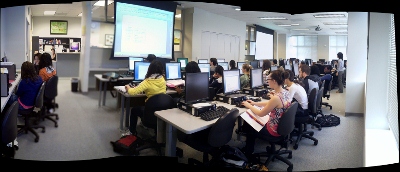
- Up to 20 seats can take an oral exam simultaneously, until we get more Sanako licenses. However, we found a way to split classes into 2 halves and have consecutive exams (we can play audio on the other students’ headsets to provide for exam conditions). The LRC main classroom is equipped with 30 seats for 2 consecutive exams with Sanako headsets.
- Sources
- Voicethread is a popular online recorder, especially for educational institutions that have no onsite support.
- Visual and audio cues can be provided by the teacher.
- Pairing of students has been attempted via sharing and responding/commenting to the partner’s submission. This is not a realistic conversation.
- Recordings are stored in the cloud.
- There is no integration with the SIS (accounts – getting students set up with accounts that can communicate back with the teacher is a challenge) and LMS (the Moodle integration is superficial).
- Voicethread is not free. The ELTI, however, has a subscription. LCS does not.
- LRC Support:
- We support Voicethread exercises with new and improved headsets.
- Help is available through the vendor.
- Audacity:
- for teachers and LRC staff and other language professionals:
- best free audio editor, also good for comparative grading. I routinely make my audio exam recordings with Audacity.
- LRC support: I have tips and tricks how you can use it in your teaching preparation and grading.
- for language learners: not the recommended option, since Audacity has not a feature set geared towards language learning nor support for language assessment workflows:
- Language learners do no need an audio editor for speaking exercises, they need a recorder. If you are a language learner, it is not pedagogical to be able to technically edit and refine your audio recording. Rather rehearse, reflect on and repeat your audio recording, until you are happy with your language output.
- Audacity is too technical: It involves too many steps, options and settings for the students to record, save, export and name the audio and to get it to the teacher, and (if it is not uploaded into a Moodle assignment, which could then be a Kaltura assignment anyway, see above), too tedious for the teacher to manage and grade files.
-
LRC Support:
- If your students are technically inclined, we do have Audacity installed in the LRC.
- Your students should not find it difficult to read the documentation. Here are my posts on Audacity.
- for teachers and LRC staff and other language professionals:
How a Student takes a Moodle Video Assignment in the LRC
- On one of the LRC iMacs, in the Safari web browser (open new window with COMMAND-key+n),
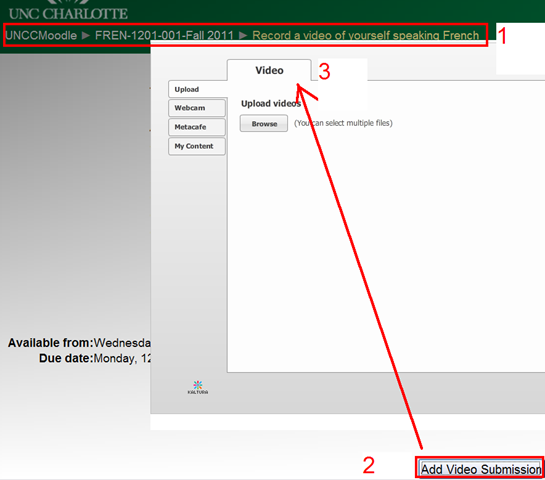
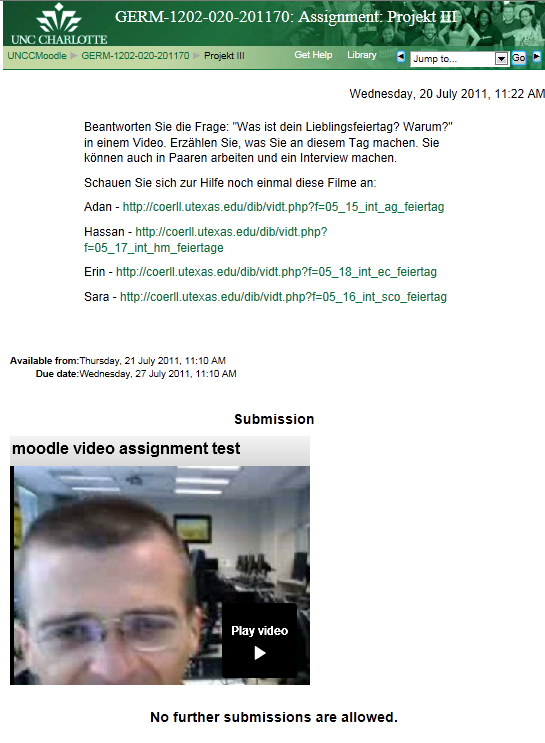
- go to your Moodle course, (1) find the video Assignment, read the assignment instructions (what your teacher wants you to record). Then click underneath the (2) button: “Add video Assignment”, to open the (3) submission window:
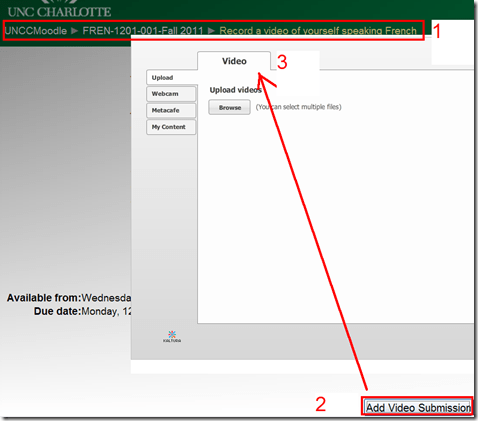
- Note that she will also have to allow the flash player to interact with her webcam first.
 If you see no web cam video window, only a black frame, read in.
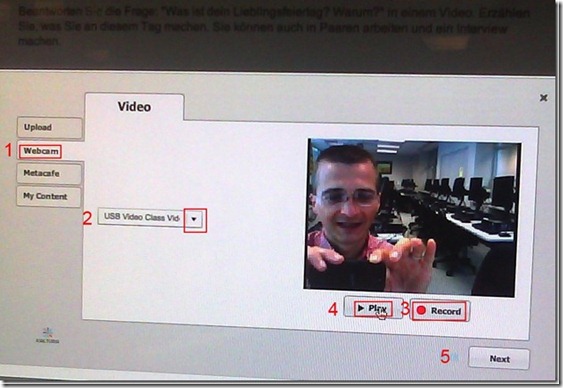
- In the submission window, choose the tab “Webcam” (1), use the dropdown to select the camera hardware (2).

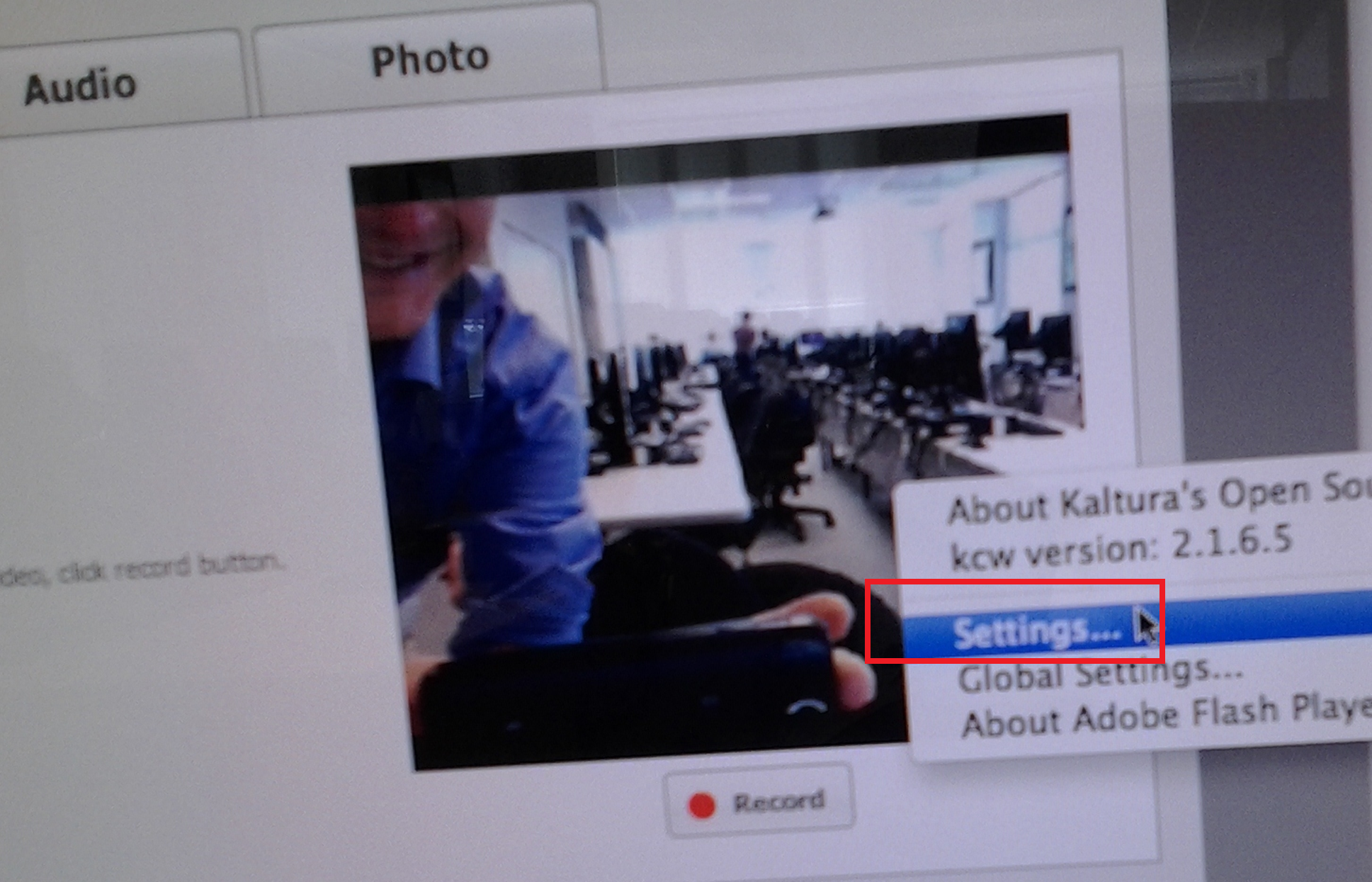
- Check the headset microphone audio: The external headset microphone on the iMacs did not work., but now it does, provided you do this: control-click on Flash’s a video preview window (= the window where you see yourself like in a mirror) for the web camera, and click on “settings”.
-

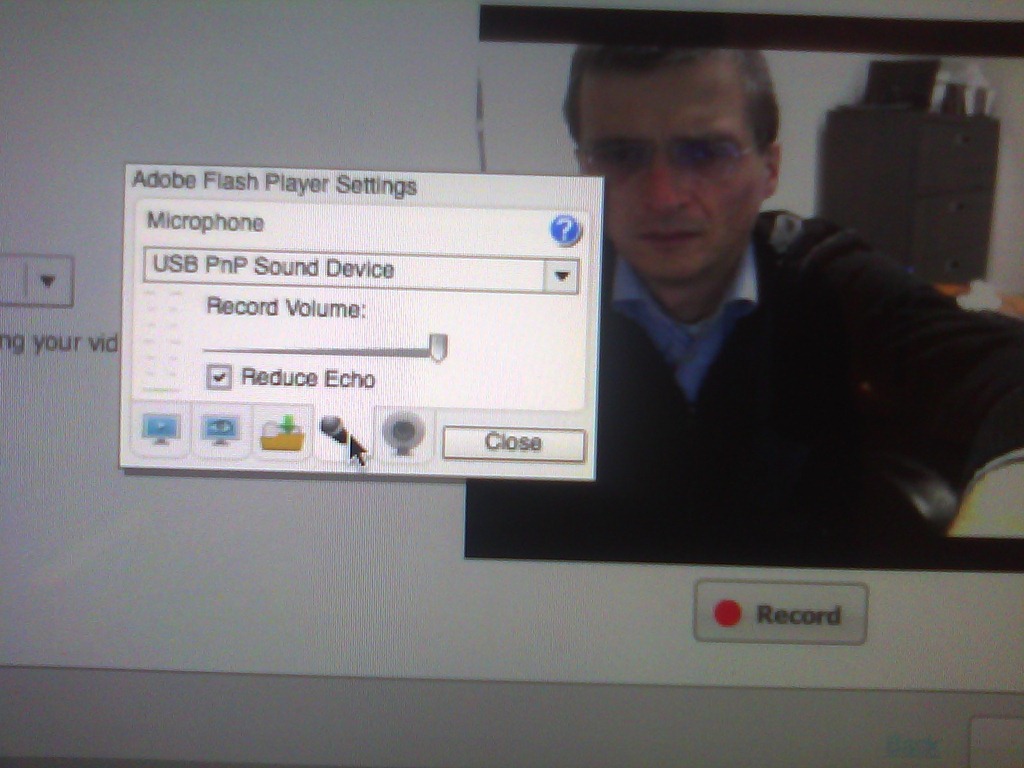
- Click on the microphone icon :

- Make sure the USB PnP device is selected.

- You can bring up the settings dialogue, make sure the USB PnP device is chosen for audio and CRANK up the microphone input sensitivity! Then, by tabbing (don’t speak yet) on the headset microphone, test the volume levels with the built-in volume meter (should show lots of green bars when you tab). Unlike in the picture, do not choose “reduce echo ”.
-
- Start (3) the video recording.
- Afterwards, the student can review (4) her submission.
- If you don’t like your first recording, (3) “record” over it and review again with (4) “Play”. If you do this and the video appears frozen, drag the timeline cursor forward to get the re-recorded video to play. If this does not seem to work, you are likely still able to submit your 2nd attempt, just not review it again.
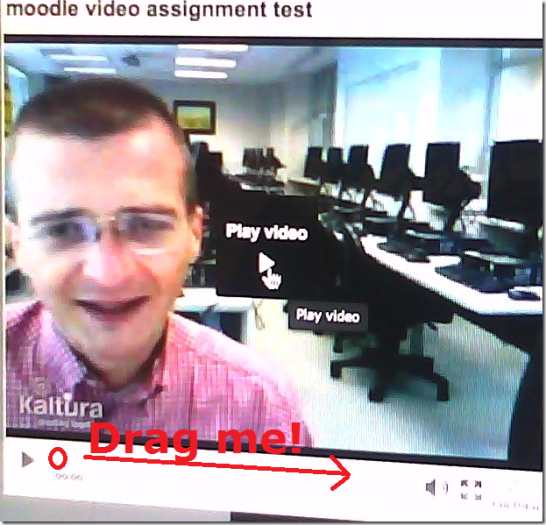
- Click through all the “Next”etc. buttons:
-


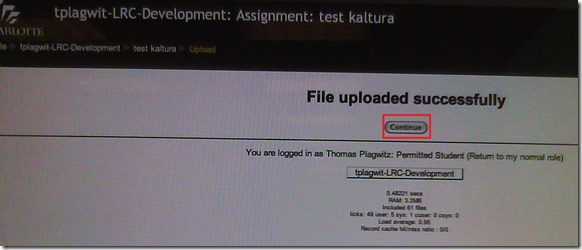
- until you get to the feedback page for the student (caveat: in IE9, the video does not fit into the frame provided on the page).

- Note, it warns you to be patient now:
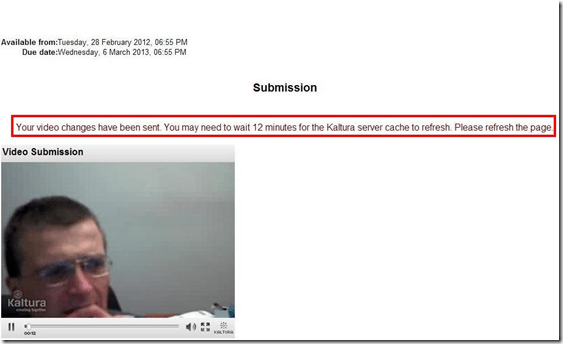
-
- LRC support:
- Depending on your hardware (webcam), software and network support, you can record your language speaking video assignments on any device that has a webcam and a browser that supports flash – and even more devices, if you are willing to post process and upload the video clip.
- If you run into problems or want to use a tested setup, we recommend using the LRC. Since our PCs have no built-in or added webcam (proposed), we can currently only use our 5 8 iMacs (see LRC Layout, see Classroom Calendar and iMacs Calendar for availability). Our (limited) tests worked better in Safari than Firefox.





Our Office 2010 natural language features upgrade: A running log
- Just logging some notes, observations, issues, step-by-step instructions… – other than non-natural-language, most collaboration features, which are being logged here.
- Office 2010 proofing tools (proofing-tools2010-install.wmv),:
- again, we select custom install, “run all from Computers”
- install is extensive, but uneventful
- Office 2010 proofing tools (proofing-tools2010-first-run-German-set-language.wmv), first run:
- German is not autodetected. You have to set the language of the selected text manually, and first find the button on the ribbon:reviewing
- While choosing the language, you can see from the checkmark which languages now have proofing tools installed
- Foreign Language Support
- One of the strongest benefits of upgrading to MS-Office 2010 in the language center is the improved foreign language support licensing for so called “Language Packs”, and that we have a complete set of licenses to the MS-Proofing Tools.
- In addition MS-Office supports free download of so called “Language interface packs” which seem essentially downscaled language packs for LCTL (usually come only with (see feature list) a spell checker and help in the language). Compare: “If a language is available in a language pack or as a fully localized version, it is not available as a language interface pack”.
- Unfortunately multi-user (= learner of different language) support is not the primary usage scenario of these tools. It is, however, possible, to set the language to a default (e.g. Spanish, Arabic or Chinese, depending on your environment). Switching to another language is relatively easy for a user
- changing the screen-tip language: http://skydrive.live.com/embedicon.aspx/screencasts/office-2010-switch-screentip-language.wmv?cid=4fa3329905d7e1ce&sc=photos
How to do Sanako Oral Exams with large classes, but few licenses: A workaround using partial classroom layouts
When you open the Study1200 tutor, a dialogue comes up which lets you select you the “classroom layout’. What this actually means – since the physical classroom (LRC layout) is obviously immutable –, is: which computers do you want the Study1200 to connect.
The “template classroom” (this happens to be just the default name within Sanako) tries to connect all students logged in on computer in COED434 to the teacher from the “corridor” (= where Study1200 leaves all computers that it knows of, but that you do “into” want to let into the classroom; the corridor has link in the bottom center of the Study1200 teacher window, and it flashes if there is a change “in “ the corridor Stuy1200 wants to make you aware of) that the Study1200.
However, beyond the 20th client (first come, first serve), this will fail because of licensing restrictions, and a grey exclamation mark will appear in the classroom layout in the Study1200 window for these student icons.
The “left-half”and “right-half” layouts that I created load only the computers in either the left or right half of the COED434 classroom (each without the wall/window-facing computers at the very edges) into the classroom layout (other logged-in students will remain in the “corridor”, linked in the bottom center of the tutor interface, if you want to add select students – note that the student icon will not appear on screen in their approximate physical position in the classroom.
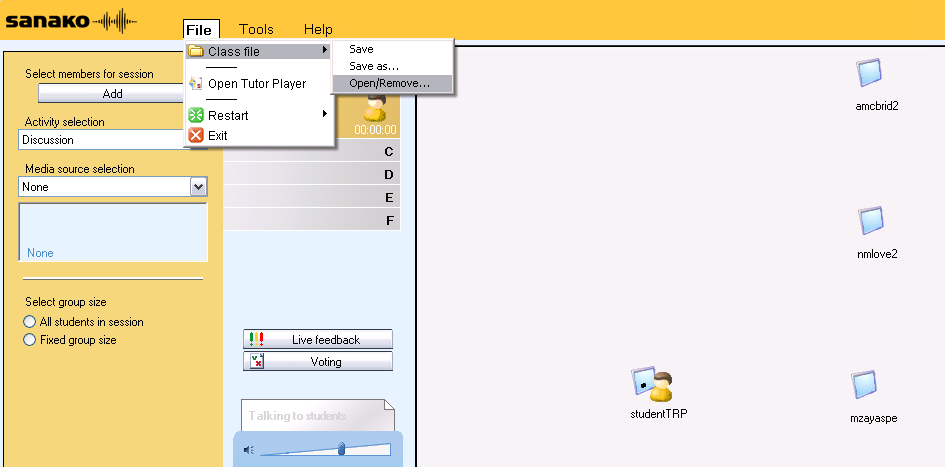
You can also bring up the dialogue from which you can choose classroom layout after the initial startup of the tutor: Go to top menu: file / classroom layout. A 45-second screencast of this switching our classroom layouts in Sanako Study 1200 is available for download (requires Windows Media player).
In the screencast, you can see how the visual layout on screen reflects the physical layout in the classroom (the number labels on top of our computer monitors appear (optionally) in seat numbers): rotate by 90% clock- or counterclockwise (I wish we would have not only more licenses, but also a higher screen resolution. Stay tuned).
This technique of splitting the classroom, unloading and loading half of it at a time, you can exploit for administering oral exams consecutively with class sizes (current maximum is 25/30, depending on level) that exceed the number of licenses we have (currently 20 + teacher).
This technique of excluding computers from connecting to the teacher we could also use to merge the listening station computers, even though they have a different audio hardware configuration (analog headsets only, no Sanako headsets with built-in sound card and disabled on board sound) into the main software image without consuming valuable licenses – not without other problems.
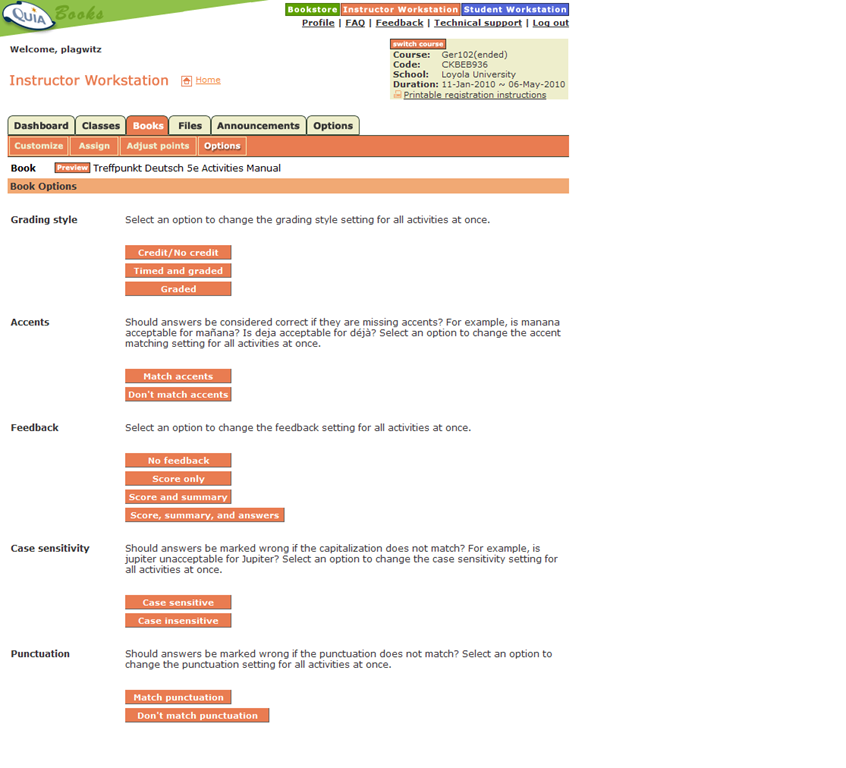
Quia Options for Grading in course or book or exercise
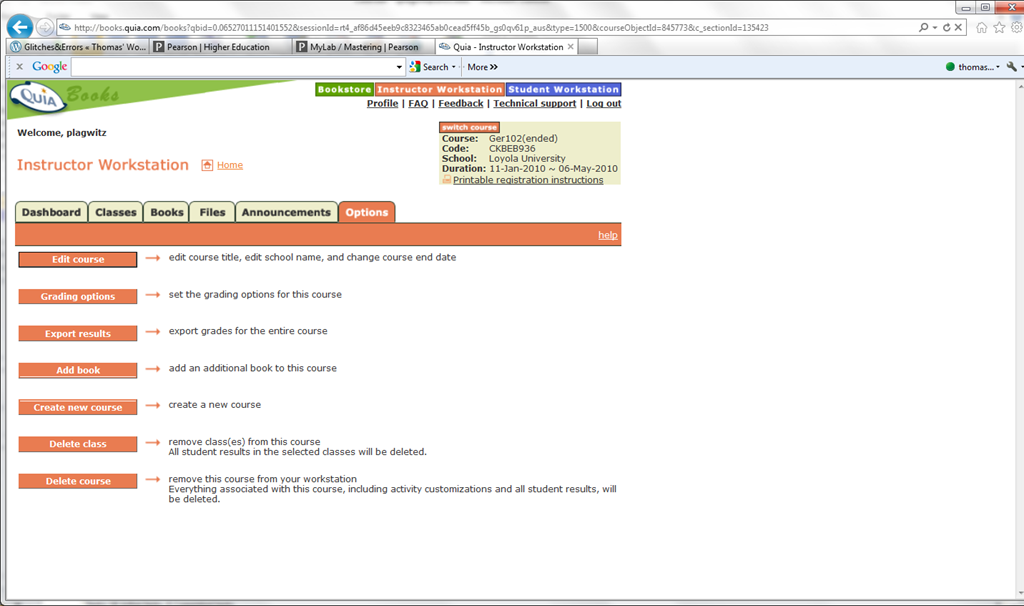
- The instructor workstation features prominently the tab : options.

- if you go into grading, you see that not all options can be changed from here.
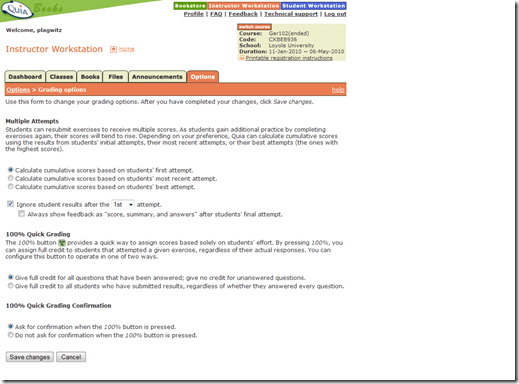
- However, when customizing your book, you may have already found the options next to each individual exercise that allow you to change Spelling/Case sensitivity

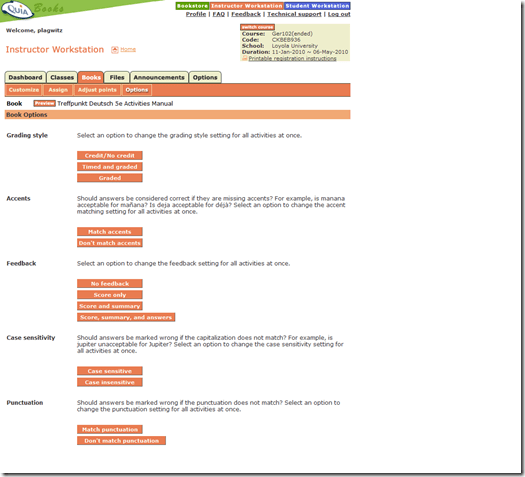
- However, if you go to the tab: book, you will find more options there, including how you can change Feedback and Spelling/Case sensitivity for the entire book instead of individual exercises:

Moodle Metacourses, part III: The support workflow: File-renaming
We discussed file renaming utilities in an earlier post. Here are some more practical tips:
Limitations: While both utilities can accept Windows Search Result sets, drag-drop seems limited to fewer than 256 files at a time (on my Vista 64-bit – but that is not an OS limitation, since MS Expression Encoder can accept a drag-and-drop of all over 3.5k files that need reencoding).
Workaround: both utilities have a folder-select, and Renamer in addition accepts file masks, which can mimic some basic searches:
![image_thumb[2]](/Users/trp/AppData/Local/Temp/WindowsLiveWriter1286139640/supfilesB79F19A/image[6].png "image_thumb[2]")
Bulk Rename Issue: While it allows for “Select from Clipboard” which you can use with the Windows “Copy as Path”/”Send to Clipboard as Name” feature which works with search result sets. However, I could not get this feature to work (neither with the default “” around the path nor, after removing them manually, without).
Renamer, Issue: rule, clean up, strip-out-content-of-brackets-does-not-what-it-should:
Renamer-translit-anglicize-foreign-language-diacritics: unfortunately still recommended for technical reasons; Renamer has presets, e.g. German here: TBA
Only one preset can be inserted add a time (overwrites previous) – but you can build your list with copy/paste from/to this text box and persist it to disk to load it later, just like the search rules – an extremely handy feature.
Sanako Study-1200 slow spanning 2 screens with different resolutions
- UPDATE2: 2013-09: apparently new video driver crashes with autoscan window, this time even on primary screen alone?
- UPDATE: 2011-01:Problem seems to have disappeared (windows update?)
- Symptom: This is on a Dell Optiplex 760 (B6CCLK1) which has no problems with Sanako’s screen sharing application, as long as you do not attempt to span the windows across two screens with different resolution which makes even the mouse jerky. Not sure, but do not remember having this problem across two screens with the same resolution. Actually, the Sanako subwindow (remote ctronl specifically) slows down the computer even if it is only on th secondary screen.
- Solution: Relatively easily fixed, if you can afford upgrading not only the screen, but also the LCD projector that hangs on one of the screens…
- Workaround: Do not span sub-windows of Sanako Study-1200 across screens. This problem can become so bad that the Sanako sub window becomes completely unresponsive and cannot be moved or closed (neither with the close button in the upper right nor with ALT-F4). Try CTRL-ALT-ESC then and kill the process. You could also try and upgrade the video card driver which may be the true culprit. However, on the Sanako sub windows seem to display the problem (screensharing with remote control, chat also). E.g. Internet Explorer windows do not have the same problem when spanned across screens.
How best to fit your class into the Sanako Study1200 Classroom Layout
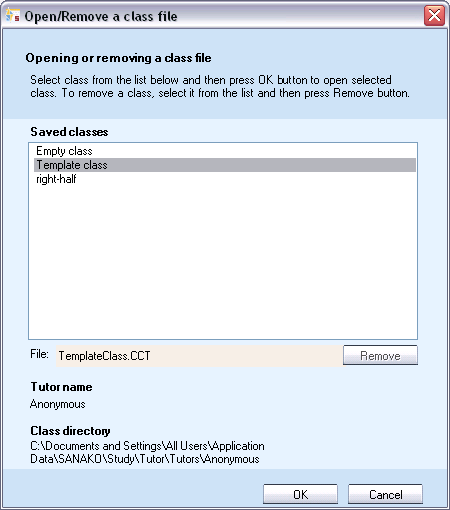
- When started, the Study1200 Tutor will prompt for the classroom layout (computer and student icons in the right part of the Sanako window) that you want to load, like so:
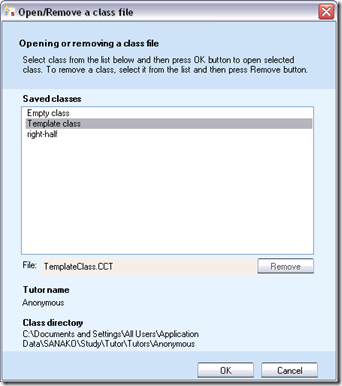
- We have 2 classroom layouts preconfigured for common uses of the LRC
- “right-half”: only the right half, as viewed by the teacher, of the coed434 main classroom. If you come with smaller classes (<16), this will fit relatively nicely onto the screen.
- “template class” = all that can fit onto the screen which means:To fit students (and, more importantly, the reasonably sized thumbnails of their desktops) onto the screen (Sanako Tutor will not span both screens, at least not if they have different resolutions), we had to
- take the main classroom COED434

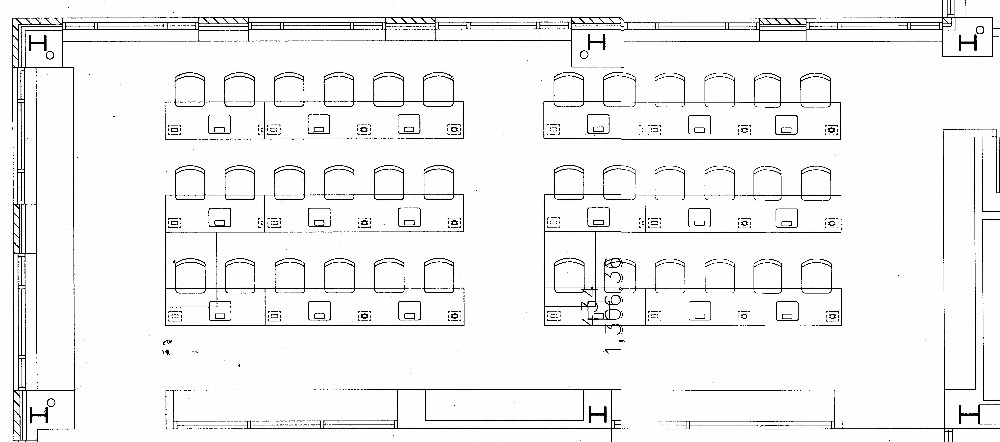
- break out the front 2 rows, break them apart in the middle, and turn them counterclockwise, like so:
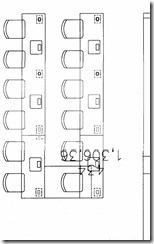
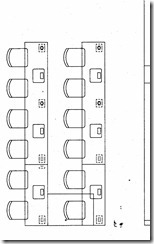
- to achieve the following result in the Study 1200 classroom layout:
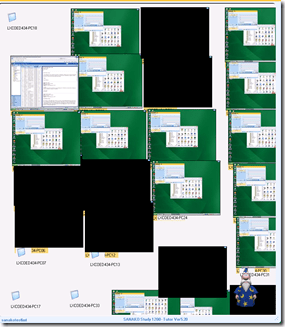 thumbnails of the 2 front rows barely fit the layout, remaining computers from the rear row are cluttering the bottom of the classroom layout. This severely limits the usefulness of this great feature, and is counter-intuitive, which is twice as bad when standing in front of (or here rather: behind) a class. We are working on getting a bigger secondary screen on the teacher podium. Since we will also eventually need more Sanako licenses to equip the whole classroom. So the secondary screen should be as big as we can possibly get for the podium: 1900*1200 would be 1.75 times what we have now.
 - To simplify this while we wait, we have numbered the seats (rather: the monitors) in the LRC according to the computer numbers. In the Study-1200 classroom layout, you can show the computer (names which end in these) numbers instead of the the student login names, by going to menu: tools / admin / change student names.
- if you classroom configuration changes,
- you can change the layout by reloading a preconfigured classroom layout file, like so:

- you can alter the layout on the right on the fly, by CTRL-SHIFT dragging student/computer icons
- If you have done this, on exiting, the study1200 tutor will ask you whether you want to save your changes to the layout. Feel free to do this, as longs as you save them in your personal tutor folder. Please do not overwrite existing layouts for all teachers.
- Classroom layouts are stored with the extension CCF, but are simply XML files. To preview or even edit them, You can open them in your preferred XML editor, like so in MS-Excel:





Questions? Read the About. Or just ask me a quick Our Databases: Resources with calendars -- Language learning material Moodle Sites, multimedia files -- films


FAQs for LRC student staff or for students or for teachers. To search our FAQs, in the browser addressbar, add after "https://plagwitz.wordpress.com/feed/?tag=faqs+/" "+TAG1" (from tag cloud below) OR "https://plagwitz.wordpress.com/feed/tag=faqs
&category_name=" "CAT1" (from category hierarchy below). OR search both categories and tags, and multiple TAGs/CATs (connect with "," for OR-search, with "+" for AND-search), like so: https://plagwitz.wordpress.com/feed/?tag=TAG1+TAG2+...TAGn&category_name=CAT1
+CAT2+...CATn"
Other ways to find help
If you cannot find it here, look there: 5,500 Language-Learning Links and Programs for learning or teaching 150 languages
Shortcuts:Our Lists, Our Maps, LRC Staff Moodle Site,LRC Project Moodle Site, 49erexpress, UNCC Moodle, Student Recordings: s:claslcslrcsanakostudent
Learning usage samples: Sanako oral exam, Kaltura webcam presentation, Dictation with speech recognition, Sanako written exam, Chinese and Japanese interactive stroke-order practice
Test the Sanako Installer, Webbrowser Popup Konfigurator for XP, or Windows7, faster LRC TeacherPC Log-in Let MS facilitate diacritics writing by installing for you US-International keyboard layout
This is my personal blog (Google+). The views expressed on these pages are mine alone and not those of my employer. The information in this weblog is provided “AS IS” with no warranties, and confers no rights.

