Archive
FERPA in the Language Resource Center
Here I am collecting (i.e. simply curating; my thanks go to http://www2.ed.gov/policy/gen/guid/fpco/ferpa/students.html and http://counsel.cua.edu/ferpa/questions/index.cfm) guidance and a few opinions on cases that are common in the Language Resource Center:
- http://www2.ed.gov/policy/gen/guid/fpco/ferpa/students.html:
This guidance document is designed to provide eligible students with some general information regarding FERPA and their rights, and to address some of the basic questions most frequently asked by eligible students. You can review the FERPA regulations, frequently asked questions, significant opinions of the Office, and other information regarding FERPA at our Website as follows:
www.ed.gov/policy/gen/guid/fpco/index.html
The term "education records" is defined as those records that contain information directly related to a student and which are maintained by an educational agency or institution or by a party acting for the agency or institution.
FERPA generally prohibits the improper disclosure of personally identifiable information derived from education records.
Another exception permits a school to non-consensually disclose personally identifiable information from a student’s education records when such information has been appropriately designated as directory information. "Directory information" is defined as information contained in the education records of a student that would not generally be considered harmful or an invasion of privacy if disclosed. Directory information could include information such as the student’s name, address, e-mail address, telephone listing, photograph, date and place of birth, major field of study, participation in officially recognized activities and sports, weight and height of members of athletic teams, dates of attendance, degrees and awards received, the most recent previous educational agency or institution attended, grade level or year (such as freshman or junior), and enrollment status (undergraduate or graduate; full-time or part-time).
A school may disclose directory information without consent if it has given public notice of the types of information it has designated as directory information, the eligible student’s right to restrict the disclosure of such information, and the period of time within which an eligible student has to notify the school that he or she does not want any or all of those types of information designated as directory information. Also, FERPA does not require a school to notify eligible students individually of the types of information it has designated as directory information. Rather, the school may provide this notice by any means likely to inform eligible students of the types of information it has designated as directory information.
Pasted from <http://www2.ed.gov/policy/gen/guid/fpco/ferpa/students.html>
- Q Is a student’s assignment (written or perhaps a video production), once handed in to a professor, an education record protected by FERPA? A In a September 1, 1993, opinion letter to the American Library Association, LeRoy Rooker, the Director of the Family Policy Compliance Office, stated the following: "Generally any written examination or paper that is prepared by a student and that reveals or discloses a student’s identity would be considered an ‘education record’ under [the regulatory] definition (so long as it is maintained by the institution). That is, in ordinary circumstances FERPA prevents an institution from disclosing or publishing a student’s written examination or paper without prior written consent, except in accordance with the specific exceptions set forth in 34 C.F.R. § 99.31." 34 CFR 99.31 lists a number of exceptions, including disclosure to other school officials with a legitimate educational interest; disclosure in connection with financial aid for certain purposes; stated and local educational authorities; and to accrediting organizations among others."
-
- Q. My institution has migrated to Google for email and now is interested in making Google Docs available to the community. The idea is that faculty and students will be able to collaborate on documents using Google Docs which would make the learning environment richer. I am concerned that this "sharing" may inadvertently lead to the inappropriate disclosure of FERPA protected information especially the information of those students who have opted out of disclosing "directory information". I would love to learn what other institutions have done to deal with this issue. A. The first thing to figure out is whether your contract with Google (which typically covers both e-mail and apps together) is FERPA-compliant to begin with. Google doesn’t "volunteer" that, so chances are it isn’t, which raises issues as to whether you can disclose information even to Google. To the extent that the "docs" are accessible only to students enrolled in a particular class, I believe that your faculty have some leeway to discuss students and their work — much as they do in a physical class. (For example, FPCO has stated that students have no right under FERPA to remain anonymous in class, and, as one Justice noted in the Owasso case, much to the dismay of law students everywhere, FERPA does not prohibit use of the Socratic method.) However, if the "docs" are accessible more broadly, your faculty could not post anything that would constitute an education record without the student’s consent, and it’s worth thinking through, from a policy perspective, whether faculty should be allowed to require students to post things directly to an open site. Another issue to think through is copyright. While most of the commercial CMS systems are now capable of facilitating TEACH compliance easily, through integration with your SIS, my understanding of Google Apps is that it currently would require each individual faculty member to take all of the necessary steps manually. Answer courtesy of Steven J. McDonald, General Counsel, Rhode Island School of Design.
- Q. An on-campus speaker was videotaped, and the sponsoring department wants to put the video up on its website (i.e., non-commercial use). The videographer was in plain sight. The speaker’s consent was obtained, but not those of students who asked questions (mostly off-camera). Anyone have a problem with posting the video? A. If any of the students are "personally identifiable" (under FERPA’s broad definition), I think you’d need FERPA consent. In a similar context, FPCO has stated that the transcript of a hearing that was held open at the student’s request is still an "education record" and therefore can’t be released without the student’s consent. You can include photographs in your list of directory information, but I doubt FPCO would agree to audio, at least generically. Answer courtesy of Steven J. McDonald, General Counsel, Rhode Island School of Design.
- Q. My institution has migrated to Google for email and now is interested in making Google Docs available to the community. The idea is that faculty and students will be able to collaborate on documents using Google Docs which would make the learning environment richer. I am concerned that this "sharing" may inadvertently lead to the inappropriate disclosure of FERPA protected information especially the information of those students who have opted out of disclosing "directory information". I would love to learn what other institutions have done to deal with this issue. A. The first thing to figure out is whether your contract with Google (which typically covers both e-mail and apps together) is FERPA-compliant to begin with. Google doesn’t "volunteer" that, so chances are it isn’t, which raises issues as to whether you can disclose information even to Google. To the extent that the "docs" are accessible only to students enrolled in a particular class, I believe that your faculty have some leeway to discuss students and their work — much as they do in a physical class. (For example, FPCO has stated that students have no right under FERPA to remain anonymous in class, and, as one Justice noted in the Owasso case, much to the dismay of law students everywhere, FERPA does not prohibit use of the Socratic method.) However, if the "docs" are accessible more broadly, your faculty could not post anything that would constitute an education record without the student’s consent, and it’s worth thinking through, from a policy perspective, whether faculty should be allowed to require students to post things directly to an open site. Another issue to think through is copyright. While most of the commercial CMS systems are now capable of facilitating TEACH compliance easily, through integration with your SIS, my understanding of Google Apps is that it currently would require each individual faculty member to take all of the necessary steps manually. Answer courtesy of Steven J. McDonald, General Counsel, Rhode Island School of Design.
The LRC writing input methods (“keyboards”) are not configured right

- In intl.cpl, we do not want keyboards installed for western and central-European (= characters a-z, merely altered by diacritics) languages, including US. We type these languages, including US-English, with the us-international keyboard extended 2.1, which has to be set as default, and that US-English extended 2.1gets checked as the keyboard for all western languages ("show more"). The regular US keyboard gets removed/made invisible to the user, and with any reasonably recent version of MS Sysprep tools, that is no problem anymore.
- For non-Western languages, the built-in windows keyboards should be "checked", and also the alternate input that we had to download and install methods need to be "checked" under their languages: MS Maren, Google input methods nee to be enabled (checked): e.g. Farsi is not enabled (checked).
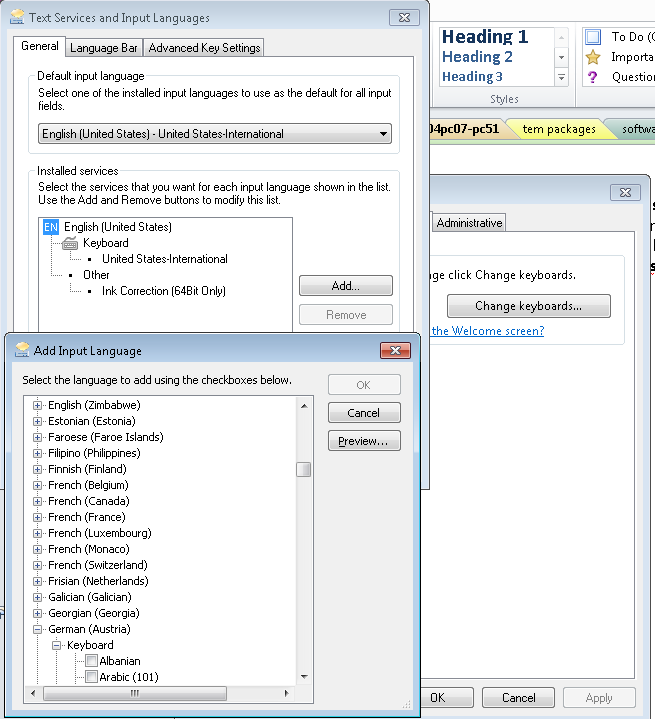
Does the Sanako Study 1200 tutor set the input language to Chinese (traditional)?
- Or why is my input language set to Chinese after the Sanako tutor install:

- Unclear whether the tutor install has an effect on the default language, but we observed this problem earlier on an XP computer that also had the Sanako study 1200 tutor.

ICS corruption in Moodle calendar events?
- I am seeing once again a large number of events loaded as internet calendar into MS-Outlook via an iCal link default to the same day:

- This time the iCal sources is Moodle, but it also displays the iCal feed internally so:

- I observed a similar issue when loading certain Drupal calendars into MS-Outlook, only that
- it seems to have affected only certain sites on the same (?) Drupal instance (is this user input error?)
- Events defaulted to the current day in MS-Outlook – the Moodle issue does not.
- All events were effected – not so in this Moodle issue.


Sanako Light Recorder insert recording has no teacher track audio, but voice graph?
- UPDATE: We reinstalled and this time made sure we restarted the system, and voice-insert is working fine now.
- We are trying to introduce having teachers using the Sanako voice-insert feature to issue spoken feedback into student assessment recordings, since the Sanako Recorder makes voice-insert as easy as
- the (repeated) click of red “speak” button
- and a “save as” (default format MFF preferred).
- On a teacher computer, we recorded and saved as
- either MFF (fast for the teacher to save; we were hoping to have the students download the free Sanako light recorder to be able to play this format;
- or WMA.
- We tested playing back, and hear the student original audio recording, but could not hear the teacher insertion, no matter whether we tried
- in the Sanako light recorder
- or in Windows Media Player.
- Because of the proprietary formats, it is a bit difficult to troubleshoot this. Audacity won’t open either audio format.
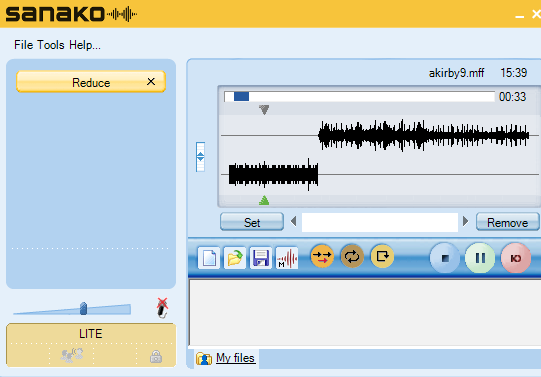
- In the Sanako light recorder, we can see the audio inserted in the 2nd track (lower) in the voice graph:

- Is this a licensing restriction? No, even the free light recorder can do this. See here for the installation options to choose when running the studentrecorder.exe on the teacher computer.
- Investigating… Update:
- Must be demonstration effect, as voice insert works fine on my office computer, as expected and it had before.
- Will try the usual suspects when getting my hands on this computer again (refresh, restart, reinstall, replace hardware…)…

How you can resolve Enterprise Library 5 Visual Studio 2012 error: "Could not locate the Enterprise Library binaries required to launch the configuration console"
- When right-clicking on my App.config to access the Enterprise Library configuration tool, I kept getting this error:

- after installing
- VS.net 2012;
- Enterprise library 5.0.414 through nuget (why does nuget install only this older version?);
- the unofficial Enterprise Library Extension vsix updated for VS.net 2012 published by the Enterprise Library team here.
-
What fixed this error for me was (YMMV, November 2012):
- installing Enterprise Library 5.0 optional update 1 (=5.0.515) using this approach:
- msiexec /i "Enterprise Library 5.0.msi" REINSTALLMODE=vomus REINSTALL=ALL
- – Adding to the vs.net 2012 SLN file, at the end of "Global" (immediately before "EndGlobal")
- GlobalSection(ExtensibilityGlobals) = postSolution
EnterpriseLibraryConfigurationToolBinariesPath = C:\Program Files (x86)\Microsoft Enterprise Library 5.0\Bin
EndGlobalSection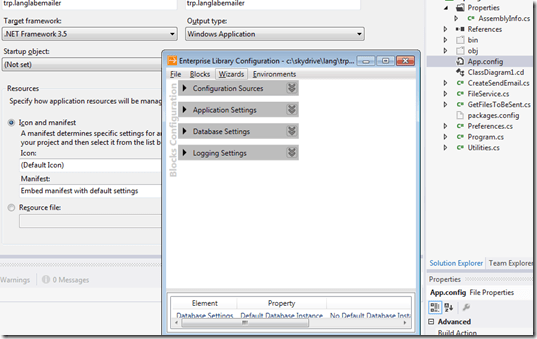

STM Crash
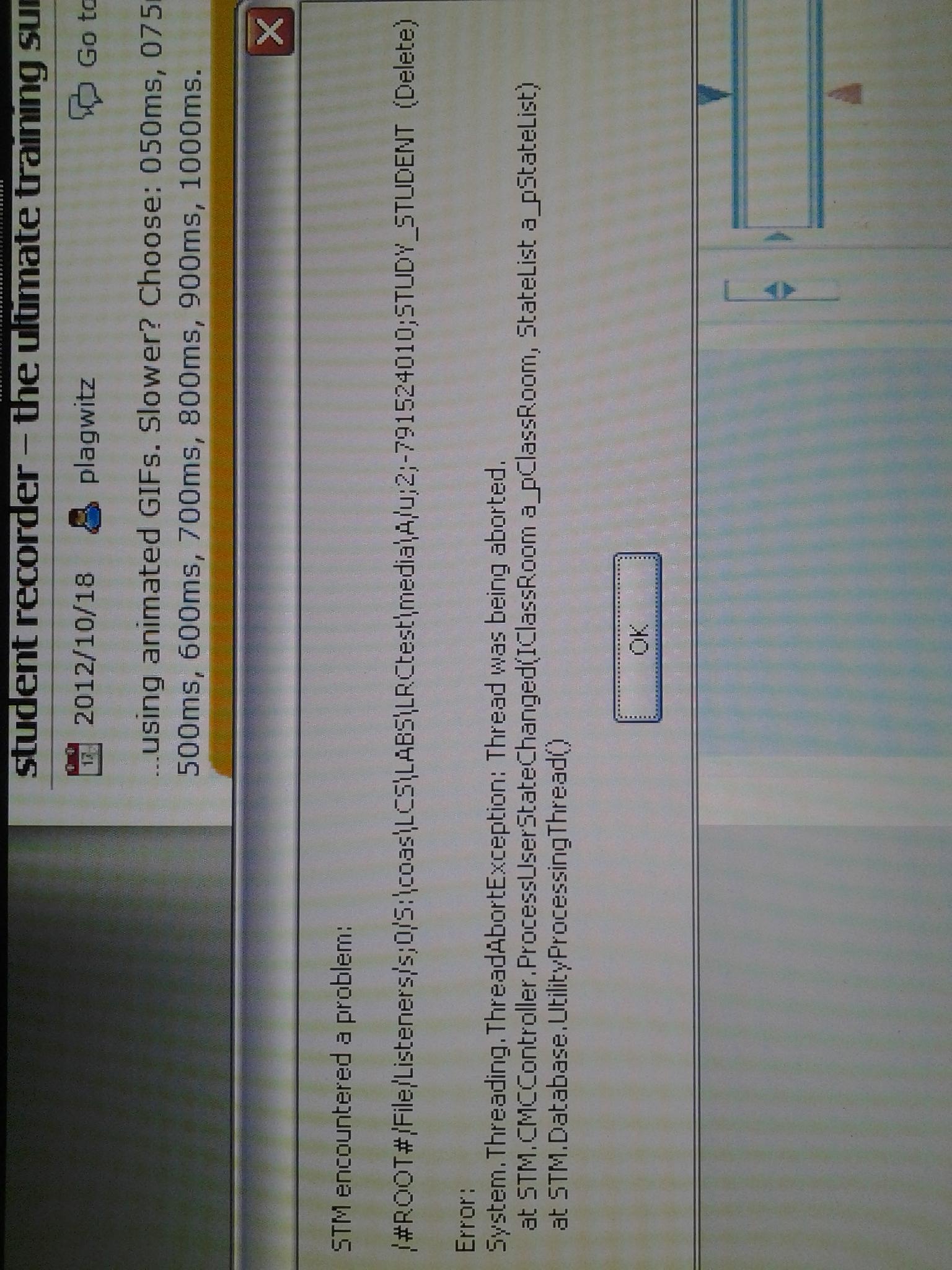
Oops? Haven’t seen that one before, and the Sanako Study 1200 has been stable. Networking issues again? (availability of file share S-drive?) See similar crash of licensing service recently.
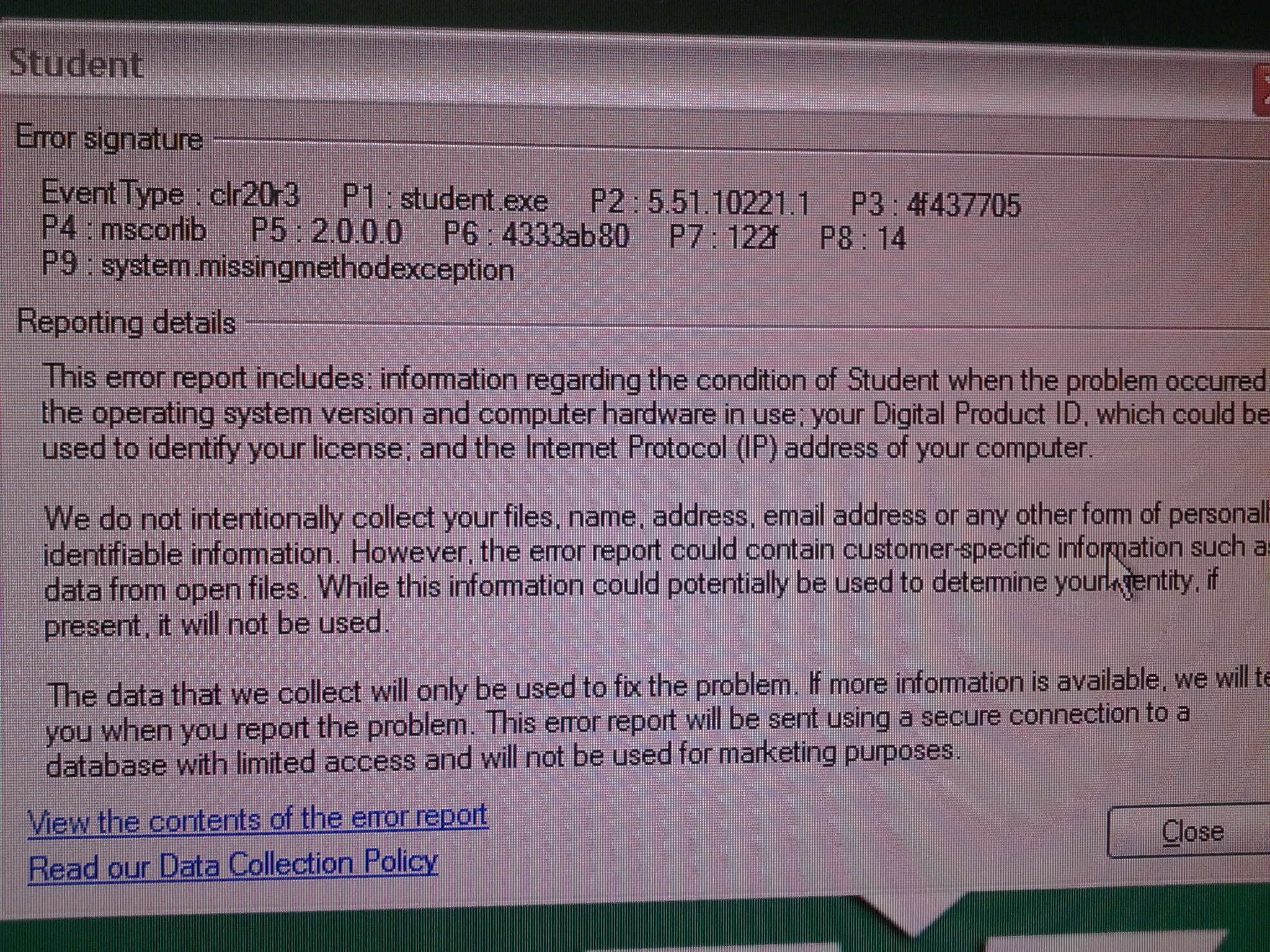
System.MissingMethodException error when installing recorder standalone light
Do we know why? – Still not, but looking into whether all prerequisites are fulfilled (this looks like a .Net error, but the my framework check says higher than version 2 is installed on that faculty computer).


Questions? Read the About. Or just ask me a quick Our Databases: Resources with calendars -- Language learning material Moodle Sites, multimedia files -- films


FAQs for LRC student staff or for students or for teachers. To search our FAQs, in the browser addressbar, add after "https://plagwitz.wordpress.com/feed/?tag=faqs+/" "+TAG1" (from tag cloud below) OR "https://plagwitz.wordpress.com/feed/tag=faqs
&category_name=" "CAT1" (from category hierarchy below). OR search both categories and tags, and multiple TAGs/CATs (connect with "," for OR-search, with "+" for AND-search), like so: https://plagwitz.wordpress.com/feed/?tag=TAG1+TAG2+...TAGn&category_name=CAT1
+CAT2+...CATn"
Other ways to find help
If you cannot find it here, look there: 5,500 Language-Learning Links and Programs for learning or teaching 150 languages
Shortcuts:Our Lists, Our Maps, LRC Staff Moodle Site,LRC Project Moodle Site, 49erexpress, UNCC Moodle, Student Recordings: s:claslcslrcsanakostudent
Learning usage samples: Sanako oral exam, Kaltura webcam presentation, Dictation with speech recognition, Sanako written exam, Chinese and Japanese interactive stroke-order practice
Test the Sanako Installer, Webbrowser Popup Konfigurator for XP, or Windows7, faster LRC TeacherPC Log-in Let MS facilitate diacritics writing by installing for you US-International keyboard layout
This is my personal blog (Google+). The views expressed on these pages are mine alone and not those of my employer. The information in this weblog is provided “AS IS” with no warranties, and confers no rights.
 Thomas' Work Space