Archive
Wimba Classroom –> Saba Centra: A running log
- http://teaching.uncc.edu/ctl-blog/centra-classroom-replace-wimba
- As this pertains to the LRC, more info will be posted here, as it becomes available, and issues and resolutions, as they come up.
Test of Join.me for Remote assistance/Screensharing across the internet
- How easy is this? (not a rhetorical question, we will have to try and test):
- originator
- goes to http://join.me, clicks on share, downloads and installs an Applet.
- receives a join.me URL with a session number which he gives to (best over the phone)
- receiver who loads this session URL to view the screen.
- originator
- What works
- from wireless to wired intranet TBA
- from off-campus to wired on-campus
- What does not work
- accurate reporting of remote mouse position
- Demo: viewing laptop connected over wireless laptop to desktop

- Test in practice worked flawlessly (with one limitation: it (the basic version?) only shares only your primary screen), when connecting a software reseller 400miles away to troubleshoot, here is the pretest:


How to improve learning center staff communications using Windows Live Messenger instant group messaging through live@edu. A running log
- Our 1st line of support – student temp staff – is not able to answer all questions and troubleshoot all issues that LRC clients come up with.
- We are experimenting with enabling quick escalation of issues from 1st line to 2nd and 3rd line using instant messaging.
- live@edu provided our university staff and student accounts with access to Windows Live Messenger instant messaging, including useful sub features
- presence: see faster who is (or is not) there to help you by the colored presence icons. The convention in MS software is a green ball for available:

- group messaging: UNCC-LRC created and invited to a “LRC Staff” group that includes student temp and permanent staff.
- presence: see faster who is (or is not) there to help you by the colored presence icons. The convention in MS software is a green ball for available:
- Here is what comes up when temp staff logs into the computer (sorry, no linking to Windows user IDs, but then again, we do not have this form of single sign-on in our other systems either):


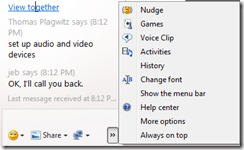
- Here are the options we start with (which need refinement)


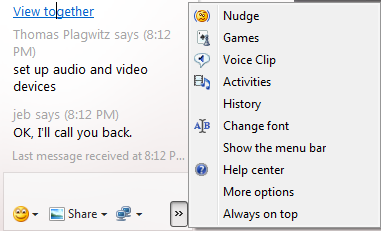
Windows Live Messenger Advanced Options

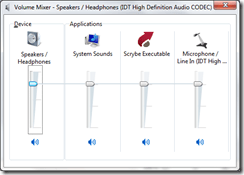
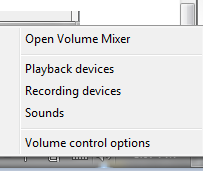
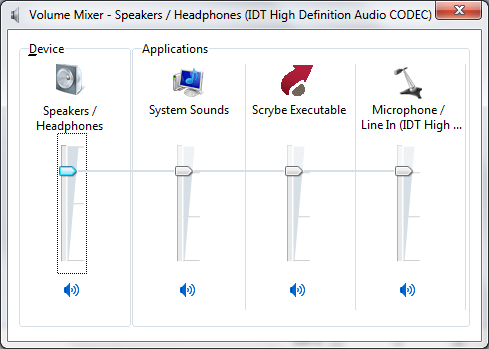
- mixer:
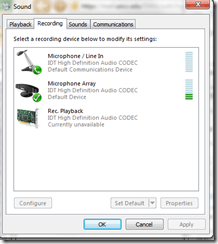
- recording devices (playback is the other tab) : does your input volume meter show activity? Can you press a button: “configure to activate/turn on the microphone? meter
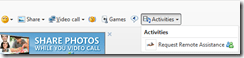
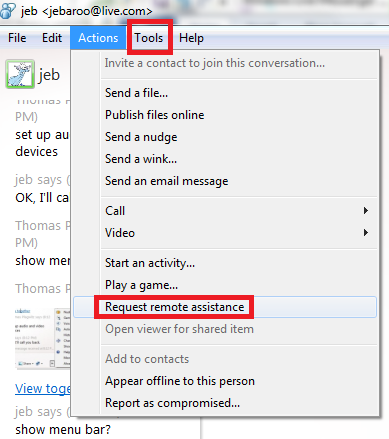
- how to request remote assistance ( via screen and control sharing)

- or so


MS-Office Communicator: Tips for using: Presence
No time for playing phone-tag (or “Phone-tag: Next generation”, aka email-tag)? “Presence” is your friend.
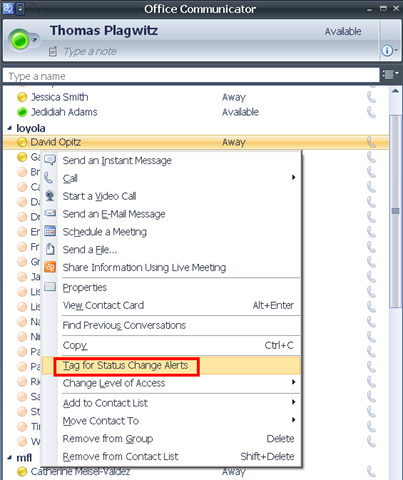
In Communicator, from your contact-list, right-click on a contact, choose “tag-for-status-change-alerts”.
From MS-Help: Tag a contact so you are notified when they are available: “Communicator can notify you of changes in a contact’s availability by displaying an alert whenever their presence status changes to Available or Offline. The alert shows the contact’s name, title, instant messaging address, and new presence status. You can click the alert to start an instant messaging session with the contact. Configuring Communicator to display this alert for a given contact is called tagging.”
Like in these screenshots:

Videoconferencing: Tandberg Conference-Me Test
While we initially ran into a glitch during the client install:
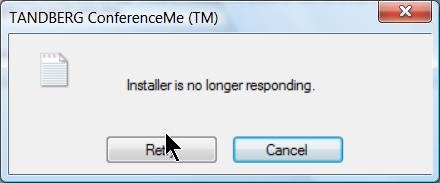
The application did seem to install correctly.
The video quality was acceptable even with low bandwidth settings. The application provides well-structured documentation as well as convenient interface, including through context menus:
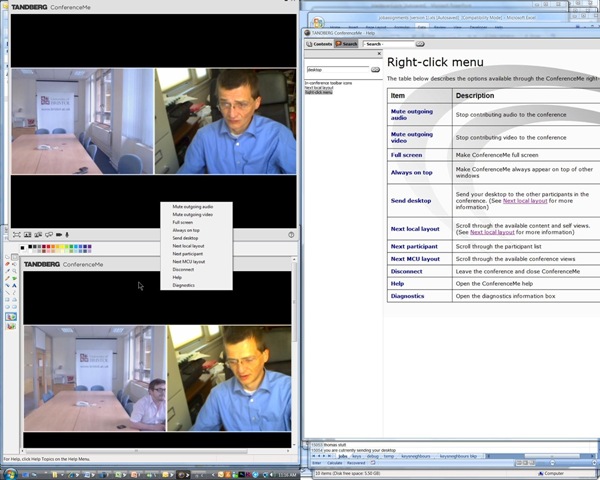
The diagnostic tools also seems strong:

Overall, Tandberg’s Conference-Me application looks like an attractive package.
Video Conferencing during Simultaneous Conference Interpreting Training
- i should probably step further away from implementation details, but i am looking for an anchor in a field which is heavily in flux, and in an environment which seems opaque.
- existing solutions: seem to be a superficially adapted/integrated application of existing video conferencing implementations for business meetings (Polycom VXS 7000 based?). I have seen academics complaining about “the emperor’s new clothes” when it came to teaching with technology innovation that made much more sense to me than this one, so i am concerned what will be the uptake once the hype is over (Yes, you can video conference over the internet. And for quite some time now. My 70-year old mother calls me every Sunday night on Windows Live Messenger. But we do not do interpreting training in an educational business environment).
- solutions more fit for purpose for interpreting in general and interpreter training in particular: the incoming speaker audio can be displayed to every one; but the interpreter audio, insofar outgoing (as opposed to be displayed to select audience locally), while being able to use the video conferencing unit, if its audio is full duplex, should not be universally displayed remotely,
- neither on the speaker-side (it would confuse and interrupt the speaker; but another part of the speaker-side audience likely needs to hear it, either for interpreting or for training (evaluation) purposes;
- nor on the 3rd-party (if video conferencing unit supports 3-point connections) site, but rather be displayed separate from the speaker audio
- for 3-point conferences, if the video conferencing unit supports separate (left – right) tracks for incoming audio, and if the incoming audio can be routed/switched, it should be possible to transmit 1 speaker (a-language) and 2 interpreters (b-language 1 and b-language 2) during the same video conferencing session
- implementation example: audio should be sent from video conferencing unit to headphones, or better a headphone connected to a system that allows switching and routing locally (e.g. a language lab system);
- video is only needed from the speaker
- live video from the speaker is not needed: there is no interaction between the speaker and the interpreter and (practically? sometimes it is recommended that the interpreter can visually sign to the audience) no visual interaction between the interpreter and the audience. if the video of the speaker can be launched to remote sites (streamed or downloaded as an archived file), only audio connections are needed.


Questions? Read the About. Or just ask me a quick Our Databases: Resources with calendars -- Language learning material Moodle Sites, multimedia files -- films


FAQs for LRC student staff or for students or for teachers. To search our FAQs, in the browser addressbar, add after "https://plagwitz.wordpress.com/feed/?tag=faqs+/" "+TAG1" (from tag cloud below) OR "https://plagwitz.wordpress.com/feed/tag=faqs
&category_name=" "CAT1" (from category hierarchy below). OR search both categories and tags, and multiple TAGs/CATs (connect with "," for OR-search, with "+" for AND-search), like so: https://plagwitz.wordpress.com/feed/?tag=TAG1+TAG2+...TAGn&category_name=CAT1
+CAT2+...CATn"
Other ways to find help
If you cannot find it here, look there: 5,500 Language-Learning Links and Programs for learning or teaching 150 languages
Shortcuts:Our Lists, Our Maps, LRC Staff Moodle Site,LRC Project Moodle Site, 49erexpress, UNCC Moodle, Student Recordings: s:claslcslrcsanakostudent
Learning usage samples: Sanako oral exam, Kaltura webcam presentation, Dictation with speech recognition, Sanako written exam, Chinese and Japanese interactive stroke-order practice
Test the Sanako Installer, Webbrowser Popup Konfigurator for XP, or Windows7, faster LRC TeacherPC Log-in Let MS facilitate diacritics writing by installing for you US-International keyboard layout
This is my personal blog (Google+). The views expressed on these pages are mine alone and not those of my employer. The information in this weblog is provided “AS IS” with no warranties, and confers no rights.
 Thomas' Work Space