Archive
Protected: Meet the Resource Attendants and their Scheduling Assistants– or Who are these people, anyway?


Refine your pronunciation by operating the LRC Windows 7 PCs using voice commands
- No speech recognition assignment, and only a bit of spare time to practice the language you study in the LRC? Try the Command mode with these Try the Command mode with these voice commands that Windows 7 speech recognition recognizes
- Note there are some hoops to jump through, including some one-time setup: We have them/you covered in this step-by-step guide on using speech-recognition in the LRC
.
How to change the display language and speech recognition language on LRC Windows 7 computers (and which languages are available)
- UPDATE: Since this page seems to be getting a lot of hits, I want to clarify: The step-by-step guide below only applies after you installed (free) language (or language interface) packs (see list here) on Windows 7 Enterprise or Ultimate SKU (others SKUs cannot add multiple language interfaces). UPDATE2: Things got much easier with Windows 8.
- In order to
- view the GUI of Windows and Internet Explorer in a foreign language,
- use the speech recognition in (a subset of the below) foreign languages,
- and also switch the default language of MS-Office
- Double-click the desktop shortcut “Region and language – Keyboards and languages”.
- Select the desired language from the dropdown box, click “OK”.

- Click: “Log off now”:
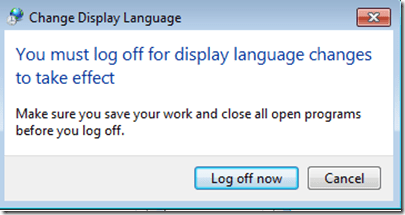
- “Log back in” (without restarting).
- And if you want the available display languages in English,
- here are the fully supported (MS Language packs):
Language Native name Arabic العربية Chinese (Simplified) 中文(简体) Chinese (Traditional) 中文 (繁體) English English French français German Deutsch Greek Ελληνικά Hebrew עברית Italian italiano Japanese 日本語 Korean 한국어 Polish polski Portuguese (Brazil) Português Portuguese (Portugal) português Russian Русский Spanish español - and here the partially supported (MS-Language Interface packs):
Hindi हिंदी KiSwahili Kiswahili Persian (Farsi) فارسی Yoruba ede Yorùbá - And here are the languages that support speech recognition:


How you can reuse your speech profile even on deepfrozen Language resource center computers
- “A [Windows Speech] profile is basically the collection of all settings and information about how to recognize your voice when using Windows Speech Recognition. Before changing the language used or letting other persons use Windows Speech Recognition it is best to create a new profile so that your current one will remain unaltered”.
- To be able reuse your effort training the computer to recognize your voice speaking in your study language – even though the LRC Windows 7 computers get reset when restarted -, you can backup, and later reload, your Speech Profile, preferably to your H:-drive.
- The Microsoft tool that allows you to do that has been put on WSRProfile.exe desktop of the LRC Windows 7 PCs. I can copy these instructions directly from the Microsoft blog page:
- Double-click WSRProfile.exe to start the WSR Profile tool wizard.

- To back up a speech profile using the WSR Profile tool, select Backup my speech profile.
- In the Select your Speech Profile dialog box, choose the speech profile you wish to back up and then click Next.
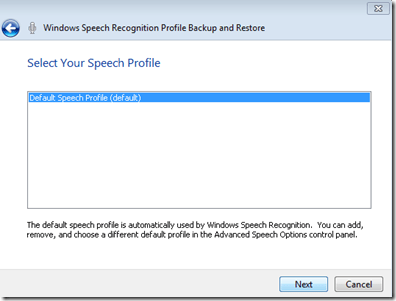
- The wizard will prompt you for a filename and location to save the file. When you have entered this information, click Next. The WSR Profile tool wizard will start the backup process of the selected speech profile.

- After the backup operation successfully finishes, click Close .

- In the Select your Speech Profile dialog box, choose the speech profile you wish to back up and then click Next.
- To restore a speech profile using the WSR Profile tool, select Restore my Speech Profile.
- On the File to Restore wizard page, click Browse and locate the backed up speech profile, and then click Next.
- Choose the speech profile you want to restore to.
- Select Use the current speech profile if you want to overwrite the current default speech profile.
- Select Create a new speech profile if you want to restore to a new speech profile. If you choose to restore to a new speech profile you will be prompted to provide a name for the new profile.
- After the restore operation successfully finishes, click Close.


Setting time zone for all and for all misconfigured OWA users
live@edu/Office365 Exchange in the cloud does not seem to allow setting a default time zone, but rather leaves it to the user to change the time zone (defaulting to the time zone the cloud server is in that the user happens to hit) on first login – in the world I operate in, большая ошибка!
How to use the cmdlet set-MailboxRegionalConfiguration with parameter TimeZone to change the time zone of all your mailboxes is nicely explained on the blog How Exchange Works here, including screenshot and PowerShell command.
Unfortunately such an operation is reported to have needed 3 days for updating all mailboxes in an educational live@edu installation with 30000 users… You can restrict the mailboxes touched by examining first which are not in your local time zone (consult the MS TimeZone table for syntax, e.g. US “Eastern Standard Time”):
$mymailboxes = get-mailbox
ForEach ($examinedmailbox in $mymailboxes){
$regionalconfig = get-MailboxRegionalConfiguration –identity $examinedmailbox.identity
if ($regionalconfig.timezone -ne “Eastern Standard Time”){
Set-MailboxRegionalConfiguration -identity $examinedmailbox.identity -TimeZone “Eastern Standard Time” -confirm:$false
}
}


Questions? Read the About. Or just ask me a quick Our Databases: Resources with calendars -- Language learning material Moodle Sites, multimedia files -- films


FAQs for LRC student staff or for students or for teachers. To search our FAQs, in the browser addressbar, add after "https://plagwitz.wordpress.com/feed/?tag=faqs+/" "+TAG1" (from tag cloud below) OR "https://plagwitz.wordpress.com/feed/tag=faqs
&category_name=" "CAT1" (from category hierarchy below). OR search both categories and tags, and multiple TAGs/CATs (connect with "," for OR-search, with "+" for AND-search), like so: https://plagwitz.wordpress.com/feed/?tag=TAG1+TAG2+...TAGn&category_name=CAT1
+CAT2+...CATn"
Other ways to find help
If you cannot find it here, look there: 5,500 Language-Learning Links and Programs for learning or teaching 150 languages
Shortcuts:Our Lists, Our Maps, LRC Staff Moodle Site,LRC Project Moodle Site, 49erexpress, UNCC Moodle, Student Recordings: s:claslcslrcsanakostudent
Learning usage samples: Sanako oral exam, Kaltura webcam presentation, Dictation with speech recognition, Sanako written exam, Chinese and Japanese interactive stroke-order practice
Test the Sanako Installer, Webbrowser Popup Konfigurator for XP, or Windows7, faster LRC TeacherPC Log-in Let MS facilitate diacritics writing by installing for you US-International keyboard layout
This is my personal blog (Google+). The views expressed on these pages are mine alone and not those of my employer. The information in this weblog is provided “AS IS” with no warranties, and confers no rights.

