Archive
Archive for the ‘audience-is-students’ Category
How students can manage sidetone manually
2014/03/08
Leave a comment
Sidetone echoes your voice from the microphone back into your headphone speakers. It makes wearing the headphones feel more natural, and lets you evaluate your pronunication better.
Until it is configured properly out of the box, to enable it, you have to:
Open sound settings: 
Check and Increase the sidetone volume until you can hear yourself talking well: 
Categories: audience-is-students, digital-audio-lab, e-languages, Speaking
sanako-study-1200, sidetone

Watch how you can backup and restore your Windows speech-recognition training data
2014/03/07
Leave a comment

Categories: audience-is-students, Student-Computers
speech-recognition
Example 5: Watch how you can dictate to Windows speech-recognition (e.g. in English) and correct results in MS-Word
2014/03/07
Leave a comment

- Important: Listen carefully: I am not a native speaker, but have a reasonably low amount of errors, because it enunciate, speak clearly and slowly, and separate the words.
- Consider it part of the exercise that you will have to re-read and re-type some your output – use track changes in MS-Word:
- Make it a game: How good can you get?
- If you get really good at it, make a screencast like this one and include it in your Mahara ePortfolio as authentic evidence of your foreign language proficiency.
- Overall, it’s like how I refer to cycling: Beats walking. Anytime.

Categories: assignments, audience-is-students, audience-is-teachers, e-languages, English, French, German, Hindi, Japanese, Mandarin, multimedia-recording, Operating-system, Reading, Screencasts, service-is-applying-learning-tools, Spanish, Speaking, Student-Computers, training, Writing
ePortfolio, MS-Word, speech-recognition, track-changes
A first look at the Google Dictionary extension for Chrome
2014/03/06
Leave a comment
- We
- have not pre-installed in the LRC (for that the extension would need to be more manageable by the teacher during face-to-face classes, which include exams),
- but can (with some reservations) recommend the Google Dictionary extension (even though it is only available for Chrome). Here is why:
- Google dictionary extension provides an interface to Google define and translate
- that is convenient (as quickly accessed like glosses) for reading activities in many languages (Q: is the privileged word sense displayed here intelligently chosen?)
- while (for some languages more than for others) providing access to additional word senses, usage examples and historical background information
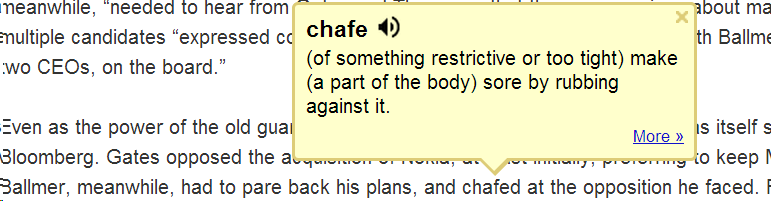
- Interface 1: Tooltip,
- for English with audio

- for other languages without audio (even though audio pronunciation may be available in Google translate for that language):

- convenient access (I have been loving the tooltip interface since Google toolbar days)
- limited, but useful information,
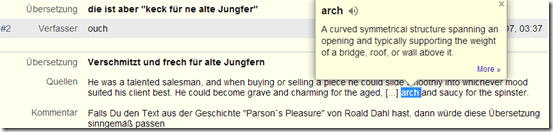
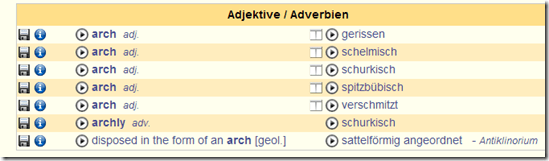
- a word sense – not that this is still not contextually intelligent (Cannot blame them here!) and hence more than one word sense should be offered (here I must blame them: Boo!!): E.g. here “arch” should at show more than the most common word sense:
- including pronunciation (not IPA, but audio)
- a word sense – not that this is still not contextually intelligent (Cannot blame them here!) and hence more than one word sense should be offered (here I must blame them: Boo!!): E.g. here “arch” should at show more than the most common word sense:
- Interface 2 (“more”)
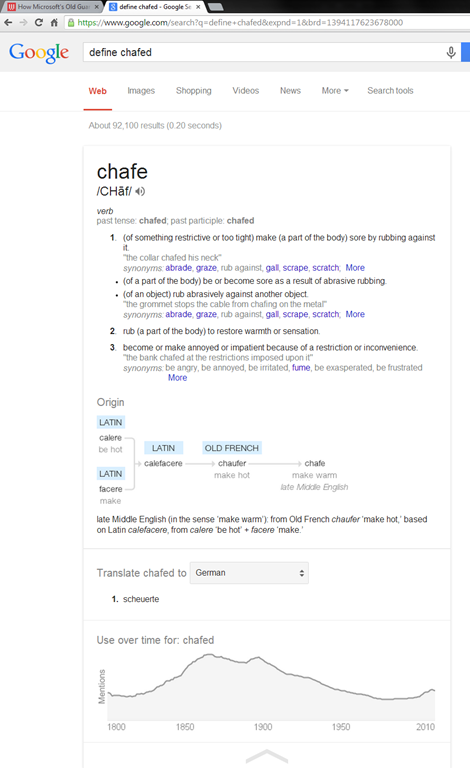
- For English, a click on “more” leads to the Google “define”search operator (the related etymology search operator has been reviewed here before):

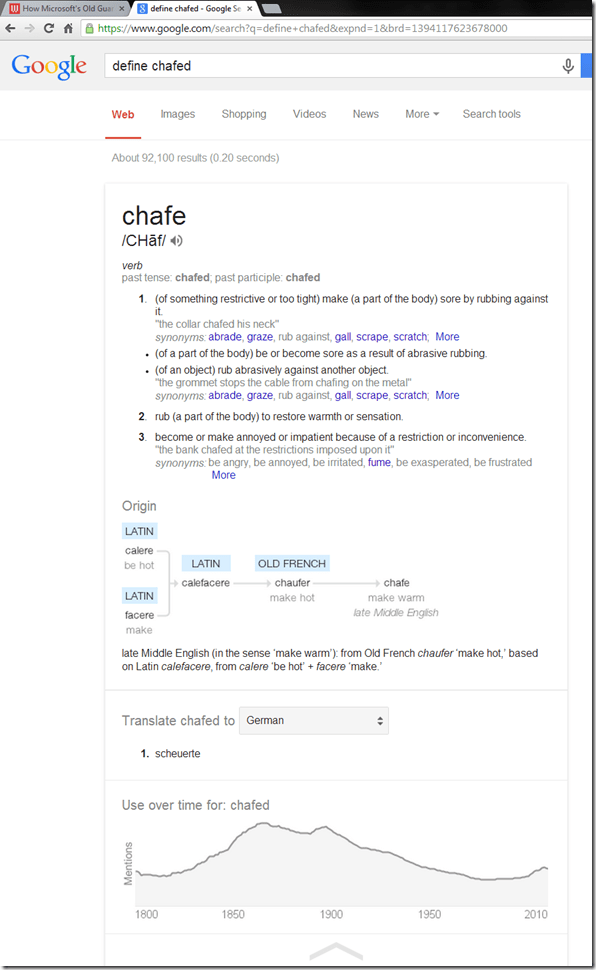
- Interface 3: unfold the search results by clicking on the down arrow at the bottom to access additional information:
 =
=
- additional word sense entries
- historical:
- etymology
- frequency data
- translation/dictionary entry:
- for our learners of languages other than English, the translation appears right in the tool tip, see above;
- for our ESL learners, this seems a few too many steps for accessing this information, although a monolingual dictionary is useful in many instances also.
- For English, a click on “more” leads to the Google “define”search operator (the related etymology search operator has been reviewed here before):
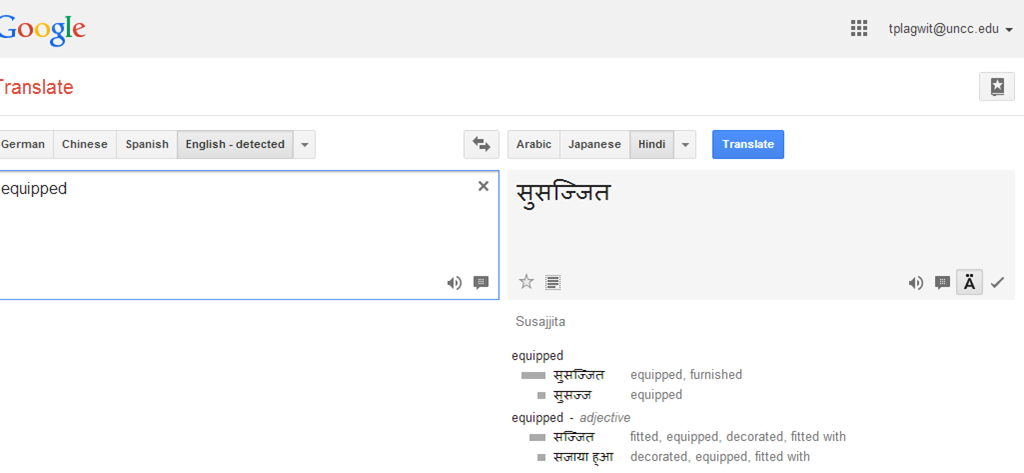
- For languages other than English, a click on more leads to Google translate, which (should get its own article, but for what it is worth) can be
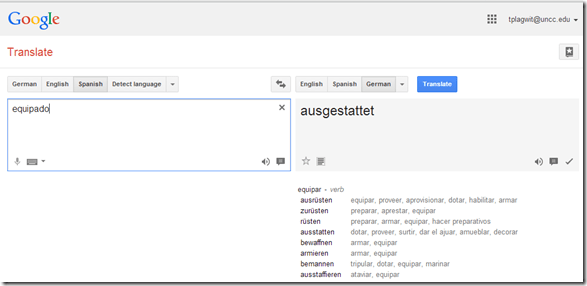
- more limiting than “define”: While you are given multiple word senses for
- Spanish:
- and to a lesser extent, for
- Arabic:

- Hindi:

- Arabic:
- Spanish:
- for many languages the results are much more limiting:
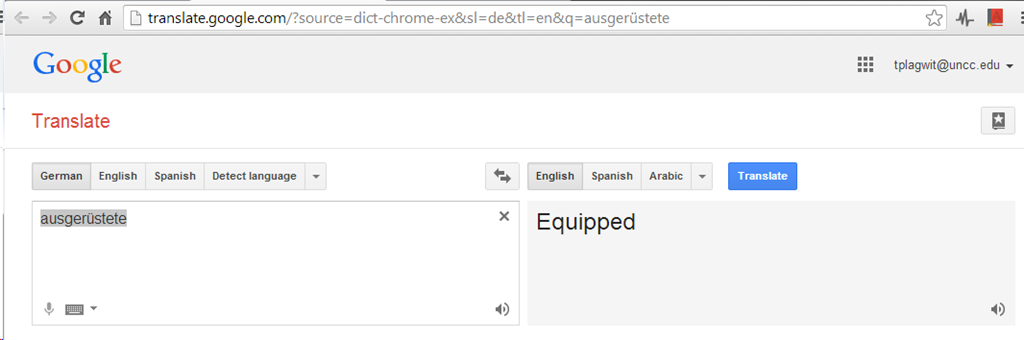
- Even if you look up German or French, you revert back to the (pedagogically terrible) single word-sense original “translation” interface )

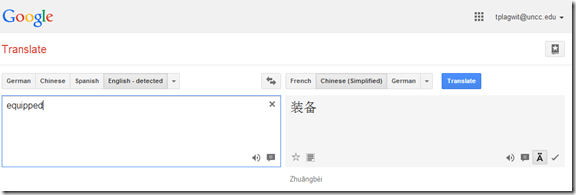
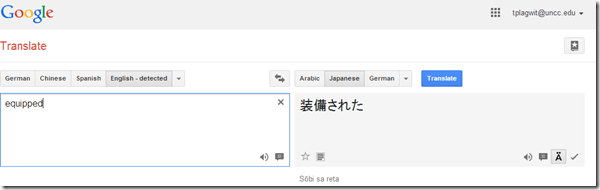
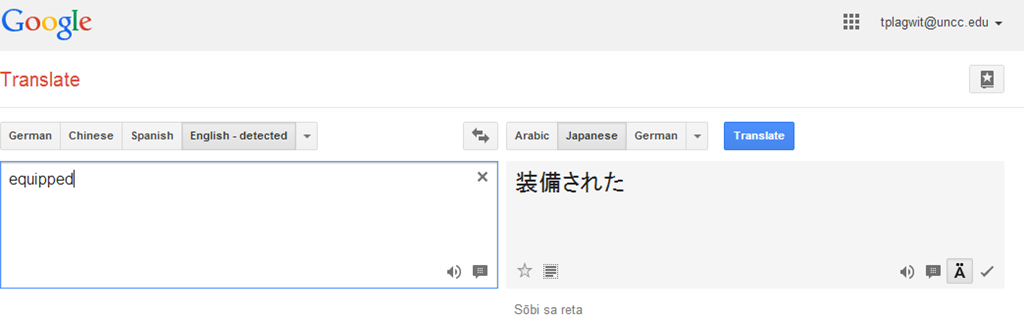
- For East Asian languages, you get Roman alphabet transcriptions
- e.g. Chinese with Pinyin:
- e.g. Japanese:
- e.g. Chinese with Pinyin:
- Even if you look up German or French, you revert back to the (pedagogically terrible) single word-sense original “translation” interface )
- more limiting than “define”: While you are given multiple word senses for
- for English with audio
- Still no per-user tracking? Here it would make sense for the user.





Categories: Arabic, audience-is-students, audience-is-teachers, Dictionaries, English, Farsi, French, German, Greek (modern), Hebrew, Hindi, Italian, Japanese, Korean, Latin, Mandarin, Polish, Portuguese, Reading, Russian, service-is-evaluating-learning-tools, Spanish, Swahili, websites, Yoruba
glossing, google, google-dictionary, google-translate
Audio player error message involving “pluginfile.php” in Moodle quiz
2014/02/24
Leave a comment
- LRC assistants may get called by students with this error regarding pluginfile.php in a Moodle quiz, it appears in the audio player interface itself and looks like this:
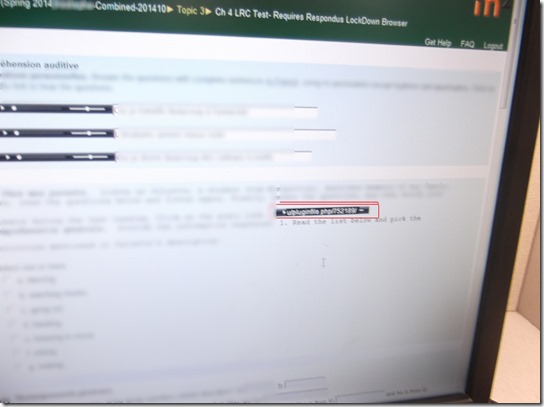
- The error messages flashes only briefly, and afterwards the audio simply will not play.
- In a Respondus lockdown browser quiz, you can bring up the error message again by clicking “next” and then resuming the attempt. When the quiz page reloads, the error message will briefly flash again.
- LRC assistants cannot work around this error, they need to alert permanent staff. Usually it is related to a quiz author needing to update the audio file link, like so:
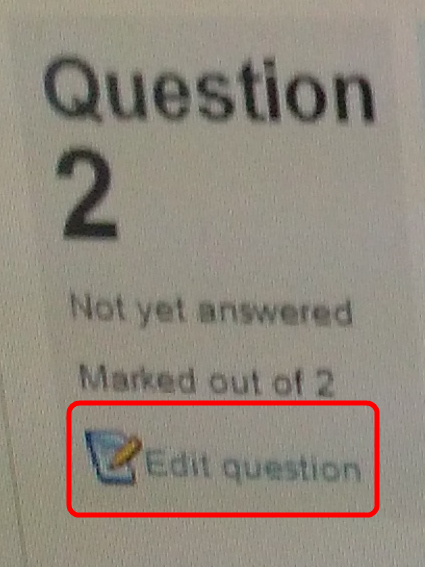
- Go into the quiz, on the left, click “edit the quiz”):
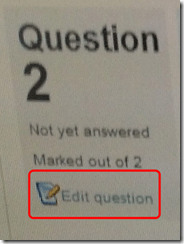
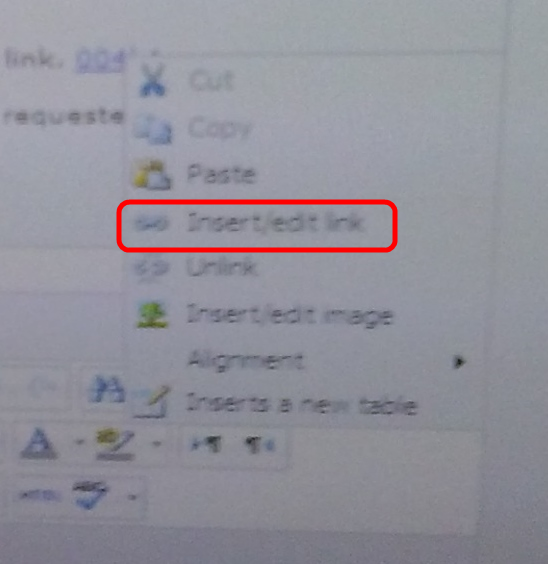
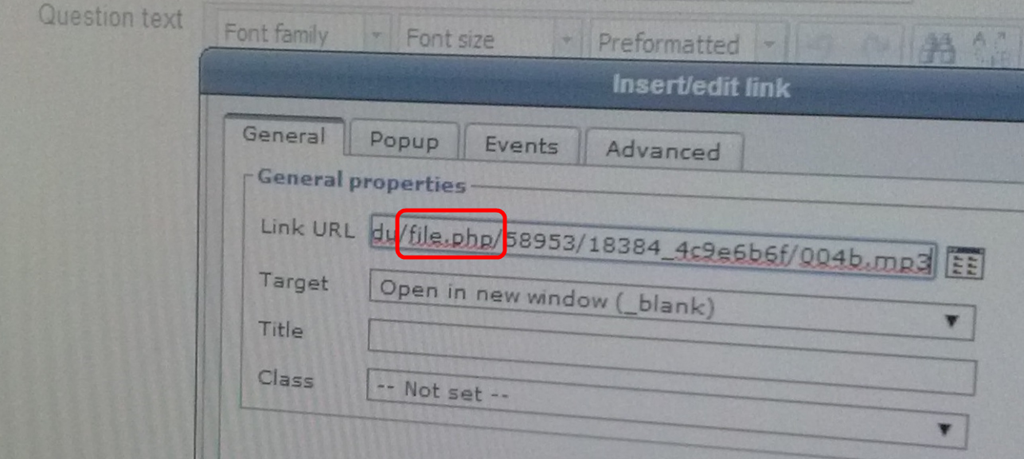
- Find the audio file link, edit the link:

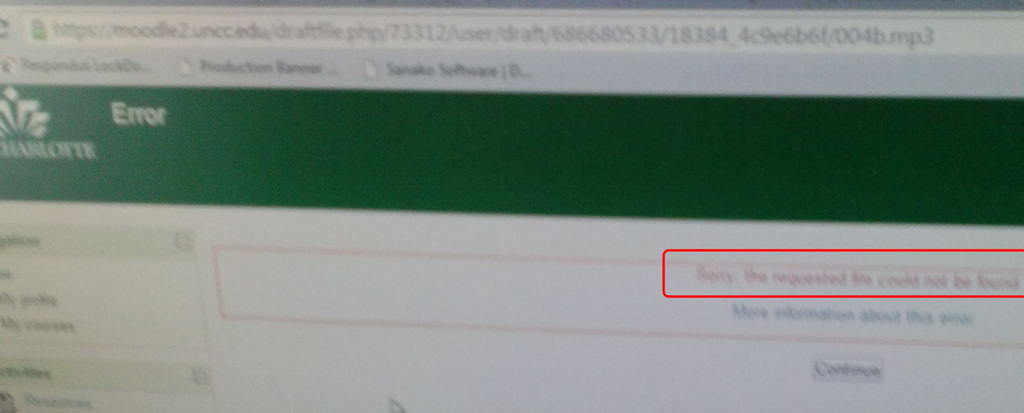
- Can you actually load the link? If it says “file not found”, you have the root cause:
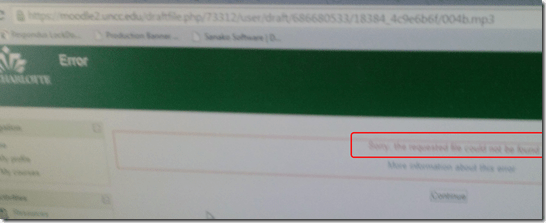
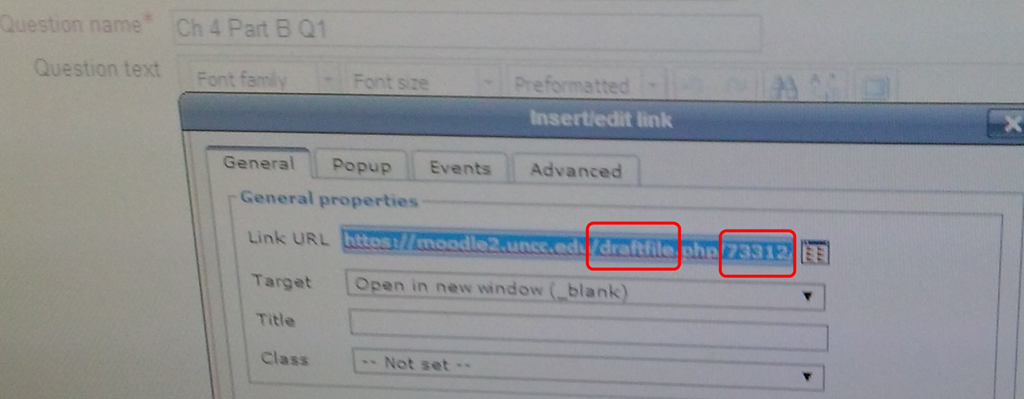
- Does it say “draft” in there? Not good. Copy the unique identifier from the path:

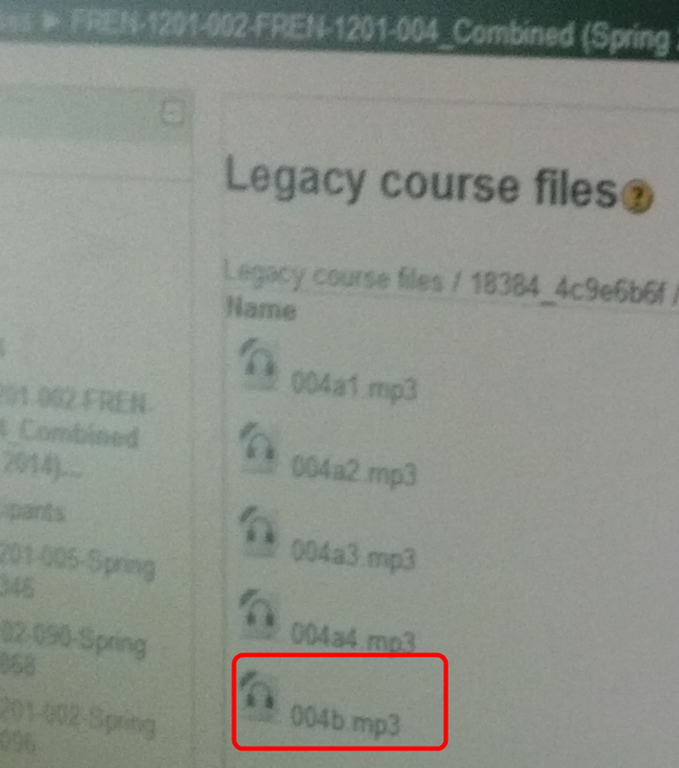
- Go to in Moodle course / Files section, locate the offending file (you can use the unique id you put in the clip board to search), i.e. make sure it actually exists:
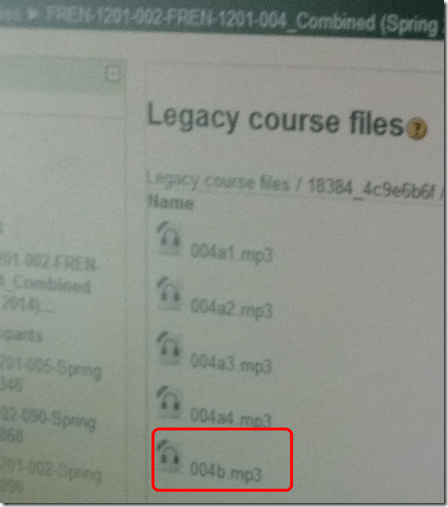
- Get the correct URL for the file, puit it int the clipboard:
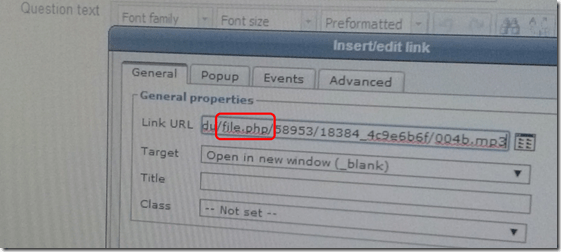
- Go back to editing the quiz, update the wrong URL with the correct one.
- Save the updated quiz.
- Go into the quiz, on the left, click “edit the quiz”):
- Now the student can reload the quiz, if in Respondus lockdown browser, like above by clicking “next”and back.

FAQs for issues with Respondus Lockdown Browser
2014/02/18
Leave a comment
- New to Respondus Quizzes? Read the CTL’s write-up.
- No Photo ID (Niner ID or other state-issued)? Use the reception desk camera to take a photo with sheet, like below, we will forward it to the teacher for verification.

- Issues with starting:
- Respondus won’t open: How to bypass a Moodle Popup Window when using Respondus lockdown browser
- Test won’t open and you get a warning
- in Moodle that this test must be run in Respondus Lockdown Browser? Close your regular web browser and double click on the desktop on the Moodle Lockdown Browser Icon:
 , then go to Moodle2 from in there.
 - in Respondus that “No more attempts are allowed”, but the student has not made any attempts yet and the quiz closing date is long in the past: contact the teacher to check whether the quiz needs updating.

- in Moodle that this test must be run in Respondus Lockdown Browser? Close your regular web browser and double click on the desktop on the Moodle Lockdown Browser Icon:
- Issues with Audio:
- Students are advised to test the headsets before entering Respondus Lockdown browser assessments:
- Start Audacity from the desktop, click record: if you say something, you must see something;
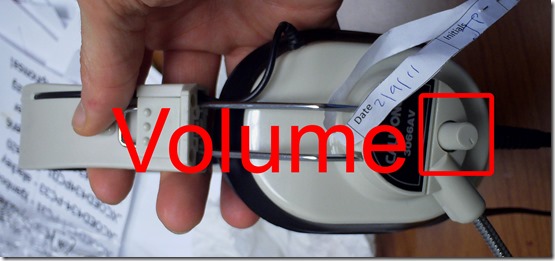
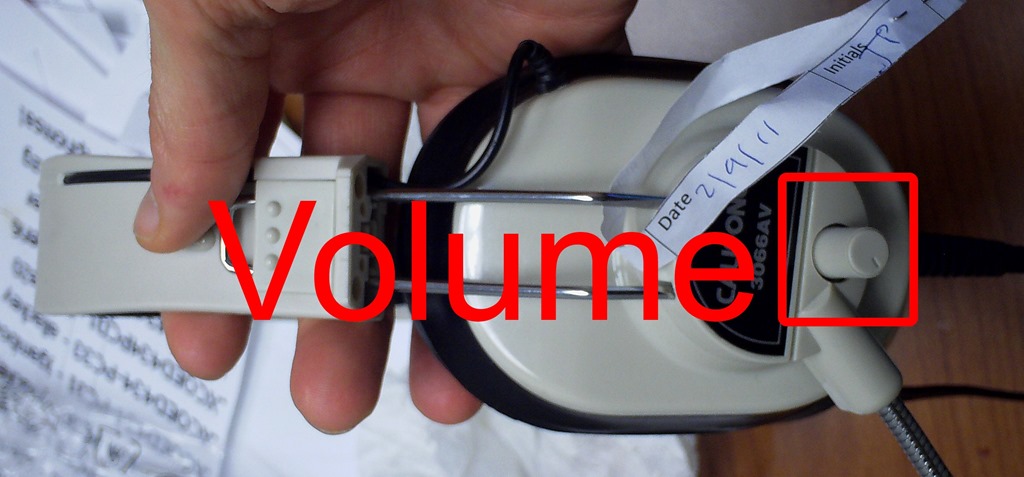
- Play back to test the speakers. Hear nothing? Try the volume knob:
- (More detail here).
- Rewind-audio may get you stuck – to fix, next-page, then back (reloads page). More info: How to workaround Moodle quiz audio not playing to the end in Respondus Lockdown Browser
- How to bypass a Moodle Popup Window when using Respondus lockdown browser
 If no audio and error “pluginfile” flashes when clicking “Next”and back: notify permanent staff.
- Students are advised to test the headsets before entering Respondus Lockdown browser assessments:
- Issues with Writing:
- Lost the
 ?
?
- Clicking around nearby where it was may bring it back.
- Or
 , quickly cancel (gets you out of lockdown browser), new attempt from desktop shortcut.
 - Learn to use the installed US-international keyboard shortcuts.
 .
. - more info: Problems with accented characters in Respondus Lockdown Browser
- If your keyboard stops typing in English in a Respondus lockdown browser quiz…
- Lost the
- Issues with finishing
- If the test won’t submit, start Respondus lockdown browser on a different computer to see whether you can resume your attempt there.
- More issues? Let us know in the comments here.




 .
.The Films on Demand subscription of Atkins library
2014/02/17
Leave a comment
- Benefits:
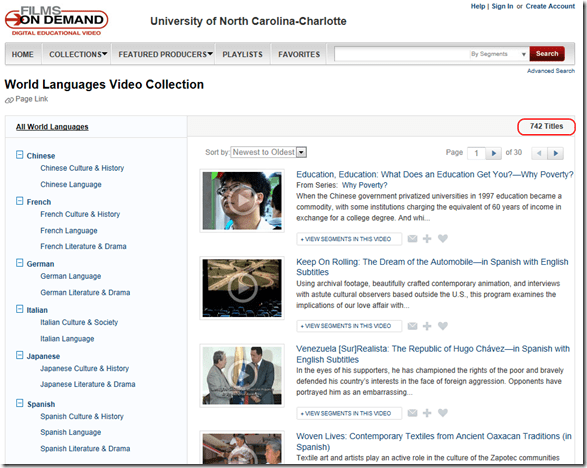
- provides access to over ten thousand streaming videos.

- including world languages:
- Remaining Problems:
- 741 titles for World languages is not a lot (additional materials may be applicable to language learning, but I do not see the most commonly requested foreign language films used in the department which we are currently trying to rescue across the demise of VHS). Any particular silo of information is not comprehensive (given the power of the network effect, YouTube wins hands-down most if the times),
- any content is difficult to integrate into a language skill curriculum,
- any added interface restrictions may make it more difficult, not more stable,
- not unlike YouTube, files you may have used, even linked, can get removed.
- the website seems to be available only on campus – even if you are logged into your campus account (university VPN will likely help, and not, given that it has video throughput issues).




Questions? Read the About. Or just ask me a quick Our Databases: Resources with calendars -- Language learning material Moodle Sites, multimedia files -- films


FAQs for LRC student staff or for students or for teachers. To search our FAQs, in the browser addressbar, add after "https://plagwitz.wordpress.com/feed/?tag=faqs+/" "+TAG1" (from tag cloud below) OR "https://plagwitz.wordpress.com/feed/tag=faqs
&category_name=" "CAT1" (from category hierarchy below). OR search both categories and tags, and multiple TAGs/CATs (connect with "," for OR-search, with "+" for AND-search), like so: https://plagwitz.wordpress.com/feed/?tag=TAG1+TAG2+...TAGn&category_name=CAT1
+CAT2+...CATn"
Other ways to find help
If you cannot find it here, look there: 5,500 Language-Learning Links and Programs for learning or teaching 150 languages
Shortcuts:Our Lists, Our Maps, LRC Staff Moodle Site,LRC Project Moodle Site, 49erexpress, UNCC Moodle, Student Recordings: s:claslcslrcsanakostudent
Learning usage samples: Sanako oral exam, Kaltura webcam presentation, Dictation with speech recognition, Sanako written exam, Chinese and Japanese interactive stroke-order practice
Test the Sanako Installer, Webbrowser Popup Konfigurator for XP, or Windows7, faster LRC TeacherPC Log-in Let MS facilitate diacritics writing by installing for you US-International keyboard layout
This is my personal blog (Google+). The views expressed on these pages are mine alone and not those of my employer. The information in this weblog is provided “AS IS” with no warranties, and confers no rights.
 Thomas' Work Space
