Skydrive@uncc.edu
- Ninermail’s live@edu implementation includes SkyDrive, Microsoft’s cloud document sharing and collaboration solution,
- Log in with your UNCC credentials at http://skydrive.live.com:

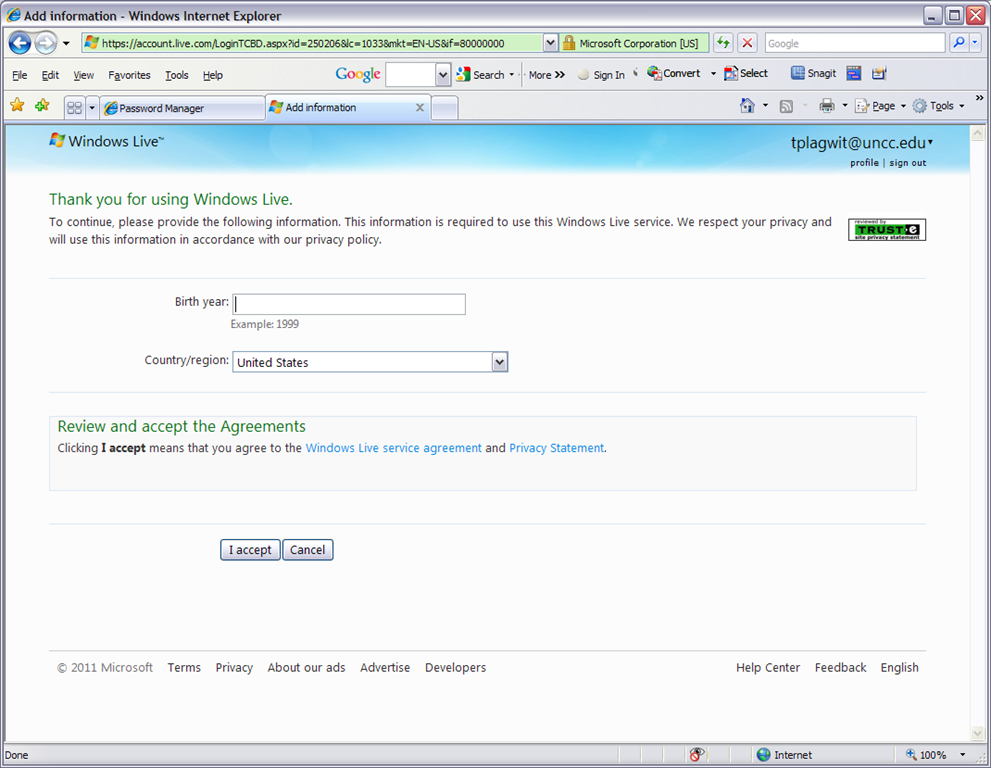
- OK, you may have to reset your password, then log in:


How to play unplayable DVDs with VideoLan VLC-Player
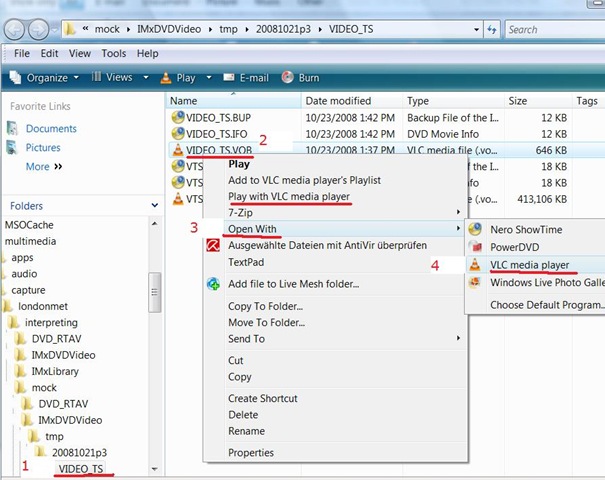
If you run into problems playing a DVD video – either since there is no (non-free up to Windows XP) DVD-decoder installed on your computer, or since the DVD was not mastered properly for your DVD-playing software – and if you have VideoLan VLC-Player installed – like on the teacher computer in the LRC main classroom–, you can work around these issues by right-clicking on the Video_TS.vob file – which you will presumably find in the Video_TS subfolder if you browse your DVD as a disk with Windows Explorer (usually drive D: – you may haveto bypass your default DVDS playing software to get in there– and choose from the context menu either directly to “Play with VLC” or via “Open with”, like in this screenshot:
 (Updated from 2009/04/07).
How not to book LRC equipment: Scheduling conflicts
- Do not send a meeting request to an item for a time when the item has a prior meeting request.
- The tab: scheduling assistant within the meeting request you edit is there to tell you when items have prior meeting requests.
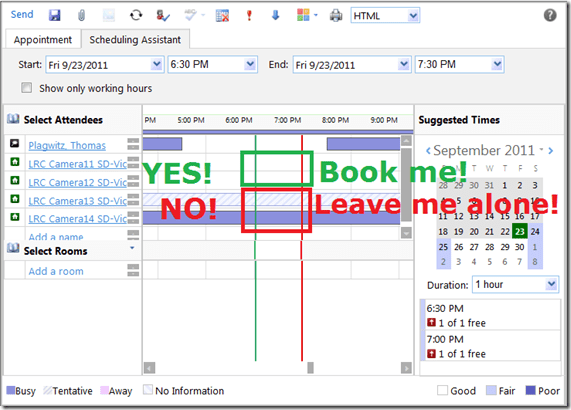
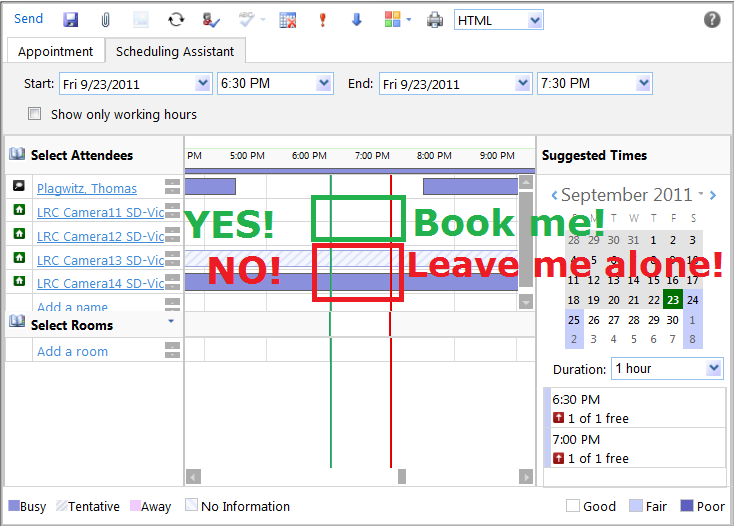
- A “blocked” timeline denotes a prior meeting request: The item has already been booked (solid block) or requested (hatched block) during the start and end time of your meeting. Do not crash their party.
- “blank” timeline means “item is free”. Go ahead: You can request a meeting with this item between your start and end time.
- Once you have this overview, you can easily remove, by right-clicking on the resource, extra resources that you cannot book or could, but which you do not need:

- Once the university has mail-enabled your cloud-accounts on campus, we will have a computer decline such conflicting requests automatically, and force you to start over with a new meeting request. It will be still worth your while memorizing the above: You can save time and avoid disappointment.

How to use the LRC Room Coed 434 Teacher Computer
- Teacher podium
- Even though the teacher computer may have 2 screens, log in as normal: Follow the instructions on the screen (press CTRL-ALT-DEL and enter your credentials).

- Also check our instructions for using the dual screen on the teacher computer.
- Even though the teacher computer may have 2 screens, log in as normal: Follow the instructions on the screen (press CTRL-ALT-DEL and enter your credentials).
- Connected computer to the right of the podium
- If you see this “Computer has been Locked” message, try and get hold of the person whose account name appears as the last logged in user when you press CTRL-ALT-DEL, to unlock the computer. If you cannot get hold off the person, or of somebody with an administrator account, you have to restart (power cycle) that computer.
- If the screens are black and do not come on when you move the mouse and type on the keyboard, turn that computer on using the Power button in front.
- If you want to use a CD, DVD, thumb drive, insert it into that computer.
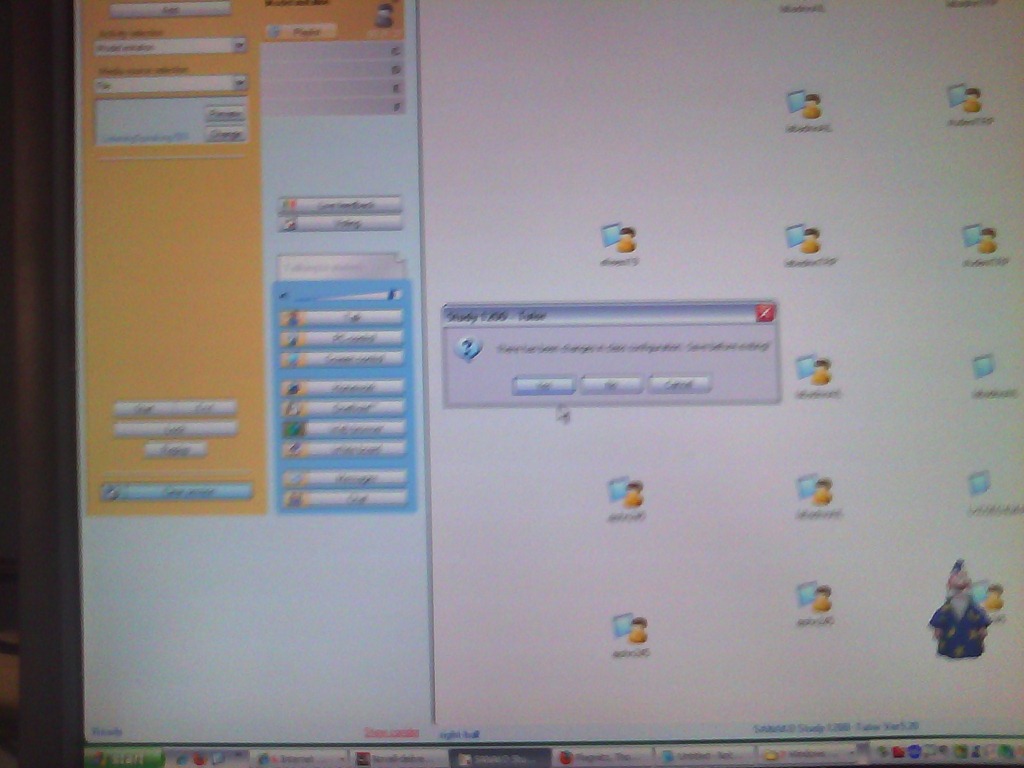
- If you get this message when closing the Sanako Study1200, say “no”.

How teachers can grade student recordings done with the LRC Sanako Study-1200 in their Office
-
Teacher on their office PC (MAC users talk to http://helpdesk.uncc.edu) can press
 windows-key+e, and in the window, that opens,
 -
browse to the student mp3 recordings with date and time in the folder name on s:\coas\lcs\labs\lrctest\sanako\student (no S: drive on office PC? talk to http://helpdesk.uncc.edu, but in the meantime, trywindows-key+r, paste = \\DATASERV1\DVOL1\coas\lcs\labs\lrctest\sanako\student”, click “OK”),
-
open the student recording file, either by double-clicking to, presumably, open it in Windows Media Player, or, preferably, by selecting multiple files, right-clicking and choosing “Open with” to open them for comparative grading (read some tips) in Audacity.

Speaking/Listening Assessments and Oral Exams: A comparison what the LRC has to offer
- Moodle:
- I proposed for installing one of the free audio recorder plug-ins into our Moodle, but we are not there yet.
- However, we do have a new video recording assignment (which is based on Kaltura).
- Format: free form, according to your written instructions in the assignment. Students can review and repeat the recording as often as they wish.
- The video overhead is minimal since it is streamed, and video is better for authentic language assessments – unless you specifically prepare your students for phone interviews: then just have students step out of the viewing angle of the webcam).
- thanks to Moodle, the familiar interface and the underlying LMS support infrastructure, it is easy
- for the teacher
- to create and assign a video-assignment
- to grade it from the gradebook
- for the students to take it and submit it.
- for the teacher
- LRC Support:
- Since our PCs have no built-in or added webcam (proposed), we can currently only use our 5 iMacs for Moodle video assignments. Since the MACs do not have headsets (but built-in microphones), the audio quality is not as good as on the PCs. Since 5 seats are not sufficient for class-size activities/exams, it is best to use this as a homework assignment
- I list all necessary steps for a video assignment
- Additional support is available through the campus Moodle support team.
- Sanako
- Sources
-
Dual-track comparative recorder:
- the teacher can prepare an input track (or provide one live. Preparing is easy, and worth your while, since easily reusable. I can help you)).
- the students records on her own track
-
Pair and group recording:
- Sanako makes it easy to pair or form groups of students and to record free-form conversations.
- These recordings can be either controlled remotely by the teacher or locally by the user
-
- Control
- Remote-controlled recording under exam conditions,
- responding to a listening cue within a preset (or live) pause in the teacher track
- model&imitation: for phonetics and pronunciation exercises,
- question&response for a wide variety of activities as commonly used in SLA textbooks and classroom, including practicing grammar structures or vocabulary recently
- question&response&model response: the teacher can also include after the pause in the teacher track a model answer for the students to compare their own output to.
- automatically saved with student names to be accessed from the teacher office desktop
- easy comparative grading using Audacity (see below)
- responding to a listening cue within a preset (or live) pause in the teacher track
- Remote-controlled recording under exam conditions,
- User-controlled recording is also possible, using the student recorder in manual operation mode
- which has more language learner features (bookmarks, voice graph, dual band recording), and a simpler interface than a full blown audio editor like Audacity (see below).
- The task how to save and sent the assignment to the teacher is here left to the user.
- LRC support:
- I can help you
- creating an audio recording with your content and speaking cues and pauses – using Audacity (see below)
- conducting the remote-controlled exam
- Up to 20 seats can take an oral exam simultaneously, until we get more Sanako licenses. However, we found a way to split classes into 2 halves and have consecutive exams (we can play audio on the other students’ headsets to provide for exam conditions). The LRC main classroom is equipped with 30 seats for 2 consecutive exams with Sanako headsets.
- Sources
- Voicethread is a popular online recorder, especially for educational institutions that have no onsite support.
- Visual and audio cues can be provided by the teacher.
- Pairing of students has been attempted via sharing and responding/commenting to the partner’s submission. This is not a realistic conversation.
- Recordings are stored in the cloud.
- There is no integration with the SIS (accounts – getting students set up with accounts that can communicate back with the teacher is a challenge) and LMS (the Moodle integration is superficial).
- Voicethread is not free. The ELTI, however, has a subscription. LCS does not.
- LRC Support:
- We support Voicethread exercises with new and improved headsets.
- Help is available through the vendor.
- Audacity:
- for teachers and LRC staff and other language professionals:
- best free audio editor, also good for comparative grading. I routinely make my audio exam recordings with Audacity.
- LRC support: I have tips and tricks how you can use it in your teaching preparation and grading.
- for language learners: not the recommended option, since Audacity has not a feature set geared towards language learning nor support for language assessment workflows:
- Language learners do no need an audio editor for speaking exercises, they need a recorder. If you are a language learner, it is not pedagogical to be able to technically edit and refine your audio recording. Rather rehearse, reflect on and repeat your audio recording, until you are happy with your language output.
- Audacity is too technical: It involves too many steps, options and settings for the students to record, save, export and name the audio and to get it to the teacher, and (if it is not uploaded into a Moodle assignment, which could then be a Kaltura assignment anyway, see above), too tedious for the teacher to manage and grade files.
-
LRC Support:
- If your students are technically inclined, we do have Audacity installed in the LRC.
- Your students should not find it difficult to read the documentation. Here are my posts on Audacity.
- for teachers and LRC staff and other language professionals:
Exchange 2010 and Live@edu: How to use resource calendar publishing to implement a help desk timetable and signup sheet
- Calendar sharing with students that have only cloud accounts in live@edu requires them to be mail-enabled users in on-premise AD and only works if a users privileged to share shares with individuals through the GUI (in our circumstances: no groups, no PowerShell access).
- Workaround to share resource calendar information is: publish calendars to the internet. This needs careful consideration of privacy issues, but Exchange 2010 provides you with a number of helpful options, including “availability only”.

- If you publish, you can easily generate the links from the resource mailbox name, and manage large sets of calendars e.g. in an MS-Excel Web app.
- As you can see in the below LRCTutor12 calendar subscribed to in either OWA or Windows Live, the Exchange 2010 ICS does not seem to provide the calendar name, users have to update it manually (maybe use the resource mailbox account name from the calendar URL).
![student-internet-calendar-in-owa-error_thumb[2]](https://thomasplagwitz.com/wp-content/uploads/2011/09/student-internet-calendar-in-owa-error_thumb2_thumb.png?w=526&h=287 "student-internet-calendar-in-owa-error_thumb[2]")
![student-internet-calendar-in-windows-live-works_thumb[2]](https://thomasplagwitz.com/wp-content/uploads/2011/09/student-internet-calendar-in-windows-live-works_thumb2_thumb.png?w=545&h=342 "student-internet-calendar-in-windows-live-works_thumb[2]")
- If you “hack” resource calendars to be a help desk timetable (support personnel, like lab assistants/tutors, one calendar per language, sharing the support role), and have personnel update their availability with late-breaking changes through their Outlook calendars (“cancel this occurrence”) and automatically get these changes pushed out to all users over the internet.
- You can also “hack” a signup sheet “on steroids”:
- enforce a MaximumDurationInMinutes suitable for a sign-up appointment duration)
- set the AutomateProcessing option to AutoUpdate,
- accept the meeting requests of lab assistants/tutors at term start, so that they appear as solid blocks in the calendar, and advise clients trying to sign-up that only 1 client can sign-up during any given solid block with the office.
- Then ignore meeting requests of clients during the term (but communicate the rule to clients: only one client can sign up for support from the “office” during any given time slot. There is in my knowledge no way to set a number in Exchange 2010. Neither MaximumConflictInstances nor ResourceCapacity are applicable). The client meeting requests will remain tentative and appear hatched in the calendar for any other client to see.
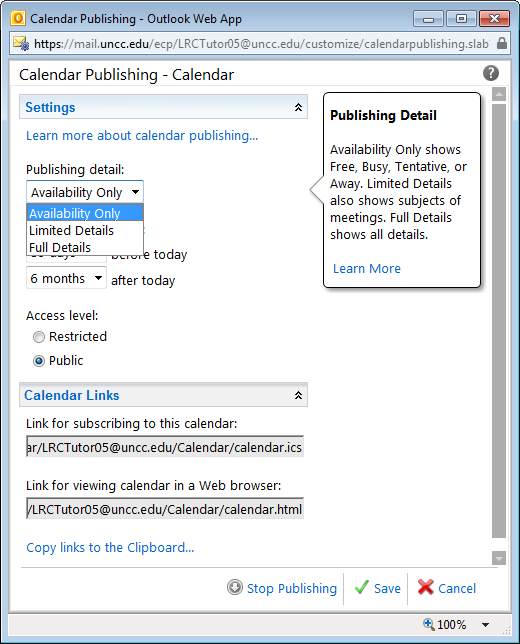
- It is advisable to publish the calendar not with “Availability” only, but with “Limited Detail”, so that additional information (office hours dedicated to specific support topics/clinics, specific requests by clients) can be passed back and forth between support personnel and clients (and anything is better than “Free/Busy” which is especially misleading for such office calendars). Note that even if OrganizerInfo is included on-premise, it seems not included on calendars published to the internet (option “public”; “restricted” has not been tested), which makes Limited Detail possible in our environment.
- Publishing the calendar to the internet with “Full details” could be used for passing additional information, like special handling instructions to student workers,
- like this:
 (this is the publically viewable HTML – oddly)
 - This notes passing does not work with cloud-accounts that are subscribed to the calendar ICS that are not mail-enabled in AD: no notes field gets through to them in OWA)
- But the one-size-fits-all approach is unsatisfactory. If the group of student workers is small, it could (once mail-enabled in AD) be shared the calendar with instead.
- incidentally, what happens with the organizer field under “full details”
- Ìt appears that a calendar can not simultaneously be published "public" and "restricted" (need to know the obscure URL), let alone with different levels of information included.
![student-internet-calendar-in-owa-error_thumb[2]](https://thomasplagwitz.com/wp-content/uploads/2011/09/student-internet-calendar-in-owa-error_thumb2.png "student-internet-calendar-in-owa-error_thumb[2]")
![student-internet-calendar-in-windows-live-works_thumb[2]](https://thomasplagwitz.com/wp-content/uploads/2011/09/student-internet-calendar-in-windows-live-works_thumb2.png "student-internet-calendar-in-windows-live-works_thumb[2]")



Questions? Read the About. Or just ask me a quick Our Databases: Resources with calendars -- Language learning material Moodle Sites, multimedia files -- films


FAQs for LRC student staff or for students or for teachers. To search our FAQs, in the browser addressbar, add after "https://plagwitz.wordpress.com/feed/?tag=faqs+/" "+TAG1" (from tag cloud below) OR "https://plagwitz.wordpress.com/feed/tag=faqs
&category_name=" "CAT1" (from category hierarchy below). OR search both categories and tags, and multiple TAGs/CATs (connect with "," for OR-search, with "+" for AND-search), like so: https://plagwitz.wordpress.com/feed/?tag=TAG1+TAG2+...TAGn&category_name=CAT1
+CAT2+...CATn"
Other ways to find help
If you cannot find it here, look there: 5,500 Language-Learning Links and Programs for learning or teaching 150 languages
Shortcuts:Our Lists, Our Maps, LRC Staff Moodle Site,LRC Project Moodle Site, 49erexpress, UNCC Moodle, Student Recordings: s:claslcslrcsanakostudent
Learning usage samples: Sanako oral exam, Kaltura webcam presentation, Dictation with speech recognition, Sanako written exam, Chinese and Japanese interactive stroke-order practice
Test the Sanako Installer, Webbrowser Popup Konfigurator for XP, or Windows7, faster LRC TeacherPC Log-in Let MS facilitate diacritics writing by installing for you US-International keyboard layout
This is my personal blog (Google+). The views expressed on these pages are mine alone and not those of my employer. The information in this weblog is provided “AS IS” with no warranties, and confers no rights.


