Archive
How a teacher can organize a student-controlled high-stakes assessment recording session using the Sanako in the LRC
- How:
- An initial central microphone and speaker test (animated step-by-step) is recommended. Clear the session afterwards.
- Recording: Have the student operate the Sanako recorder to individually record (like during a self-access assignment)
- For starters, teacher can display this narrated individual recordings with the Sanako Student Recorder training screencast, it auto-starts and auto-cycles):
- And/or explain:
- Red Record Button to record;
- Blue Stop button to stop recording
- Green Play Button to play their assignment for review (also use the recap button to jump back)
- Menu: “File / New”, if they want to redo the assignment.
- Button: call/envelope to call the teacher on the teacher station for help (an audio connection between student and teacher should pause the recorder automatically)
- Submitting:
- Individually by students:
- Menu “File” / “Save” (opt to save as student track mp3), to save locally, once student is happy to submit.
- (recommended:) upload the save file to a Moodle single-file upload assignment. Requires the teacher to create a Moodle Single file upload assignment, with optional attached file first.
- From the Sanako tutor at the teacher station:
- For entire class (If you do not need the flexibility to have students end at different times). TBA
- Group-wise (varying (staggered) recording times): TBA
- Individually by students:
- Pro’s:
- Less distraction from language learning by having to operate technology (editing audio rather then practicing L2) and more language-learning-specific features (sidetone, recap) than if using Audacity.
- Works with the Sanako Study 1200 teacher stations (e.g. automatic pause of recorder when remote connecting to student during monitoring of recording task).
- Con’s:
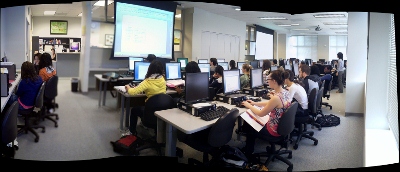
- noise interference with dozens of student speaking in a confined space simultaneously. Nobody wants to return to the language lab station of yore, i.e. in a cubicle. However, a teacher-controlled oral exam (sample video, step-by-step video),
- can play a soothing background sound to students over the headphones which insulates them from their neighbors (prevents both distraction and cheating);
- there is no room for distracting unrelated chit-chat;
- there is no need for distracting conversation when students do technical troubleshooting, during highly structured question/response exams.
- More user flexibility/control is achieved by more individual distracting operation of computer technology, which always implies more opportunity for user error. To reduce (not eliminate!) the error ratio:
- Students
- have to have received the general digital audio lab introduction for students.
- have to double-check their recordings for quality before submitting.
- Teachers
- have to monitor students’ recording progress closely
- which the Sanako Study 1200 teacher station (link cannot replace hands-on training) greatly facilitates (provided Students use the Sanako Student Recorder, as described above).
- however, even with a classroom management system like Sanako Study 1200, it is impossible to completely monitor a class size of students operating computers. Therefore teachers
- have to check the validity of submissions before students leave.
- If you use submission through Moodle, here are 2 tips how to do this quicker:
- Whether you use submission through Moodle or collection through Sanako tutor:
- view end of this video for how to quickly check validity of all file submissions in a folder using Audacity
- are advised to have a make-up assessment plan not only for those students missing the exam, but also for those that miss to complete the computerized multimedia assessment correctly.
- have to monitor students’ recording progress closely
- Students
- noise interference with dozens of student speaking in a confined space simultaneously. Nobody wants to return to the language lab station of yore, i.e. in a cubicle. However, a teacher-controlled oral exam (sample video, step-by-step video),
New Sanako Lite Recorder Installation error
As seen when starting up the Student.exe after instalaltion (and before restart). What i noticed was the red warning in the sanako student “no audio”. After a restart after installation, i could play back sound. no microphone was installed on the system, but should that result in such errors? we are having a lot of installation issues with the sanako lite recorder on our pretty standard (xp dp3, win7 64-bit) dell optiplex (755, 760,780 mostly) machines. I am used to reading stack traces, but my users are not and would run into this – plus this one seems deliberately obfuscated.
************** Exception Text **************
System.ArgumentOutOfRangeException: Index was out of range. Must be non-negative and less than the size of the collection.
Parameter name: index
at System.Collections.ArrayList.get_Item(Int32 index)
at A.B.A()
at A.B.A(Int32 offset)
at A.B.b(Object sender, EventArgs e)
at System.Windows.Forms.Control.OnClick(EventArgs e)
at System.Windows.Forms.Button.OnClick(EventArgs e)
at System.Windows.Forms.Button.OnMouseUp(MouseEventArgs mevent)
at System.Windows.Forms.Control.WmMouseUp(Message& m, MouseButtons button, Int32 clicks)
at System.Windows.Forms.Control.WndProc(Message& m)
at System.Windows.Forms.ButtonBase.WndProc(Message& m)
at System.Windows.Forms.Button.WndProc(Message& m)
at System.Windows.Forms.Control.ControlNativeWindow.OnMessage(Message& m)
at System.Windows.Forms.Control.ControlNativeWindow.WndProc(Message& m)
at System.Windows.Forms.NativeWindow.Callback(IntPtr hWnd, Int32 msg, IntPtr wparam, IntPtr lparam)
************** Loaded Assemblies **************
mscorlib
Assembly Version: 2.0.0.0
Win32 Version: 2.0.50727.5466 (Win7SP1GDR.050727-5400)
CodeBase: file:///C:/Windows/Microsoft.NET/Framework/v2.0.50727/mscorlib.dll
—————————————-
SoundDeviceWizard
Assembly Version: 5.51.10221.1
Win32 Version: 5.51.010221.01
CodeBase: file:///C:/Program%20Files%20(x86)/SANAKO/Study/Student/SoundDeviceWizard.exe
—————————————-
System.Windows.Forms
Assembly Version: 2.0.0.0
Win32 Version: 2.0.50727.5468 (Win7SP1GDR.050727-5400)
CodeBase: file:///C:/windows/assembly/GAC_MSIL/System.Windows.Forms/2.0.0.0__b77a5c561934e089/System.Windows.Forms.dll
—————————————-
System
Assembly Version: 2.0.0.0
Win32 Version: 2.0.50727.5467 (Win7SP1GDR.050727-5400)
CodeBase: file:///C:/windows/assembly/GAC_MSIL/System/2.0.0.0__b77a5c561934e089/System.dll
—————————————-
System.Drawing
Assembly Version: 2.0.0.0
Win32 Version: 2.0.50727.5467 (Win7SP1GDR.050727-5400)
CodeBase: file:///C:/windows/assembly/GAC_MSIL/System.Drawing/2.0.0.0__b03f5f7f11d50a3a/System.Drawing.dll
—————————————-
Localization
Assembly Version: 5.51.10221.1
Recommended settings for a departmental Sanako Lite Recorder installation
The following settings are not in the default installation for the language lab, but rather manually overridden (in the Student Recorder Settings) for installation on faculty office computers: [HKEY_CURRENT_USER\Software\Sanako\Study\Student\Settings]
“My files directory”=”s:\\coas\\lcs\\lrc\\sanako\\teacher\\”
“AlwaysUseRecorderLiteVersion”=dword:00000001
The following setting obviously needs to be generalized:[HKEY_CURRENT_USER\Software\Sanako\Study\Student\Settings]
“Temporary files directory”=”C:\\Documents and Settings\\tplagwit\\Local Settings\\Temp\\”
The helper.exe architecture should be disabled outside of the Sanako classroom (details here):
[HKLM\SYSTEM\CurrentControlSet\Services\Sanako Helper]
“Start”==dword:0×00000004
and for backup:
[HKLM\SYSTEM\ControlSet001\Services\Sanako Helper]
“Start”=dword:0×00000004
Even with the helper.exe neutralized, the “associate media files” option appears too greedy – at least here I cannot get it to associate, as it seems to promise, the media files only when the student.exe is running, rather the following file associations changes seem to get baked into the registry permanently – so the following is not recommended (leave the checkbox in the settings unchecked):
[HKEY_CURRENT_USER\.mff]
“”=”StudyStudent.Document”
“Content Type”=”Application/StudyStudent.Document”
[HKEY_CURRENT_USER\StudyStudent.Document]
“”=”StudyStudent.Document”
[HKEY_CURRENT_USER\StudyStudent.Document\DefaultIcon]
“”=”C:\\Program Files\\Sanako\\Study\\Student\\Student.exe,0”
The following associations seem to be added when checking “associate media files”in admin settings , but it does not look like this association is limited to during run time of the recorder
[HKEY_CURRENT_USER\StudyStudent.Document\shell\open\command]
“”=”C:\\Program Files\\Sanako\\Study\\Student\\Student.exe %1”
[HKEY_CURRENT_USER\.dim]
“”=”StudyStudent.Document”
“Content Type”=”Application/StudyStudent.Document”
[HKEY_CURRENT_USER\.maa]
“”=”StudyStudent.Document”
“Content Type”=”Application/StudyStudent.Document”
[HKEY_CURRENT_USER\.wav]
“”=”StudyStudent.Document”
“Content Type”=”Application/StudyStudent.Document”
[HKEY_CURRENT_USER\.snd]
“”=”StudyStudent.Document”
“Content Type”=”Application/StudyStudent.Document”
[HKEY_CURRENT_USER\.au]
“”=”StudyStudent.Document”
“Content Type”=”Application/StudyStudent.Document”
[HKEY_CURRENT_USER\.aif]
“”=”StudyStudent.Document”
“Content Type”=”Application/StudyStudent.Document”
[HKEY_CURRENT_USER\.aic]
“”=”StudyStudent.Document”
“Content Type”=”Application/StudyStudent.Document”
[HKEY_CURRENT_USER\.aifc]
“”=”StudyStudent.Document”
“Content Type”=”Application/StudyStudent.Document”
[HKEY_CURRENT_USER\.aiff]
“”=”StudyStudent.Document”
“Content Type”=”Application/StudyStudent.Document”
[HKEY_CURRENT_USER\.asf]
“”=”StudyStudent.Document”
“Content Type”=”Application/StudyStudent.Document”
[HKEY_CURRENT_USER\.asx]
“”=”StudyStudent.Document”
“Content Type”=”Application/StudyStudent.Document”
[HKEY_CURRENT_USER\.wax]
“”=”StudyStudent.Document”
“Content Type”=”Application/StudyStudent.Document”
[HKEY_CURRENT_USER\.wm]
“”=”StudyStudent.Document”
“Content Type”=”Application/StudyStudent.Document”
[HKEY_CURRENT_USER\.wma]
“”=”StudyStudent.Document”
“Content Type”=”Application/StudyStudent.Document”
[HKEY_CURRENT_USER\.wmd]
“”=”StudyStudent.Document”
“Content Type”=”Application/StudyStudent.Document”
[HKEY_CURRENT_USER\.wmp]
“”=”StudyStudent.Document”
“Content Type”=”Application/StudyStudent.Document”
[HKEY_CURRENT_USER\.wmx]
“”=”StudyStudent.Document”
“Content Type”=”Application/StudyStudent.Document”
[HKEY_CURRENT_USER\.wp1]
“”=”StudyStudent.Document”
“Content Type”=”Application/StudyStudent.Document”
[HKEY_CURRENT_USER\.wvx]
“”=”StudyStudent.Document”
“Content Type”=”Application/StudyStudent.Document”
[HKEY_CURRENT_USER\.mid]
“”=”StudyStudent.Document”
“Content Type”=”Application/StudyStudent.Document”
[HKEY_CURRENT_USER\.midi]
“”=”StudyStudent.Document”
“Content Type”=”Application/StudyStudent.Document”
[HKEY_CURRENT_USER\.rmi]
“”=”StudyStudent.Document”
“Content Type”=”Application/StudyStudent.Document”
[HKEY_CURRENT_USER\.mp3]
“”=”StudyStudent.Document”
“Content Type”=”Application/StudyStudent.Document”
[HKEY_CURRENT_USER\.m3u]
“”=”StudyStudent.Document”
“Content Type”=”Application/StudyStudent.Document”
[HKEY_CURRENT_USER\.m1v]
“”=”StudyStudent.Document”
“Content Type”=”Application/StudyStudent.Document”
[HKEY_CURRENT_USER\.mp2]
“”=”StudyStudent.Document”
“Content Type”=”Application/StudyStudent.Document”
[HKEY_CURRENT_USER\.mpa]
“”=”StudyStudent.Document”
“Content Type”=”Application/StudyStudent.Document”
[HKEY_CURRENT_USER\.mpe]
“”=”StudyStudent.Document”
“Content Type”=”Application/StudyStudent.Document”
[HKEY_CURRENT_USER\.mpeg]
“”=”StudyStudent.Document”
“Content Type”=”Application/StudyStudent.Document”
[HKEY_CURRENT_USER\.dat]
“”=”StudyStudent.Document”
“Content Type”=”Application/StudyStudent.Document”
[HKEY_CURRENT_USER\.mp2v]
“”=”StudyStudent.Document”
“Content Type”=”Application/StudyStudent.Document”
[HKEY_CURRENT_USER\.mpv2]
“”=”StudyStudent.Document”
“Content Type”=”Application/StudyStudent.Document”
[HKEY_CURRENT_USER\.ogg]
“”=”StudyStudent.Document”
“Content Type”=”Application/StudyStudent.Document”
[HKEY_CURRENT_USER\.mov]
“”=”StudyStudent.Document”
“Content Type”=”Application/StudyStudent.Document”
[HKEY_CURRENT_USER\.qt]
“”=”StudyStudent.Document”
“Content Type”=”Application/StudyStudent.Document”
[HKEY_CURRENT_USER\.mp4]
“”=”StudyStudent.Document”
“Content Type”=”Application/StudyStudent.Document”
[HKEY_CURRENT_USER\.ra]
“”=”StudyStudent.Document”
“Content Type”=”Application/StudyStudent.Document”
[HKEY_CURRENT_USER\.rm]
“”=”StudyStudent.Document”
“Content Type”=”Application/StudyStudent.Document”
[HKEY_CURRENT_USER\.ram]
“”=”StudyStudent.Document”
“Content Type”=”Application/StudyStudent.Document”
[HKEY_CURRENT_USER\.rmm]
“”=”StudyStudent.Document”
“Content Type”=”Application/StudyStudent.Document”
[HKEY_CURRENT_USER\.rmx]
“”=”StudyStudent.Document”
“Content Type”=”Application/StudyStudent.Document”
[HKEY_CURRENT_USER\.swf]
“”=”StudyStudent.Document”
“Content Type”=”Application/StudyStudent.Document”
[HKEY_CURRENT_USER\.smi]
“”=”StudyStudent.Document”
“Content Type”=”Application/StudyStudent.Document”
[HKEY_CURRENT_USER\.rmj]
“”=”StudyStudent.Document”
“Content Type”=”Application/StudyStudent.Document”
[HKEY_CURRENT_USER\.rt]
“”=”StudyStudent.Document”
“Content Type”=”Application/StudyStudent.Document”
[HKEY_CURRENT_USER\.mnd]
“”=”StudyStudent.Document”
“Content Type”=”Application/StudyStudent.Document”
[HKEY_CURRENT_USER\.pls]
“”=”StudyStudent.Document”
“Content Type”=”Application/StudyStudent.Document”
How to install the Sanako Lite Recorder without it auto-starting and auto-restarting
- Problem:
- For a personal installation, but especially for a faculty-wide deploy, the default installation of the Sanako Lite Recorder seems to have too much of a footprint: Sanako Lite Recorder not only auto-starts (see e.g. the student icon in the notification area) with Windows, but also auto-restarts when exited –
- a useful feature of the classroom recorder from which the standalone recorder is derived, but not so much for a standalone recorder rollout. The feature is achieved by installing a service (helper.exe) that itself is during installation set to SERVICE_AUTO_START (0x00000002).
- This architecture also makes the installation option to “associate media files” with the Sanako Lite Recorder too greedy, even though it could be useful during the actual work of faculty with the Recorder.
- Workaround (for either manual reconfiguration after the install or to be integrated into the automated deployment):
- Can one set the underlying helper.exe service that gets installed during the Sanako Lite install to SERVICE_DEMAND_START (0x00000003)? Not tested. At best, this would help between computer restarts, but not when a teacher is done with editing the study recorder and tries to exit it (helper.exe, if itself started, will restarts the student.exe).
- Can one entirely disable this helper.exe service from services.msc, will the recorder still start? Testing with starting the student.exe and playing audio files did work. So one should try also during a deploy, use value SERVICE_DISABLED (0x00000004) for keys HKLM\SYSTEM\CurrentControlSet\Services\Sanako Helper\Start (and, in case something goes wrong later: HKLM\SYSTEM\ControlSet001\Services\Sanako Helper\Start).
What is “Content location” in Sanako Study Student Recorder (including Lite) for?


- While working on rolling out the free Sanako Light recorder to all faculty computers in a more systematic, automated way, the question has come up:
- What is “Content location” in Sanako Study Student Recorder (Ver 6, including Lite) “Administrative Settings” for, and how can it accept a URL?
- No such field in Ver 5.51; no mention in the help file; no manual this new (free) version would help seems included with the download.
- I am trying to point the “My files” to a more shared and LRC-accessible location on our SANAKO network share. Should I try the same with “Content Location”, or is this (defaults to “Application Data”) a strictly temporary location for during authoring?
- Answer: Sanako seems to be planning using this for distributing their own learning materials, esp. for ESL.
How to terminate Sanako student.exe
- Since I am getting search engine hits from the above query on my blog, a quick answer:
- You likely need to terminate the helper.exe in the process manager first, since this service restarts the student.exe, for the good reason that
- you do not want students to opt out of your Sanako class,
- and also in case of student.exe crashes.
- Now here is wondering why you want to terminate it….

How a teacher can use Sanako voice insert to easily add spoken comments to students’ Sanako oral proficiency exams- step–by step
- Requirements:
- you need access to the network share to open/save student recordings (this works in your office;
I do not know whether there is technology supported on campus thatthis makes this work in your home office also, - you need to have the free Sanako student recorder Lite installed, here is how: Just “Run” the above link.
- Recommended: in the student recorder, from menu: TBA, set your “default save directory” to the current folder with the student recordings – otherwise you have to change the save as dialogue back to this destination for each file you save.
- you UPDATE: DO NOT ANYMORE need to disable the voice graph (
notcompatible with voice-insert recording; you can, however show the voice graph again when done recording and reviewing the file) - you need to save the student recording, updated with your comments, in the same folder with the same file name as the source (when “saving as” and choosing the name, preferably do not type it, but rather select or copy/paste it. The original file will still be preserved since your version will be saved in a a different format and therefore have a different file extension)
- you need access to the network share to open/save student recordings (this works in your office;
- TBA:you can rewind to listen, and re-record to overwrite comments that you want to revise
- More training:

Questions? Read the About. Or just ask me a quick Our Databases: Resources with calendars -- Language learning material Moodle Sites, multimedia files -- films


FAQs for LRC student staff or for students or for teachers. To search our FAQs, in the browser addressbar, add after "https://plagwitz.wordpress.com/feed/?tag=faqs+/" "+TAG1" (from tag cloud below) OR "https://plagwitz.wordpress.com/feed/tag=faqs
&category_name=" "CAT1" (from category hierarchy below). OR search both categories and tags, and multiple TAGs/CATs (connect with "," for OR-search, with "+" for AND-search), like so: https://plagwitz.wordpress.com/feed/?tag=TAG1+TAG2+...TAGn&category_name=CAT1
+CAT2+...CATn"
Other ways to find help
If you cannot find it here, look there: 5,500 Language-Learning Links and Programs for learning or teaching 150 languages
Shortcuts:Our Lists, Our Maps, LRC Staff Moodle Site,LRC Project Moodle Site, 49erexpress, UNCC Moodle, Student Recordings: s:claslcslrcsanakostudent
Learning usage samples: Sanako oral exam, Kaltura webcam presentation, Dictation with speech recognition, Sanako written exam, Chinese and Japanese interactive stroke-order practice
Test the Sanako Installer, Webbrowser Popup Konfigurator for XP, or Windows7, faster LRC TeacherPC Log-in Let MS facilitate diacritics writing by installing for you US-International keyboard layout
This is my personal blog (Google+). The views expressed on these pages are mine alone and not those of my employer. The information in this weblog is provided “AS IS” with no warranties, and confers no rights.
 Thomas' Work Space