Archive
A comparison of options for student oral photo presentation assignment
- Objective: Student presents personal photos in target language (e.g. home). b
- Contenders for Tools:
- Voicethread (free version)
- University-environment
- For Multimedia authoring:
- MS-PowerPoint
- not yet contenders
- MS-Community Clips (screen capture recording, to be installed)
- benefit: single purpose, record yourself talking while flipping through the images on your computer
- cost: new tool to learn, and no long term perspective
- Sanako Student Recorder: not a contender, it has subtitling options, but cannot author multimedia presentations (teachers used to with the Sanako authoring tool, but this is not longer supported).
- MS-Community Clips (screen capture recording, to be installed)
- As LMS: Moodle.
- For Multimedia authoring:
- Comparison:
- Student
- Authoring:
- (PowerPoint ties:) Image upload is easy in Voicethread (including batches):
 , but PowerPoints Insert / Photo album is as fast (if you have digital photos).
 - Image narration:
- (PowerPoint ties:) Image upload is easy in Voicethread (including batches):
-
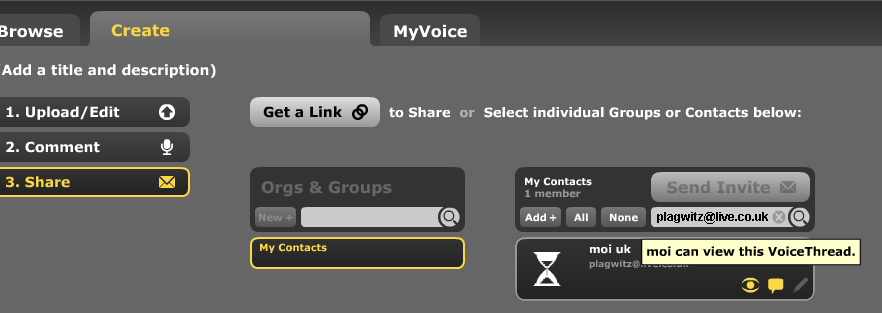
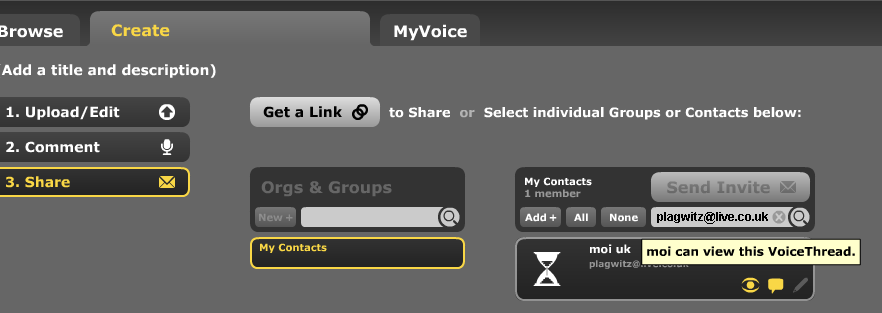
Assignment submission: Voicethread (free) has no support for assignments, only for sharing. Students have to find a way to submit their Voicethread,
- either by email or invitation to pre-created contacts:

- or, – with higher initial setup cost, but greater reusability benefit – by invitation to a pre-created contact:
 ,
, 

- either by email or invitation to pre-created contacts:
- Sharing/peer-editing/grading:
- (Moodle would win where it has peer-grading options. YMMV:) Sharing within the class is possible, but sharing with "anyone" is a privacy (possibly FERPA) issue, and sharing with a handmade class list (no import) is tedious.
- Authoring:
- Teacher: grading
- Managing submissions
- (LMS wins?:) Voicethread (free) does not allow an export that could be uploaded to the LMS.
 Student can email links or invitations like these:
 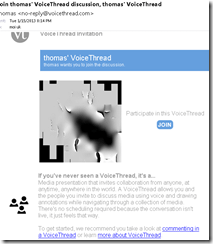 . It is up to you managing them, and completion of assignment and grading for the class. This is no LMS gradebook.
 - (Voicethread wins:) PowerPoint can be saved as a slideshow that starts on click (save as .ppsx) (including with narration). But opening and listening, without the need for saving to a local file, remains easier in Voicethread.
- (LMS wins?:) Voicethread (free) does not allow an export that could be uploaded to the LMS.
- (Voicethread wins:) Providing feedback is possible,
 including oral
  – but is this insert recording? And providing editing access is not the default: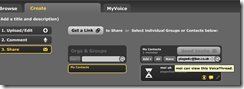
- Record-keeping:
- (Moodle wins:) Voicethread: Uh.. oh..?! I see no retention story, especially not in the free version. With Moodle, you can leave all that to the institutional support.
- Managing submissions
- Student: receiving feedback
- (A tie:) Voicethread’s audio feedback versus Moodle/PowerPoints gradebook access.
- Learning curve:
- Voicethread has the advantage of being a specialized tool (relatively few options, still relatively simple interface – few distractions).
- Other tools have the advantage of greater familiarity in the long run and reusability. Of course it depends also where you are working: stable positions get greater benefit from embarking on the institutional environment.
- Student
-
Summary: PowerPoint/Moodle remains the solution for the pedagogical task at hand that the LRC currently supports. Fortunately
- a narration of a picture presentation using PowerPoint and
- its submission by the student and grading by the teacher on the basis of a Moodle single file upload assignment are not too difficult.




How to re-enroll in MyLanguageLab/MyGermanLab in a new term in the LRC
- Bring:
- Valid Email Address
- Student Access Code – packaged with your text or available standalone at the bookstore.
- Your Instructor’s Section/Course ID ___________ (Note: The Course ID must be entered exactly as it is provided to you including typing the hyphen “-“ and using all capital letters.)
- Open Internet Explorer, go to goo.gl/JUSUC.
Ø Click Sign in under “Sign in” 
Ø Enter the username and password you created as part of registration.
Ø In the new window, under Your Courses and Products select the link with the title of your required text.
Ø Click Enroll in Course
Ø Enter Course ID (provided by your instructor) (Note: The Course ID must be entered exactly as it is provided to you including typing the hyphen “-“ and using all capital letters.)
Done!
Or not: IMPORTANT NOTICE for Returning Users who:
· used a MyLanguageLabs course with your textbook in a previous semester
· purchased 24-month access
· received the following error after entering the Course ID you received from your instructor
If you get this error  , go to www.mylanguagelabs.com and under Sign In click “Problems with your Course ID? Click here.”
(adapted for the LRC from How to Enroll in a New Semester Handout )

How teachers can record audio materials here
The purpose of doing a recording of learning materials for the SANAKO during a faculty workshop is merely to get you started. The use of the SANAKO is not limited to the LRC. After taking the workshop, you can:
-
if needed,
-
check out one of the LRC faculty headphones (we have now 5 for faculty use in our list of LRC resources),
-
install the Sanako standalone recorder on your office or home PC,
-
-
start the recorder and press the red record button,
-
read your questions into the headset microphone, preferably after you have put them in the format of my exam template (consider this sample exam recording a model),
-
use something like a bell, whistle (or simply clap your hands) to create audible cues for when you want to start/stop speaking cues
-
watch the timer on the Student Recorder to leave the same amount of response time for the students as you announced after the questions
-
save the file to the proper location that I listed here: https://thomasplagwitz.com/2012/11/06/how-teachers-find-their-sanako-materials/ .
That’s all. If you need a refresher, please come to one of my bi-weekly LRC “Sanako Clinics” that will appear in the LRC hours&events calendar.
How to extend your LRC class booking to the entire term by adding weekly recurrence
- The single screenshot booking FAQ mentions recurrence briefly. If you failed to add recurrence when you booked the LRC for your class, you can likely still add it:
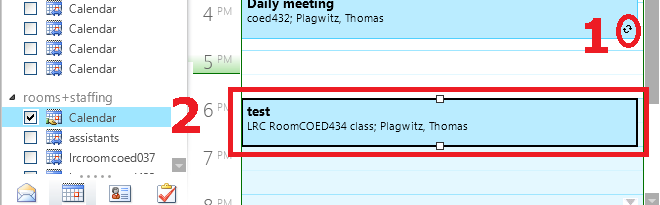
- Go to your NINERMAIL calendar, open your “meeting”, like so:

- if the (1) recurrence indicator is missing or if, when browsing your NINERMAIL calendar for the term, your class booking shows up not every week, only during the first?
- Then (2) open your class booking by double-clicking on it.
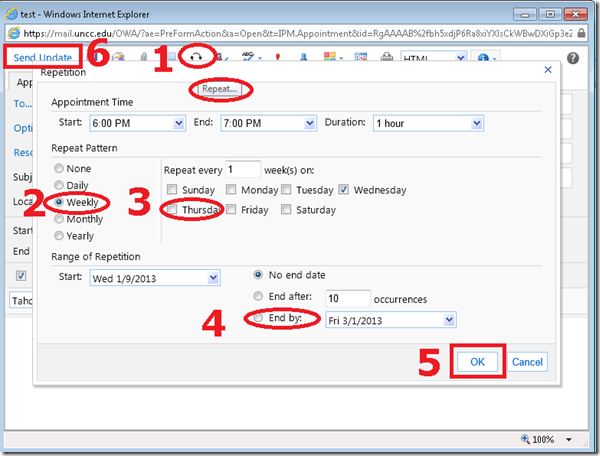
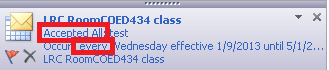
- In the window of your class booking, do these steps (use your own class times, not the ones in the example)
- note how the (1) tooltip for the “repetition” dialogue says “repeat”;
- classes meet (2) “weekly”, but more complex schedules can also be set up (“repeat every x week”)
- don’t forget to (4) “end by” the last day of classes.
- You will receive an immediate response from the LRC classroom in your NINERMAIL inbox. Check it for and report any problems that you cannot resolve to the LRC reception desk.


MS-SkyDrive-related blog posts
LRC Spring 2013 announcements
Over the break SANAKO permissions for students and teachers were set up according to vendor specifications.
Benefits on LRC computers, office PCs (and MACs, except for Sanako standalone recorder; try also home computers if you use university network shares from home):
1. Teachers in LCS and ELTI can save their learning material files directly from their office PCs to the SANAKO folders for distribution within the LRC.
2. Teachers don’t anymore have to request permission for SANAKO before first visit of the LRC with students enrolled in ARBC, CHNS, ELT, FLED, FREN, GERM, GREK, ITLN , JAPN, LACS, LATN , LTAM, PORT, RUSS, SPAN, TRAN, they automatically have access to use the SANAKO in the LRC.
3. Teachers can from their office PCs grade their students’
- writing with written feedback
- and recordings with oral feedback using Sanako voice-insert
- and have the feedback automatically distributed to students (requires finalization of my langlabemailer extension for the SANAKO).
While I have no tools to test the permissions, I am optimistic that this will work much better than the unfinished configuration we had to make do with during the first 21 months of the SANAKO. In the unlikely event that you run into errors, let us know like so: https://thomasplagwitz.com/2011/10/18/how-to-make-a-screenshot-of-your-computer-screen/).
Unfortunately, the SANAKO root folder had to be changed also due to new ITS requirements. This breaks the folder shortcuts (not the standalone recorder) that I have manually added to some teacher’s computers. I am investigating whether a new computer management tool ITS is introducing (TEM) can do this update of shortcut, as well install of shortcuts and Sanako standalone recorder. In the meantime, I updated goo.gl/yqR18 (password:uncclrct), your entry point to SANAKO folders (explanation and clickable link) , whether you work on the LRC teacher computer on your office PC or MAC. I also have a simple step-by-step how to install the standalone student recorder if you need it sooner: goo.gl/LzuDE.
Workshops: Teachers have requested earlier SANAKO workshops this term, at the same time finding common time for LRC workshop scheduling has proven to be difficult. So I would like to test 2 new things:
1. expanding the self-access training materials collection introduce during the last workshop: goo.gl/r5Izg (work in progress, your companion at the teacher station with step-by-step videos for common Sanako activities.
2. offering a bi-weekly drop-in clinic (from week 3) for preparing activities based on these training materials.
a. Where: All clinics will be in the LRC main classroom, in the hope of using the SANAKO hands-on the creation and delivery of learning materials/activities, helping multiple teachers simultaneously.
When: So that everybody can find a time that fits into their schedule, the time-slot of the clinic will be rolling through-out the term (starting on Tuesday at an even hour and on Thursday at an odd hour), and continuing 2hrs later each consecutive week (barring your prior booking of the LRC for classes and exams which take priority – please book as soon as you finalize your syllabus so that I can finalize the clinic schedule). Just look for "Sanako Clinic" in the LRC calendar (http://mail.uncc.edu/owa/calendar/LRCRoomCOED434@uncc.edu/Calendar/calendar.html, or to be able to search, add it to your NINERMAIL like so: https://thomasplagwitz.com/2011/11/21/how-to-subscribe-to-an-lrc-calendar/) and drop-in to create plans and materials for SANAKO activities like in the companion. If, however, you need a different time slot, send a meeting request to LRCroomcoed434@uncc.edu and me and I will reschedule for this week (please "signal" early so as to avoid "bumping " other clinic attendants.


Questions? Read the About. Or just ask me a quick Our Databases: Resources with calendars -- Language learning material Moodle Sites, multimedia files -- films


FAQs for LRC student staff or for students or for teachers. To search our FAQs, in the browser addressbar, add after "https://plagwitz.wordpress.com/feed/?tag=faqs+/" "+TAG1" (from tag cloud below) OR "https://plagwitz.wordpress.com/feed/tag=faqs
&category_name=" "CAT1" (from category hierarchy below). OR search both categories and tags, and multiple TAGs/CATs (connect with "," for OR-search, with "+" for AND-search), like so: https://plagwitz.wordpress.com/feed/?tag=TAG1+TAG2+...TAGn&category_name=CAT1
+CAT2+...CATn"
Other ways to find help
If you cannot find it here, look there: 5,500 Language-Learning Links and Programs for learning or teaching 150 languages
Shortcuts:Our Lists, Our Maps, LRC Staff Moodle Site,LRC Project Moodle Site, 49erexpress, UNCC Moodle, Student Recordings: s:claslcslrcsanakostudent
Learning usage samples: Sanako oral exam, Kaltura webcam presentation, Dictation with speech recognition, Sanako written exam, Chinese and Japanese interactive stroke-order practice
Test the Sanako Installer, Webbrowser Popup Konfigurator for XP, or Windows7, faster LRC TeacherPC Log-in Let MS facilitate diacritics writing by installing for you US-International keyboard layout
This is my personal blog (Google+). The views expressed on these pages are mine alone and not those of my employer. The information in this weblog is provided “AS IS” with no warranties, and confers no rights.
 Thomas' Work Space