Archive
Announcing new MS-Word templates for writing assignments during face-to-face-classes in the LRC
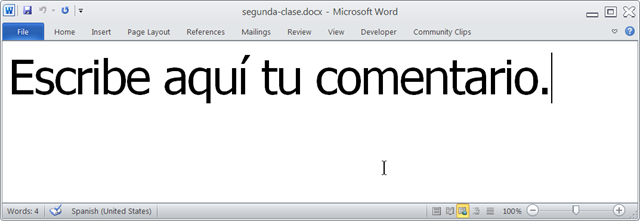
- Benefits
- MS-Word is technology that has become “transparent”for most users:
- Have teachers focus on assignment pedagogy, not authoring technology.
- Have students focus on the target language, not authoring technology.
- Document is protected (for restricting formatting to predefined Word-styles):
- Have students focus on form or content, but not on distracting formatting issues.
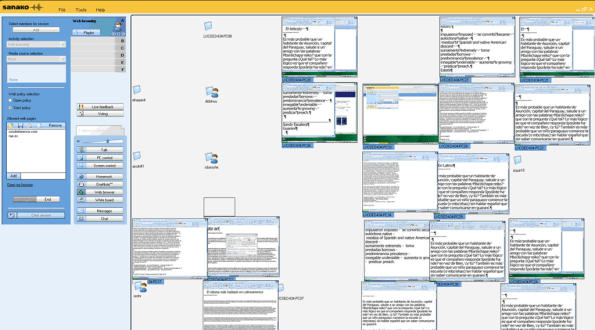
- Styles are designed to facilitate teacher monitoring students’ work using Sanako screensharing, like so:
- Take advantage of MS-Office Proofing tools (templates are preset for your target language).
- Take advantage of easy assignment file management with Sanako homework activity.
- Take advantage of internet lookup process, especially pedagogical if you combine with Sanako controlled-web-browsing activity
- MS-Word is technology that has become “transparent”for most users:
- Requirements:
- Teacher
- The easiest is to save the writing template for your language in C:\Program Files\Microsoft Office\Templates\1033 (or if your run 32-bit MS-Word on a 64-bit Windows, C:\Program Files (x86)\Microsoft Office\Templates\1033)
- Then base your writing assignment document on the template (e.g. by double-clicking the template in the folder you saved it to).
- Then save your writing assignment to your class material folder on the Sanako network share (from the office or in the LRC).
- In class, launch the Sanako homework activity.
- Student: none other than downloading and submitting the Sanako homework.

- Teacher
How you can view the computer screens of your class using Sanako Study 1200
- Here is a 2.5 minute screencast showing off the different ways how you can view your students’ screens using the Sanako Study 1200,
 .
. - from smallest to biggest, all accessible form the button:”screensharing”
- first thumbnails
- then thumbnails in extra window
- finally autoscan
- There will always be tradeoff on the teacher computer between size of individual student screen and overview over class.
- for as long as the teacher screen resolution is nowhere near the combined sizes of the student screen resolution;
- having the same screen resolution is also desirable, for projecting the teacher screen to the students; multi-monitor teacher stations are a nice compromise.
- However, as you can see in the screencast, there a number of nice options that make switching between large size and overview (drilling in and moving back out) easy.
- The newer versions of the Sanako (here 5.2) allow you to choose many different student screen sizes.
- The newest version of the Sanako (5.4) also allows to fit many students screens on a teacher screen by implementing by letting the teacher scroll through the classroom layout).
Sanako Study 1200 Version 5 now allows for larger student screen thumbnails, but still limits the classroom layout size
- The capability of increasing the size of the student thumbnails, to be able to easily read the MS-Word writing student exercises template that I had programmed for Sanako Lab 300 was sorely missed in version 1 and 2 of the Sanako Study 1200 software.
-
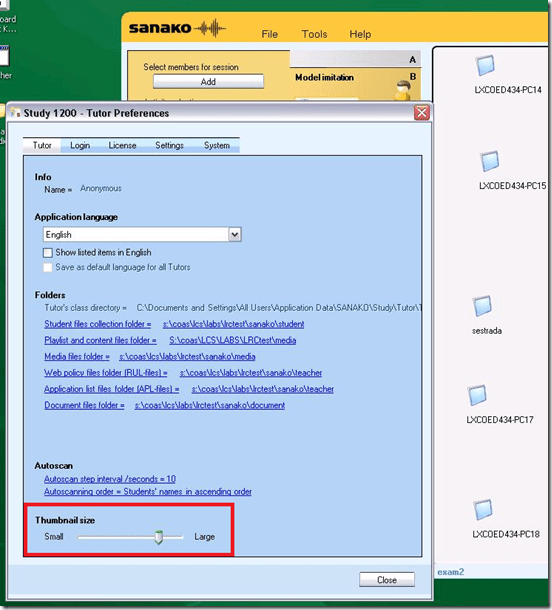
In version 5, the capability to adjust the size has been added. In Tutor.exe, Go to Menu: tools / preferences / thumbnail-size.
- Now, however, the 20 licensed student seats we have, already fill up the entire Teacher software’s screen estate since the software window cannot be spanned across our multi-monitor setup (The Sanako software seems to have this single-screen limitation built-in. Our unusual asymmetric (1280 and 1024) dual-monitor system may have something to do with it).
- Fortunately, in the newest version 5.42 for of Sanako Study, scrollbars appear and allow for panning the classroom layout window if there are more student icons/thumbnails than will fit on the screen.
- Upgrading to a screen with a larger screen resolution on the teacher computer would be even better.
- We hope to teach up to 30 students (class sizes seem to be constantly increasing, but the LRC also caters to visits of merged class sections which may be even larger than 30 students) in this large classroom setup:


Evaluating Student Writing with Adobe Acrobat Pro
- Interesting article on how audio comments (which save grader time) get through through to students better, by an language teaching practitioner in the EDUCAUSE Quarterly Magazine 2011.
- Using simple standard and readily available tools: your version of Adobe Acrobat Professional is ready for your use under Novell Applications.
-
Thinking through the observation that students tend to read only the bottom line grade of a returned paper, and do not even bother looking at the teacher’s comments, and that forcing them to the latter by assigning them to revise their papers is less popular, leads one to the question: what more advanced technology is available to take advantage of the teachable moments when writing? Maybe a blend of automated corrective feedback by natural language processing tools like the MS-Office proofing tools and – for the demise of the advanced real-time online collaboration platform Google Wave – a face-to-face writing tutorial emporium where a tutor monitors the writing progress of many students using screensharing applications of classroom management systems like NetOp School or Sanako Study 1200, like here (in a better resolution than this thumbnail, obviously, but you get the idea):
MS-Office Communicator: Tips for using: Screen-Sharing
Here is a successful real-world example of a screen-sharing session on getting shared calendars set up using MS-Exchange and/or MS-SharePoint.
Think of screen-sharing session as an online or virtual meeting which, while less time-consuming than a real meeting, aids in communicating, maybe even more so than the former, since the topics themselves are online/”virtual”. If you provide computer support to family members in different parts of the world, you may be familiar with “Remote Assistance” form MS-Windows XP. I have always regretted that such technology is not used more for the support needs in HE environments, since I first used it at Lycos-Bertelsmann in March 2000.
It demos how MS-Communicator allows you to start a text-messaging session, based on presence in your contacts list, and then, if need be, can easily ‘”escalate” to sharing your screen. Not quite as easy as handing papers around in a “real” meeting, but much more useful
communicator-email-contact-drag.wmv (TBA: find start and escalation – left as an exercise to the reader)
Instant language services support on office and classroom IT lab computers. Part I: Initial Setup
-
If you have Windows XP on your office computer, we can use MS-Messenger (ver 4.7) “Application Sharing” to provide immediate live assistance with computer problems in remote parts (also useful for collaboration with colleagues on documents, including web pages, when a phone call is too little and a meeting is too much).
-
click “Start”, “Run”, type (or copy/paste): “C:\Program Files\Messenger\msmsgs.exe“, click “OK”
-
Initial setup (you have to do this only once)
-
“Add a .net passport to your windows xp user account”:
-
Email account
-

-
Users of http://hale-translation.groups.live.com/, http://hale-interpreting.groups.live.com/, or the Interpreting online calendar (http://calendar.live.com) can re-use their windows live account
-
Other users can use existing hotmail/windows live accounts or create a new hotmail/windows live account (you may want to create a separate account for work related messaging)
-
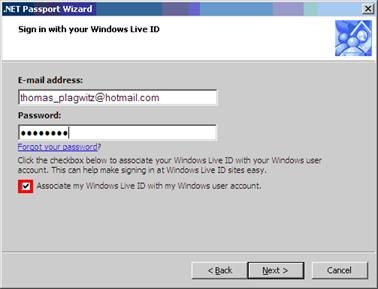
On your office computer, also check the checkbox to “Associate your account with your windows user account”, like here:
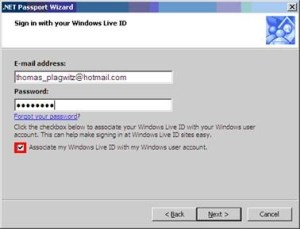 , when asking for help on a student computer, uncheck this
 -
Add “Thomas_plagwitz” at “hotmail.com” as a contact (initially, I will have to accept this before you can contact me):
-
Click on “I Want To … Add A Contact” (green plus sign)
-
Once set up with Messenger like described here, go to PART II.
Instant language services support on office and classroom IT lab computers. Part II: Usage
-
Once set up, if you have Windows XP on your office computer, we can use MS-Messenger “Application Sharing” to provide immediate live assistance with computer problems in remote parts (also useful for collaboration with colleagues on documents, including web pages, when a phone call is too little and a meeting is too much).
Click “Start”, “Run”, type (or copy/paste): “C:\Program Files\Messenger\msmsgs.exe“, click “OK”.
-
Start a conversation by double clicking on the user icon (“Thomas Plagwitz” or whoever) in your contact list.
-
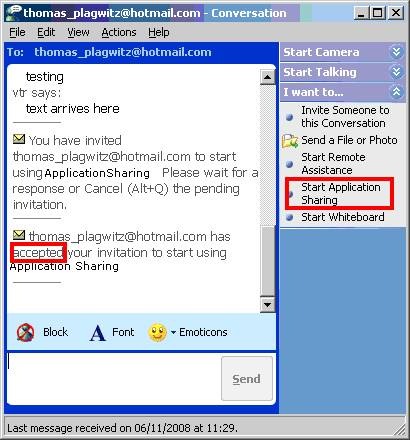
Right Menu: Section: “I want to” / “Start Application Sharing”
-

-
All is well if the other party has “accepted your invitation”, like above – allow some time for the screen sharing to start up on old computers.
-
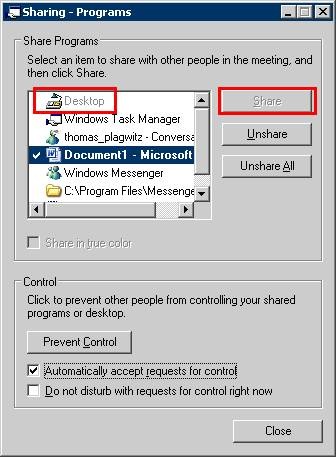
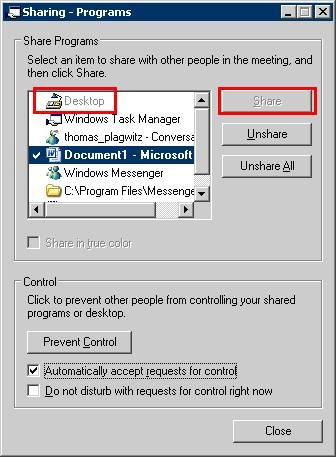
When a dialogue comes up which asks you which application to share, use “Desktop”, like below – this will allow the other party to see your screen.
-

-
At the end of the session, “Unshare” your desktop, or simply end the “conversation”.
How AI and human intelligence can blend in the language lab to form personalized instruction

- An example from long before mobile computing but still: While I personally like communicative uses of the language lab infrastructure best (pairing, group conferences, with recording, screen sharing, collaborative writing),
- the above (click image to download and play WMV video, also on MAC – sorry, file won’t transcode) may be the 2nd best :
- The student is engaged
- primarily with a listening (comprehension) exercise using authentic target language media (German chanson),
- also with some light writing (recognition of vocabulary words)
- and receives automated feedback in response form quiz template.
- The communicative aspect is added
- through seamless, effortless, surgical and last not least private teacher intervention or “remote assistance”
- when the teacher (“automonitoring” all LAB300 students one after the other) notices from afar (even though thumbnail-sized, hence the large fonts of the quiz template)
- how the current automated error feedback may not be enough of an explanation, but may have created “a teachable moment”:
- Student heard phonetically correctly, but not etymologically. German “Fahrstuhl”, not “Varstuhl””: literally a “driving chair” – after this little intervention, likely a quite memorable compound.
- A good example how language lab computers need not get “in between you and your student”, but connect you – just like has become an everyday reality, in the meantime, in the social web world.
- The student is engaged


Questions? Read the About. Or just ask me a quick Our Databases: Resources with calendars -- Language learning material Moodle Sites, multimedia files -- films


FAQs for LRC student staff or for students or for teachers. To search our FAQs, in the browser addressbar, add after "https://plagwitz.wordpress.com/feed/?tag=faqs+/" "+TAG1" (from tag cloud below) OR "https://plagwitz.wordpress.com/feed/tag=faqs
&category_name=" "CAT1" (from category hierarchy below). OR search both categories and tags, and multiple TAGs/CATs (connect with "," for OR-search, with "+" for AND-search), like so: https://plagwitz.wordpress.com/feed/?tag=TAG1+TAG2+...TAGn&category_name=CAT1
+CAT2+...CATn"
Other ways to find help
If you cannot find it here, look there: 5,500 Language-Learning Links and Programs for learning or teaching 150 languages
Shortcuts:Our Lists, Our Maps, LRC Staff Moodle Site,LRC Project Moodle Site, 49erexpress, UNCC Moodle, Student Recordings: s:claslcslrcsanakostudent
Learning usage samples: Sanako oral exam, Kaltura webcam presentation, Dictation with speech recognition, Sanako written exam, Chinese and Japanese interactive stroke-order practice
Test the Sanako Installer, Webbrowser Popup Konfigurator for XP, or Windows7, faster LRC TeacherPC Log-in Let MS facilitate diacritics writing by installing for you US-International keyboard layout
This is my personal blog (Google+). The views expressed on these pages are mine alone and not those of my employer. The information in this weblog is provided “AS IS” with no warranties, and confers no rights.
 Thomas' Work Space