Archive
LRC Outlook/Exchange 2010 Resource Calendaring: How staff view resource “Calendars from your organization” in OWA
- Note: Students that have not been specifically invited to share a calendar, must use (staff may also) this approach to view calendars, to avoid a permission problem .
- Staff can load resource calendars, but as somebody who books the resource (except where you still cannot book/schedule/sign up: Tutors), you normally neither need nor want to (unless you manage the resources).
- To preview the free/busy schedule of the resource, use the scheduling assistant instead.
- To make sure that you have booked the resource, load your OWN calendar instead: Since it is you who “meets” with the resource, your meeting will be reflected on there. If you also loaded the resource’s calendar, you would see your “meeting” twice. A meeting always appears in the calendar of all “participants” – only that, other than for resource calendars, you normally do not view the calendar of the other participants who are “human resources”(or maybe you are, at least in the scheduling assistant, but not with details beyond “busy”).

- You may want to load the resource calendar to learn details about the other “meetings”of the resource (e.g. which conflicting meeting organizer you can contact in an emergency, or to know how many tentative meeting requests are already pending for a tutor). Below is how:
-
Similarly to in Outlook (desktop):
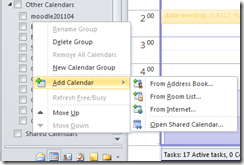 , in OWA, click on the lower left “Calendar-icon”
  to unfold the “My Calendars” list
  in the left pane, then right-click on “My Calendars”, choose “Add Calendar”
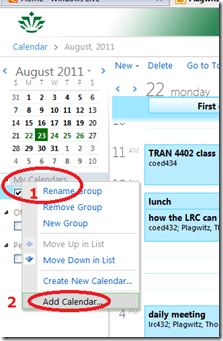 .
. -
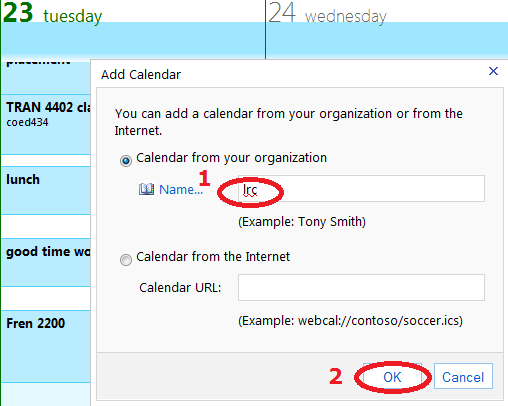
put (part of) the name, click “ok”
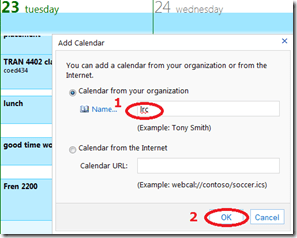
-
if there are multiple matches, select the correct one (you can only select one at a time)

-
press “OK” again:
 .
. -
As explained above, there is little reason to go overboard and add too many calendars, unless you have to manage:

-
However, you can also easily remove calendars, through the context menu item “Remove shared calendar”







Room and Equipment handling using MS-Exchange Resource Mailboxes: What the parameter AddNewRequestsTentatively means
-
It is an instruction to the calendarattendant, that seems to be conjured up by automateprocessing: autoupdate, but also, now together with, but still separate from, the resource booking assistant, by automateprocessing: autoaccept
-
It is an instruction relating only to meeting requests, not to meetings. But it is not the calendarattendant, but rather the resource booking assistant that decides what is to remain a request and what not (= what is to be accepted or denied, and thus to stop being a mere request and be promoted to a meeting). if there are no (mere) requests (since all requests, for whatever other settings, are either auto-accepted or auto-denied, so effectively automatically rendered into non-(not anymore) requests, the AddNewRequestsTentatively will have no effect on the calendar. It is these other settings, that may allow requests to remain requests. Even though the parameter name may sound like it is doing this, it is NOT AddNewRequestsTentatively that will turn off/override these other settings to make all incoming requests remain requests. It is rather automateprocessing: autoupdate (or a combination of automateprocessing: autoaccept and allbookinpolicy: $false and Allrequestinpolicy: $true (and even more so AllRequestOutOfPolicy: $true) that would do that.
-
However, the latter is the combination if have for pseudo-rooms where it is important that the delegate can collate requests in a calendar-format when deciding which to accept/deny, instead of having to cobble together a picture from forwarded meeting request messages.
-
Organizer can make a request (out of policy: maxduration), and it appears on the organizers calendar
![outlook test AddNewRequestsTentatively true automateprocessing not autoupdate maxduration outfofpolicy lrc calendar this looks tentative_thumb[1]](https://thomasplagwitz.com/wp-content/uploads/2011/08/outlook-test-addnewrequeststentatively-true-automateprocessing-not-autoupdate-maxduration-outfo3.png?w=141&h=39 "outlook test AddNewRequestsTentatively true automateprocessing not autoupdate maxduration outfofpolicy lrc calendar this looks tentative_thumb[1]")
-
It appears on the room calendar for the delegate as tentative
![owa test AddNewRequestsTentatively true automateprocessing not autoupdate maxduration outfofpolicy lrc calendar this looks not tentative_thumb[1]](https://thomasplagwitz.com/wp-content/uploads/2011/08/owa-test-addnewrequeststentatively-true-automateprocessing-not-autoupdate-maxduration-outfofpol3.png?w=142&h=55 "owa test AddNewRequestsTentatively true automateprocessing not autoupdate maxduration outfofpolicy lrc calendar this looks not tentative_thumb[1]")
-
It appears in the scheduling assistant as tentative, for others to see
![owa test AddNewRequestsTentatively true scheduling assistant _thumb[1]](https://thomasplagwitz.com/wp-content/uploads/2011/08/owa-test-addnewrequeststentatively-true-scheduling-assistant-_thumb1_thumb.png?w=244&h=94 "owa test AddNewRequestsTentatively true scheduling assistant _thumb[1]")
![outlook test AddNewRequestsTentatively true automateprocessing not autoupdate maxduration outfofpolicy lrc calendar this looks tentative_thumb[1]](https://thomasplagwitz.com/wp-content/uploads/2011/08/outlook-test-addnewrequeststentatively-true-automateprocessing-not-autoupdate-maxduration-outfo2.png "outlook test AddNewRequestsTentatively true automateprocessing not autoupdate maxduration outfofpolicy lrc calendar this looks tentative_thumb[1]")
![owa test AddNewRequestsTentatively true automateprocessing not autoupdate maxduration outfofpolicy lrc calendar this looks not tentative_thumb[1]](https://thomasplagwitz.com/wp-content/uploads/2011/08/owa-test-addnewrequeststentatively-true-automateprocessing-not-autoupdate-maxduration-outfofpol2.png "owa test AddNewRequestsTentatively true automateprocessing not autoupdate maxduration outfofpolicy lrc calendar this looks not tentative_thumb[1]")
![owa test AddNewRequestsTentatively true scheduling assistant _thumb[1]](https://thomasplagwitz.com/wp-content/uploads/2011/08/owa-test-addnewrequeststentatively-true-scheduling-assistant-_thumb1.png "owa test AddNewRequestsTentatively true scheduling assistant _thumb[1]")
Room and Equipment handling using MS-Exchange Resource Mailboxes: What the parameter AllowConflict means
-
NOT TRUE HERE? More info here, search “AllowConflicts”.
-
Is required for a practically very desirable feature in handling of recurring meeting requests: A conflict exception still allows the basic recurrent meeting go through I found a helpful flowchart
 , see bottom left for effect of Allowconflicts.
 -
what will the effect be on non-recurring meeting requests? Will conflict in.stances (there are only instances with non-recurring meeting requests) still be denied? From the flowchart and when allowconflicts comes into play (only after automateprocessing: autoaccept (it does not come into play with automateprocessing:autoupdate) immediately before thresholds ) and that it still does not allow actual conflicts, it appears to me that allowconflicts should have been called “allow-a-recurring-meeting-request-to-be-not-outright-denied-if-it-has-conflict-instances-that-have-to-be-denied-(always-by-the-autoaccept-agent)-as-long-as-not-the-ConflictPercentageAllowed-and-MaximumConflictInstances-numbers-are-also-exceeded”. it was, however, with good reason not called: “allowdoublebooking” J
- That much about the theory. Now the Test results for AllowConflicts $true
-
What works: Allowconflicts does not prompt the autoprocessing: autoaccept (calendar booking assistant) to allow actual conflict instances (double bookings)) from recurring meeting requests.
-
What does not seem to work, but is not important right now: thresholds for conflict amounts are ignored, even if both are crossed
-
MaximumConflictInstances= 5
-
ConflictPercentageAllowed= 25% guides the calendar booking assistant in deciding whether a recurring meeting request gets
-
(10 conflict instances out of 20) still get accepted,
-
-
Room and Equipment handling using MS-Exchange Resource Mailboxes with Autoprocessing: AutoAccept and ForwardtoDelegates
- Autoprocessing: AutoAccept automates managing (blocking, sharing information on the block, unblocking) resources for users (those that can BookInPolicy, or AllBookInPolicy).
- At least as long as the policies that resource mailboxes allow you to define and the user groups that can be and have been set up in your MS-Exchange environment.
- AdditionalResponse can aid in avoiding some of the problems, if the requesters collaborate.
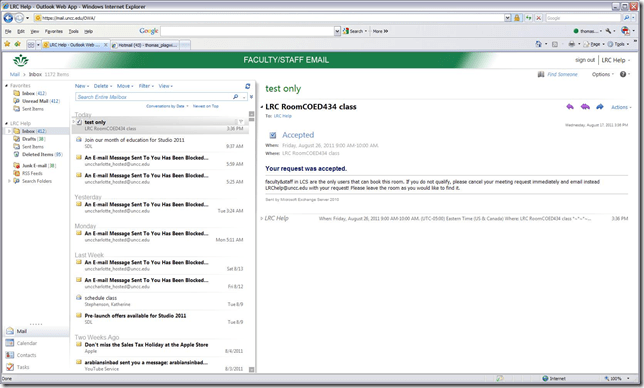
- Here is an example of an automated autoaccept message with an additional response:
- Forwardtodelegates
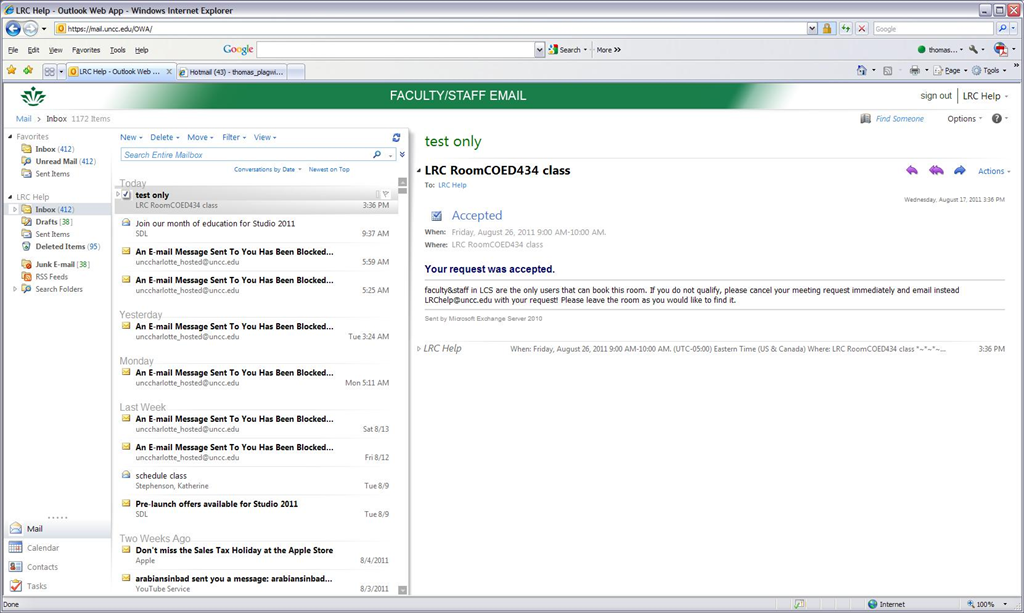
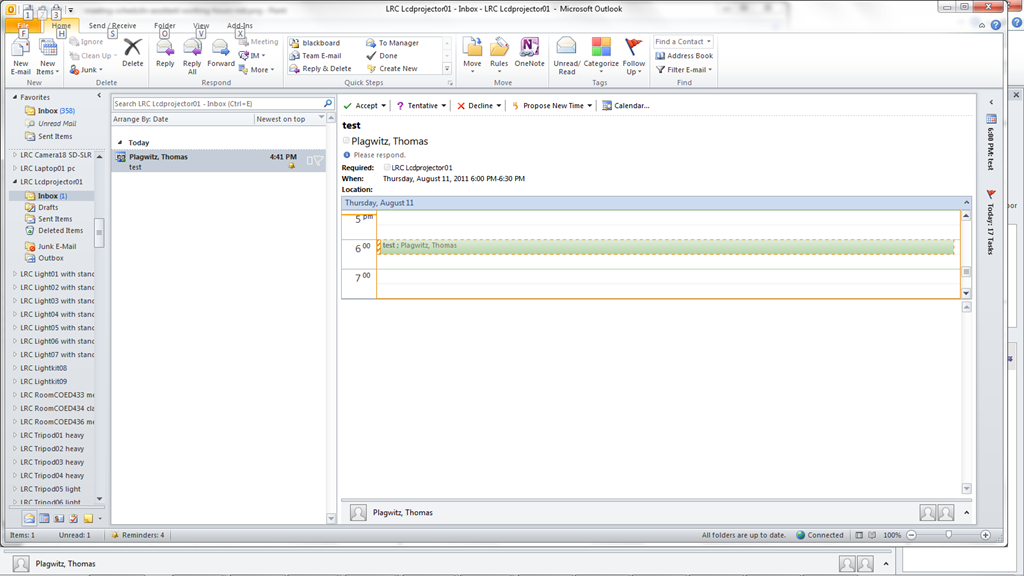
- forwards requests, saving delegates the effort to monitor the resource mailbox and calendar, like so:

- Not only that, it seems to also forward accepted requests, useful for creating a paper-trail, e.g. for future reporting needs (Q:can the entire history of a request, including all changes be monitored this way?).

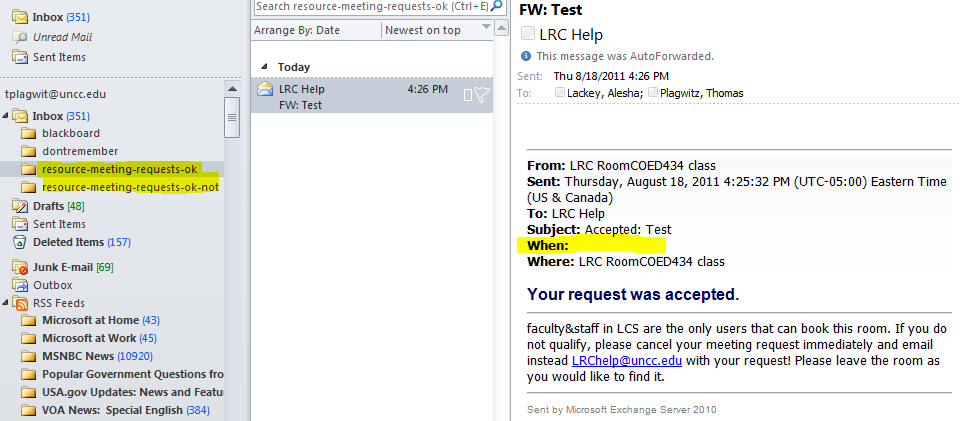
- This forwardtodelegates seems to work reliably, and you can filter notifications with a rule into the “digital paper-trail” folder:

- I notice a few gotchas with forwardtodelegates , however:
- Not all requesters will have their requests forwarded: If your requester is a delegate, or her account even only linked to that of a delegate, it seems no notification message is forwarded to delegates (at least for in-policy requests).
- As you can see in the above screenshots, the forwardtodelegates seems to omit meeting time requested (bug?) which you can track down by opening the calendar of the resource and search for the the meeting title, both of which are included in the notification message.
- forwards requests, saving delegates the effort to monitor the resource mailbox and calendar, like so:

Calendaring: How to use your Moodle course calendars to keep your students up to date
- UPDATE: this now stopped working here. Clicking on the link from IE9, using “open with”: MS-Outlook 2010 fails with “the requested information store could not be found in the active profile”. I have not found a way to feed the Moodle ical link manually into MS-Outlook 2010 (Shared Calendars / Add Calendar / From Internet) or OWA different problem). Stay tuned…
- Easy if you use standard Moodle assignments: “Adding closing dates to course activities — assignments, quizzes etc. will cause them to show up in the calendar block as course events. “
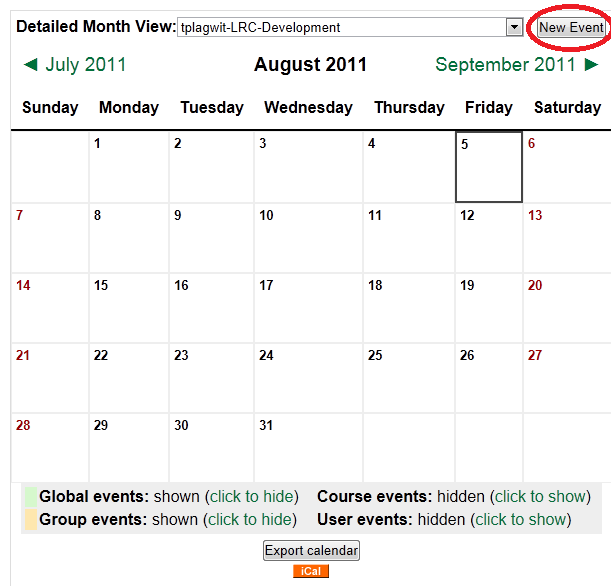
- Other assignments you have to add manually, like so:
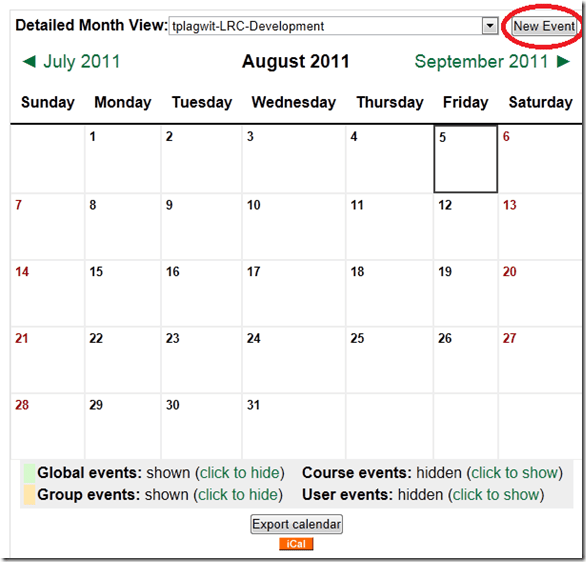

- Resulting in this:
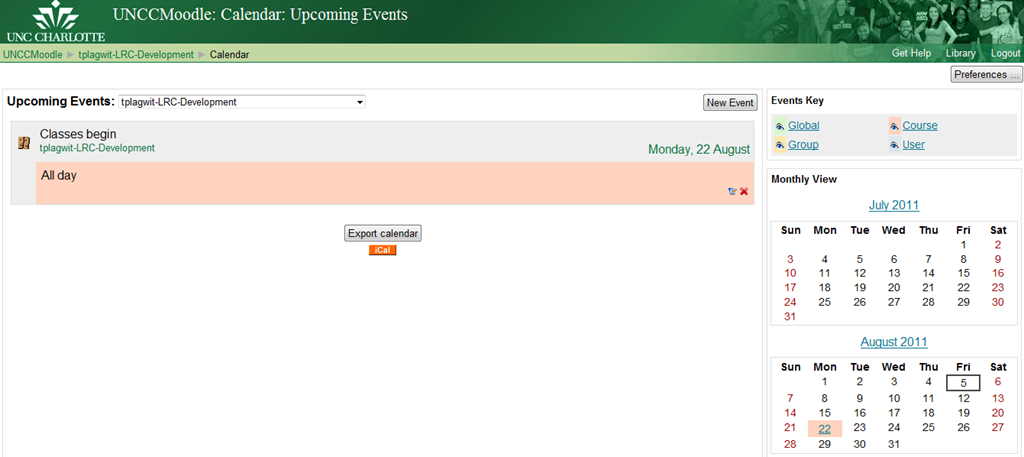
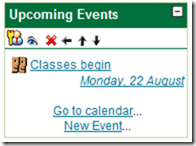 or this:
- Editing your calendar in other applications and importing, even synching it with Moodle is not currently (2.1) supported.
- More on Calendar you can find in the official 1.9 Moodle calendar doc and FAQ.


LCR Calendars and Scheduling
Obsolete since FALL 2011, instead see here.
LRC scheduling Crunch-time:
Faculty need to schedule exams in the LRC, communicate this to students in a timely manner and avoid conflicts with other LRC events.
While the LRC staff lost editing access to the LRC Website, including its calendar (they underlying software is being upgraded from Joomla to Drupal).
That’s why we roll out our new LRC scheduling service early.
It takes advantage of Outlook Desktop edition (2007 for the PC, 2011 for the MAC) and Outlook Web Access for MS-Exchange 2010 (for faculty/staff), and of the calendar web app of live@edu (for students).
live@edu and Outlook 2011 (MAC) are being introduced by the university over the summer.
Outlook 2007 (PC) faculty and any student who uses a web calendar are already ready to roll.
Faculty/Staff, including LRC permanent staff, can view, add and change LRC bookings directly, and coordinate them with their personal and Moodle class calendars: Read more in “Calendaring: How teachers can reserve and schedule classes in the LRC” (includes path in your Outlook to get to the LRC calendars).
Students, including LRC student staff, can view the LRC bookings from their web calendar. Read more in “Calendaring: How students can view the LRC schedules” (includes web links to LRC calendars)
Here is what you get:

Calendaring: How teachers can reserve the LRC for classes and schedule tutors in the LRC
- This is obsolete from Fall 2011, please view instead https://plagwitz.wordpress.com/2011/08/31/the-new-way-of-booking-lrc-rooms-and-equipment-from-fall-2011/.
- You may already collect calendars in one place to stay on top of your course calendars in Moodle and of your non-teaching-related university or departmental activities.
- Now you can do the same with the schedules of LRC rooms and “human resources” (tutors, LRC assistants, the director free/busy schedule is also available – equipment checkout remains to be solved!): We have added new calendars to the LRC public information and moved them into our newly upgraded MS-Exchange infrastructure.
- Short answer: In Outlook (desktop, OWA may vary), go to Folder view / Public Folders / Languages / Coed 037 and Coed 434, with sub-calendars. Make any calendar you need a favorite (or in the dialogue (show below) “Add favorites” for Coed434, check “Add all subfolders”) . In Calendar view, show the calendar by adding a check to the checkbox in front of it. Add and edit your (recurring) appointments as on your personal calendar.
- For class reservation, put class number and activity in the Subject field. Put in the notes field sensitive information which you do not want to put on the WWW, as well as, if you need our support, details of technology activities planned and student numbers that need computers and headsets.
- For tutor scheduling, we have one schedule per language being tutored. Protect the tutor privacy by using the notes field for personal information. Use the Outlook recurrence options as a time-saver (just delete individual exceptions instead of the entire series).
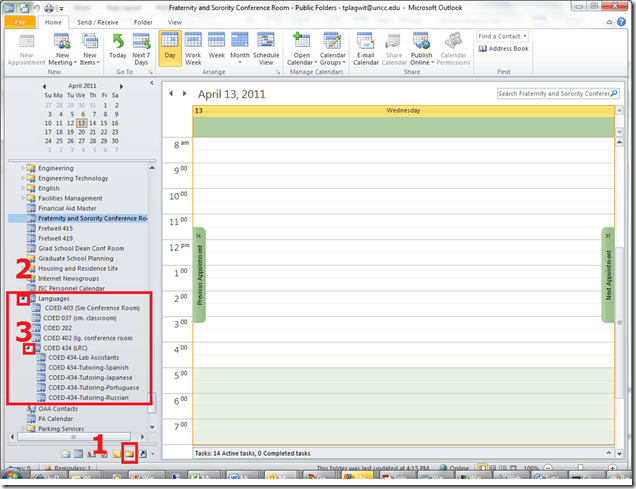
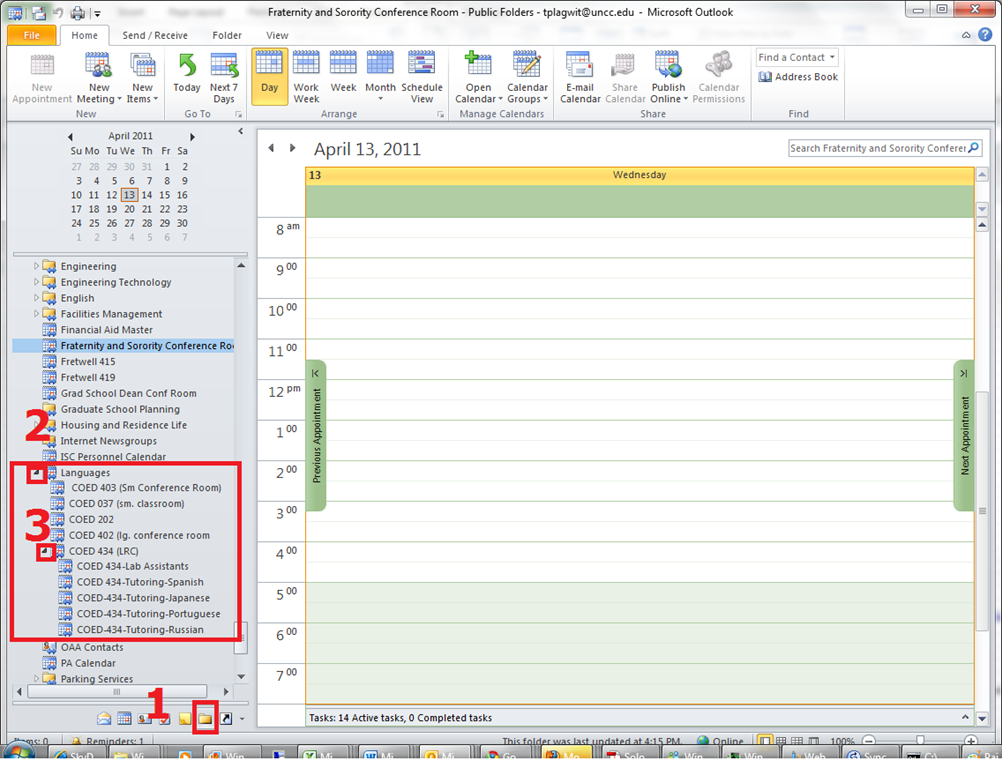
- More detail: You can access the calendar from 1. Folder view, 1a (not shown) Public Folders, 2. Languages and 3: Coed434, like you see here:
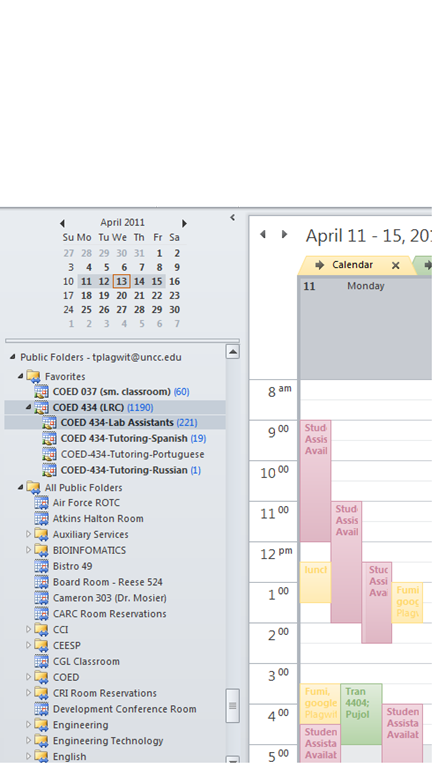
- I recommend adding them to your calendar favorites for easier management, like so:


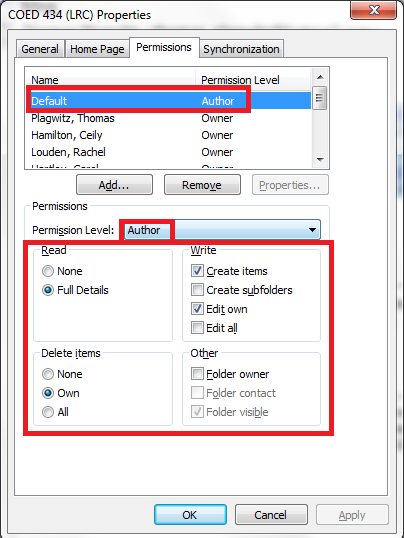
- Per default, you can see and edit (problems? request access) the LRC calendars in the Outlook "Public Folders" under "LRC", as the permissions dialogue below shows:




Questions? Read the About. Or just ask me a quick Our Databases: Resources with calendars -- Language learning material Moodle Sites, multimedia files -- films


FAQs for LRC student staff or for students or for teachers. To search our FAQs, in the browser addressbar, add after "https://plagwitz.wordpress.com/feed/?tag=faqs+/" "+TAG1" (from tag cloud below) OR "https://plagwitz.wordpress.com/feed/tag=faqs
&category_name=" "CAT1" (from category hierarchy below). OR search both categories and tags, and multiple TAGs/CATs (connect with "," for OR-search, with "+" for AND-search), like so: https://plagwitz.wordpress.com/feed/?tag=TAG1+TAG2+...TAGn&category_name=CAT1
+CAT2+...CATn"
Other ways to find help
If you cannot find it here, look there: 5,500 Language-Learning Links and Programs for learning or teaching 150 languages
Shortcuts:Our Lists, Our Maps, LRC Staff Moodle Site,LRC Project Moodle Site, 49erexpress, UNCC Moodle, Student Recordings: s:claslcslrcsanakostudent
Learning usage samples: Sanako oral exam, Kaltura webcam presentation, Dictation with speech recognition, Sanako written exam, Chinese and Japanese interactive stroke-order practice
Test the Sanako Installer, Webbrowser Popup Konfigurator for XP, or Windows7, faster LRC TeacherPC Log-in Let MS facilitate diacritics writing by installing for you US-International keyboard layout
This is my personal blog (Google+). The views expressed on these pages are mine alone and not those of my employer. The information in this weblog is provided “AS IS” with no warranties, and confers no rights.
 Thomas' Work Space