How to set the home page in your web browser
E.g. if you want to update your email start page from http://unccmail.uncc.edu to http://mail.uncc.edu.
in Safari, go to menu: Safari / Preferences / home page: type your updated page address in here and click OK. Visual walkthrough is e.g. here: http://www.youtube.com/watch?v=VIGocolMtzU.
Similarly in the preferences of all other common web browsers.
Sanako Study 1200 Workshop Fall 2011
Those who wanted to, but did not make it to the vendor training by Sanako’s David Golden (who gave us a basic orientation displaying functions of teacher screen and student screen and demonstrated basic activity functions and what happens at the student screen), might want to have a look at the unedited screencast footage (for Windows Media Player on Windows, if necessary, resort to LRC) I recorded during the entire 2 1/4-hour session:
- the first one recording the screen of a sample student station
- with an explanation of the student player at the beginning,
- the second one recording the screen of the teacher computer
- have a look at the end around 2:10:00 where we connect a group of students via screensharing and audio (headsets), so that a group, dispersed across the classroom, can orally collaborate on an MS-Word document that one student types into but all students see.
- The Sanako features used for this are from the dropdown: activity: discussion, and from the button: pc control:model student. Both can be combined with each other, and with a third feature, the capability to subdivide the class in multiple groups.
- This application I found useful when, before reviewing materials with one half of the class, I sent my more advanced learners off to a more independent and applied group writing task. I allows any member of the class to join the advanced group, no matter where they are located. It also forces the group members to communicate all the target language aurally to the model student. Finally, it affords them access (though not individually) to the language learning tools of a computer while working on their tasks
Sanako Study 1200 Teacher Guide

Taken directly from the Sanako documentation and posted here for your convenience (click on image for larger version), this practical cheat sheet is also available on the teacher podium.
Sanako Study 1200 Workshop Spring 2011
Those who wanted to, but did not make it to my introductory training for the newly installed Sanako Study-1200 in LRC COED434 might want to have a look at the unedited screencast footage of the teacher computer that I recorded during this session (for Windows Media Player on Windows, if necessary, resort to LRC PCs).
Room and Equipment handling using MS-Exchange Resource Mailboxes with Autoprocessing: AutoAccept and ForwardtoDelegates
- Autoprocessing: AutoAccept automates managing (blocking, sharing information on the block, unblocking) resources for users (those that can BookInPolicy, or AllBookInPolicy).
- At least as long as the policies that resource mailboxes allow you to define and the user groups that can be and have been set up in your MS-Exchange environment.
- AdditionalResponse can aid in avoiding some of the problems, if the requesters collaborate.
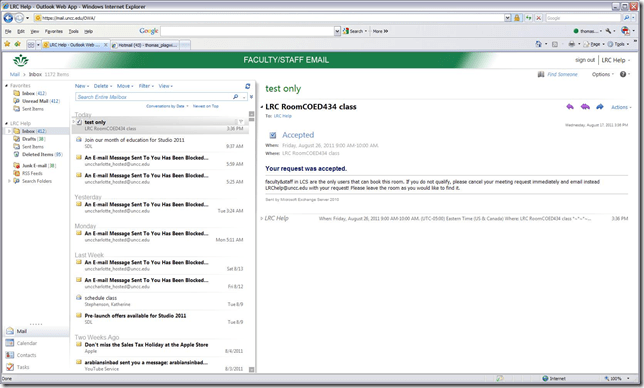
- Here is an example of an automated autoaccept message with an additional response:
- Forwardtodelegates
- forwards requests, saving delegates the effort to monitor the resource mailbox and calendar, like so:

- Not only that, it seems to also forward accepted requests, useful for creating a paper-trail, e.g. for future reporting needs (Q:can the entire history of a request, including all changes be monitored this way?).

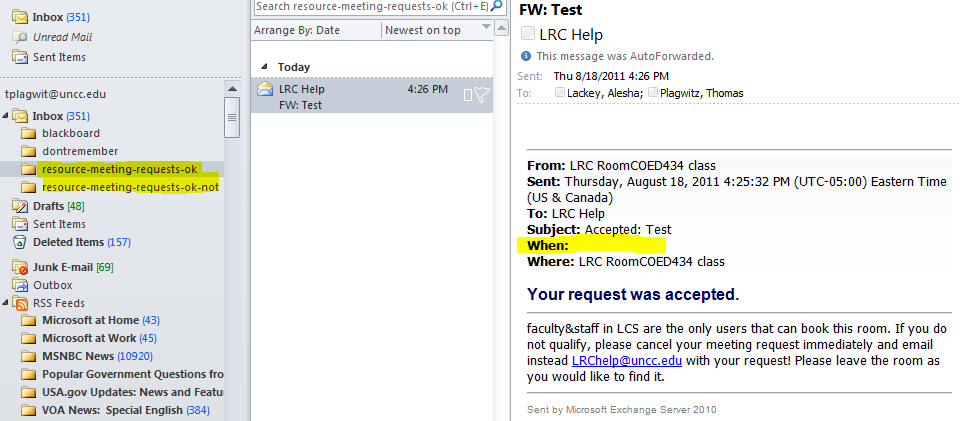
- This forwardtodelegates seems to work reliably, and you can filter notifications with a rule into the “digital paper-trail” folder:

- I notice a few gotchas with forwardtodelegates , however:
- Not all requesters will have their requests forwarded: If your requester is a delegate, or her account even only linked to that of a delegate, it seems no notification message is forwarded to delegates (at least for in-policy requests).
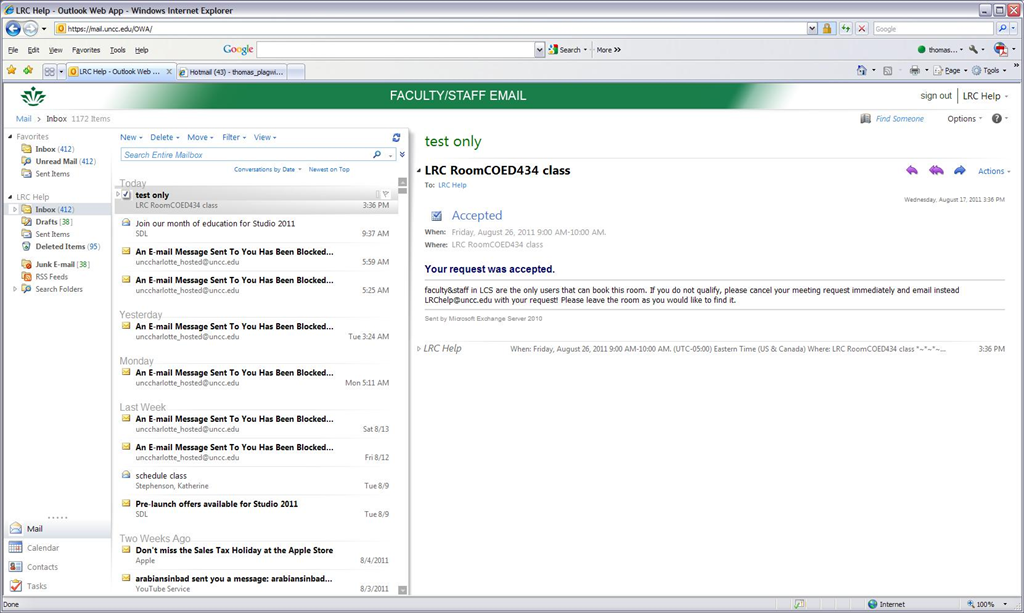
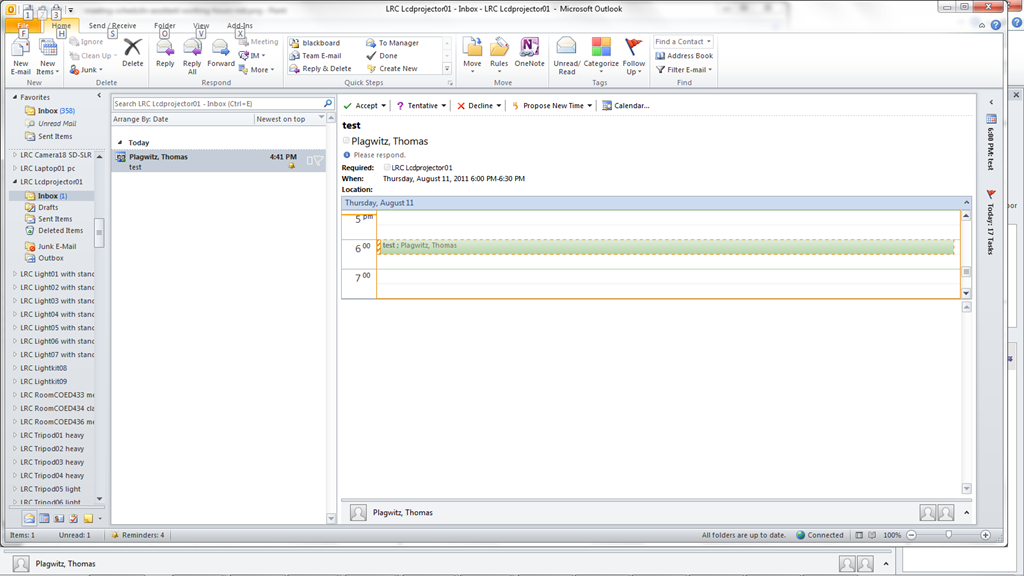
- As you can see in the above screenshots, the forwardtodelegates seems to omit meeting time requested (bug?) which you can track down by opening the calendar of the resource and search for the the meeting title, both of which are included in the notification message.
- forwards requests, saving delegates the effort to monitor the resource mailbox and calendar, like so:



Questions? Read the About. Or just ask me a quick Our Databases: Resources with calendars -- Language learning material Moodle Sites, multimedia files -- films


FAQs for LRC student staff or for students or for teachers. To search our FAQs, in the browser addressbar, add after "https://plagwitz.wordpress.com/feed/?tag=faqs+/" "+TAG1" (from tag cloud below) OR "https://plagwitz.wordpress.com/feed/tag=faqs
&category_name=" "CAT1" (from category hierarchy below). OR search both categories and tags, and multiple TAGs/CATs (connect with "," for OR-search, with "+" for AND-search), like so: https://plagwitz.wordpress.com/feed/?tag=TAG1+TAG2+...TAGn&category_name=CAT1
+CAT2+...CATn"
Other ways to find help
If you cannot find it here, look there: 5,500 Language-Learning Links and Programs for learning or teaching 150 languages
Shortcuts:Our Lists, Our Maps, LRC Staff Moodle Site,LRC Project Moodle Site, 49erexpress, UNCC Moodle, Student Recordings: s:claslcslrcsanakostudent
Learning usage samples: Sanako oral exam, Kaltura webcam presentation, Dictation with speech recognition, Sanako written exam, Chinese and Japanese interactive stroke-order practice
Test the Sanako Installer, Webbrowser Popup Konfigurator for XP, or Windows7, faster LRC TeacherPC Log-in Let MS facilitate diacritics writing by installing for you US-International keyboard layout
This is my personal blog (Google+). The views expressed on these pages are mine alone and not those of my employer. The information in this weblog is provided “AS IS” with no warranties, and confers no rights.

