Archive
Webinar: Respondus 4.0 for Moodle by Vendor
In case you could not make it to this live online presentation shortly before the term start, I taped this respondus-4-moodle-webinar (plays for sure in Windows Media Player on the Lab PCs) for your review. I also made this transcript which can help you jump to the information that interests you most:
|
0: 00 |
question editor |
|
1: 00 |
signing up for a test bank |
|
4: 00 |
importing questions from a test bank (example: human biology) |
|
6: 30 |
editing the quiz based on the test bank |
|
7: 00 |
adding another question, multiple choice |
|
07: 00 |
question types in Moodle and Respondus are similar |
|
08: 00 |
ad advanced formatting, like bold or html or multimedia |
|
09: 00 |
from a local computer or on the web, like youtube.com |
|
10: 00 |
equations |
|
12: 00 |
printing exams |
|
14: 00 |
publishing exams directly into Moodle |
|
14: 00 |
enter your Moodle server information (once; or never, if your administrator has prepopulated these fields for you) |
|
16: 00 |
summary |
|
18: 00 |
lockdown browser: can’t print, capture screen as image or video, can’t browse web or instant messaging programs |
|
20: 00 |
integration with Moodle (Moodle block if hosted, module if self-hosted) |
|
21: 00 |
within Moodle, on the update quiz link, in the section: Respondus lockdown browser |
|
21: 30 |
students perspective: local client software install |
|
23: 30 |
example of taking an exam with the lockdown browser |
|
28: 30 |
what the exam will look like if the students tries to access it with another browser |
|
30: 30 |
admin perspective: info for the lockdown browser license administrator, including for lab administrators with imaging and answer files |
|
34: 30 |
summary |
|
36: 30 |
online documentation |
|
37: 30 |
pricing |
|
38: 30 |
q&a: support for Moodle: 2.0,2.1 yes |
|
39: 30 |
q&a: the admin can in the admin portal prepopulate the server settings for the teachers’ Respondus |
|
40: 30 |
q&a: question types in Moodle are different from blackboard : these get dropped when you change the personality (blackboard/Moodle) within Respondus, but most basic question types simply carry over back and forth |
|
41: 30 |
q&a: default font size: menu: file / menu item: preferences/ tab: edit&publish |
|
42: 30 |
q&a: convert exam view files – go through the publisher of the text bank – or export to word, put the Respondus import markup in, import word into Respondus |
|
44: 30 |
q&a: lockdown browser system requirements: see online http://www.Respondus.com/lockdown/faq.shtml |
|
44: 30 |
q&a: timed exams? Yes, but through Moodle, lockdown browser just passes this through |
|
45: 30 |
q&a: virtual machine: lockdown browser prevents it (no need for vm with windows with new mac version of lockdown browser) |
|
46: 30 |
q&a: dual screen: lockdown browser prevents it , beyond enforcing full screen |
|
47: 30 |
q&a: how to push out the lockdown browser to your students during the first quiz? Best set up a test quiz with just this purpose |
|
48: 30 |
q&a: will the timer from Moodle show in the lockdown browser: yes |
|
49: 30 |
q&a: about hosting |
|
50: 30 |
q&a: multiple questions to a single image |
|
51: 30 |
q&a: publishers |
While I like the impetus of Respondus to facilitate formative assessment, its utility seems limited if you do not have pre-authored publisher test bank for your topic. Or rather the functionality of preformatting text in MS-Word and importing it – not demonstrated in this screencast – seems more convenient (and partially could be automated, especially in SLA quizzes by using NLP) than actually authoring quizzes in Respondus – but is also available in Moodle itself.
Or use a simple quiz-generating MS-Word template if you do not need an LMS, but rather feedback so much faster than on the WWW, as implemented in current LMS, that a difference in quantity difference forms a new quality).
And I can also not say that I see much new in Respondus since 2004, except for the Moodle support, which naturally did not exist then. In the area of Web 2.0, one would wish for more than just publisher-driven test banks (where language are largely absent except for the most popular courses).
Multi-monitor setups
Bill Gates has been quoted not too long ago praising his IT staff for equipping him with a “three screens, synchronized to form a single desktop” office computer.
Multi-monitor user interfaces are increasingly deemed useful, if not necessary, to handle the richer data flows created by computers (The following slideshow contains samples of such systems I have collected over recent years, not a few are from Language centers).


.jpg?psid=1 "View album")

Calendaring: How to use your Moodle course calendars to keep your students up to date
- UPDATE: this now stopped working here. Clicking on the link from IE9, using “open with”: MS-Outlook 2010 fails with “the requested information store could not be found in the active profile”. I have not found a way to feed the Moodle ical link manually into MS-Outlook 2010 (Shared Calendars / Add Calendar / From Internet) or OWA different problem). Stay tuned…
- Easy if you use standard Moodle assignments: “Adding closing dates to course activities — assignments, quizzes etc. will cause them to show up in the calendar block as course events. “
- Other assignments you have to add manually, like so:
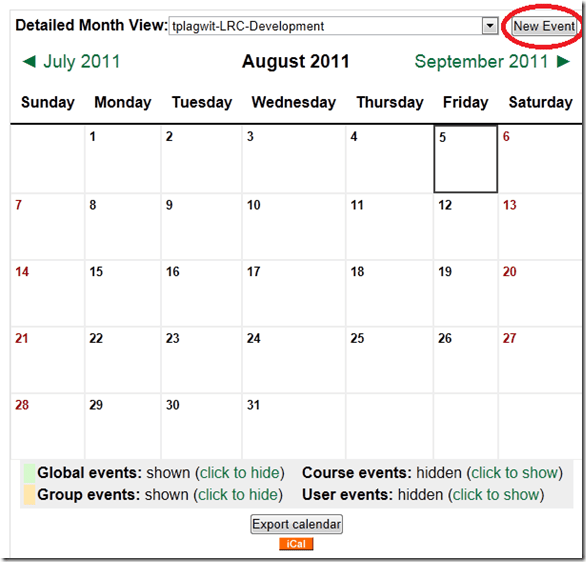

- Resulting in this:
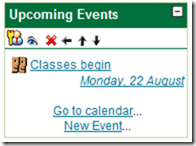 or this:
- Editing your calendar in other applications and importing, even synching it with Moodle is not currently (2.1) supported.
- More on Calendar you can find in the official 1.9 Moodle calendar doc and FAQ.
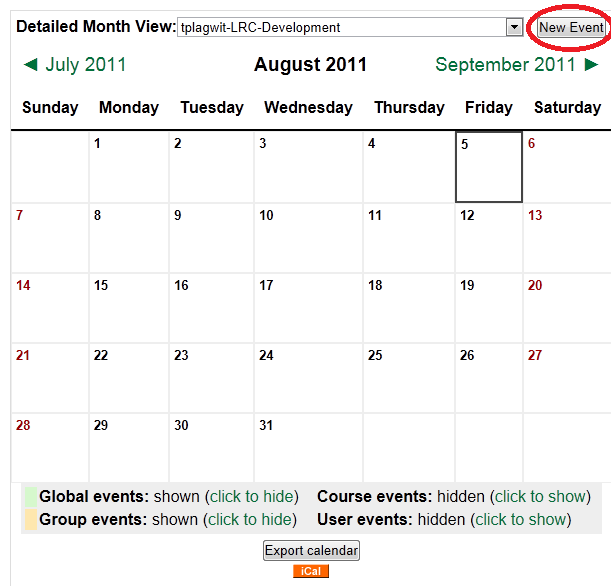


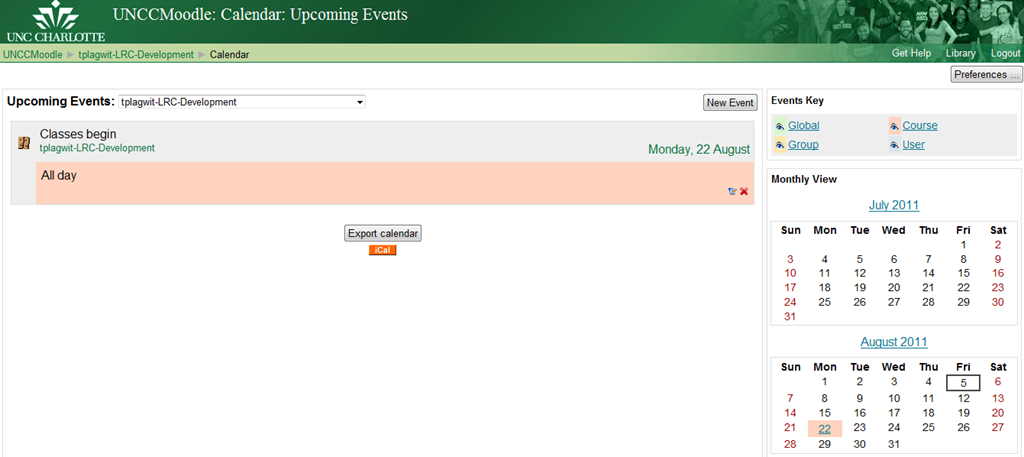
How to disable or rather bypass the Popup Blocker in your Web browser
Try pressing the CTRL-key when clicking a link that tries to open a popup window.
This is a known problem with web-based learning applications like Moodle or library ereserves (like UNCCC’s Docutek ERes-based one) .
You can permanently disable popup blockers for certain sites if you study the documentation that comes with your browser (and possibly with the shared computer) you are working on.
Free screencast recording software from Microsoft
Teachers ask me about software for making screencasts explaining procedures to their students. I have not googled for free screencast recorders recently, since I have been happy for many years to use (or rather work with extensively, and recommend) Windows Media Encoder 9 on MS-Windows. Allegedly as of end of 2010, this software is not linked on Microsoft’s website anymore (but can still be googled and downloaded). Even though not officially supported on this OS any more, I have also used it successfully on Windows 7 (64-bit) (after Vista (64-bit) and Windows XP)).
The official replacement screencast recorder from Microsoft is Windows Expression Encoder (of which I still use the inexpensive Version 3), which is available here (Version 4 SP1) for free. Media Encoder is almost 10 years old, so Expression Encoder is clearly superior – however, the free version is somewhat crippled, most notably in this context I seem to remember the time limit for screencasts is 10 minutes.
Both Encoders are somewhat technical in nature. In particular, I suspect the reason why considerable experts did not know Media Encoder as a screencast recorder (which is not the same as a documentation and training maker: its post-editing capabilities are limited and not specialized for documentation, unlike e.g. Camtasia), was that its default settings for screencast recordings are low quality.
To “uncork” the real possibilities of this software, your first need to alter the compression settings within the WME configuration file that your screencast is based on (you can do this from within Windows Media Encoder itself). Moreover, for this change to stick, you need to alter an underlying PRX template file also. This file is hidden away in the depths of the Encoder install directories; after installing Windows Media Encoder, search your programs folder for a file named schia.prx, it is an XML file that will open with the Windows Media Encoder utilities.
QuickNotes: For ELTI 201/202/501 Student Recordings with Sanako Study1200
- This is 20 students class doing a model imitation for English phonetics and grammar – use right half of classroom plus 2 rightmost columns of left half.
- Have a couple of spare student computers logged in as labadmn (not as presenter: has no permissions to s-drive to save recordings) for emergencies.
- Your students will log in, then take their break. Wait until entire class shows up in the Sanako Classroom layout. Then you can lock their keyboard and mouse – but remember when computers go into locked mode, Sanako cannot control them
- See http://plagwitz.org, upper right corner “Quick links” for the path to copy/paste. Or, on the teacher computer in LRC 434, in folder C:\Temp, you can find a shortcut to the Sanako folders
- “media” with teacher audio (to be prepared with pauses and beeps once it has been recorded and sent; you can easily prepare it yourself: download and view how with Windows Media Player);
- “student” with student recordings
- You can download and view with Windows Media Player the (unedited) screencast of our summative walkthrough here.
How to do Call forwarding on the Cisco IP Phone 7912
Press button “CFwdAll“:
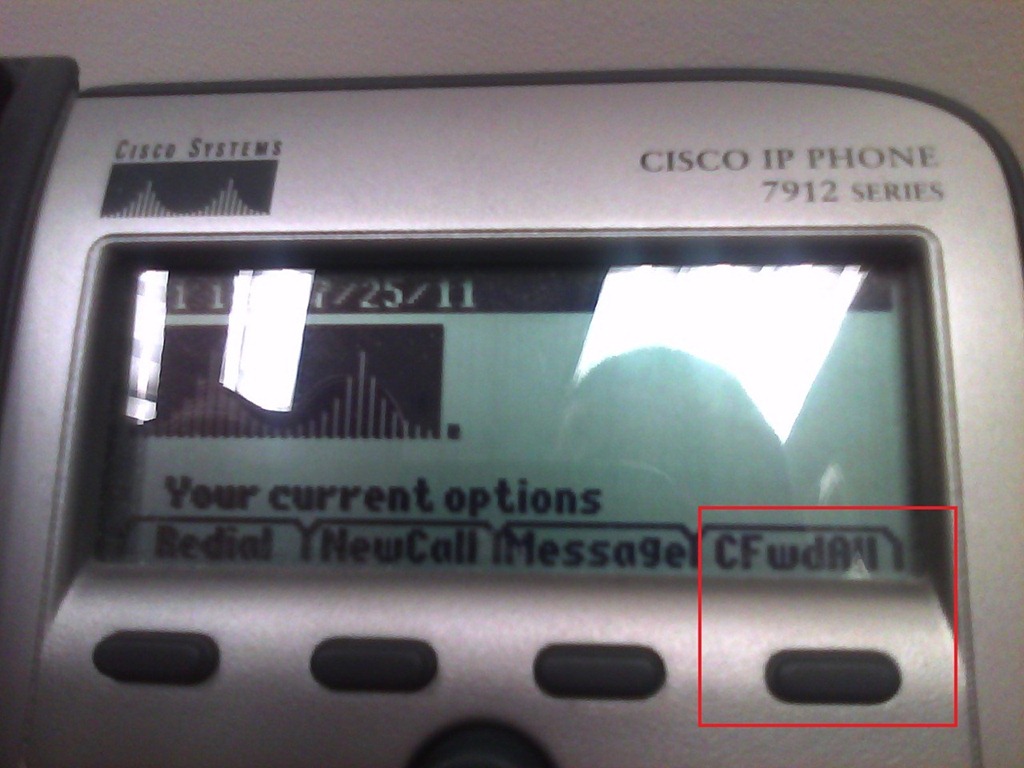
Type the phone number:
 .
.
To un-forward, press button “CFwdAll” again.
Summary: Foreign language character input in LRC and on your own Windows PC
On popular request, I am posting a summary on this topic:
https://plagwitz.wordpress.com/2011/04/14/foreign-language-character-input-on-windows-xp-in-the-lrc/
DO try this on your PC at home: https://plagwitz.wordpress.com/2009/09/04/character-input-methods-for-sla-western/, includes an Interactive Demo of installation procedure (personal computers outside of the LLC) here: keyboard_usinternational.swf.


Questions? Read the About. Or just ask me a quick Our Databases: Resources with calendars -- Language learning material Moodle Sites, multimedia files -- films


FAQs for LRC student staff or for students or for teachers. To search our FAQs, in the browser addressbar, add after "https://plagwitz.wordpress.com/feed/?tag=faqs+/" "+TAG1" (from tag cloud below) OR "https://plagwitz.wordpress.com/feed/tag=faqs
&category_name=" "CAT1" (from category hierarchy below). OR search both categories and tags, and multiple TAGs/CATs (connect with "," for OR-search, with "+" for AND-search), like so: https://plagwitz.wordpress.com/feed/?tag=TAG1+TAG2+...TAGn&category_name=CAT1
+CAT2+...CATn"
Other ways to find help
If you cannot find it here, look there: 5,500 Language-Learning Links and Programs for learning or teaching 150 languages
Shortcuts:Our Lists, Our Maps, LRC Staff Moodle Site,LRC Project Moodle Site, 49erexpress, UNCC Moodle, Student Recordings: s:claslcslrcsanakostudent
Learning usage samples: Sanako oral exam, Kaltura webcam presentation, Dictation with speech recognition, Sanako written exam, Chinese and Japanese interactive stroke-order practice
Test the Sanako Installer, Webbrowser Popup Konfigurator for XP, or Windows7, faster LRC TeacherPC Log-in Let MS facilitate diacritics writing by installing for you US-International keyboard layout
This is my personal blog (Google+). The views expressed on these pages are mine alone and not those of my employer. The information in this weblog is provided “AS IS” with no warranties, and confers no rights.
 Thomas' Work Space