Archive
Learning materials management: Links (1998-2004)
Originally implemented for a series of Canadian universities teaching Wirtschaftsdeutsch, then continually expanded into all of German for Queen’ s University, and multiple languages, including non-western, for university of Michigan-Dearborn and Drake university.
Was based on an open source software project by Gossamer Threads popular for web 2.0 precursors of collaborative links collections, whose Perl-CGI code needed only minor modification to facilitate the “”commenting”” on instructor-“posted” ( i.e. assigned links) by students.
The model was Yahoo’s human-edited web-catalogue. the data structure was the tree (nested folders, unidirectional graph). For managing, I implemented a secondary branch mirroring the primary under the root “old links” for, using Perl regex, automatically moving links which a batch link-checking management script in the open source had identified and logged as “broken” (404 and a few other similarly bad http return codes) into.
The original layout of the “ontology” first introduced me to the complexity of such a task. The basic content division was between 2 branches.
- web-based ready-made teaching materials for commenting (recommending, categorizing) by instructors and self-access by students (no feedback of student data to the instructor mostly, except by email, and outside of the application, in those days).
- the other content branch consisted of not teaching-related “”authentic materials””: the early day web applications, sometimes multimedia (maps, audio and video collections, news), often times also self-service database interfaces (online shopping and public services) whose language-wise rather restricted interface and topical focus (think Wirtschaftsdeutsch) lent themselves to capstone exercises at the end of textbook chapters (our “Friday in the lab””, not even a language lab then. Geek bonus points: one of these Fridays, a future queens university educated engineer asking me whether i had written all these pages they browsed through in the searchable catalogue of eventually 1500 links. Well, dynamic web pages were not common at all in education in those days, and the credit goes to Gossamer Threads.).
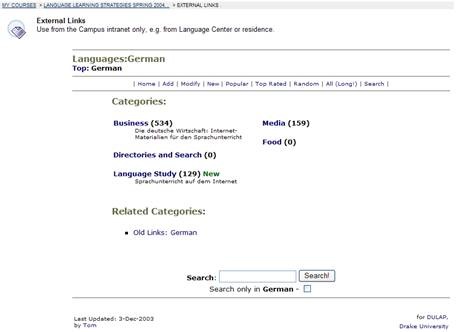


While there was hope to collect a comprehensive teaching resource through collaboration, “der Weg war das Ziel”, having students interact with and review foreign language web content. The links database remained definitely, as it grow in bursts revolving around the topics of our chapters. I had a lot of fun finding instructional ways to having students review all those fancy web applications in which endless amounts of money were poured before the first bubble in this millennium burst. E.g. the first early online city maps for “Wegbeschreibung” in German 102. as well web 2.0 like developments, like grassroots web cams (Germans allowing the world to spy on their surroundings 24/7, including remote camera panning – you could go all kinds of places, “”Wie heißt der bürgermeister von Wesel? was macht das wetter in der Schweizzzzzz?” but alas, the time lag, especially during winter term.
A couple of screen casts for instructor training are here and here.
Auralog Tell-me-more Demo Screencasts
An overview, mostly narrated:
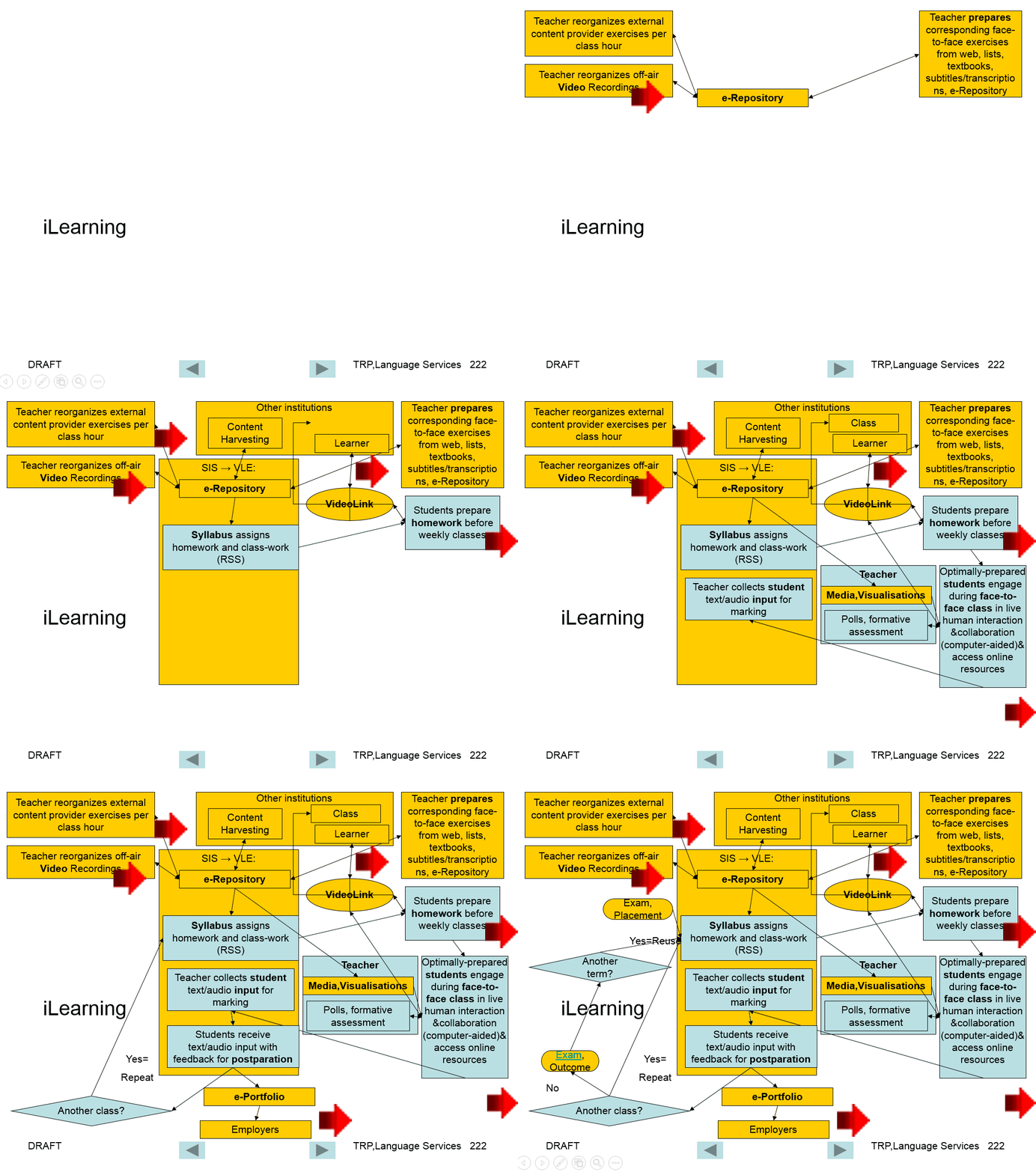
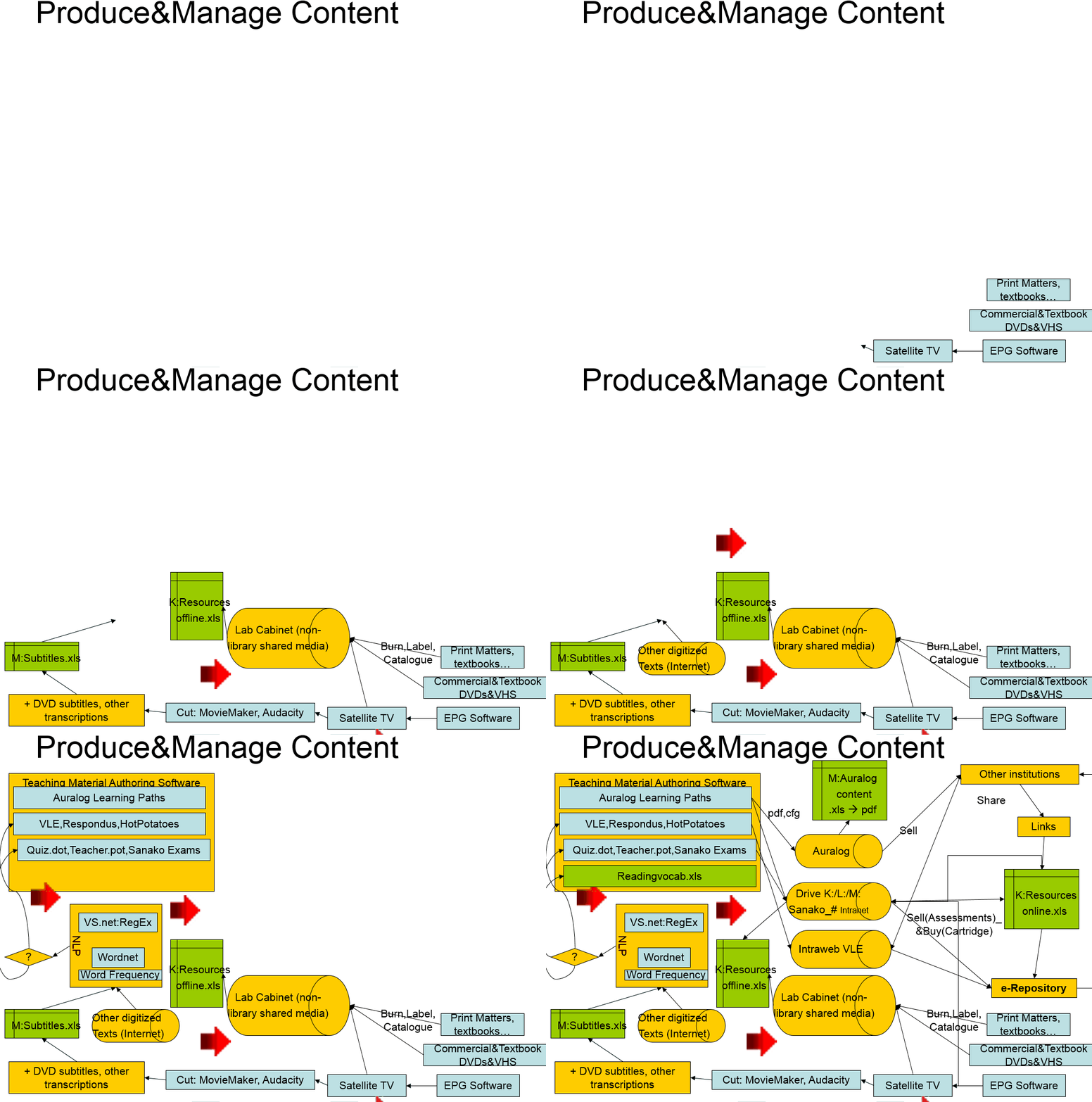
Example 8: Auralog Tell-Me-More Speech Recognition Test
How usable is the Auralog Speech Recognition for language learning? This test, by a non-native speaker of English, gives some authentic data points.

The test shows: Auralog Speech Recognition
- can be easily tripped up; however, by errors that a non-native language learner would not normally make
- more concerning is that the built-in AI, instead of e.g. escalating to additional feedback or help, like the pronunciation waveforms (which in itself seem to encourage only repeated attempts to mimic a given intonation, while not being fine-grained enough to spot mispronunciations on a word, let alone letter level) – lowers the requirements when a speaker repeatedly fails (which in extreme seems to amount to “waving through” any utterance).
- the preset dialogue – only few exercises including wrong answer options, most exercises testing only a comprehensible pronunciation of a given reading text which makes the exercise much easier for the built-in speech recognition, but also much less realistic and useful for a language learner (or more of a reading exercise).
Language Lab Techniques for (Self-)Evaluation and Grading of Student Recordings with Audacity
This quick and dirty (not narrated and uncut: time is money, and storage cheap…) video  demonstrates a technique in (the free audio editor) Audacity with which instructors and students can more easily (self-)evaluate parallel recordings from (be it model imitation, question-response, or consecutive interpreting exercises in) the language lab (in this case the output of a Sanako Study1200, which automatically gets stored in a folder on network share):
|
When? |
What? |
|
0,00 |
how to load 10 student files à 5mb = 2:30min (but as a batch, allowing you do something else in the foreground instead of waiting) |
|
2,50 |
how to select a part of the timeline to play |
|
3,00 |
how to move tracks up to more easily work with them and the menu |
|
3,30 |
how to play all tracks simultaneously (choir, normally not very useful for evaluation) |
|
3,40 |
how to play only one track (solo): evaluate & compare |
Automating Auralog Tell-Me-More with AutoIt. Presentation at EUROCALL 2008
Auralog Tell-Me-More is a leading language learning software system which provides a vast amount of content in an advanced technical infrastructure that we found lacking in usability within an higher education language learning environment.
AutoIt is a programming language for GUI automation which I used to better integrate the Auralog software into the higher education language learning process, including
- programmatic
 creation of courses and accounts
 - programmatic extraction and digital repository management for over 30.000 learning units.

- programmatic creation of 10,000s of learning paths,

Results  were presented (screencast) at EUROCALL 2008: “Automating Auralog (pdf)”:
creates 100s of courses  , creates
  and enrols
  up to 2,000 student accounts every term,
- content extraction
 produces files
 for adding search
  and spreadsheet for sort/filter functionality:
- learning path creation.
More detailed background information here: plagwitz_auralog_accounts_project_pub.pdf, plagwitz_auralog_project_pub.pdf


Questions? Read the About. Or just ask me a quick Our Databases: Resources with calendars -- Language learning material Moodle Sites, multimedia files -- films


FAQs for LRC student staff or for students or for teachers. To search our FAQs, in the browser addressbar, add after "https://plagwitz.wordpress.com/feed/?tag=faqs+/" "+TAG1" (from tag cloud below) OR "https://plagwitz.wordpress.com/feed/tag=faqs
&category_name=" "CAT1" (from category hierarchy below). OR search both categories and tags, and multiple TAGs/CATs (connect with "," for OR-search, with "+" for AND-search), like so: https://plagwitz.wordpress.com/feed/?tag=TAG1+TAG2+...TAGn&category_name=CAT1
+CAT2+...CATn"
Other ways to find help
If you cannot find it here, look there: 5,500 Language-Learning Links and Programs for learning or teaching 150 languages
Shortcuts:Our Lists, Our Maps, LRC Staff Moodle Site,LRC Project Moodle Site, 49erexpress, UNCC Moodle, Student Recordings: s:claslcslrcsanakostudent
Learning usage samples: Sanako oral exam, Kaltura webcam presentation, Dictation with speech recognition, Sanako written exam, Chinese and Japanese interactive stroke-order practice
Test the Sanako Installer, Webbrowser Popup Konfigurator for XP, or Windows7, faster LRC TeacherPC Log-in Let MS facilitate diacritics writing by installing for you US-International keyboard layout
This is my personal blog (Google+). The views expressed on these pages are mine alone and not those of my employer. The information in this weblog is provided “AS IS” with no warranties, and confers no rights.

