Archive
Beep – beep – boop?! Cannot get classic mode to stick for editing my existing WordPress.com pages
Looks like I can get classic mode to stick by clicking on “classic mode” in the upper right of edit mode, for creating new posts.
Looks like I cannot for editing existing posts – what gives?
Best advice seems currently to edit through the “dashboard” – unacceptable to me, I often need to revise/refine posts when I browse them.
UPDATE: Well, the test-“Edit” to refine after publishing this post gave me the classic mode of editing – does it remember something? Currently, the behavior seems more like hit or miss…
UPDATE2: The edit for an old post still gets me “Beep – beep – boop” edit mode. Is it possible that the choice of “classic mode” affects only new posts after choosing?!
Update3: OK, looks like my choice of the old-style editor is being remembered now. Not sure that I did something to achieve that.
Windows XP user profiles copy to greyed out ?
- Problem:
- For all profiles, not only for the logged in profile… Not likely a permissions problem? I can delete

- Solution:
- “if you’ve ever been logged into a profile without rebooting you won’t be able to copy that profile either. So you might have to restart before you can copy the profile.”
- or use shutdown /r when connecting via MSTSC.

Request to download the digital audio lab classroom audio configuration on the fly, program and source for Windows XP
UPDATE: A Windows7 (and Vista) version is in the works, check back for a new post here.


Back to description of reset of classroom audio configuration on the fly program
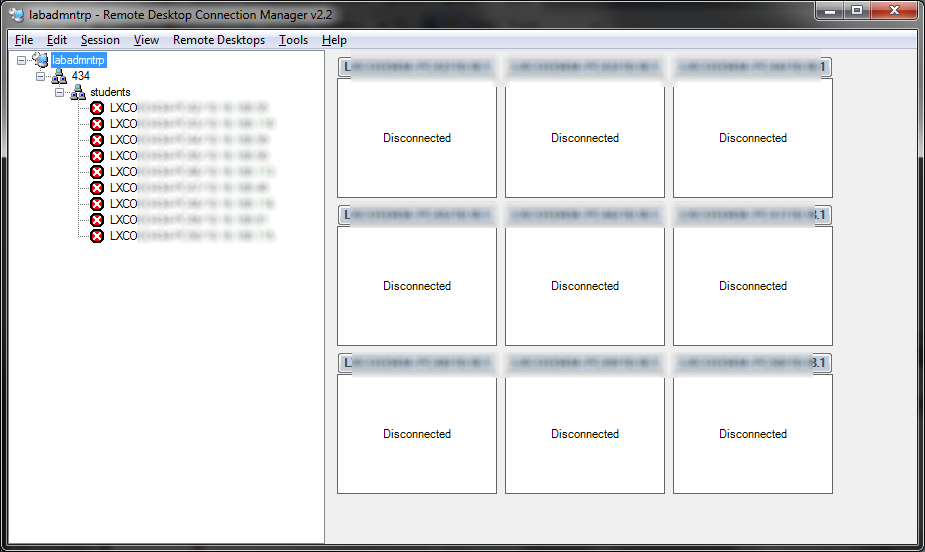
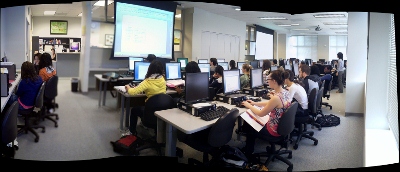
How to use Remote Desktop Connection Manager for computer lab access instead of having to manage faculty computers
- We have conflicting needs for a language technology software environment: diversity, simplicity, quality, manageability. We use of software configuration management tools like TEM. However, we are sitting between an extremely diverse user base (supporting 17 languages) in our unit and a central IT support with a diverse base of units to support.
- Enter MSTSC, facilitated by Remote Desktop Connection Manager:
 . If your LRC allows for MSTSC access, consider providing faculty access to a LRC computers via Remote Desktop.
 - this is for us a great time saver, compared with maintaining subsets of software on subsets of faculty computers that are as similar to the configuration of the subset software on LRC computers as possible,
- while for faculty at the same time a realistic test bed what it will be like to operate LRC computers during class.
- We provide access to a subset (which is easily set and edited in the RDG file loaded into Remote Desktop Connection Manager, which is stored on a shared network drive so that we can update the connection files without disruption of faculty access should there be network changes) since we teach faculty not to log out currently logged in users when they try to connect, but rather choose another computer from the subset that is free to not. We exclude computers used in classes where we frequently have high-stakes exams. We also have high-stakes assignments (using Respondus Lockdown browser)
- we put a shortcut to the Remote Desktop Connection Manager on the start menu or desktop.
- Our computer numbering scheme is simple enough for faculty to navigate – besides, since we connect only to the uniform LRC PC environment, it does not matter.


Solved: Cannot remote desktop into 2nd Microsoft account on Windows 8
- MSTSC’ing from the remote computer simply fails with a non-descriptive error message.
- However, if you get as far as the remote computer login screen, you get a valuable hint: Your 2nd Microsoft account has not been added to the Remote Desktop Users Group (presumably this happens by default when you create your first Microsoft account).

- To fix this, log in as admin on your Windows 8 machine (either locally or remotely with an account which is in the Remote Desktop Users Group), windows key+f, “users”, click on “settings”, and use the direct shortcut to “remote desktop users group” to add the user in question (with the Microsoft account email) to the permitted users group.
- Adding what I believed was the local account equivalent of the 2nd Microsoft account via desktop / windows-ley x/ “computer management” / “users and groups” to the “remote desktop users group” did not work.


How to remote desktop from a vertical dual-monitor config on MS-Vista (and up) to MS-Vista (and up)
Just let mstsc figure it out: mstsc /span /v:<servername>
Trying to feed the resolution /v and /h commandline parameters did fail.
The new span dual monitor support in the MS-Vista MSTSC does not only support horizontal monitor configurations (mine are 2*w:1050*H:1680), seems a tad slow, though).
How to get dkRandomdata to run on 64-bit Excel
- Dick Kusleika made this very useful random data generator for Excel (more random data sources I plan to list here).
- To get this to run on 64-bit Excel 2013, I need to make a few quick changes in the source (which will break on 32-bit Excel):
- First, the usual “must be updated for use on 64-bit systems”:
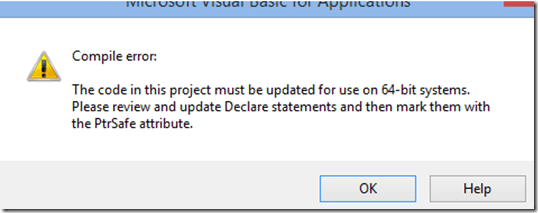 , fixed by this (but note the 1st line):
Private mlParentPtr As LongPtr 'trp:Long
#If VBA7 Then
Private Declare PtrSafe Sub CopyMemory Lib "kernel32" Alias "RtlMoveMemory" _
	(dest As Any, Source As Any, ByVal bytes As Long)
#Else
Private Declare Sub CopyMemory Lib "kernel32" Alias "RtlMoveMemory" _
(dest As Any, Source As Any, ByVal bytes As Long)
#End If
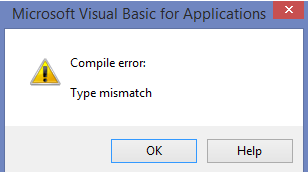
- Then, to fix the various “Type mismatch” errors
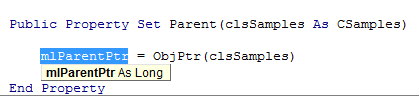
 , e.g. at
  , change Lomg into PtrLong: in these locations:
-
above: Private mlParentPtr As LongPtr 'trp:Long
-
Private Function ObjFromPtr(ByVal pObj As LongPtr) As Object
'trp Private Function ObjFromPtr(ByVal pObj As Long) As Object
-
- First, the usual “must be updated for use on 64-bit systems”:
- Then I am finally getting to the xmlDoc As MSXML2.DOMDocument error on Windows 8.1, but that has been solved in the comments here earlier this year (also for Windows 8.1, but apparently with Excel 32-bit): I changed MSXML2.DOMDocument to MSXML2.DOMDocument60 where I could:
-
Dim xmlDoc As MSXML2.DOMDocument60 'trp: Dim xmlDoc As MSXML2.DOMDocument
-
WriteToFile:
-
Dim xmlDoc As MSXML2.DOMDocument60 'here it is already fixed? Dim xmlDoc As MSXML2.DOMDocument6
-
Dim xmlStyle As MSXML2.DOMDocument60
-
Dim xmlOutput As MSXML2.DOMDocument60
-
-
LoadFromFile(): Dim xmlDoc As MSXML2.DOMDocument60
'trp: Dim xmlDoc As MSXML2.DOMDocument
-
testxml() (looks like the XML issue has been worked on since the comments):
-
Dim xmlDoc As MSXML2.DOMDocument60 'trp: Dim xmlDoc As MSXML2.DOMDocument
-
Set xmlDoc = New MSXML2.DOMDocument60 'trp: New MSXML2.DOMDocument
-
-
test_writetofile():
-
Set xmlDoc = New MSXML2.DOMDocument60 'here it is already fixed, and here
-
Set xmlStyle = New MSXML2.DOMDocument60
-
Set xmlOutput = New MSXML2.DOMDocument60
-
-
- Finally, if you have trouble getting the add-in buttons to show in Excel 2013 ribbon, close all workbooks, and you may (but I did not) have to restart Excel (KB2761240):

- Viola. And I sure like me some Seinfeld references in my sample data….




Questions? Read the About. Or just ask me a quick Our Databases: Resources with calendars -- Language learning material Moodle Sites, multimedia files -- films
FAQs for LRC student staff or for students or for teachers. To search our FAQs, in the browser addressbar, add after "https://plagwitz.wordpress.com/feed/?tag=faqs+/" "+TAG1" (from tag cloud below) OR "https://plagwitz.wordpress.com/feed/tag=faqs
&category_name=" "CAT1" (from category hierarchy below). OR search both categories and tags, and multiple TAGs/CATs (connect with "," for OR-search, with "+" for AND-search), like so: https://plagwitz.wordpress.com/feed/?tag=TAG1+TAG2+...TAGn&category_name=CAT1
+CAT2+...CATn"
Other ways to find help
If you cannot find it here, look there: 5,500 Language-Learning Links and Programs for learning or teaching 150 languages
Shortcuts:Our Lists, Our Maps, LRC Staff Moodle Site,LRC Project Moodle Site, 49erexpress, UNCC Moodle, Student Recordings: s:claslcslrcsanakostudent
Learning usage samples: Sanako oral exam, Kaltura webcam presentation, Dictation with speech recognition, Sanako written exam, Chinese and Japanese interactive stroke-order practice
Test the Sanako Installer, Webbrowser Popup Konfigurator for XP, or Windows7, faster LRC TeacherPC Log-in Let MS facilitate diacritics writing by installing for you US-International keyboard layout
This is my personal blog (Google+). The views expressed on these pages are mine alone and not those of my employer. The information in this weblog is provided “AS IS” with no warranties, and confers no rights.
 Thomas' Work Space