Archive
Archive for the ‘audience-is-language-learning-center-manager’ Category
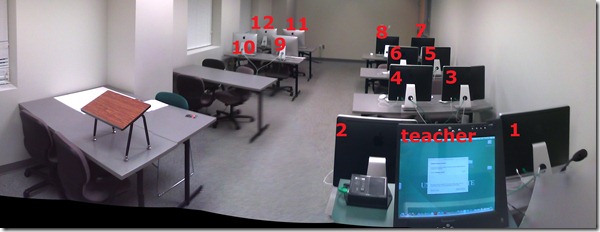
LRC Coed037 Film studies lab
2012/02/15
Leave a comment
- Panorama with computer numbering in lieu of a layout

Categories: audience-is-IT-staff, audience-is-language-learning-center-manager, audience-is-language-learning-center-staff, audience-is-students, audience-is-teachers, documentation, e-infrastructure, Film-studies, Institution-is-University-of-North-Carolina-Charlotte, Photos, presenter-computer, student-computers
maps
ProofPoint Email archiving
2012/02/15
Leave a comment
- UPDATE: location (http://mail.uncc.edu/archive) and availability (all) have changed.
- This email archive search
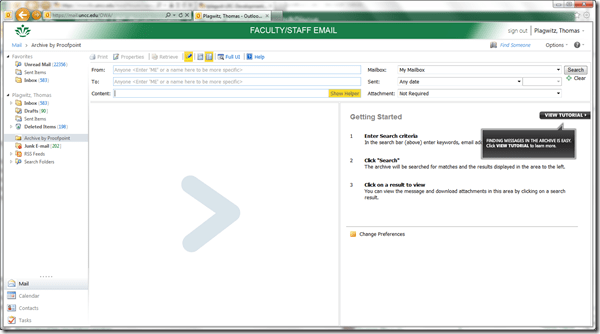

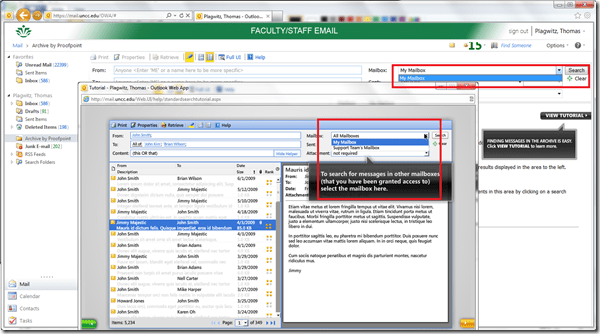
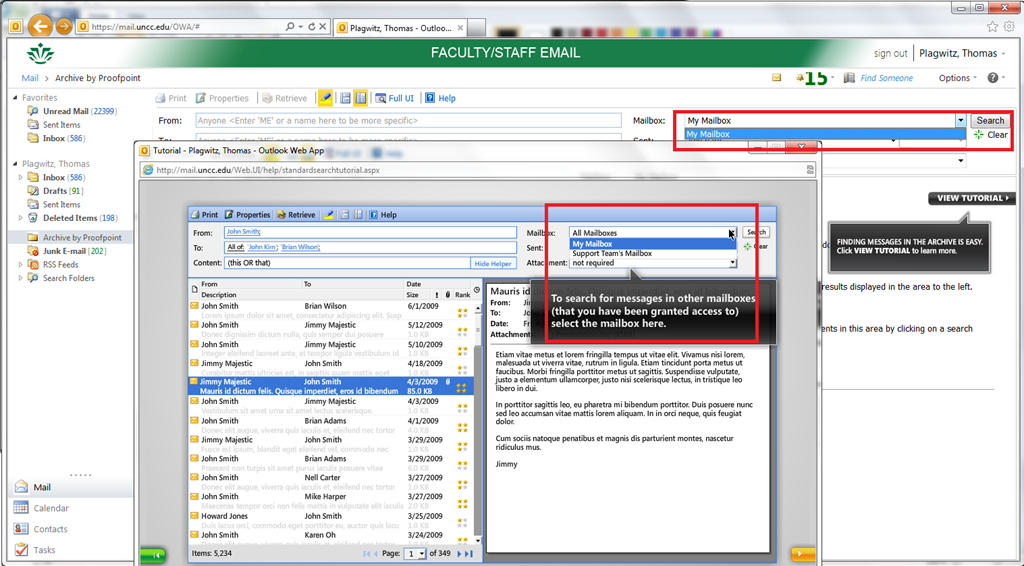
- includes the capability to search other mailboxes, if you have been granted access, like archived institutional knowledge. The following screenshot shows both what options you see if you have been granted access, and what if not:


Unable to edit MS-Excel online spreadsheet because of other user locking
2012/02/08
Leave a comment
- Problem: Why is a user opening a spreadsheet in the browser (even if with edit.aspx URL) causing a warning "The spreadsheet is locked by another user" if i try to open it in MS-Excel? I thought Excel Web App allows multiple uses to edit the spreadsheet at the same time?
- Solution: Opening the spreadsheet for editing in the browser still locks it for being opened in MS-Excel (and vice versa), but not for opening it for editing in another browser.
How to improve learning center staff communications using Windows Live Messenger instant group messaging through live@edu. A running log
2012/02/02
Leave a comment
- Our 1st line of support – student temp staff – is not able to answer all questions and troubleshoot all issues that LRC clients come up with.
- We are experimenting with enabling quick escalation of issues from 1st line to 2nd and 3rd line using instant messaging.
- live@edu provided our university staff and student accounts with access to Windows Live Messenger instant messaging, including useful sub features
- presence: see faster who is (or is not) there to help you by the colored presence icons. The convention in MS software is a green ball for available:

- group messaging: UNCC-LRC created and invited to a “LRC Staff” group that includes student temp and permanent staff.
- presence: see faster who is (or is not) there to help you by the colored presence icons. The convention in MS software is a green ball for available:
- Here is what comes up when temp staff logs into the computer (sorry, no linking to Windows user IDs, but then again, we do not have this form of single sign-on in our other systems either):


- Here are the options we start with (which need refinement)


How to make changes to a meeting request to update/alter a reservation
2012/01/10
2 comments
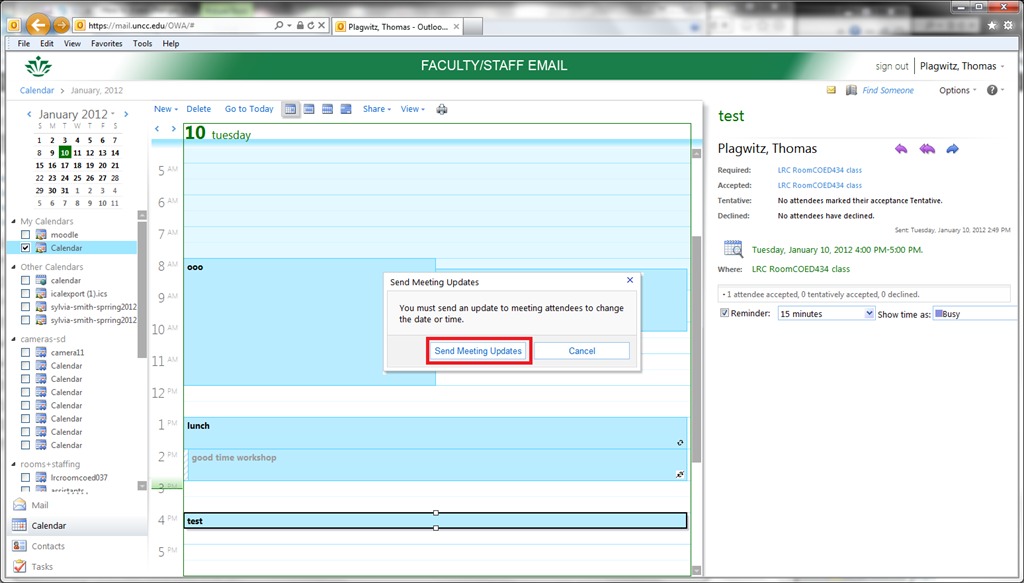
- You can easily release a reservation of an LRC room or resources, completely or partially (e.g. some of the time when you return an item earlier than anticipated), from your calendar in OWA/NINERMAIL:
- By opening the meeting request
- In (staff:)OWA,
- go to your calendar
- find and open your meeting
- make changes to the meeting, e.g. start and end time
- click “Send Update”
- (students:)NINERMAIL: looks like you have to cancel the meeting and recreate it with new times. This may change once we get the calendars used by students set up to autoaccept.
- More conveniently, without opening:
- right-click on and choose delete the appointment (if necessary, the system is smart enough to ask you whether you want to delete an entire series of appointments or only this occurrence; on cancelling, see also here).
![owa-update-recurring2_thumb[1]](https://thomasplagwitz.com/wp-content/uploads/2012/01/owa-update-recurring2_thumb1_thumb.png?w=559&h=302 "owa-update-recurring2_thumb[1]")
- Or to release the reservation partially (= reduce the time), drag the upper or lower margin to the new desired start or end time.
![owa-update-recurring_thumb[2]](https://thomasplagwitz.com/wp-content/uploads/2012/01/owa-update-recurring_thumb2_thumb.png?w=572&h=309 "owa-update-recurring_thumb[2]")
- If you are working with a meeting request (which by definition has more than the organizer as participants, unlike appointments you make for yourself on your calendar; be wary of making changes to meeting requests which you are not the organizer of (= you did not initially create the meeting request)), the system offers you – and should should accept – to notify the other participants automatically.

- Which in this case is not a person, but only (unless other people have been included in the resource booking which can be done) a resource mailbox which, if configured to autoaccept, may still respond to you like so, in this case with an acceptance, since you can not cause a conflict when releasing a resource that had been reserved for you):

- This also only affects the occurrence you are currently working with, as you can see from the stricken-out recurrence icon that results:
![owa-update-recurring1_thumb[2]](https://thomasplagwitz.com/wp-content/uploads/2012/01/owa-update-recurring1_thumb2_thumb.png?w=600&h=324 "owa-update-recurring1_thumb[2]")
- This flexibility is one of the main reasons (= better resource utilization) why we introduced this system: so that users who want to visit the LRC with their class/borrow a resource on short (often happens, depending on pedagogy, with a couple off days or less ) notice don’t have to be turned away with no good reason.
- Just do not try updating from the publically viewable web calendars, those are for “view”-ing only, including by students:
![owa-update-don-not-do-this-from-the-publically-viewable-web-calendar_thumb[3]](https://thomasplagwitz.com/wp-content/uploads/2012/01/owa-update-don-not-do-this-from-the-publically-viewable-web-calendar_thumb3_thumb.png?w=570&h=325 "owa-update-don-not-do-this-from-the-publically-viewable-web-calendar_thumb[3]")
- right-click on and choose delete the appointment (if necessary, the system is smart enough to ask you whether you want to delete an entire series of appointments or only this occurrence; on cancelling, see also here).
![owa-update-recurring2_thumb[1]](https://thomasplagwitz.com/wp-content/uploads/2012/01/owa-update-recurring2_thumb1.png "owa-update-recurring2_thumb[1]")
![owa-update-recurring_thumb[2]](https://thomasplagwitz.com/wp-content/uploads/2012/01/owa-update-recurring_thumb2.png "owa-update-recurring_thumb[2]")

![owa-update-recurring1_thumb[2]](https://thomasplagwitz.com/wp-content/uploads/2012/01/owa-update-recurring1_thumb2.png "owa-update-recurring1_thumb[2]")
![owa-update-don-not-do-this-from-the-publically-viewable-web-calendar_thumb[3]](https://thomasplagwitz.com/wp-content/uploads/2012/01/owa-update-don-not-do-this-from-the-publically-viewable-web-calendar_thumb3.png "owa-update-don-not-do-this-from-the-publically-viewable-web-calendar_thumb[3]")
Logging off fails on teacher station?
2011/12/08
Leave a comment
- Symptoms: Cannot log off.
- Diagnostics:
- Not even after taskkilling so far (got to around “S” in process name initials)).

- When did this behavior first manifest itself? This week? MS-Office 2010 upgrade? Novell upgrade?
- Not even after taskkilling so far (got to around “S” in process name initials)).
- Workaround: Current best workaround is power-cycling the computer.
- Solution: Problem seems to have disappeared. Cause and resolution unclear, though.



Questions? Read the About. Or just ask me a quick Our Databases: Resources with calendars -- Language learning material Moodle Sites, multimedia files -- films


FAQs for LRC student staff or for students or for teachers. To search our FAQs, in the browser addressbar, add after "https://plagwitz.wordpress.com/feed/?tag=faqs+/" "+TAG1" (from tag cloud below) OR "https://plagwitz.wordpress.com/feed/tag=faqs
&category_name=" "CAT1" (from category hierarchy below). OR search both categories and tags, and multiple TAGs/CATs (connect with "," for OR-search, with "+" for AND-search), like so: https://plagwitz.wordpress.com/feed/?tag=TAG1+TAG2+...TAGn&category_name=CAT1
+CAT2+...CATn"
Other ways to find help
If you cannot find it here, look there: 5,500 Language-Learning Links and Programs for learning or teaching 150 languages
Shortcuts:Our Lists, Our Maps, LRC Staff Moodle Site,LRC Project Moodle Site, 49erexpress, UNCC Moodle, Student Recordings: s:claslcslrcsanakostudent
Learning usage samples: Sanako oral exam, Kaltura webcam presentation, Dictation with speech recognition, Sanako written exam, Chinese and Japanese interactive stroke-order practice
Test the Sanako Installer, Webbrowser Popup Konfigurator for XP, or Windows7, faster LRC TeacherPC Log-in Let MS facilitate diacritics writing by installing for you US-International keyboard layout
This is my personal blog (Google+). The views expressed on these pages are mine alone and not those of my employer. The information in this weblog is provided “AS IS” with no warranties, and confers no rights.
 Thomas' Work Space