Archive
Use Getty Images’ free embed tool for culturally authentic imagery?
- Getty Images is trying a new approach for making some money of its widely pirated imagery online: a tool you can use to embed images from their database on your website
- Pros:
- Copyright permissible!
- Preserves through link to Getty Images full background metadata of image.
- Relatively sophisticated image database browsing tool – might be useful less for teachers directly, but for web quests that send students to learn by exploration.

- Cons:
- With the image embedder, you are enabling advertisements and user tracking on your page. Study the licensing agreements.
- Seems to me that Google Images’ scope and convenience will be impossible to beat.

Protected: LRC old media inventory for spring cleaning
A first look at the Google Dictionary extension for Chrome
- We
- have not pre-installed in the LRC (for that the extension would need to be more manageable by the teacher during face-to-face classes, which include exams),
- but can (with some reservations) recommend the Google Dictionary extension (even though it is only available for Chrome). Here is why:
- Google dictionary extension provides an interface to Google define and translate
- that is convenient (as quickly accessed like glosses) for reading activities in many languages (Q: is the privileged word sense displayed here intelligently chosen?)
- while (for some languages more than for others) providing access to additional word senses, usage examples and historical background information
- Interface 1: Tooltip,
- for English with audio

- for other languages without audio (even though audio pronunciation may be available in Google translate for that language):

- convenient access (I have been loving the tooltip interface since Google toolbar days)
- limited, but useful information,
- a word sense – not that this is still not contextually intelligent (Cannot blame them here!) and hence more than one word sense should be offered (here I must blame them: Boo!!): E.g. here “arch” should at show more than the most common word sense:
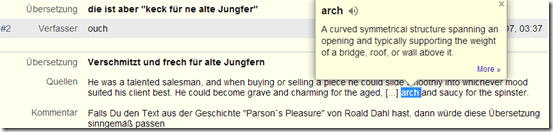
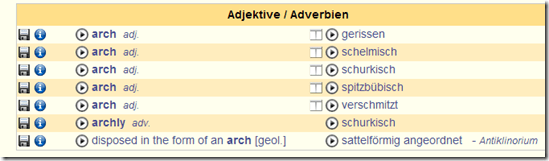
- including pronunciation (not IPA, but audio)
- a word sense – not that this is still not contextually intelligent (Cannot blame them here!) and hence more than one word sense should be offered (here I must blame them: Boo!!): E.g. here “arch” should at show more than the most common word sense:
- Interface 2 (“more”)
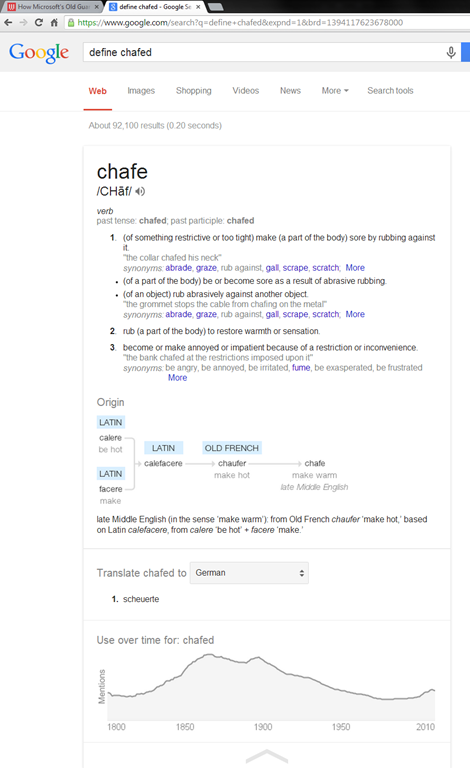
- For English, a click on “more” leads to the Google “define”search operator (the related etymology search operator has been reviewed here before):

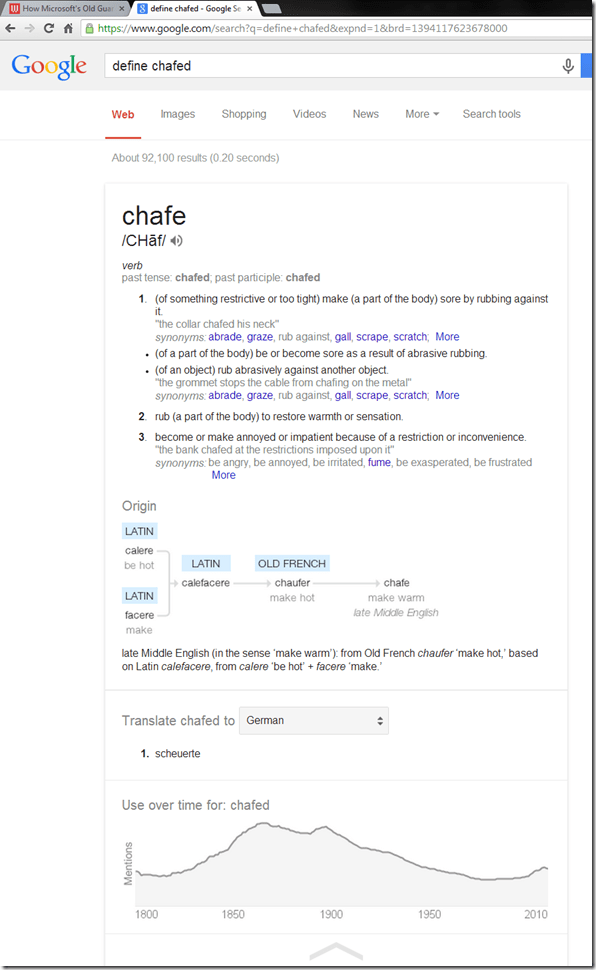
- Interface 3: unfold the search results by clicking on the down arrow at the bottom to access additional information:
 =
=
- additional word sense entries
- historical:
- etymology
- frequency data
- translation/dictionary entry:
- for our learners of languages other than English, the translation appears right in the tool tip, see above;
- for our ESL learners, this seems a few too many steps for accessing this information, although a monolingual dictionary is useful in many instances also.
- For English, a click on “more” leads to the Google “define”search operator (the related etymology search operator has been reviewed here before):
- For languages other than English, a click on more leads to Google translate, which (should get its own article, but for what it is worth) can be
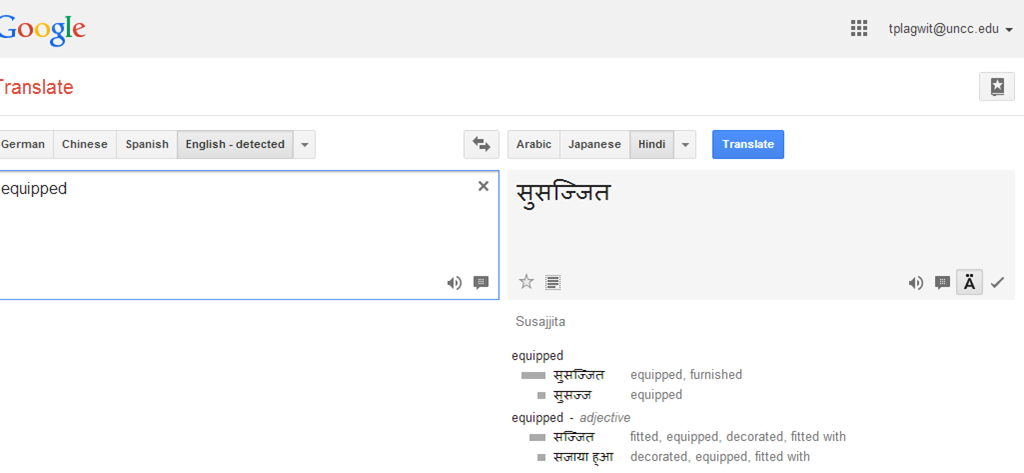
- more limiting than “define”: While you are given multiple word senses for
- Spanish:
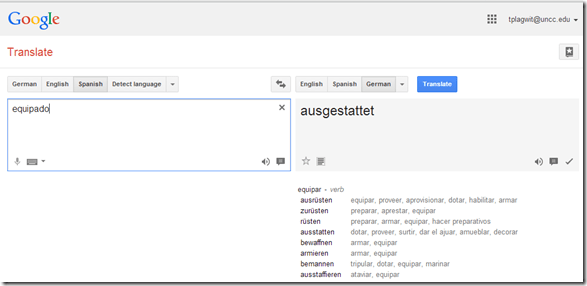
- and to a lesser extent, for
- Arabic:

- Hindi:

- Arabic:
- Spanish:
- for many languages the results are much more limiting:
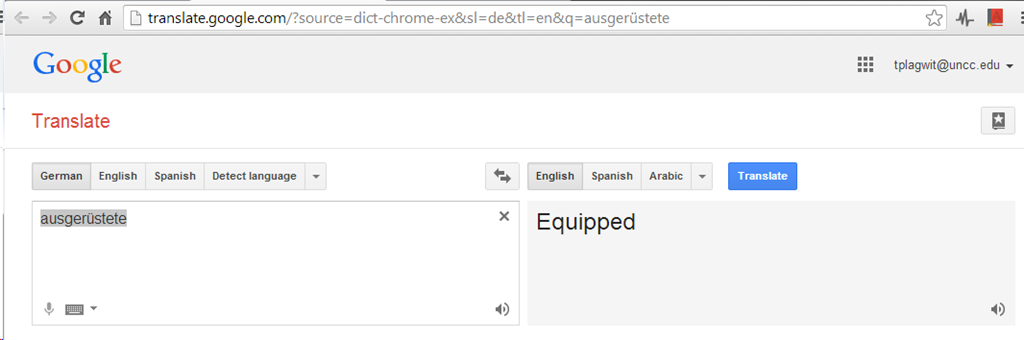
- Even if you look up German or French, you revert back to the (pedagogically terrible) single word-sense original “translation” interface )

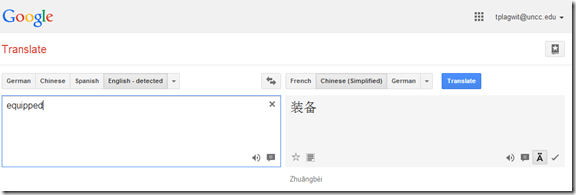
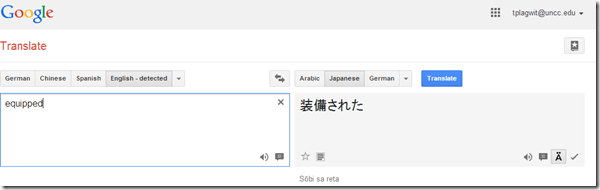
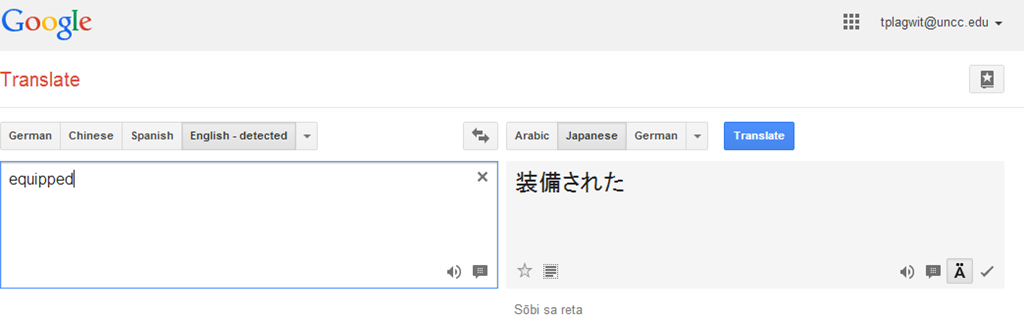
- For East Asian languages, you get Roman alphabet transcriptions
- e.g. Chinese with Pinyin:
- e.g. Japanese:
- e.g. Chinese with Pinyin:
- Even if you look up German or French, you revert back to the (pedagogically terrible) single word-sense original “translation” interface )
- more limiting than “define”: While you are given multiple word senses for
- for English with audio
- Still no per-user tracking? Here it would make sense for the user.






What a delegate in MS-Outlook/MS-Exchange is and does
- Definitions:
- I would say: S/he can act on your behalf, while you keep in the loop and others see who s/he is acting on behalf of which disintermediates (e.g. saves tags like “This message is sent on behalf of [you]”: The message will appear to originate from you, as it ought to – imagine e.g. that users want to search their email for “from:[you]”).
- Looking for guidance, I find Cornell.edu has generally good instructions for their similar Outlook/Exchange environment, so I also quote them:
- “Just as an assistant can help you manage your paper mail, your assistant can use Outlook to act on your behalf”.
- “If your manager has granted you delegate access, you have the ability to act "on behalf of" him or her. Depending on exactly how much access they’ve given you, you may be able to respond to meeting requests, send out meeting invitations, and handle their email messages.”
- Find more information on delegates here for the source.
- Sounds interesting? Next steps:
- How you can set up a delegate
- what does the delegate see/do
Notes on how to act as a delegate in MS-Outlook on Exchange
- In Manage another person’s mail and calendar items, you can learn form the source, how to:
- Cornell.edu has generally good instructions for their similar Outlook/Exchange environment, so I just quote them :
Create meeting requests on behalf of your manager: You must be viewing your manager’s calendar in order for the meeting request to appear to come from them rather than you. (How do I view my manager’s calendar?)
If you have more than one calendar open (many people leave both their own calendar and their manager’s calendar open), click anywhere in your manager’s calendar before creating the meeting request.
Notice that in the Scheduling Assistant, your name will not appear. Instead, your manager’s name is included. Which is what you want. So that’s good. Respond to meeting requests on behalf of your manager: [with delegate access,] You can respond to these messages in exactly the same way you would respond to an invitation sent to you.
Step-by-step how to set up a delegate for your mail account in MS-Outlook 2010 on MS-Exchange 2010

We are just using the default options here – explore more on your own, as you wish (e.g. Let someone else mind your busyness). You need to use MS-Outlook – I don’t see an option in OWA to set up delegate access. But your delegate will carry over to OWA if you prefer to use the webmail client.
Next question: what does the delegate see/do?
Can’t rename default folder names for Room and resource mailboxes with MFCMAPI
- To get the MS-Exchange calendar ICS to include a name line other than “X-WR-CALNAME:Calendar” (which, when trying to aggregate calendars, does not play well with other mailbox calendars also emitted by MS-Exchange with default name )
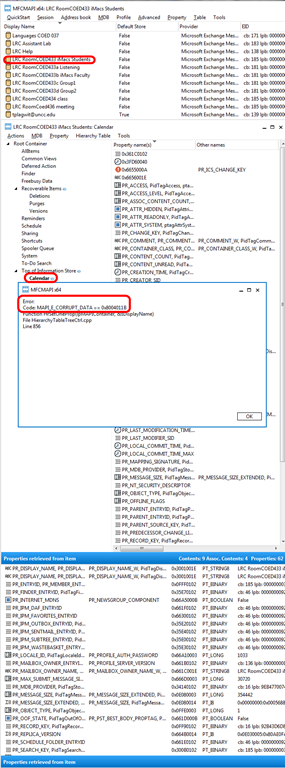
- when trying to follow the renaming instructions here using MFCMAPI (which seem however for personal mailboxes, not the different folder hierarchy: “information store”).
- I only get this 0x8004011b mapi_e_corrupt_data (would have kind of surprised me they had let me mess with MS-Exchange, this is not PST world anymore):

- Is there another way to rename room/resource mailbox calendars? Seems like not. But there is a recommended feedback form for this (or is this for office online only, not for exchange on premise?).


Questions? Read the About. Or just ask me a quick Our Databases: Resources with calendars -- Language learning material Moodle Sites, multimedia files -- films


FAQs for LRC student staff or for students or for teachers. To search our FAQs, in the browser addressbar, add after "https://plagwitz.wordpress.com/feed/?tag=faqs+/" "+TAG1" (from tag cloud below) OR "https://plagwitz.wordpress.com/feed/tag=faqs
&category_name=" "CAT1" (from category hierarchy below). OR search both categories and tags, and multiple TAGs/CATs (connect with "," for OR-search, with "+" for AND-search), like so: https://plagwitz.wordpress.com/feed/?tag=TAG1+TAG2+...TAGn&category_name=CAT1
+CAT2+...CATn"
Other ways to find help
If you cannot find it here, look there: 5,500 Language-Learning Links and Programs for learning or teaching 150 languages
Shortcuts:Our Lists, Our Maps, LRC Staff Moodle Site,LRC Project Moodle Site, 49erexpress, UNCC Moodle, Student Recordings: s:claslcslrcsanakostudent
Learning usage samples: Sanako oral exam, Kaltura webcam presentation, Dictation with speech recognition, Sanako written exam, Chinese and Japanese interactive stroke-order practice
Test the Sanako Installer, Webbrowser Popup Konfigurator for XP, or Windows7, faster LRC TeacherPC Log-in Let MS facilitate diacritics writing by installing for you US-International keyboard layout
This is my personal blog (Google+). The views expressed on these pages are mine alone and not those of my employer. The information in this weblog is provided “AS IS” with no warranties, and confers no rights.
 Thomas' Work Space