Archive
Archive for October, 2013
How can I configure my PC to write in Arabic
2013/10/22
Leave a comment
- In Windows past XP, you can just choose – without first installing support for Right-to-left languages – by pressing +R, typing ïntl.cpl”, clicking ”OK”, clicking ”keyboards and languages”and “change keyboard”.
- An Arabic keyboard layout that is commonly preferred by Westerners (closer to the phonetic layout of the keyboard) is a separate download: https://thomasplagwitz.com/2013/01/06/imrans-phonetic-keyboard-for-arabic/
- A transliterating IME (type on a Western keyboard sounds as you speak, pick suggestions in Arabic letters from a dropdown menu).
- Popular choices are Google Input Arabic: http://www.google.com/inputtools/windows/
- Microsoft Maren: offers more, also morphological analysis. Transliteration tool is linked at the bottom of this post: https://thomasplagwitz.com/2011/06/09/ms-maren-morph-helps-read-arabic-web-pages/ .
Categories: Arabic, audience-is-students, audience-is-teachers, Writing
charinput, FAQs, ms-windows
How teachers can include a link to their metacourse content in their Moodle course
2013/10/21
Leave a comment
- How teachers get the metacourse link:
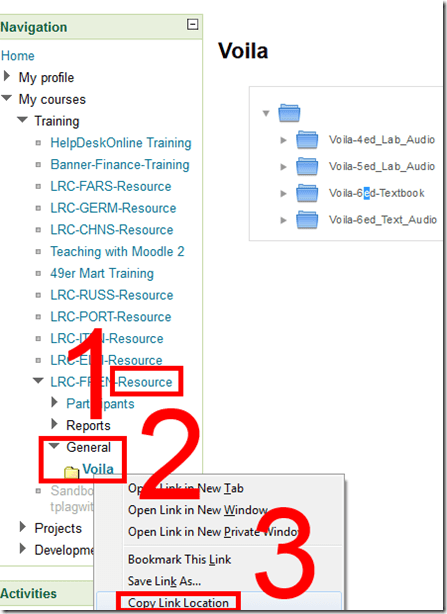
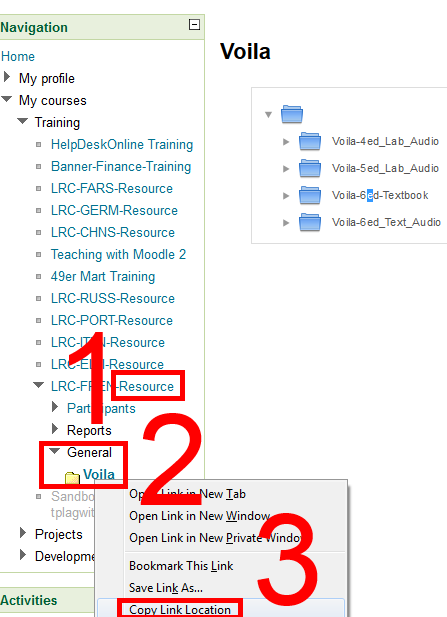
- Find your metacourse and expand (1).
- find your resource (the textbook is actually “Voilà”, but we want to make extra sure there are no non-ASCII compatibility issues) and right-click (2).
- Click “copy link location” (3).
- How to use the metacourse link in your actual course:
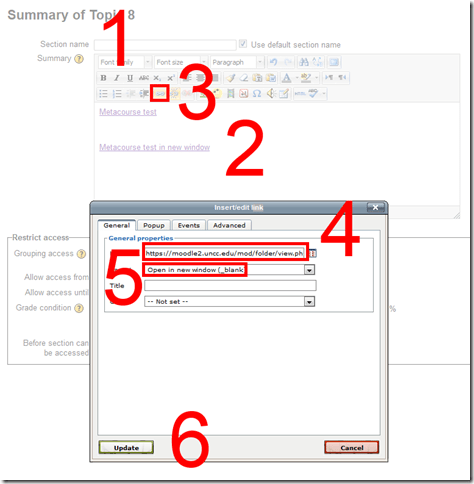
- You can e.g. start a new topic (0).
- Add title (1).
- Add text (2).
- Add link to text (3).
- Paste link from clipboard. (4)
- I you choose open in new window (5), following the link will not navigate the student away from your actual course in the main web browser window.
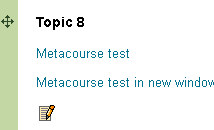
- Result:
 Caveats:
 - FireFox opens in a new tab, even if you in Moodle request to open in a new window.
- You can only link to the root folder of a Moodle Metacourse. If there are multiple content sets within your textbook folder, please advise your student of the name.

Categories: audience-is-teachers, documentation, learning-materials, lms, textbooks
audio, metacourses, moodle
Upgrade to the Moodle 2 on the LRC reception desk computers is overdue…
2013/10/18
Leave a comment
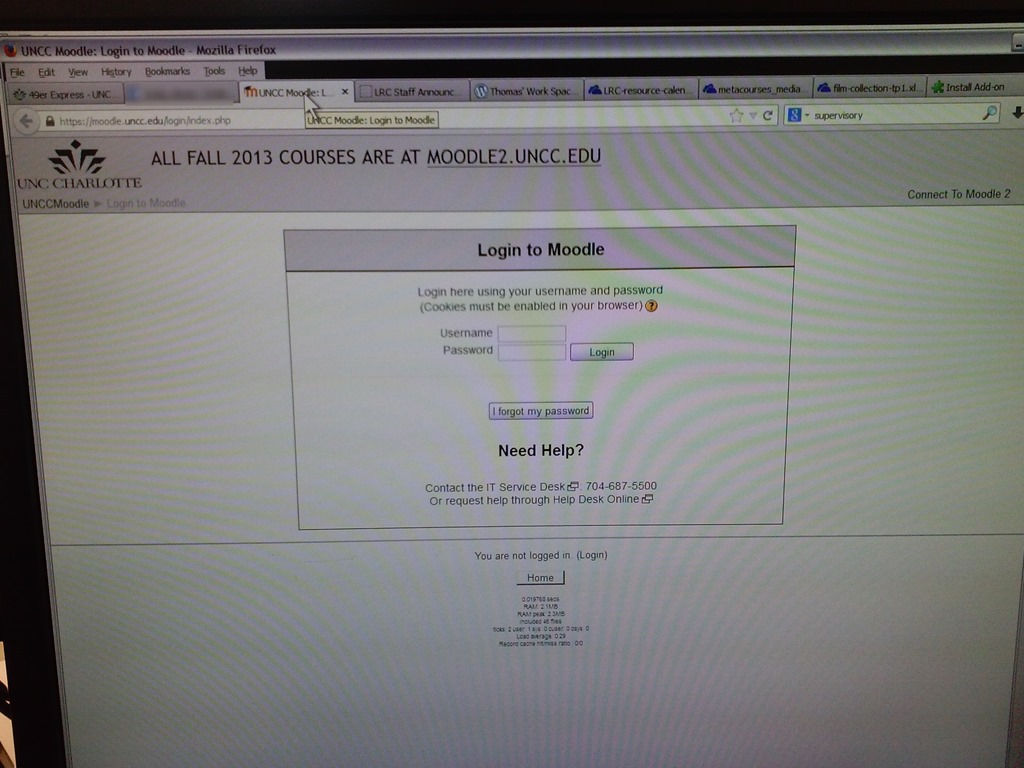
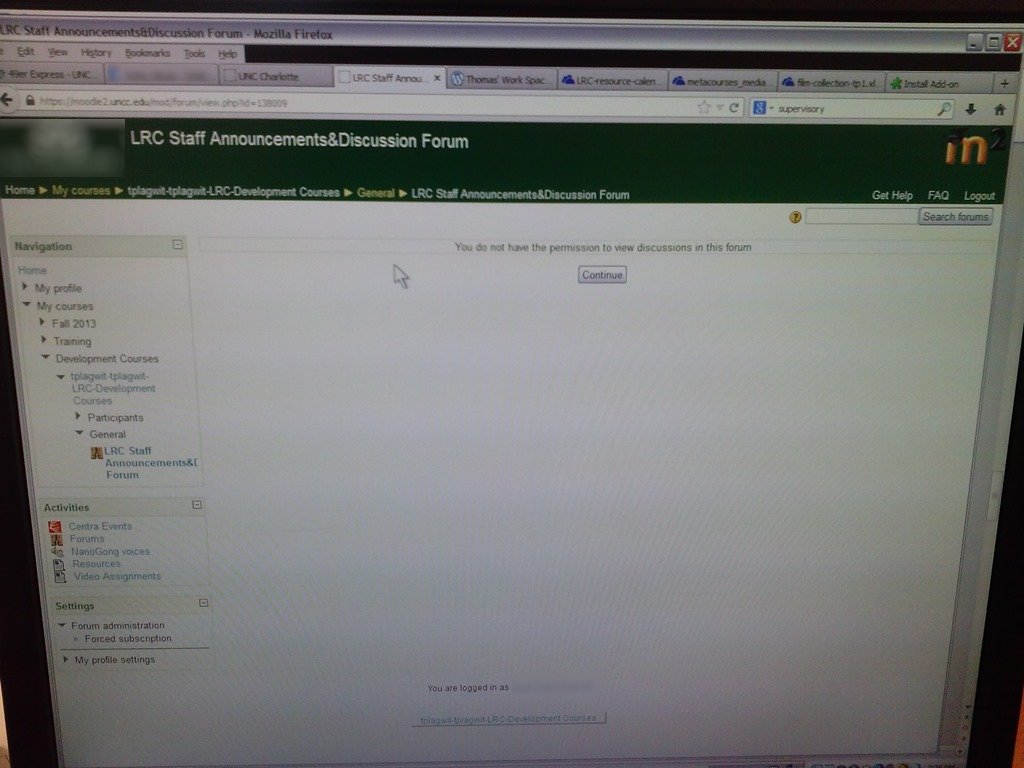

It will be fixed eventually – let me know if not.
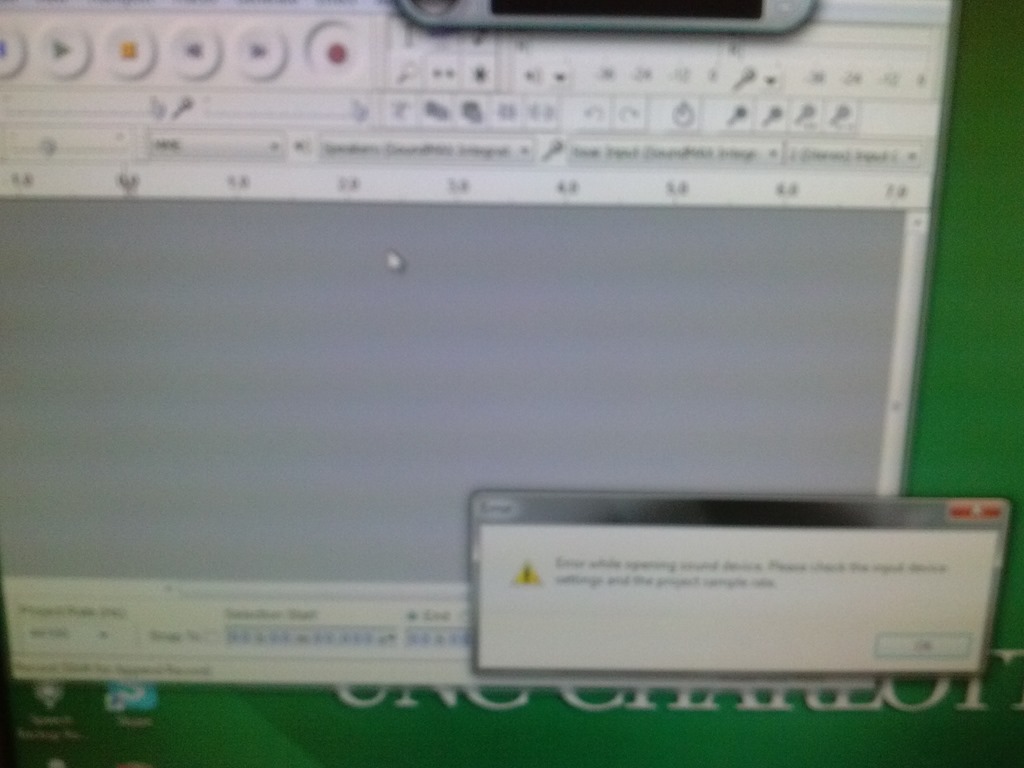
Audacity on startup automatically selects the "microphone" as recording device…
2013/10/18
Leave a comment
- Which is a problem if we do not use the front microphone jack, but rather the rear input:
- Seems to be still an issue on the Group computers….
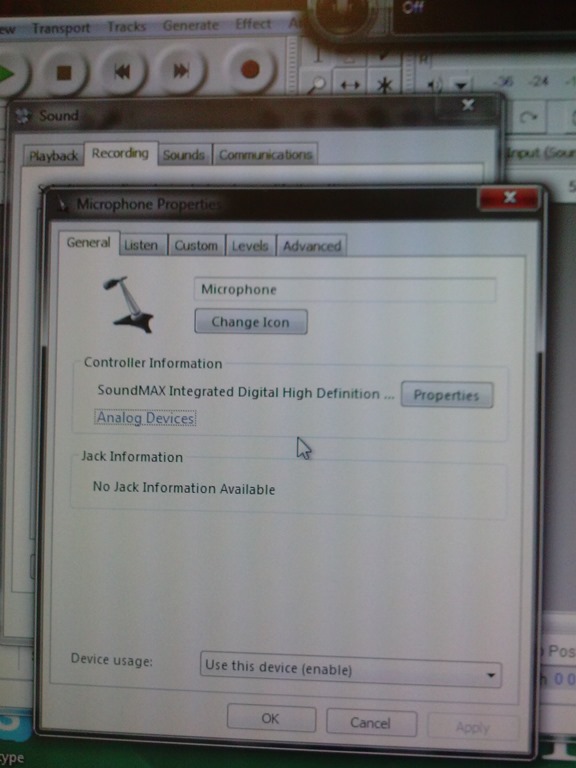
- Solution is the same as found and documented for the listening stations in relation to problems students had with how Saba Centra handles audio hardware, disable the front jack in mmsys.cpl of Windows7:

How a teacher can easily grade a NanoGong audio recording assignment in Moodle
2013/10/17
Leave a comment
- Similar to grading video recording assignments with Moodle Kaltura, You can enter in 2 ways:
- By clicking on the assignment like your students:
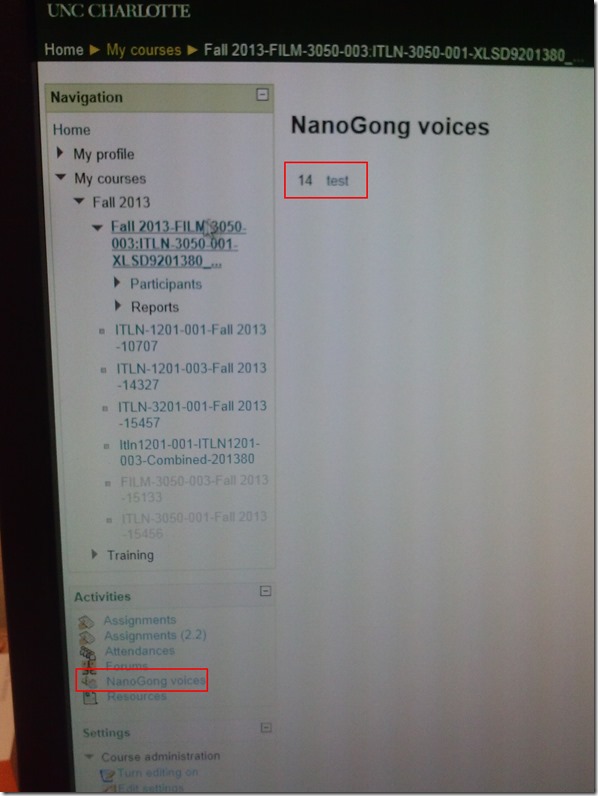
- Or by clicking on Activities: NanoGong Voices
- By clicking on the assignment like your students:
- Before you make it to the assignment page and can see the NanoGong plugin, you may have to bypass some Java warning dialogues.
- On the assignment page:
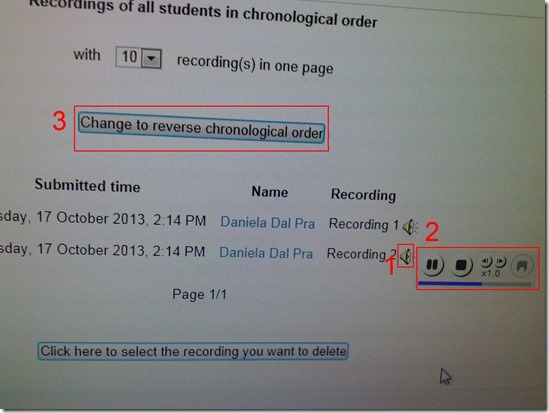
- Click (1) speaker symbol for the recorder control to show up.
- You can also
- enter (1) feedback
- or (2) re-sort the submissions – we had to click this once for the recordings to actually shows up (seems to refresh the page).

- I have not had the chance to see the results in the Gradebook, but here are some screenshots from blogs of users that have:

- Click (1) speaker symbol for the recorder control to show up.


Categories: assignments, audience-is-teachers, grading, lms, multimedia-recording, recording-software
audio, gradebook, moodle, nanogong
How a teacher can use NanoGong’s plugin for the HTML editor to easily send their own audio to students
2013/10/17
Leave a comment
- The rich HTML editor recorder plug-in is supposed to make it easier for the teacher (than other recorders that require the teacher to save to file and upload the file to a Moodle activity). Here is how it can work:
- Add an activity which includes the rich HTML editor plugin, e.g. a page.
- Click on the loudspeaker icon denotes NanoGong among the editor tools.
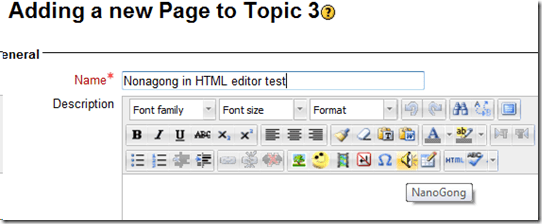
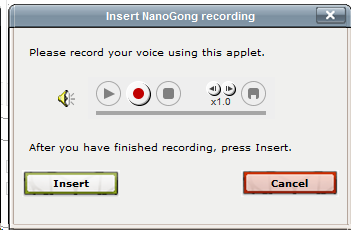
- A window will open that includes the recorder JAVA applet (you may have to bypass Java warnings):

- Click the red record button and speak.
- When done, click insert.
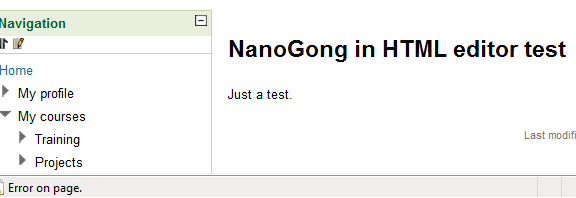
- Result:
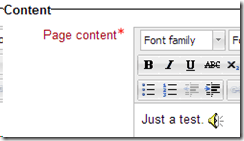
- Note, however, that so far I have run into issues actually displaying this teacher-added NanoGong recorder content.


Categories: audience-is-teachers, documentation, e-languages, Listening, lms, multimedia-recording, recording-software
audio, moodle, nanogong
Troubleshooting NanoGong recorder assignments for students and rich HTML editor content creation by teachers
2013/10/17
Leave a comment
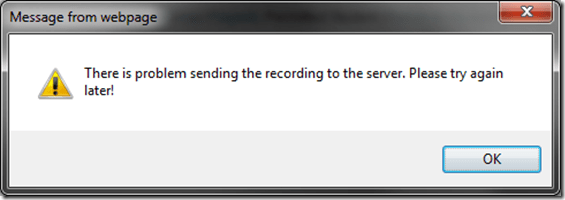
- Once, when submitting, I got this error? But other teachers managed to test the NanoGong recording assignment application successfully when working as a “permitted student”? That may be related to using a project site.
- If you try to use NanoGong in a browser not fully supportive of Java, you can get easily stuck:
- Firefox which has not been explicitly configured to allow JAVA applets – you will get stuck w/o the option to bypass warning dialogues.

- Chrome is not very forgiving either (here for the HTML editor plug-in):
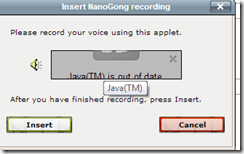 , but you can get past it:
  .
. - I am running into more problems using the rich HTML editor recorder plug-in which I supposed to make it easier for the teacher to provide their own audio to their students:
- IE8 does not display the content at all.
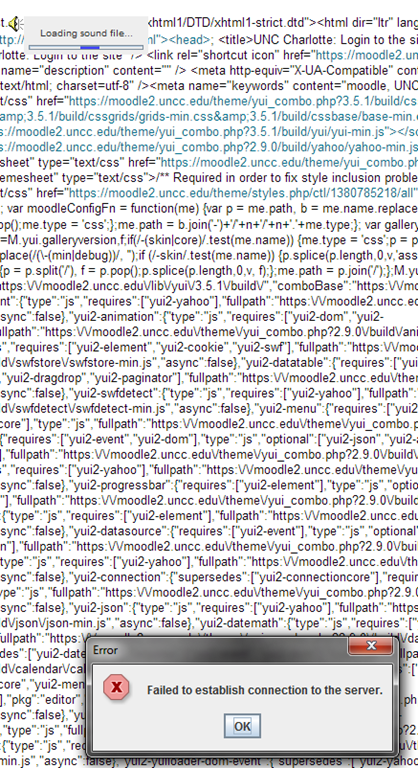
- Chrome 30 spits out raw code, and when you locate and click on the loudspeaker icon, I only get this :
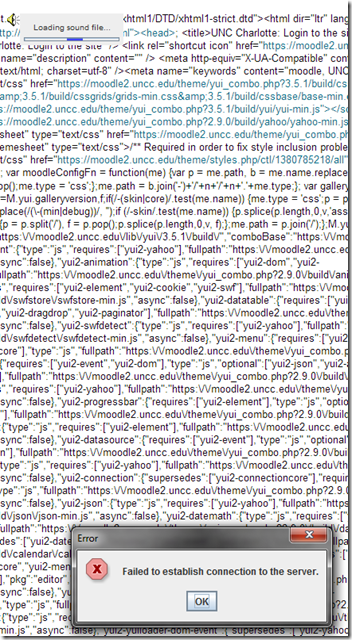 .
. - IE8, on the other hand, draws a blank:


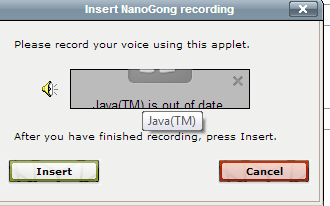

How to use NanoGong in your Moodle course as an audio file recorder
2013/10/17
Leave a comment
- NanoGong is primarily meant for submitting audio recordings to the teacher and fellow students.
- However, it can also serve as a simple audio recorder that can save a recording to a files:
- accessible anywhere where you have internet access (on a JAVA-capable device. I have not tested NanoGong’s compatibility with smartphones or tablets, though) and a microphone – provided you/your teacher have added a NanoGong activity to the Moodle Course.
- Might be useful for collecting recordings as pieces for your language learner ePortfolios.
- To use NanoGong as an audio recorder: Instead of (or on top of/before) submitting your recording to the course, click the rightmost button:
 :
:
- and you can save your recording to a file
![image_thumb[17]_thumb[1]](https://thomasplagwitz.com/wp-content/uploads/2013/10/image_thumb17_thumb1_thumb.png?w=600&h=530 "image_thumb[17]_thumb[1]") ,
,- in a variety of formats (compressed WAV is likely most compatible),
- including in the different speeds:
![image_thumb[18]_thumb](https://thomasplagwitz.com/wp-content/uploads/2013/10/image_thumb18_thumb_thumb.png?w=244&h=68 "image_thumb[18]_thumb") that you de/increased the playback speed here:
that you de/increased the playback speed here: ![image_thumb[15]_thumb](https://thomasplagwitz.com/wp-content/uploads/2013/10/image_thumb15_thumb_thumb.png?w=129&h=103 "image_thumb[15]_thumb") .
.

![image_thumb[17]_thumb[1]](https://thomasplagwitz.com/wp-content/uploads/2013/10/image_thumb17_thumb1.png "image_thumb[17]_thumb[1]")
![image_thumb[18]_thumb](https://thomasplagwitz.com/wp-content/uploads/2013/10/image_thumb18_thumb1.png "image_thumb[18]_thumb")
![image_thumb[15]_thumb](https://thomasplagwitz.com/wp-content/uploads/2013/10/image_thumb15_thumb1.png "image_thumb[15]_thumb")
Categories: Arabic, audience-is-students, audience-is-teachers, documentation, English, eportfolio, Farsi, French, German, Greek (modern), Hebrew, Hindi, Italian, Japanese, Korean, Mandarin, multimedia-recording, Polish, Portuguese, recording-software, Russian, Spanish, Speaking, Swahili, Yoruba
audio, moodle, nanogong


Questions? Read the About. Or just ask me a quick Our Databases: Resources with calendars -- Language learning material Moodle Sites, multimedia files -- films


FAQs for LRC student staff or for students or for teachers. To search our FAQs, in the browser addressbar, add after "https://plagwitz.wordpress.com/feed/?tag=faqs+/" "+TAG1" (from tag cloud below) OR "https://plagwitz.wordpress.com/feed/tag=faqs
&category_name=" "CAT1" (from category hierarchy below). OR search both categories and tags, and multiple TAGs/CATs (connect with "," for OR-search, with "+" for AND-search), like so: https://plagwitz.wordpress.com/feed/?tag=TAG1+TAG2+...TAGn&category_name=CAT1
+CAT2+...CATn"
Other ways to find help
If you cannot find it here, look there: 5,500 Language-Learning Links and Programs for learning or teaching 150 languages
Shortcuts:Our Lists, Our Maps, LRC Staff Moodle Site,LRC Project Moodle Site, 49erexpress, UNCC Moodle, Student Recordings: s:claslcslrcsanakostudent
Learning usage samples: Sanako oral exam, Kaltura webcam presentation, Dictation with speech recognition, Sanako written exam, Chinese and Japanese interactive stroke-order practice
Test the Sanako Installer, Webbrowser Popup Konfigurator for XP, or Windows7, faster LRC TeacherPC Log-in Let MS facilitate diacritics writing by installing for you US-International keyboard layout
This is my personal blog (Google+). The views expressed on these pages are mine alone and not those of my employer. The information in this weblog is provided “AS IS” with no warranties, and confers no rights.
 Thomas' Work Space