Archive
Blended Learning Templates for the e-Learning Center. Download
- Download the Blended Learning Templates for the e-Learning Center, as presented here:
- MS-Word VBA-based quiz template for Students
- MS-PowerPoint Template for Teacher
- VBA-Lookup-Add-In for teacher computer’s MS-PowerPoint installation. (included with student quiz template).
- Find more instructions here.
Blended Learning Templates for the e-Learning Center. Presentation EUROCALL 2007
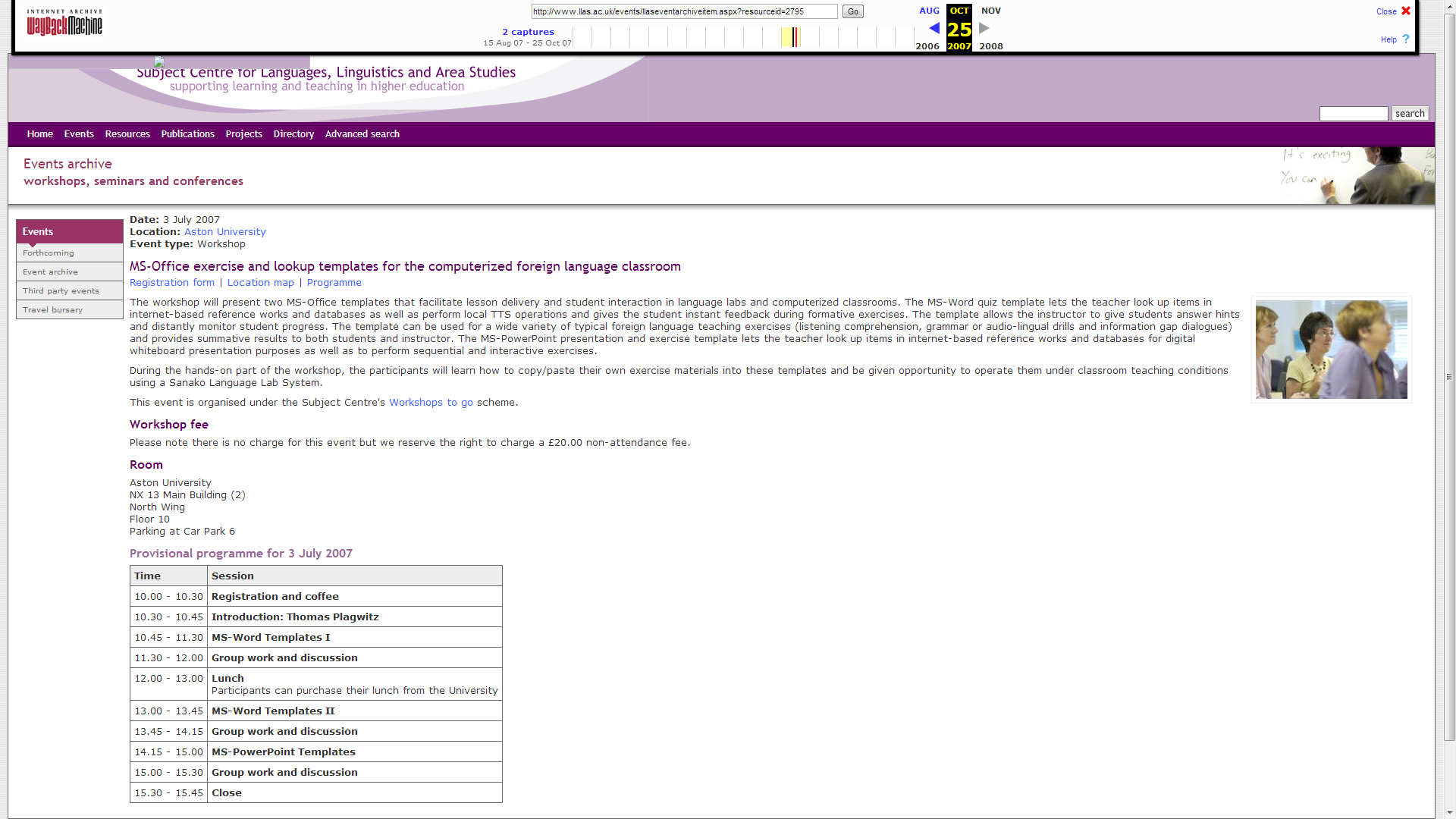
MS-Office Templates for the computerized Foreign Language Classroom. LLAS-sponsored Workshop2Go.

An LLAS-sponsored workshop held at Aston University in Birmingham and University of Nottingham. This is a raw unedited screencast of the former from the presenter screen (sorry, the video of demonstration screencasts played during this screencast do not get recorded due to hardware acceleration – I’ll insert them if I get around to cut this screencast).
Using home-brew NLP regular expressions to automate question generation for learning material creation
- The trpQuizGenerator, from which the screenshots below are taken,
- is an attempt to facilitate, speed up, automate question generation for foreign language learning by collecting a regular expressions, reflecting typical patterns that cause difficulties for language learners in a number of L2 – inspired by common 1st and 2nd year textbooks:

- German: differentiation between Dative and Accusative case personal pronouns
- Italian: contraction of article and preposition
- Spanish: demonstrative pronouns.
- Some more rather arbitrary, but easily implemementable examples for ESL:
- Numbers: ―Much/many‖ dichotomy
- which/who‖ relative pronoun dichotomy: Difficult for German students of English which has no such
dichotomy for innate beings/things, but whose (antiquated) relative pronoun ―Welch‖ as a false friend
of which tends to lead to a wrong preference of ―which‖ to ―who‖ by German speakers. - Sub clauses/tenses: if clauses up to period/comma, giving the number of words as hints. Would
require a delegate.
- Regular expressions in .Net have a number of advanced features that makes the platform a good choice for this enterprise:

- The resulting texts can be e.g. easily delivered as formative assessment exercises to students using trpQuiz.dot.
- is an attempt to facilitate, speed up, automate question generation for foreign language learning by collecting a regular expressions, reflecting typical patterns that cause difficulties for language learners in a number of L2 – inspired by common 1st and 2nd year textbooks:
- Update:
- In a much more recent approach to the same automation problem, I am trying to repurpose well-established existing NLP-platforms for question generation.
- However, compared with the above customized approach, to transform the built-in, not SLA-specific NLP recognition I have found so far taking not only much more work for reformatting for delivery, but also more creativity, or willingness to put up with limitations when it comes to homing in on typical learner problems.


Sanako Lab300 Final exam: Movie listening comprehension with grammar, vocabulary cloze
Here is a raw (unedited) video of a final exam in a German 202 class.
It was delivered with Sanako Lab 300 in a synchronous face-to-face teaching environment.
Students (re)viewed a movie (Lola rennt), while doing target language subtitle-based with self-developed (MS-Word templates using VBA) fill-in-the-gap exercises on grammar and vocabulary – listening comprehension.
Apart from the teacher managing the exam distribution on the Sanako Lab 300 Teacher computer, you can see the teacher watching the students taking the exams – each thumbnail with subtitle text in the Sanako Mosaic window represents one student computer.
The students get the benefit of AI: lookup of internet resources (which is enabled through VBA with double-click on words in a subtitle which leads to the default dictionary, in this case set to http://dict.leo.org), as well as a dropdown menu with more advanced Dictionaries and Encyclopedia.
The students also get the benefit of immediate AI feedback to their input – better basis for learning than receiving a corrected homework or exam in a, time-wise, complete disconnect from the learning activity (and the feedback is faster than if it were web-based, since it is local to the client computer).
The teacher gets the benefit of an easy overview of students learning, of routine corrections being performed by AI in the exercise template, and, where s/he finds additional guidance is needed – even if not in this outcome exam situation, then during similar preparatory face-to-face activities – , can – with the help of the Sanako audio and student computer remote control system – immediately connect to a student for additional instruction at “teachable moments” (Example here).
How AI and human intelligence can blend in the language lab to form personalized instruction

- An example from long before mobile computing but still: While I personally like communicative uses of the language lab infrastructure best (pairing, group conferences, with recording, screen sharing, collaborative writing),
- the above (click image to download and play WMV video, also on MAC – sorry, file won’t transcode) may be the 2nd best :
- The student is engaged
- primarily with a listening (comprehension) exercise using authentic target language media (German chanson),
- also with some light writing (recognition of vocabulary words)
- and receives automated feedback in response form quiz template.
- The communicative aspect is added
- through seamless, effortless, surgical and last not least private teacher intervention or “remote assistance”
- when the teacher (“automonitoring” all LAB300 students one after the other) notices from afar (even though thumbnail-sized, hence the large fonts of the quiz template)
- how the current automated error feedback may not be enough of an explanation, but may have created “a teachable moment”:
- Student heard phonetically correctly, but not etymologically. German “Fahrstuhl”, not “Varstuhl””: literally a “driving chair” – after this little intervention, likely a quite memorable compound.
- A good example how language lab computers need not get “in between you and your student”, but connect you – just like has become an everyday reality, in the meantime, in the social web world.
- The student is engaged


Questions? Read the About. Or just ask me a quick Our Databases: Resources with calendars -- Language learning material Moodle Sites, multimedia files -- films


FAQs for LRC student staff or for students or for teachers. To search our FAQs, in the browser addressbar, add after "https://plagwitz.wordpress.com/feed/?tag=faqs+/" "+TAG1" (from tag cloud below) OR "https://plagwitz.wordpress.com/feed/tag=faqs
&category_name=" "CAT1" (from category hierarchy below). OR search both categories and tags, and multiple TAGs/CATs (connect with "," for OR-search, with "+" for AND-search), like so: https://plagwitz.wordpress.com/feed/?tag=TAG1+TAG2+...TAGn&category_name=CAT1
+CAT2+...CATn"
Other ways to find help
If you cannot find it here, look there: 5,500 Language-Learning Links and Programs for learning or teaching 150 languages
Shortcuts:Our Lists, Our Maps, LRC Staff Moodle Site,LRC Project Moodle Site, 49erexpress, UNCC Moodle, Student Recordings: s:claslcslrcsanakostudent
Learning usage samples: Sanako oral exam, Kaltura webcam presentation, Dictation with speech recognition, Sanako written exam, Chinese and Japanese interactive stroke-order practice
Test the Sanako Installer, Webbrowser Popup Konfigurator for XP, or Windows7, faster LRC TeacherPC Log-in Let MS facilitate diacritics writing by installing for you US-International keyboard layout
This is my personal blog (Google+). The views expressed on these pages are mine alone and not those of my employer. The information in this weblog is provided “AS IS” with no warranties, and confers no rights.
 Thomas' Work Space