Archive
How to transcribe English into phonetic alphabet using Phonetizer.com
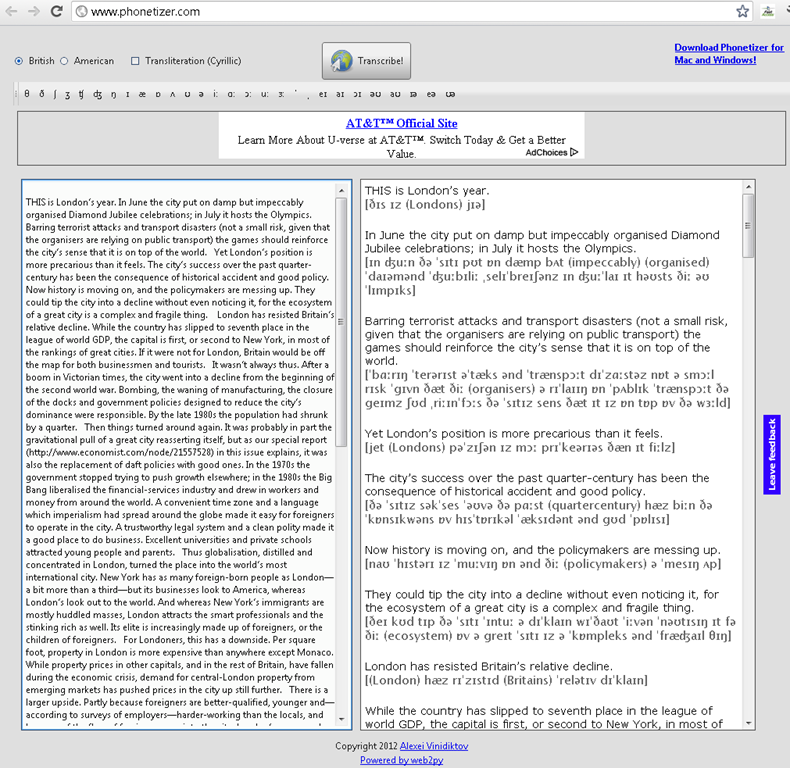
Phonetizer transcribes into IPA. The vocabulary seems somewhat limited (45000 claimed) – English spelling variants do not help, although Phonetizer offers BE as an input option. I have not found a length limit for the transcription with an article from the current Economist of over 1000 words – should be plenty for most reading/recording assignments in the LRC. Easy as (web2)py.  The web version is advertisement-based. The downloadable version is not free, so we cannot install it in the LRC, unfortunately.
Google-Translate for phonetization?
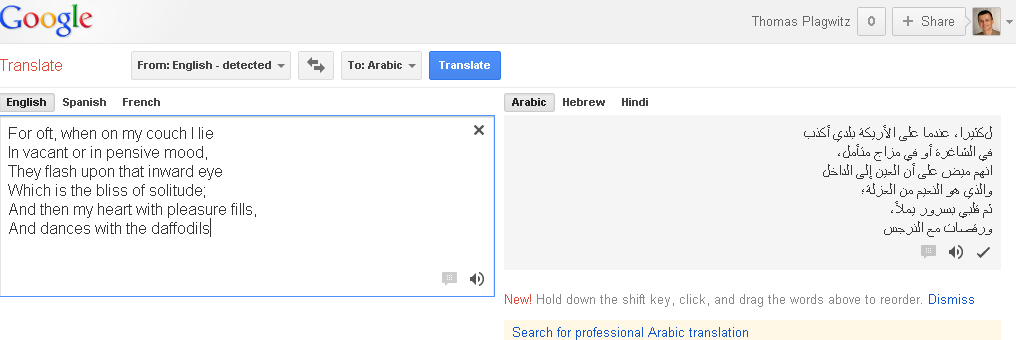
- Google-Translate also offers some phonetic transliterations. You may have noticed this when attempting (remember, though, that it is for a reason that they link to “professional translation” services, and also invite anybody to amend the machine translation offered) to translate from English into other languages,

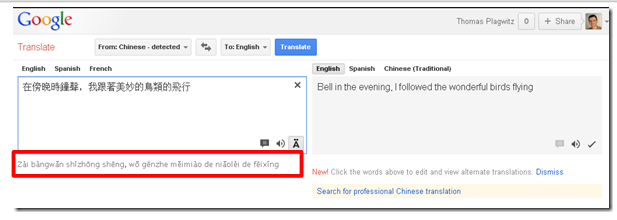
- However, if you type or paste non-Romanized text into the source textbox, you also get the option button “read phonetically” (meaning transliterate to phonetic symbols or phonetize).
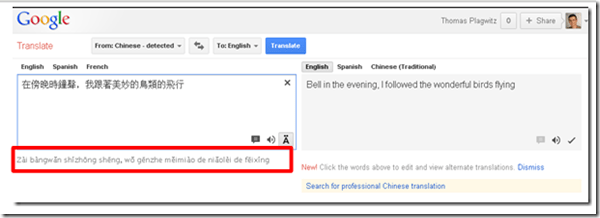
- Limited use in the LRC: Few languages are supported.
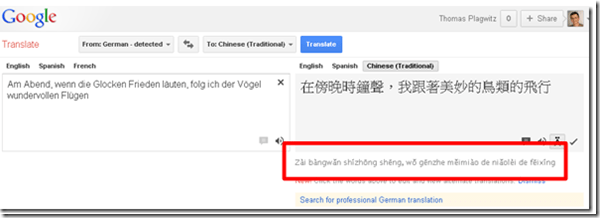
- Only languages written in non-roman letters are offered. E.g. French or German are not deemed difficult enough (I know a few that would beg to differ
 ).
).
- Arabic, Farsi and Hebrew are also not supported (root cause: right-to-left? Strangely these right-to-left-languages work in the TBA:Google transliterate IME which attempts to do roughly the opposite of phonetization):

- Leaves: Chinese, Greek, Hindi, Japanese, Russian. However, note finally that not a standard phonetic alphabet is being used either for these transcriptions.


Phonetic transcription websites
Computerized Language resource centers are supposed to work wonders improving SLA students’ pronunciation: Can’t computers analyze and visualize sound for us?
However, it turned out there seems to be a considerable “impedance mismatch” not only between computers analyzing and understanding the signal, but also between a computer voice graph and the capability of a language learner to process and improve pronunciation on the basis of it.
Voice graphs may have some use for tonal languages. But can you even tell from a voice graph of a letter which sound is being produced?
Enter the traditional phonetic transcription that pre-computerized language learners remember from their paper dictionaries (provided you can teach your language learners phonetic symbol sets like the IPA). Not only are good online dictionaries perfectible capable of displaying phonetic symbol sets on the web (it’s all in Unicode nowadays).
There are now experimental programs that can automate the transcription of text into phonetic symbol sets for e.g. English, Portuguese or Spanish. The more advanced ones also come with text-to-speech.
You can provide your students with audio (or, text-to-speech capability provided) or text models and have them study the phonetic transcription, listen to the audio, and record their model imitation in the LRC. Maybe you will find that practice with recording and a phonetic transcription of the recorded text is more useful for your students’ pronunciation practice than a fancy voice graph.
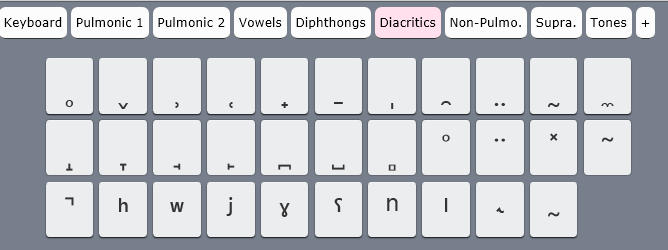
I2speak.com: Web-based IPA Keyboard
The Sciweavers Team announces http://www.i2speak.com: “an online Smart IPA Keyboard that lets you quickly type IPA phonetics without the need to memorize any symbol code. For every Roman character you type, a popup menu displays a group of phonetic symbols that share the same sound or shape beneath typed character. Use arrow keys to select the proper symbol then hit the Enter button. I2Speak also supports the following features:
1. The Sampa English Keyboard lets you type English phonetics using Roman characters according to SAMPA (Speech Assessment Methods Phonetic Alphabet) rules.
2. The IPA English Keyboard provides you with a full English phonetics keyboard. Press the symbol of interest using a suitable input device.
3. You can type directly on your physical keyboard or on the virtual on-screen keyboard using a suitable input device such as mouse or touch screen device.
4. You can change the keyboard symbols by selecting another layout from the list box located above the virtual keyboard.
5. For every keyboard layout, more symbols can be displayed by pressing the CAPS Lock.
6. When you hover the mouse over an English phonetic button, a slick tooltip will show some example English words.
7. You can save typed phonetics as an MS-Word file by clicking the Save button, copy them to clipboard using the Copy button, or post them to Twitter, Facebook, etc. by clicking the desired button.”



How to use the online Spanish pronunciation help to generate phonetic alphabet transcriptions and text-to-speech
- Go to http://showroom.daedalus.es/es/tecnologias-de-la-lengua/phonetictrans/phonetictrans.php, enter your text, select your phonetic symbol set:
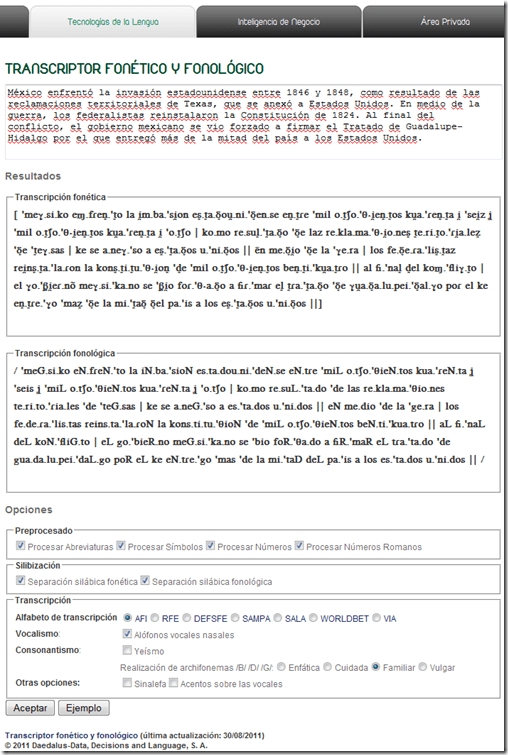
- Unlike with the Portuguese help, there is no text-to-speech option here.

How to use the online Portuguese pronunciation help to generate phonetic alphabet transcriptions and text-to-speech
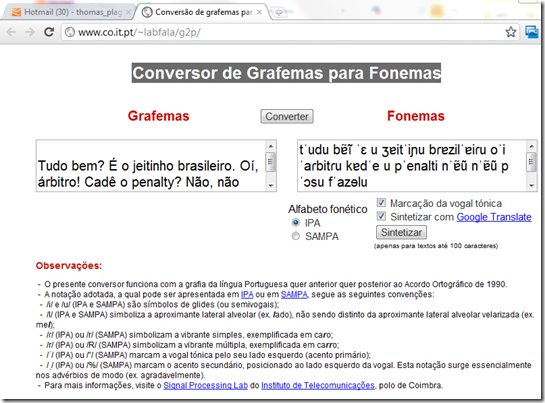
- Go to http://www.co.it.pt/~labfala/g2p/
- Write or paste your text into the textbox:“Grafemas”
- Choose your preferred phonetic alphabet (IPA, SAMPA) and other options.
- Press button: “Converter” to see results.
- Press button: “Sintetizar” to hear results.
- Like so:
- Or click here to view a demo (requires Windows Media Player) with audio (download requires Windows Media Player). Our example was:
- Input: Tudo bem? É o jeitinho brasileiro. Oí, árbitro! Cadê o penalty? Não, não posso faze-lo.
- Output: tˈudu bɐ̃ĩ ˈɛ u ʒɐitˈiɲu bɾɐzilˈɐiɾu oˈi ˈaɾbitɾu kɐdˈe u pˈenalti nˈɐ̃ũ nˈɐ̃ũ pˈɔsu fˈazɘlu



Questions? Read the About. Or just ask me a quick Our Databases: Resources with calendars -- Language learning material Moodle Sites, multimedia files -- films


FAQs for LRC student staff or for students or for teachers. To search our FAQs, in the browser addressbar, add after "https://plagwitz.wordpress.com/feed/?tag=faqs+/" "+TAG1" (from tag cloud below) OR "https://plagwitz.wordpress.com/feed/tag=faqs
&category_name=" "CAT1" (from category hierarchy below). OR search both categories and tags, and multiple TAGs/CATs (connect with "," for OR-search, with "+" for AND-search), like so: https://plagwitz.wordpress.com/feed/?tag=TAG1+TAG2+...TAGn&category_name=CAT1
+CAT2+...CATn"
Other ways to find help
If you cannot find it here, look there: 5,500 Language-Learning Links and Programs for learning or teaching 150 languages
Shortcuts:Our Lists, Our Maps, LRC Staff Moodle Site,LRC Project Moodle Site, 49erexpress, UNCC Moodle, Student Recordings: s:claslcslrcsanakostudent
Learning usage samples: Sanako oral exam, Kaltura webcam presentation, Dictation with speech recognition, Sanako written exam, Chinese and Japanese interactive stroke-order practice
Test the Sanako Installer, Webbrowser Popup Konfigurator for XP, or Windows7, faster LRC TeacherPC Log-in Let MS facilitate diacritics writing by installing for you US-International keyboard layout
This is my personal blog (Google+). The views expressed on these pages are mine alone and not those of my employer. The information in this weblog is provided “AS IS” with no warranties, and confers no rights.
 Thomas' Work Space