Archive
How you can reuse your speech profile even on deepfrozen Language resource center computers
- “A [Windows Speech] profile is basically the collection of all settings and information about how to recognize your voice when using Windows Speech Recognition. Before changing the language used or letting other persons use Windows Speech Recognition it is best to create a new profile so that your current one will remain unaltered”.
- To be able reuse your effort training the computer to recognize your voice speaking in your study language – even though the LRC Windows 7 computers get reset when restarted -, you can backup, and later reload, your Speech Profile, preferably to your H:-drive.
- The Microsoft tool that allows you to do that has been put on WSRProfile.exe desktop of the LRC Windows 7 PCs. I can copy these instructions directly from the Microsoft blog page:
- Double-click WSRProfile.exe to start the WSR Profile tool wizard.

- To back up a speech profile using the WSR Profile tool, select Backup my speech profile.
- In the Select your Speech Profile dialog box, choose the speech profile you wish to back up and then click Next.
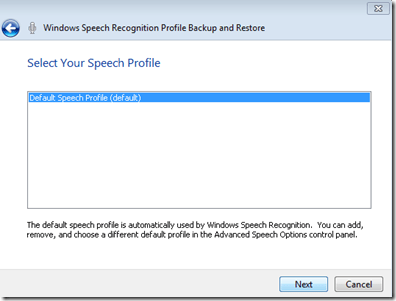
- The wizard will prompt you for a filename and location to save the file. When you have entered this information, click Next. The WSR Profile tool wizard will start the backup process of the selected speech profile.

- After the backup operation successfully finishes, click Close .

- In the Select your Speech Profile dialog box, choose the speech profile you wish to back up and then click Next.
- To restore a speech profile using the WSR Profile tool, select Restore my Speech Profile.
- On the File to Restore wizard page, click Browse and locate the backed up speech profile, and then click Next.
- Choose the speech profile you want to restore to.
- Select Use the current speech profile if you want to overwrite the current default speech profile.
- Select Create a new speech profile if you want to restore to a new speech profile. If you choose to restore to a new speech profile you will be prompted to provide a name for the new profile.
- After the restore operation successfully finishes, click Close.


Trados translation memory from TMX
- Open Trados studio professional 2011
- choose from the menu: file / new / translation memory
- in the create translation memory dialogue
- choose source and target language (the same as in the file name of the TMX files which follow the source-target naming convention)
- select “Allow multiple translation for the same source segment”
- choose as name for this translation memory the file name of the TMX files you are going to import (some include a year)
- click button: “create”,
- choose from the menu: file / import
- in the “import” dialogue window
- select “large import file”, “keep most recent”, “add to setup”
- click button “ok”
- select “large import file”, “keep most recent”, “add to setup”
- and in the dialogue “open import file”
- select as file type TMX 1.4b, if this does not work, 1.4, if this does not work, 1.1
- browse to C:\Temp\Trados to select one file (after the other)
Example 7: Exercise dictating in German to an LRC Windows 7 computer
How can we get language students more speaking practice with qualified, but affordable feedback ? Native speaker contact remains difficult to organize even in the days of online conferencing. The LRC hosts language tutoring, but numbers are limited. Enter speech recognition, the holy grail of iCALL, much easier for learners to relate to than the voice graph that digital audio can be broken down to, and thus for a long time a standout feature of costly second-language-acquisition packages like Auralog Tell-me-More (speech recognition in English tested here) – but now the LRC has Windows 7 Enterprise (and its free add-on language packs), and another crucial prerequisite: headphones with excellent microphones.
We are setting up the new Windows 7 computers in the LRC to allow for speech recognition in Chinese, English, French, German, Japanese and Spanish. Here is an example of me using this facility for a practicing my German during a dictation exercise:
Granted, German is my native tongue; but the example text is from the online component for the final chapter of the “Treffpunkt Deutsch” 1st-year textbook in use here, which sends the readers to the website of the Swiss (-German) employment agency.
Apart from infrequent words ("Archiven") and Lehnwörtern ("Bachelor" etc.), Windows 7 speech recognition accuracy seems quite impressive. The above example was actually my first dictation, except that immediately beforehand, I invested a few minutes into the standard Windows 7 speech recognition training (aimed at training the user, although may behind the scenes teach the computer a few things about the speaker already also) and a few more minutes of voice training (this one is meant exclusively for the computer, but the user can also see it fail and why). The – rather simple trick to boost speech recognition results – certainly accessible to our students – seems to be to speak not only clearly, but also slowly, with short pauses between most words.
Speech recognition in these languages is a feature of the Windows 7 (Enterprise/Ultimate version) “language packs” that we installed and switched to – that is why the entire computer interface appears in German. Practicing the L2 with (computer—operating) “voice commands” (instead of with a mouse) is also possible, simpler than replacing the keyboard (mostly) by voice, but not as easy to devise homework exercises for.
Tips for designing exercises using speech recognition: As the example shows ("Archiven") , doing all corrections by voice can quickly become tedious. But there is no pedagogical need to have your students’ bang their heads against this wall. Instead, just ask your students to correct their automatically recognized words manually at the end of their video, after their dictation. This way both you and your students get a clear summary of what they achieved – even clearer if they dictate in MS-Word with the spell and grammar check for the language (automatic with the switch to the language pack for the language) and (using key combination CTRL+SHIFT+E) track changes. We will show you later TBA:how we now enable students to easily record their screen and TBA:upload their screencast into Moodle Kaltura.
SOLVED: How to record, in Adobe-Flash, video from my built-in iSight web camera on an 2010 iMac, combined with sound from an external cs100 PnP USB audio device
- Problem : Our new campus-wide Moodle Kaltura installation enables authentic oral proficiency examinations (we have no other Moodle Plugin for audio recordings). However, we still have no webcams on our mainstay PCs. We do have a few iMacs with built-in iSight webcams, but for providing students more privacy during their assignments in the language resource center, we need headphones. We have for spare some old headphones which we would like to use up, but they are analogue. These iMacs do not have an analog headset connector, only a line-in which would require a preamp. We have good sturdy USB headsets from Sanako, but these are too expensive to purchase for the iMacs that have no ways to secure them and little other specialized language learning use which we do not already get from the PCs (and more…).
- Workaround :
- Try an inexpensive USB audio device that has 3.5mm analog headset inputs.
- On my iMac 2010
- If in system preferences / sound/ I direct input and output to the USB PnP device
- test passes playing system sounds
- in audacity (if you CRANK the microphone sensitivity to the max!)
- recording test passes: The headset loudspeakers and micro work (not well, but they work, as a tab on the microphone indicate: there is static, and the recording volume is still softish, but better than the built in webcam microphone)
- in Kaltura,
- Flash only brings up the security dialogue (in Safari 5 and current Firefox ESR and Chrome) for allowing the web application accessing to the built-in iSight web camera, but no options to choose a separate audio device
- However, if you control-click on Flash’s a video preview window for the web camera, and click on “settings” (not “global settings”, although that is useful for always allowing access from certain URLs like your LMS) .
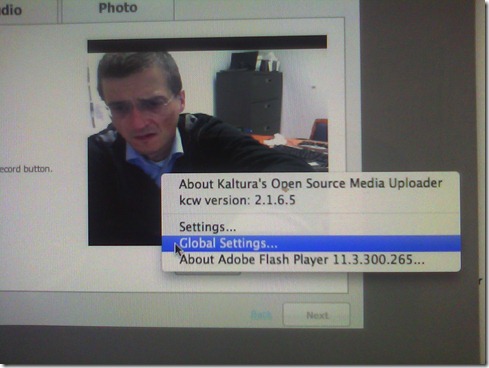
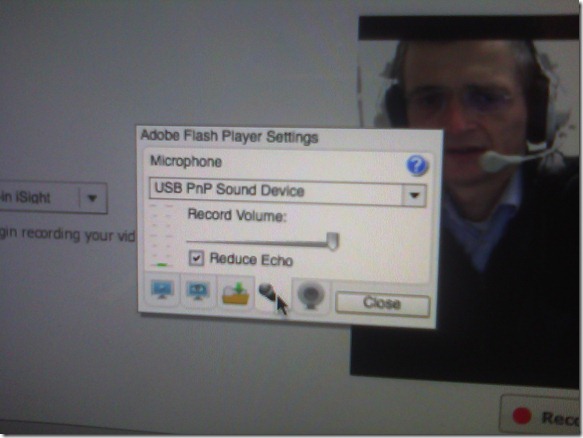
- Click on the microphone icon :

- Make sure the USB PnP device is selected.

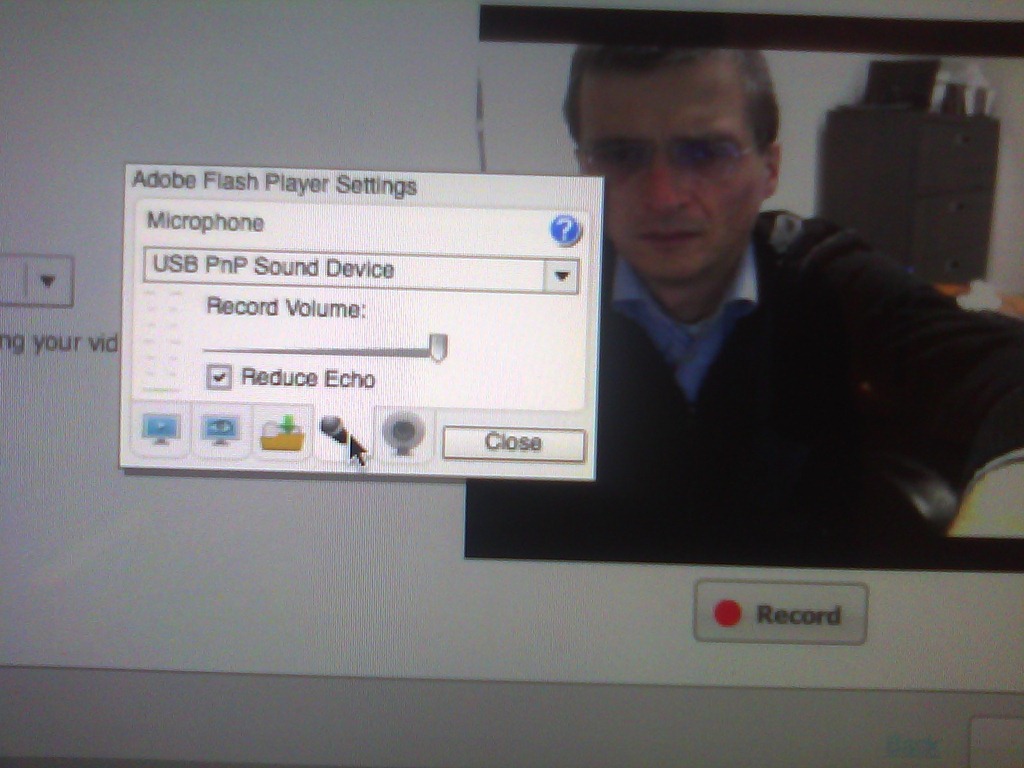
- You can bring up the settings dialogue, make sure the USB PnP device is chosen for audio and CRANK up the microphone input sensitivity! Then test the volume levels with the built-in volume meter (should show lots of green bars when you speak. You may have to adjust the Califone headset microphone arm so that the microphone is very close in front of your mouth. ) Unlike in the picture, do not choose “reduce echo ”.
- Remaining
- Questions :
- Can this sensitivity setting be permanently stored for all users in the iMac software image, or do our students always have to adjust the microphone sensitivity?
- It remains to be seen whether this inexpensive and unsecurable device survives long when being used by our student population.
- Problem : The review video function of the Moodle Kaltura Flash video remains very temperamental on the Mac OS X (In my testing, one of the numerous problems we had with Moodle Kaltura on the iMacs popped up again: when starting to review the recording, the time counter goes, but the video stalls for a few seconds – afterwards everything seems to play fine, but this is enough to confuse the heck out of my users) . While we made another small step of progress towards enabling Moodle Kaltura webcam recordings in the language resource center, it seems easier to just get web cameras for the PCs.
- Questions :



UIowa.edu phonetics website for learners of English, German and Spanish
Hone your foreign language pronunciation skills by learning about phonetics: This oft-recommended University of Iowa phonetics website “contains animated libraries of the phonetic sounds (….) for each consonant and vowel”, including “an animated articulatory diagram, a step-by-step description, and video-audio of the sound spoken in context”.

How to transcribe English into phonetic alphabet using Phonetizer.com
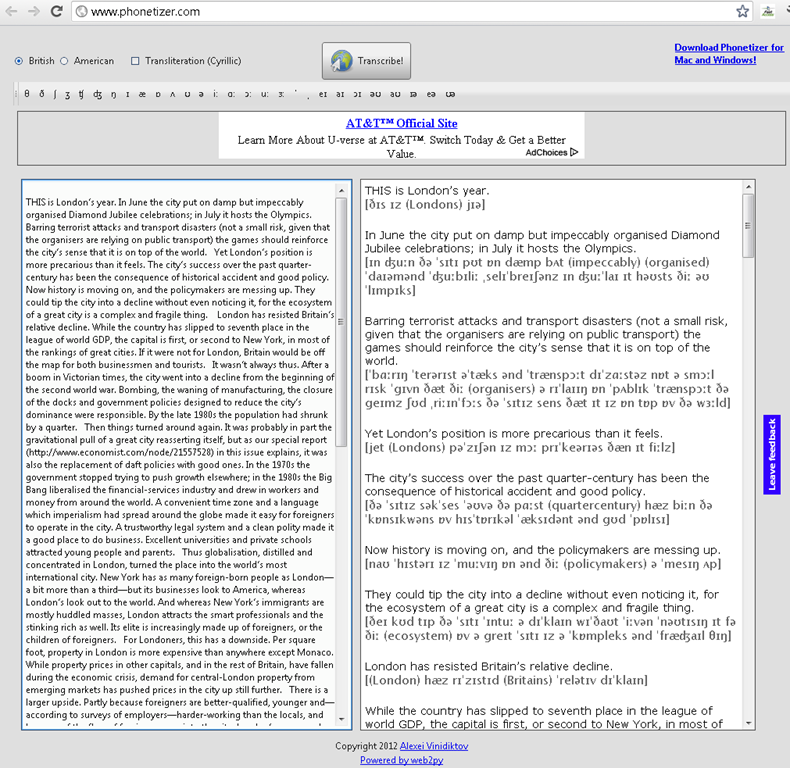
Phonetizer transcribes into IPA. The vocabulary seems somewhat limited (45000 claimed) – English spelling variants do not help, although Phonetizer offers BE as an input option. I have not found a length limit for the transcription with an article from the current Economist of over 1000 words – should be plenty for most reading/recording assignments in the LRC. Easy as (web2)py.  The web version is advertisement-based. The downloadable version is not free, so we cannot install it in the LRC, unfortunately.
Windows 7 US-English with German language pack

Just to make sure, we are still in EDT…  (and the date and other formats do not get changed with the display language either, but so does help and feedback).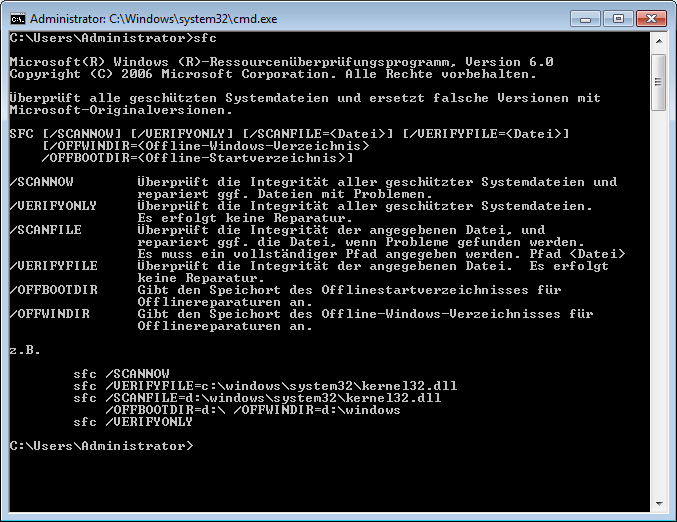
Can you find the error in Microsoft’s German localization in the command line window? Post it below.
Google-Translate for phonetization?
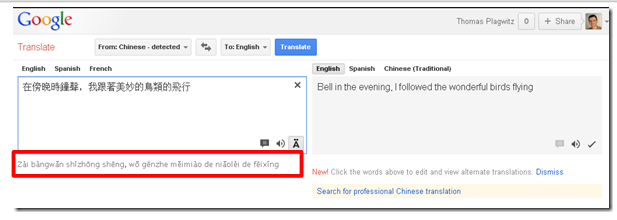
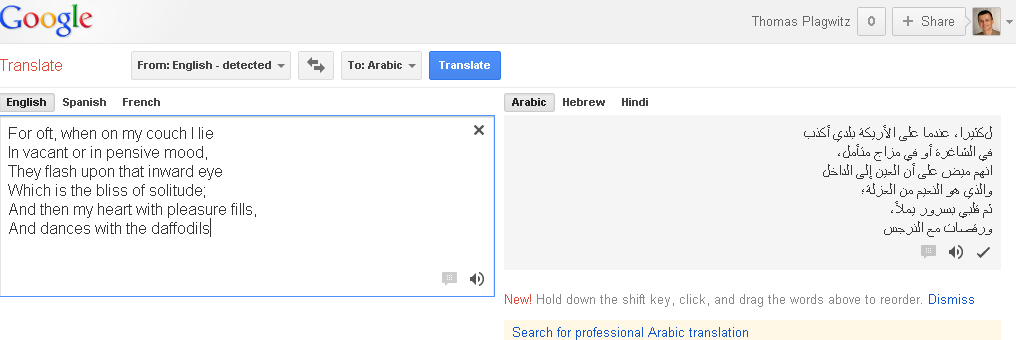
- Google-Translate also offers some phonetic transliterations. You may have noticed this when attempting (remember, though, that it is for a reason that they link to “professional translation” services, and also invite anybody to amend the machine translation offered) to translate from English into other languages,

- However, if you type or paste non-Romanized text into the source textbox, you also get the option button “read phonetically” (meaning transliterate to phonetic symbols or phonetize).
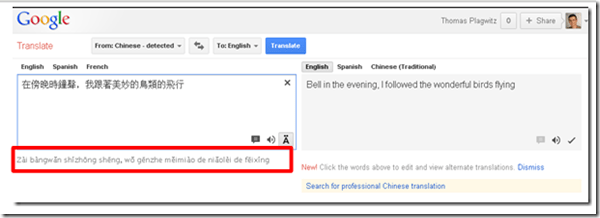
- Limited use in the LRC: Few languages are supported.
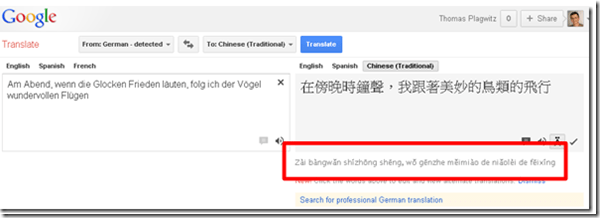
- Only languages written in non-roman letters are offered. E.g. French or German are not deemed difficult enough (I know a few that would beg to differ
 ).
).
- Arabic, Farsi and Hebrew are also not supported (root cause: right-to-left? Strangely these right-to-left-languages work in the TBA:Google transliterate IME which attempts to do roughly the opposite of phonetization):

- Leaves: Chinese, Greek, Hindi, Japanese, Russian. However, note finally that not a standard phonetic alphabet is being used either for these transcriptions.




Questions? Read the About. Or just ask me a quick Our Databases: Resources with calendars -- Language learning material Moodle Sites, multimedia files -- films


FAQs for LRC student staff or for students or for teachers. To search our FAQs, in the browser addressbar, add after "https://plagwitz.wordpress.com/feed/?tag=faqs+/" "+TAG1" (from tag cloud below) OR "https://plagwitz.wordpress.com/feed/tag=faqs
&category_name=" "CAT1" (from category hierarchy below). OR search both categories and tags, and multiple TAGs/CATs (connect with "," for OR-search, with "+" for AND-search), like so: https://plagwitz.wordpress.com/feed/?tag=TAG1+TAG2+...TAGn&category_name=CAT1
+CAT2+...CATn"
Other ways to find help
If you cannot find it here, look there: 5,500 Language-Learning Links and Programs for learning or teaching 150 languages
Shortcuts:Our Lists, Our Maps, LRC Staff Moodle Site,LRC Project Moodle Site, 49erexpress, UNCC Moodle, Student Recordings: s:claslcslrcsanakostudent
Learning usage samples: Sanako oral exam, Kaltura webcam presentation, Dictation with speech recognition, Sanako written exam, Chinese and Japanese interactive stroke-order practice
Test the Sanako Installer, Webbrowser Popup Konfigurator for XP, or Windows7, faster LRC TeacherPC Log-in Let MS facilitate diacritics writing by installing for you US-International keyboard layout
This is my personal blog (Google+). The views expressed on these pages are mine alone and not those of my employer. The information in this weblog is provided “AS IS” with no warranties, and confers no rights.
 Thomas' Work Space