Archive
Archive for the ‘Classroom-technology’ Category
Protected: Why requiring manual configuration of the Sanako by students does not work for us
2013/08/20
Enter your password to view comments.
Categories: audience-is-administration, audience-is-IT-staff, digital-audio-lab, e-languages, Glitches&Errors, Institution-is-University-of-North-Carolina-Charlotte, Presenter-Computer, service-is-configuring-learning-tools, service-is-testing-troubleshooting-debugging, Student-Computers
image2013, sanako-study-1200
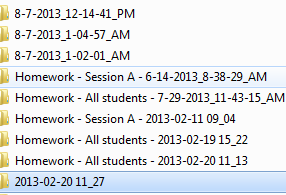
Sanako Study 1200 version 7 datetime format of file saves has changed
2013/08/09
Leave a comment
- The top items are samples from “before” (ver 5.2, XP), the bottom of “after”(ver 7, Windows 7):
 . Somewhere in between (not sure when, we skipped Sanako Study 1200 version 6 and MS-Windows-Vista), the default file naming of Sanako has changed.
 - I found out that Sanako version 7 now uses settings from the Windows Regional settings. This seems to make sense, but likely should have been always the case (it breaks or rather forces me to extend my langlabemailer), and has some disadvantage.
- So if you want a different datetime format in the file names that Sanako creates when collecting student assessments and assignments, you need to change it in Windows Regional settings now.
Categories: digital-audio-lab
datetime, langlabemailer
Request to download the Sanako Study 1200 licensing server, student and classroom name reset, program and source
2013/06/11
Leave a comment


Back to description for reset of server reset program.
Request to download the Sanako Study 1200 Recorder Installer source
2013/06/11
Leave a comment
(Please be advised that there is no compiled code download for this software program since any implementation is institution-specific. The source code (written in AutoIT) download is for demonstration purposes only and not ready to run without you making the necessary adaptations to your environment).
Back to description of sanako recorder install faculty program
How to test the LangLabEmailer
2013/06/08
Leave a comment
- The LangLabEmailer, when run, displays no GUI. To monitor:
- the progress, view the trace-listener.log;
- the results, view:
- “_sent” filenames in your assessment file store. NOTE: the LangLabEmailer will rename assessment files, by adding “_sent” to the end of the filename (for easy tracking;no deletions). If this is an issue for you, do not run it!
- “sent” items folder of mailbox used ( = mailbox of user logged into AD-domain-joined computer). NOTE: The LangLabEmailer will email assessment files from the language lab collection! (That is its primary purpose.) Specifically, it will send
- as you configured: within your campus email system (unless your campus mail administrator allows mail forwarding),
- as you configured: from the campus mail account you have the right to send from (I have the right to send ca. 3000 messages per day; you may want to inquire with your MS-Exchange admin about your limits),
- as you configured: from the student collection file share classroom data (which has special, relaxed FERPA rules),
- per its design – which is primarily based on file ownership which itself is based on who logs in on the originating lab computers and the digital audio lab software’s saving rules for pair and group work, but also by making some honest guesses about the intended recipient, based the file name and, as you configured, the list of teachers using your lab (since from experience these also happen to be logged in for students at times) – , primarily to the presumed originator and to her teacher (and in special cases, as a fallback, to whoever you configured as language lab admin).
- If this sounds a tad scary: just start with configuring
- a few “dry” test runs (no sending, no renaming, just logging what would happen)
- then some limited test runs (small time window and dummy files)
- and examine the results which the langlabemailer logs for you in either mode, and you will likely find, it is not scary.
- Next: Run. Or up:Langlabemailer table of contents.
How to troubleshoot and get help with the LangLabEmailer
2013/06/07
Leave a comment
- LangLabEmailer logs its activities automatically.
- Please consult the log files which you can find
- if you search C:\Users\[your user name]\AppData\Local\Apps\2.0\Data
- for the files
- “trace-rolling.log” (contains activity log messages).
- and, should you run into an Exception, “exception-rolling.log”.
- Useful information about the LangLabEmailer working with your MS-Exchange configuration is automatically kept in the same folder: EwsResponseHttpHeaders.txt, AutodiscoverConfiguration.txt, AutodiscoverRequest.txt, AutodiscoverRequestHttpHeaders.txt, AutodiscoverResponse.txt, AutodiscoverResponseHttpHeaders.txt, EwsRequest.txt, EwsRequestHttpHeaders.txt, EwsResponse.txt.
- Next: Request features. Or up:Langlabemailer table of contents

What are the features of the LangLabEmailer?
2013/06/07
Leave a comment
- Ver 1.0.1.0
- emails as attachments new (hitherto unsent) audio recording or writing assessment or assignment files from the language lab student collection file share to originating student and teacher
- attempts to automatically
- skip sending small files created during microphone and similar systems tests
- reroute email address for files of late students that have been collected under teacher login (simple delimited list, manually editable), but renamed to valid address
- reroute files that have been sent under position number rather than student names (including at least to one student of a student pair or group recording)
- puts meaningful course name in the email subject to easily integrate with email workflow that teachers and students will already be familiar with
- provides options to
- exclude files from sending
- language lab manager: using file name patterns and extensions
- teacher:
- by marking individual files as _sent or, preferably, put them in the subfolder
- not sending or delay sending until after grading (with inserting feedback, written or voice-insert recorded aural feedback)
- send to students only
- and more…
- Not implemented yet:
- Full Support for Sanako ver 6 save files under “last name, first name”
- Send to teacher only
- Support of Exchange Online.


Questions? Read the About. Or just ask me a quick Our Databases: Resources with calendars -- Language learning material Moodle Sites, multimedia files -- films
FAQs for LRC student staff or for students or for teachers. To search our FAQs, in the browser addressbar, add after "https://plagwitz.wordpress.com/feed/?tag=faqs+/" "+TAG1" (from tag cloud below) OR "https://plagwitz.wordpress.com/feed/tag=faqs
&category_name=" "CAT1" (from category hierarchy below). OR search both categories and tags, and multiple TAGs/CATs (connect with "," for OR-search, with "+" for AND-search), like so: https://plagwitz.wordpress.com/feed/?tag=TAG1+TAG2+...TAGn&category_name=CAT1
+CAT2+...CATn"
Other ways to find help
If you cannot find it here, look there: 5,500 Language-Learning Links and Programs for learning or teaching 150 languages
Shortcuts:Our Lists, Our Maps, LRC Staff Moodle Site,LRC Project Moodle Site, 49erexpress, UNCC Moodle, Student Recordings: s:claslcslrcsanakostudent
Learning usage samples: Sanako oral exam, Kaltura webcam presentation, Dictation with speech recognition, Sanako written exam, Chinese and Japanese interactive stroke-order practice
Test the Sanako Installer, Webbrowser Popup Konfigurator for XP, or Windows7, faster LRC TeacherPC Log-in Let MS facilitate diacritics writing by installing for you US-International keyboard layout
This is my personal blog (Google+). The views expressed on these pages are mine alone and not those of my employer. The information in this weblog is provided “AS IS” with no warranties, and confers no rights.
 Thomas' Work Space