Archive
Learning materials management: Textbook exercises (2000-2008)
Textbook exercise management is a rapidly evolving field, with more textbook becoming digital and online resources and more metadata getting added and AI getting implemented to enable personalized (data-driven, feedback-based) learning paths.
German.xls was an attempt to be able to sort, search, filter the exercises of some bigger textbooks in the American college market, each containing thousands of exercises (how many? why does it take a sumif() to find out?):

Subtitles.xls converted text files with movie subtitles which can be extracted from DVDs or found into spreadsheet for post-processing (search, filter, sort – and assign different show times, for DVD editions differ).  online,
Auralog Tell me more 7 is a language program that allegedly comes with “more than five times the amount of content than other language programs” – but strangely not with a table of contents of its exercises. Automation extracted the exercises first into the file system for full text search with Windows Desktop Search, then converted the extracted files into links in the Auralog Content XLS.
Help with playing videos
- Some videos require special codecs to display properly/ at all.
- Here is info on the H.264 codec.
- Often, it is best to try, instead of Windows Media Player (which may be the default player that opens when you (double)click on a video, but not be able to display it without manual configuration),
- the free VLC player which you can download here, if you must, and install, if you are permitted. Then right-click video, “open with”, “VLC media player”, like here:


Auralog Tell-me-more Demo Screencasts
An overview, mostly narrated:
Automating Auralog Tell-Me-More with AutoIt. Presentation at EUROCALL 2008
Auralog Tell-Me-More is a leading language learning software system which provides a vast amount of content in an advanced technical infrastructure that we found lacking in usability within an higher education language learning environment.
AutoIt is a programming language for GUI automation which I used to better integrate the Auralog software into the higher education language learning process, including
- programmatic
 creation of courses and accounts
 - programmatic extraction and digital repository management for over 30.000 learning units.

- programmatic creation of 10,000s of learning paths,

Results  were presented (screencast) at EUROCALL 2008: “Automating Auralog (pdf)”:
creates 100s of courses  , creates
  and enrols
  up to 2,000 student accounts every term,
- content extraction
 produces files
 for adding search
  and spreadsheet for sort/filter functionality:
- learning path creation.
More detailed background information here: plagwitz_auralog_accounts_project_pub.pdf, plagwitz_auralog_project_pub.pdf
MS Project training notes

- Course is about setting up a project, not tracking (but beginnings will be covered)
- file menu
- save as: e.g. webpage
- edit
- undo: only 1 undo level
- tasks
- split
- view
- calendar
- :base calendar: tools / options
- tools / change calendar [how does this relate?]
- these are company holidays
- can it load holidays like outlook – yes, from project central server
- attach the calendar to the project: project / project information
- many projects are built from finish date, but that leaves no slack time
- tasks pane
- used only with project central server?
- tool bars
- standard
- format
- ask pane
- project: quicker ways than that
- insert subtasks
- simply press insert key to insert rows
- 0 duration = milestone (can also have a milestone with a duration)
- constraints
- difference between a deadline and a constraint: deadline is less important
- review
- start
- project start date: menu / project:
- calendars:
- base calendar = tools / options / calendar
- project calendar = tools / change working time / new
- assign / attach that project calendar to the project: menu: project: project information
- show holidays on Gantt chart: context menu: Gantt chart: nonworking time (option: in front of the taskbars: interrupts the taskbars)
- recurring tasks: menu: insert: recurring task
- set duration: d = day, m = minute, mo = month, w = week
- creating link relation ships
- visually by dragging tasks onto each other in the Gantt chart
- writing in field predecessors (sf is default, s=stat, f=finish, relation ship), -lag and +lead time
- constraints and deadlines
- resources
- types
- WORK: REUSABLE
- MATERIAL: CONSUMABLE
- groups
- teams
- internal or external
- suppliers
- max units
- e.g. FULL TIME OR HALF TIME PERSON
- types
- start
- last hour
- resources – critical (overrun) tasks
- reallocating resources to reduce slack and slippage
- baseline
- set: menu: tools / tracking / baseline
- in the Gantt chart, the blackline is the baseline
- tracking
- recommended to always display the tracking toolbar
- reports
- menu: view / reports
- resources – critical (overrun) tasks
- Outlook: level 2 training
- tracking
- split task
- update task
- customization (views, reports, filters)
- master projects
- resource pools
- tracking
Collaborative timeline activity for face-to-face classes on history
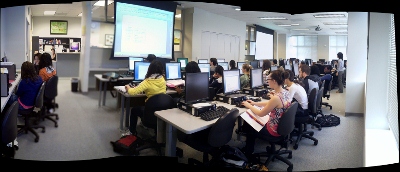
- An easily produced and repeated classroom activity, originally developed for listening comprehension and speaking practice in language classes, based on filling out collaboratively a timeline spreadsheet in the digital audio lab:
- Listen and process/write:
- Advanced German class listens to segments of an authentic German cultural history documentary from the authentic German TV series “100 deutsche Jahre” (which follows a single topic throughout 20th century German history).
- And each student enters notable summaries of events with their time of occurrence into a spreadsheet
- that the teacher
- has at beginning of activity distributed to each individual student using the digital audio labs file management features
- and after listening collects from students, merges, either with student author data or an anonymous student identifier (for corrections), into an excel timeline spreadsheet
- and visualizes the collaborative outcome as an easily collated timeline on the projector to the entire class.
- Speaking: Discuss!
- Identify what are the gravity points for the comprehension of the video by the class: Why are these events deemed important?
- What are the outliers? Criticism? Justification?
- Also correct language errors in the student output.

- In early 2006, there was no Excel web app – collaboration likely has become simpler now
- launch link to publically editable spreadsheet to class
- visualize using excel web app charts
- In early 2006, there was no Excel web app – collaboration likely has become simpler now
- Listen and process/write:


Questions? Read the About. Or just ask me a quick Our Databases: Resources with calendars -- Language learning material Moodle Sites, multimedia files -- films


FAQs for LRC student staff or for students or for teachers. To search our FAQs, in the browser addressbar, add after "https://plagwitz.wordpress.com/feed/?tag=faqs+/" "+TAG1" (from tag cloud below) OR "https://plagwitz.wordpress.com/feed/tag=faqs
&category_name=" "CAT1" (from category hierarchy below). OR search both categories and tags, and multiple TAGs/CATs (connect with "," for OR-search, with "+" for AND-search), like so: https://plagwitz.wordpress.com/feed/?tag=TAG1+TAG2+...TAGn&category_name=CAT1
+CAT2+...CATn"
Other ways to find help
If you cannot find it here, look there: 5,500 Language-Learning Links and Programs for learning or teaching 150 languages
Shortcuts:Our Lists, Our Maps, LRC Staff Moodle Site,LRC Project Moodle Site, 49erexpress, UNCC Moodle, Student Recordings: s:claslcslrcsanakostudent
Learning usage samples: Sanako oral exam, Kaltura webcam presentation, Dictation with speech recognition, Sanako written exam, Chinese and Japanese interactive stroke-order practice
Test the Sanako Installer, Webbrowser Popup Konfigurator for XP, or Windows7, faster LRC TeacherPC Log-in Let MS facilitate diacritics writing by installing for you US-International keyboard layout
This is my personal blog (Google+). The views expressed on these pages are mine alone and not those of my employer. The information in this weblog is provided “AS IS” with no warranties, and confers no rights.
 Thomas' Work Space