Archive
Archive for the ‘Presenter-Computer’ Category
How in Windows 7 multiple windows can share in one screen, and multiple screens in one window
2012/05/23
Leave a comment
- The windows management improvement I use most in Windows 7, in order to view multiple windows simultaneously (after introduction of preemptive multi-tasking in the late 80s, the operating system was renamed from MS-DOS to MS-Windows, not to “MS-Window”) is the snap-to-edge which you can access
- either by “throwing” your window (drag the title bar) to the left or right edge of your screen (top or bottom will maximize or minimize your window);
- or if you rather use the keyboard,
 + left/right arrow (+ up/down arrow will maximize or minimize your window). Keep pressing the combination and you will cycle the window position. Note that this works also across dual-screens.
- Also a welcome relief: In Windows 7 dual screen environments, you can drag and drop maximized windows between screens.
- The fact that you could not in Windows XP (where you have to de-maximize the windows first before dragging it) has caused much confusion wherever I introduced multi screen computers for teachers;
- in spite of the fact that you could not drag a maximized window away in the single screen environment that our users are more accustomed to.
- Guess I can now rather focus on upgrading a 11-year old OS to Windows 7 than on coming up with a more memorable explanation. Actually, people are currently raving about the dual-screen management improvements in Windows 8, but I that will take a bit longer to trickle through.

How to play a DVD from the LRC teacher podium
2012/05/04
Leave a comment

- On the Control panel, click on “DVD”
- This makes the DVD controls appear, which include play and FF.
- By clicking on “Advanced Controls”, you can access another screen with more controls.
- Or you can play your DVDs from the teacher podium computer which is more integrated with the rest of the computer use, and you do not have to walk over to the AV cabinet to insert the DVD. Read in…
Categories: audience-is-teachers, Presenter-Computer
DVDs, videos
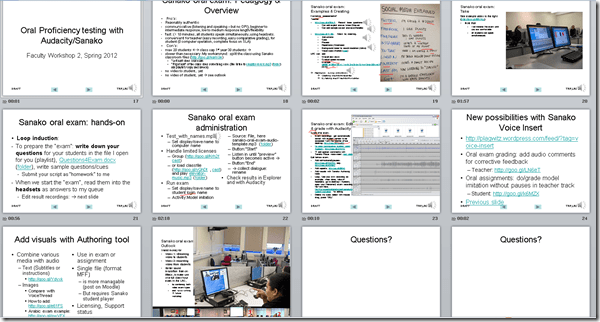
Spring 2012 Faculty Workshop II: Oral Proficiency testing with Audacity/Sanako
2012/04/30
Leave a comment
- View screens (best viewed side by side, but note that left and right screen are not synchronized):
- for full slide show (note the included short links for convenient further reading), left screen

- for Sanako interface and full audio track, right screen
 .
.
- for full slide show (note the included short links for convenient further reading), left screen
- Table of contents:
- Overview of a Sanako Oral Exam
- Examples of Exam teachers’ exam question recordings
- Example of a Sanako Exam
- Loop induction
- creating an exam question recording
- by taking a Sanako exam as a student
- Step-by-Step of administering a Sanako oral exam
- Grading Sanako oral exam student files
- Sanako voice insert for
- facilitating recording oral assignments for student without hard-coded pauses
- commenting on student responses during grading
- Sanako voice insert for
- Sanako authoring tool for providing visual on top of aural cues to students

Categories: Absolute-Beginner, Advanced, Arabic, audience-is-teachers, Beginner, digital-audio-lab, e-languages, English, Farsi, French, German, Greek (modern), Hindi, Intermediate, Italian, Japanese, Korean, Listening, Mandarin, multimedia-recording, Polish, Portuguese, Presenter-Computer, Russian, Screencasts, service-is-assessing, service-is-learning-materials-creation, Slideshows, Spanish, Speaking, step-by-step-guides, Student-Computers, Swahili, workshops, Yoruba
audacity, authoring-tool, sanako-study-1200, student.exe
How a teacher can use Sanako voice insert to easily add spoken comments to students’ Sanako oral proficiency exams
2012/04/25
Leave a comment
- All other things equal (given a limited amount of time), teachers can provide more and better corrective feedback on student oral proficiency recordings if, during their grading, they could easily insert their own oral comments into the students’ recordings (delivered as MP3 files to teachers’ desktops after Sanako oral exams).
- Both the Sanako Tutor and Student Player have a voice insert mode that is much easier and quicker to use than (albeit not free as) editing the student audio in Audacity (which we still recommend for bare-bone viewing/listening because of Audacity’s capability of loading and displaying multiple tracks simultaneously).
- Fortunately, Sanako tutor/student player are available on the teacher/student station PCs in the LRC (the latter’s insert function is available when the PC connected to the running Sanako Tutor on the teacher station).
- How easy and fast is it to use this? As you can see in this demo screencast on how to use Sanako voice insert to add spoken comments into your students’ Sanako oral exams
 , voice insert only requires:
 - a click on the voice insert button in the center, whenever a user wants to speak during listening,
- and, from the top left menu, a “file”/ “save as” at the end.
- In a next step – not only during the grading process –, how easy is it to distribute student recordings made with Sanako to students? That is TBA:a different story.
Protected: Sanako Study 1200 Final oral exam for advanced Business Spanish: A Job interview
2012/04/19
Enter your password to view comments.
Categories: Advanced, Arabic, audience-is-teachers, classroom-management-system, English, Farsi, French, German, Greek (modern), Hindi, Italian, Japanese, Korean, learning-usage-samples, Listening, LRCRoomCoed434, Mandarin, multimedia-recording, Photos, Polish, Portuguese, Presenter-Computer, Russian, Screencasts, Spanish, Speaking, step-by-step-guides, Student-Computers, Swahili, Videos, Yoruba
oral-exams, sanako-study-1200
Sanako Study 1200 controlled web browsing–strict policy
2012/04/18
Leave a comment
- View an
 80-seconds screencast showing how a teacher can set up a student activity where students are only allowed to access on web site.
 - In this example, the website is a common dictionary: http://www.dict.cc which the student will be allowed to access during an exam (in lieu of a paper dictionary policy).
- Never mind that the voiceover is partially in German – the video should be self-explanatory. If not, here is a written step-by-step on Sanako controlled webbrowsing.
Labstats Error
2012/04/11
Leave a comment
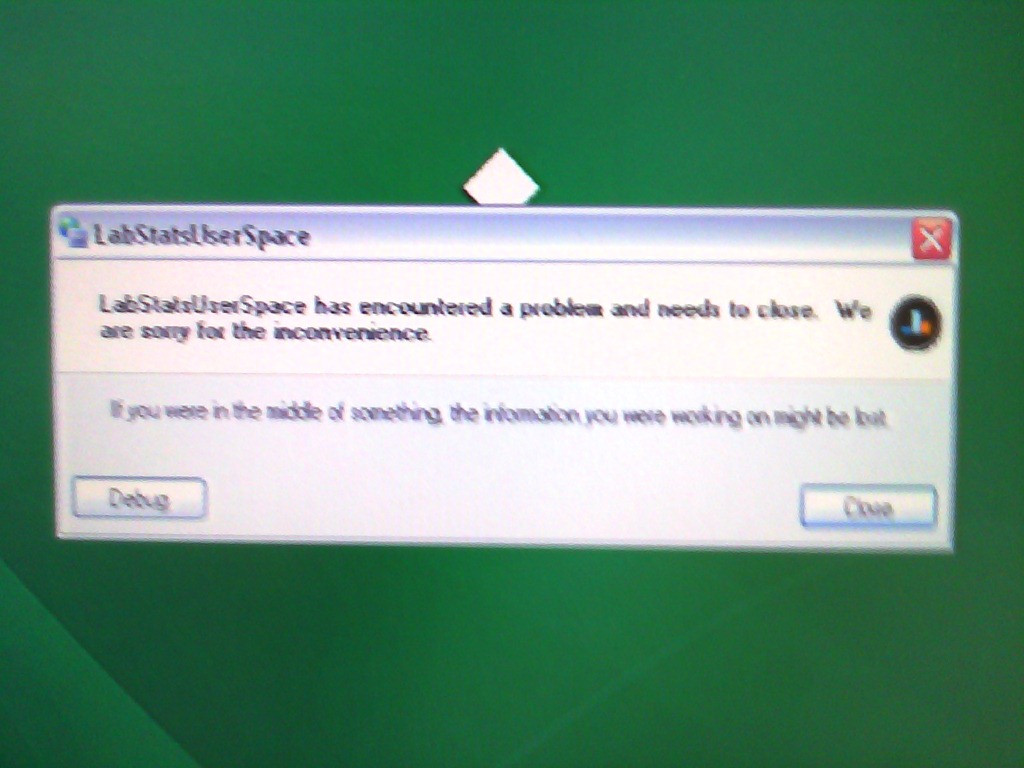
- Computer fails to shut down, with this error:
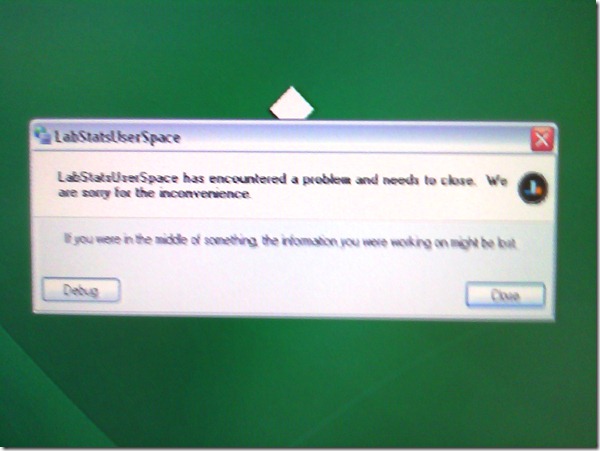
- Pressing “Debug” does not do anything.
Categories: Glitches&Errors, Presenter-Computer
labstats

Questions? Read the About. Or just ask me a quick Our Databases: Resources with calendars -- Language learning material Moodle Sites, multimedia files -- films


FAQs for LRC student staff or for students or for teachers. To search our FAQs, in the browser addressbar, add after "https://plagwitz.wordpress.com/feed/?tag=faqs+/" "+TAG1" (from tag cloud below) OR "https://plagwitz.wordpress.com/feed/tag=faqs
&category_name=" "CAT1" (from category hierarchy below). OR search both categories and tags, and multiple TAGs/CATs (connect with "," for OR-search, with "+" for AND-search), like so: https://plagwitz.wordpress.com/feed/?tag=TAG1+TAG2+...TAGn&category_name=CAT1
+CAT2+...CATn"
Other ways to find help
If you cannot find it here, look there: 5,500 Language-Learning Links and Programs for learning or teaching 150 languages
Shortcuts:Our Lists, Our Maps, LRC Staff Moodle Site,LRC Project Moodle Site, 49erexpress, UNCC Moodle, Student Recordings: s:claslcslrcsanakostudent
Learning usage samples: Sanako oral exam, Kaltura webcam presentation, Dictation with speech recognition, Sanako written exam, Chinese and Japanese interactive stroke-order practice
Test the Sanako Installer, Webbrowser Popup Konfigurator for XP, or Windows7, faster LRC TeacherPC Log-in Let MS facilitate diacritics writing by installing for you US-International keyboard layout
This is my personal blog (Google+). The views expressed on these pages are mine alone and not those of my employer. The information in this weblog is provided “AS IS” with no warranties, and confers no rights.
 Thomas' Work Space