Archive
LLC Catalogue: Video-Reserves.xlsm, Reserve desk, Schedule, using Blackboard Content System WebDAV
For a LLC video schedule, we came up with the following repurposing of existing infrastructure:
- MS-Excel: still the “Swiss army knife” of choice for the middle manager. Allows for: semi-automatic creation of reserve date sequences (insert series), given a start and end date; data validation during data entry, and, based on that, sorting and filtering and, based on that, finding.
- Blackboard Content management system (WebDAV) to manage reading and writing (editing) permissions.

- Staff can use MS-Excel to request videos – preferably at start of term – to be put on reserve within a start and end date, during which they will be periodically shown, by opening the spreadsheet from MS-Excel and filling in the green cells in the first empty row at the bottom.

- Lab Staff can use MS-Excel to periodically transfer video reserve requests into video showings.
- Lab Assistants can use MS-Excel to daily maintain video reserve desk and video showings.
- Students can use a web browser to preview video showing times during the remainder of the term.
- To open the video schedule for read-only, Loyola students and staff can simply click this link in their browser: https://blackboard.loyola.edu/bbcswebdav/users/trplagwitz/llc-pfiles/video/video-reserves.xslm. Even read-only access includes the capability to search, sort and filter the schedule data, but you cannot save back.
- To open the video schedule for editing, LLC and Modern Languages staff can start MS-Excel, click menu: File / Open, and copy/paste this link: https://blackboard.loyola.edu/bbcswebdav/users/trplagwitz/llc-pfiles/video/video-reserves.xslm, then click open.
- All users will have to authenticate with their institutional account info:


Blackboard: Content System: Permissions, Roles and Gotchas
- The “Course user list“ refers to courses.
- The “Organization user list” refers to departmental groups. The subdivision is meaning list for our department.
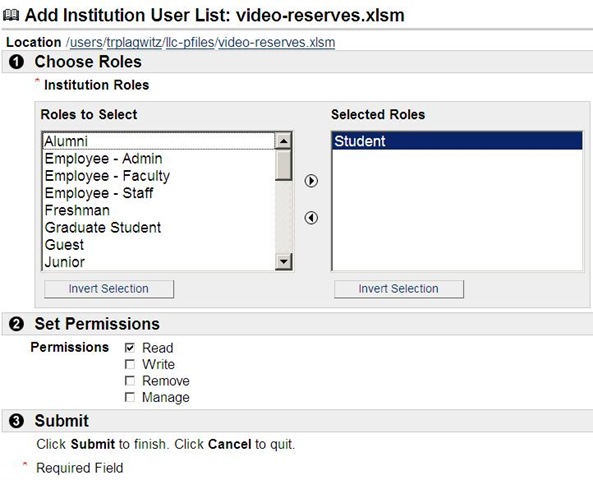
- The “Institution user list” adds the most global group level.

- Finally, you can make files available to the “Public”. Note, however, that this seems to effectively bypass the more fine-grained permission checks. E.G. if you give read access to the public, users who open your files will not receive an authentication challenge, so if you try to give some of the users write access to your files, that will not trickle through. Workaround: Do not use “public”.
A better way to do student homework audio recordings in the Sanako LAB 300, using Blackboard:Assignment
-
More robust than the more common way using the default network shares of a Sanako Lab 300 – to my knowledge, up to this day Sanako Labs lack any integration with the LMS/VLE regarding the upload of student output – is using the assignment tool of the VLE which provides integration with the Student Information System and an entire infrastructure for assessment purposes (gradebook and beyond).
-
I know that some teachers use Blackboard email with attachments for assignments, others the blackboard drop-box. Some, including me, use the assignment tool which, since it appears to be far superior to the older tools, this post would like to advertise.
-
The assignment tool automatically creates a grade center column.
-
You can batch download student file submission (papers or recordings) and blackboard assignment tool puts the assignment name and the username in the file name for easier management,
-
and you can upload a graded version to return assignments to the student and include comments.
-
You can also create comments for the instructors only to view.
-
Faculty can also use track changes and insert more fine-grained comments and corrections within MS-Word.
-
-
Here are the parts of this series:
-
How the student reviews a grade Blackboard audio recording assignments: TBA.
Student attendance metering: present signin.xls and perspectives
We are working on replacing the old attendance meter which is still down:

As you will remember, we have been recording attendance last term and made this data available to you on our new network share: H:\llc\people\Sign_In_Sheet.xls. To summarize your students attendance, you can filter this data, using standard excel features.
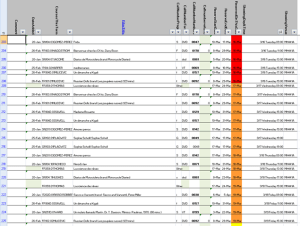
New this term: To help you with this, we added an hard-coded MS-Excel auto-filter (see down-arrows in column headers): filter by course language, then number, then teacher, then the student in question , to summarize during assessment.
We expanded the data validation, so that we get the computer help us processing the data (sort, filter, search…).
Per your request, we added the course number, section and teacher columns to the sign-in sheet (to be manually updated at every term start – a poor man’s integration into the campus information system which had better not be done even by central services, but rather only purchased by them):

Individual teachers can use the built-in filters to drill down to their classes/students for advising/grading.

Individual student can be tracked, together with their time spent in the LLC:

Students enter in the green columns, mostly having to access only built-in shortcuts and selection boxes, while the other columns get updated completely automatically.
To enable students inputting their information directly, we have hacked together a dual screen system in the LLC entrance area.

We will also use this dual screen system for improving other LLC services, by hooking into central services. We will ask students with less than clear requests (“My professor wants me to do my homework here, where is it?”) to load their syllabus from blackboard and share their screen with the lab assistant, to assist with (not solve: that would need library resources, meaning professional library catalogue, library professional staff and library professional network and procedures) locating movies and other assigned learning materials.
For the attendance meter, this means: students can enter this information themselves; lab assistants still supervise, and collect the student ID to double check and prevent the cheating that I was approached about to fix with the prior system: signing in for friends, especially with passwords separate from university-wide passwords which there is no reason to keep secret.
Please note that this home-brew spreadsheet-based system is still severely limited in its functionality.
We could POSSIBLY (this would need setup and coordination with various central offices) automate this more, given time for the initial investment.
I have experimented with hooking into the swipe card system. However, students would have to be asked to swipe out also. For other reporting purposes, I have already managed to retrieve this data in this form: 
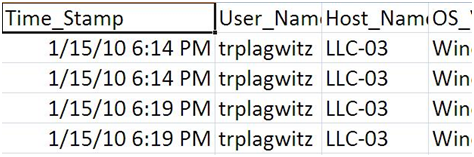
I have experimented with recording log-in (but no log-off) data on the LLC computers (another hack) in a centrally available spreadsheet, in this format:
I have inquired about using Microsoft’s SCCM (a generic software management application not meant for monitoring learning or language learning): We could gather statistics on two LLC-specific programs: the SANAKO media player and the webbrowser.exe (both, however, are likely, but not required to be used for language learning if a student prefers to do the learning in other applications). Neither would record actual files being opened.
All of these approaches, while preventing the most blatant cheating, still would not record actual language learning activity. They do not prevent students from spending their time in the LLC doing unrelated activities (like browsing sports news or playing online games) while they can do their assigned Blackboard and Quia homework from the convenience of their residence.
It is the professional systems that have been programmed with the resources from of revenue of literally thousands of campus-wide installations that can record these language learning activities.
The Sanako language lab software contains a webbrowser.exe which can not only be remote controlled by the teacher, but also be configured to allow only browsing certain (partial) urls or disallow browsing certain urls. it is also possible to apply different policies in different situations. this facility, while part of the package your purchased with the lab, has not been set up as of yet.
It would require developing policies and implementing them. E.g. one could during non-class use of the LLC only allow browsing publisher websites, including Quia.com, and Blackboard.loyola.edu and Loyola.edu (a radical approach).
One could also explicitly preventing certain websites, like Facebook (this would be more effective during face-to-face session in the LLC).
Then there are the facilities within your textbook websites (Quia) and within your course management (Blackboard, keywords for free tools being: Course Statistics, Statistics Tracking with activity_accumulator, Performance Dashboard, Early Warning System Rules, Adaptive Release rules for content, project ASTRO which is an acronym for Advanced System Tracking and Reporting Online), or as an add-on (Provost Pulse).
With the impetus being on ubiquity these days, it will have to be seen whether there are tools for Blackboard or Quia that can help enforcing that students use specific computers (maybe via IP address of computer?).
Beyond these solutions, there is an entire research area for, and software market revolving around, student retention management which also covers attendance tracking. Notable players include Hobsons EMT® Retain and Starfish Early-alert (which is run by a former Blackboard VP and can be integrated with Blackboard student data system as a building block).
I suggest we invest our limited local resources into finding better ways to integrate and train on these existing central facilities that provide information on learning (which we then can use to refine our teaching). Given current circumstances, I would recommend exploring the tracking systems in Quia and Blackboard (not restricted to being used on the LLC computers) and tracking learning outcomes (like student language recordings which the LLC can help with – not as much with the digital recording technology which is being commoditized, but rather with providing a language learning shared/collaborative/meeintg space).
Blackboard: Rolling over courses between terms
In your old course, go to CONTROL PANEL > COURSE COPY”.
Choose: “Copy Course Materials into an Existing Course” (assuming your new course shell has been created for you by your IT admin).
Click button:“Browse” and in the opening window, choose your existing current course, by the term identifier:
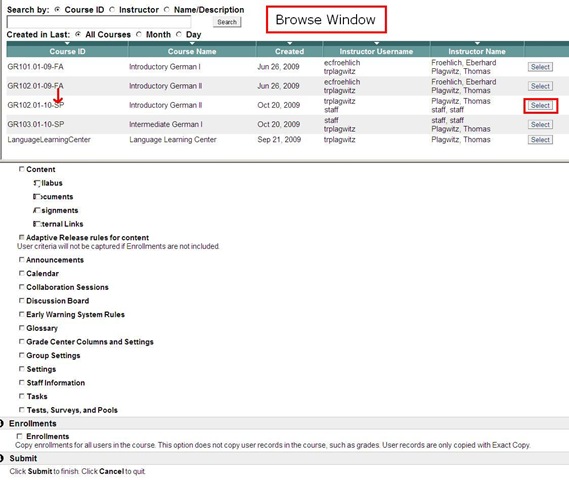
Check all items you want to copy. What is safest to avoid errors? Everything, except enrollments?
Click “Submit”/“OK” until done.
The course copy operation will be queued up, and you will be notified when the operation is finished.
Then go to your new course. This operation also copied the content items, including the content management system items.


Blackboard: Discussion board: Unread posts
- The Blackboard discussion board is designed for busy people keeping track of large constituencies – some classes have 1 instructor, 100s of participants and discussion board assignments….
- One of the most useful features is when you enter the discussion board, there is a shortcut to the “Unread Posts”, like marked here:
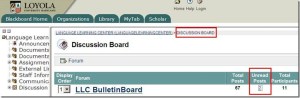
- If you click on this number of unread posts, you are taken to an overview page (sorted counter-chronologically be default; not threaded, but you have plenty of other display and management options), which you can skim for new developments, as well as use to manage your posts:

- Examine the top menu for options. You can either for individual posts click “mark as read”, as you read each one. Or you can use the “select all” tool and the “mark all as read” button in the top menu to clean up your board. Once you leave, your discussion board home page should look like this:


How to distribute learning materials using the Blackboard Content System
I needed to make a large set of textbook mp3 files accessible to myself in the classroom, as well as to students and myself from dorm/home.
The Blackboard Content System makes this easy, while observing copyright restrictions.
Below is a 6-minute narrated screencast on how to set up and use the Blackboard Content System to easily (work on batches of files on the web, just like on your computer, access from office, classrooms or home office) and securely (allow access only to qualified students) handle multimedia files
The example involves numerous mp3 files from a Textbook Audio CD previously only accessible from the LLC computers)).
This would work as well with your self-created teaching materials, from text handouts to video recordings.
If you need better management (many files, reuse across terms) than the standard course document upload can provide.
See the video file name for a brief table of contents:
If the teaching material item is already in the content collection, to publish it to a new course:
- add a new item to a content area of the course,
- follow the numbered steps 1-4 in this screenshot:

- then click submit twice: first close the content system window with
 , to automatically give your students access to the files:
  , then finish adding





Questions? Read the About. Or just ask me a quick Our Databases: Resources with calendars -- Language learning material Moodle Sites, multimedia files -- films


FAQs for LRC student staff or for students or for teachers. To search our FAQs, in the browser addressbar, add after "https://plagwitz.wordpress.com/feed/?tag=faqs+/" "+TAG1" (from tag cloud below) OR "https://plagwitz.wordpress.com/feed/tag=faqs
&category_name=" "CAT1" (from category hierarchy below). OR search both categories and tags, and multiple TAGs/CATs (connect with "," for OR-search, with "+" for AND-search), like so: https://plagwitz.wordpress.com/feed/?tag=TAG1+TAG2+...TAGn&category_name=CAT1
+CAT2+...CATn"
Other ways to find help
If you cannot find it here, look there: 5,500 Language-Learning Links and Programs for learning or teaching 150 languages
Shortcuts:Our Lists, Our Maps, LRC Staff Moodle Site,LRC Project Moodle Site, 49erexpress, UNCC Moodle, Student Recordings: s:claslcslrcsanakostudent
Learning usage samples: Sanako oral exam, Kaltura webcam presentation, Dictation with speech recognition, Sanako written exam, Chinese and Japanese interactive stroke-order practice
Test the Sanako Installer, Webbrowser Popup Konfigurator for XP, or Windows7, faster LRC TeacherPC Log-in Let MS facilitate diacritics writing by installing for you US-International keyboard layout
This is my personal blog (Google+). The views expressed on these pages are mine alone and not those of my employer. The information in this weblog is provided “AS IS” with no warranties, and confers no rights.
 Thomas' Work Space