Archive
Professional Development for Persian instructors
Persian Curriculum Design (Advanced)
Startalk Program in Washington DC
June 4, 2012 — June 15, 2012 ~ Residential Program
In the course of two intensive weeks, this program will help instructors in facing the challenges of the twenty-first century in teaching Persian. This professional development program will include sessions on standards-based curriculum planning, multi-media technology, learner-centered classroom strategies, and second language acquisition theories, as well as familiarity with assessment tools. Applications are accepted from novice and experienced instructors of Persian. Familiarity with Standards-based language teaching preferred. A limited number of stipends ($500) will be available to applicants, and accommodation available for out of town participants.
DEADLINE: April 30, 2012
To apply, please fill out the application here, and email your CV to persian@gwu.edu. Please forward any inquiries to persian@gwu.edu, or call for inquiries: Professor Pardis Minuchehr at (202) 994-7948.
How to use visual instead of aural cues during a Sanako oral proficiency exam
- This exam file has been authored with the Sanako Study 1200 TBA:authoring tool. It is displayed from the Sanako tutor application:
- images on a projection screen connected to the teacher computer,
- aural portion through the tutor-controlled Sanako student player and headsets.
- To protect the integrity and allow for reuse of the exam, only the initial instruction, example and collection of the results of an exam with visual cues are shown in this screencast
 .
.
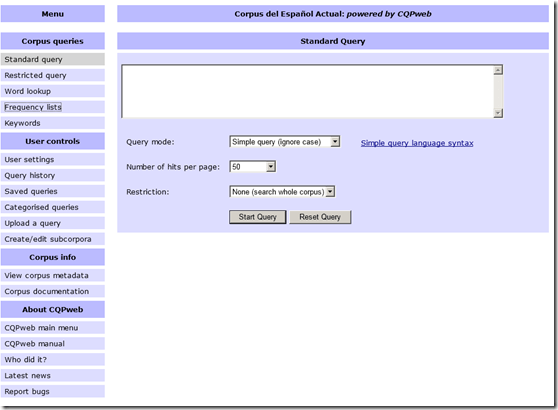
Corpus del Español Actual (CEA)
-
Link:
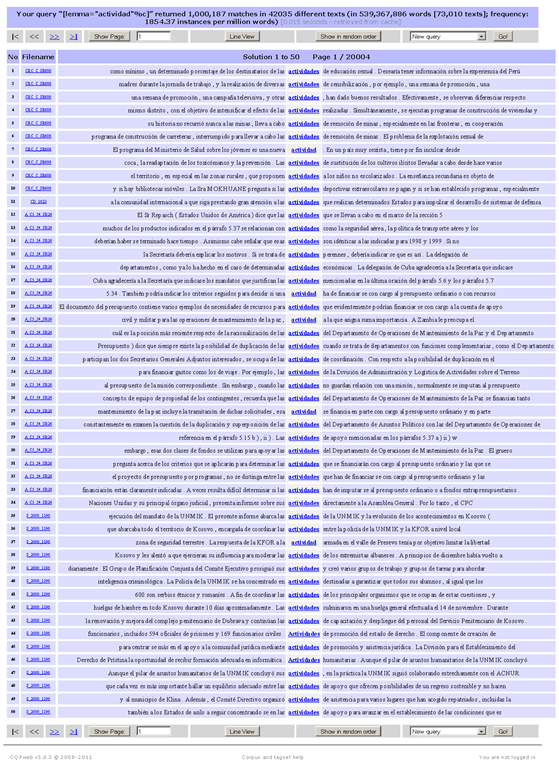
- Example of KWIC view result:

- Based on Europarl, Wikicorpus (2006!), MultiUN. From their metadata page:
Metadata for Corpus del Español Actual
Corpus name
Corpus del Español Actual
CQPweb’s short handles for this corpus
cea / CEA
Total number of corpus texts
73,010
Total words in all corpus texts
539,367,886
Word types in the corpus
1,680,309
Type:token ratio
0 types per token
Text metadata and word-level annotation
The database stores the following information for each text in the corpus:
There is no text-level metadata for this corpus.
The primary classification of texts is based on:
A primary classification scheme for texts has not been set.
Words in this corpus are annotated with:
Lemma (Lemma)
Part-Of-Speech (POS)
WStart (WStart)
The primary tagging scheme is:
Part-Of-Speech
Further information about this corpus is available on the web at:
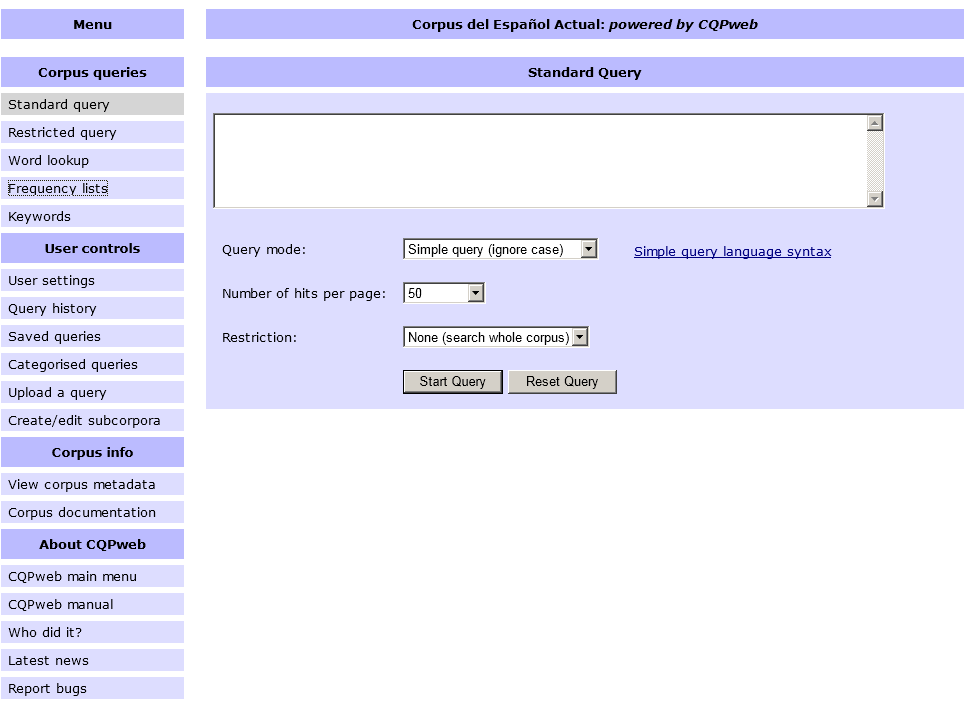
- To use, “consult the IMS’s brief description of the regular-expression syntax used by the CQP and their list of sample queries. If you wish to define your query in terms of grammatical and inflectional categories, you can use the part-of-speech tags listed on the CEA’s Corpus Tags page.”
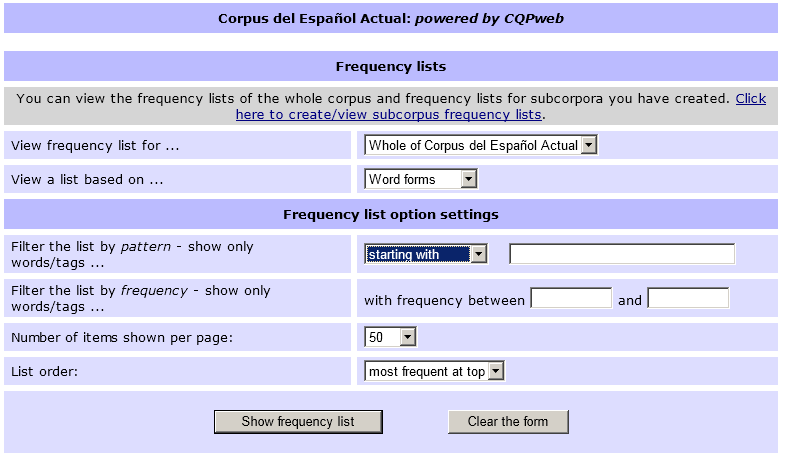
- Also provides frequency data (based on word forms or lemmas, and others – up to a 1000):

- Examples of a frequency query result (click for full-size image. Note that a lemmatized list was requested here which links all inflected forms back to the lemma, and vice versa, upon clicking the lemma, displays a KWIC view containing all forms subsumed under that lemma, see picture above):


Protected: Sanako Study 1200 Final oral exam for advanced Business Spanish: A Job interview
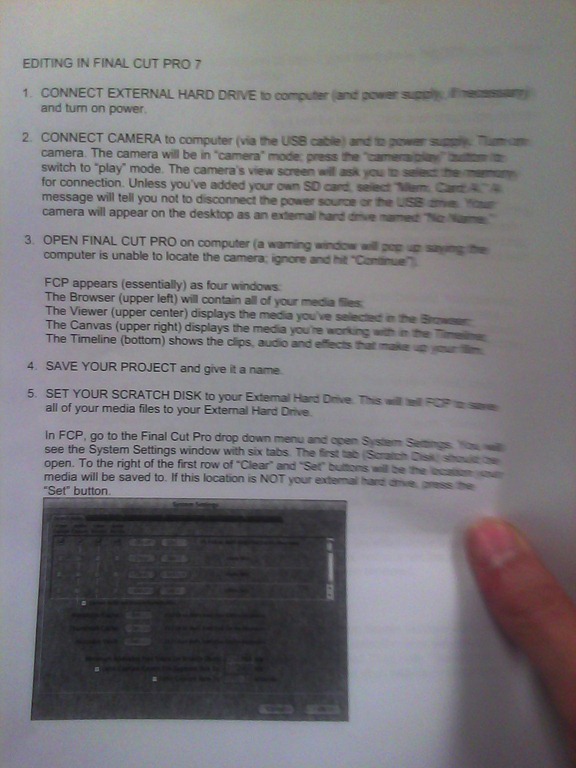
Final Cut Pro Introduction
(A handout from the Film Studies program – click on photo for larger view)


Apply for STARTALK Travel grants for Summer Institute on LCTL by 5/1/2012
“The Penn Center for Foreign Language Teaching and Learning with Technology (PLC) will host the second STARTALK Excellence in Leadership Summer Institute at the University of Pennsylvania, Philadelphia. For each of the languages (Chinese, Dari, Hindi, Swahili, Turkish and Urdu), the Summer Institute invites no more than five participants for each language group. These participants must hold positions as principals, supervisors of world language and/or language program directors who wish to implement curricular changes, employ pedagogically-sound applications of technology and gain leadership know-how in an effort to strengthen, expand and solidify their respective programs. These leaders will become STARTALK multiplicators who in turn will promote and implement programmatic and curricular changes. The program of the Summer Institute is designed for Leader-Teachers to:
• gain leadership know-how
• strengthen existing programs
• expand and solidify programs
• discuss current pedagogical trends in language education
• promote and implement curricular changes
• endorse lasting efficacy of robust learning outcomes
• practice pedagogically-sound applications of technology
• engage in succinct field building opportunities
Applications are due May 1, 2012. To apply and for information about travel and accommodations, please visit our website at:
http://www.plc.sas.upenn.edu/elsi2012/Application.html”
Installing support for non-western languages in Windows XP
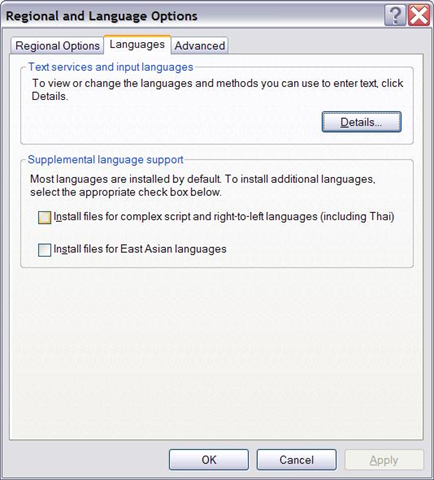
- You do not have them if your control panel / regional and language options looks unchecked like this:

- you need your Windows XP install disk
- The installer is not smart enough to find the i386 folder, nor to find all files around it.
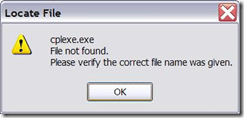
- Just point the installer to the directory manually where you located the file in question.

- The initial directory it is lookiong for is /i386/lang. The 2nd directory it is looking for is /i386.
- Additional complication: files in the install source are compressed, and their filename is altered (e.g. “.ex_” instead of “.exe”). So it is “Go figure”.
- Hm, I could have sworn this was the first thing I did here. Are downgrades being slipstreamed? I hope I did this now for the last time. Update: No, I did not…




Questions? Read the About. Or just ask me a quick Our Databases: Resources with calendars -- Language learning material Moodle Sites, multimedia files -- films


FAQs for LRC student staff or for students or for teachers. To search our FAQs, in the browser addressbar, add after "https://plagwitz.wordpress.com/feed/?tag=faqs+/" "+TAG1" (from tag cloud below) OR "https://plagwitz.wordpress.com/feed/tag=faqs
&category_name=" "CAT1" (from category hierarchy below). OR search both categories and tags, and multiple TAGs/CATs (connect with "," for OR-search, with "+" for AND-search), like so: https://plagwitz.wordpress.com/feed/?tag=TAG1+TAG2+...TAGn&category_name=CAT1
+CAT2+...CATn"
Other ways to find help
If you cannot find it here, look there: 5,500 Language-Learning Links and Programs for learning or teaching 150 languages
Shortcuts:Our Lists, Our Maps, LRC Staff Moodle Site,LRC Project Moodle Site, 49erexpress, UNCC Moodle, Student Recordings: s:claslcslrcsanakostudent
Learning usage samples: Sanako oral exam, Kaltura webcam presentation, Dictation with speech recognition, Sanako written exam, Chinese and Japanese interactive stroke-order practice
Test the Sanako Installer, Webbrowser Popup Konfigurator for XP, or Windows7, faster LRC TeacherPC Log-in Let MS facilitate diacritics writing by installing for you US-International keyboard layout
This is my personal blog (Google+). The views expressed on these pages are mine alone and not those of my employer. The information in this weblog is provided “AS IS” with no warranties, and confers no rights.
 Thomas' Work Space