Archive
Archive for the ‘service-is-tutoring’ Category
OWA Calendar collaboration is spreading on campus…
2013/02/24
Leave a comment
… in Spring 2013 to Student Advising and Central Tutoring, from the LRC tutoring, staffing and room and equipment booking since Fall 2011. Glad to see that we get more benefit out of this new tool. 
A classroom-management-system-based emporium to improve tutoring support for Hybrid Spanish students
2012/11/26
Leave a comment
- “[T]o bridge the gap between students’ demand for introductory Spanish courses and adequately staffing”, UNC-Charlotte – using, among others, a UNC-Chapel Hill pilot as a model, which, however, served a different student population and was soon faded out again – introduced a hybrid model for 1st year Spanish:
- Weekly contact hours were cut in half (effectively doubling student numbers per teacher ) ,
- and attempted to be replaced by more extensive assignment of homework exercises/quizzes from the online textbook component
- for lack of own technical resources (p.54), not that the components were designed for a hybrid purpose – but always nice to see language teachers adopt technology for ROI in creative ways when they have to.
- for the same reason of incapability of “adequately staffing”, so that teachers do not have to operate the computers, only those activities from the online components were chosen that could be automatically graded (while the continued reliance of online quizzes on right/wrong black/white schemes instead of at least considering editing distance (maybe reasonably also for foreign language diacritics), not to mention attempts on a truly semantic understanding of student input, makes one wonder if this subset of assignments could effectively and should be left to auto grading).
- and other, auxiliary syllabus guidelines, like:
- taking more advantage of the online textbook component for
- heavier formative testing
- outcome testing
- requiring “oral testing administered two or three times a semester” (p.46, 64)
- increased focus on taking advantage of contact hours by communicating, what is now often deemed flipped classroom pedagogy and used to be called homework preparation
- taking more advantage of the online textbook component for
- tutoring, for students that could not handle the cut in face-to-face time with teacher (note, tutors were from the grad student teacher pool – not all teachers were grad students)
- face-to-face:
- online, during off-hours (weekends):
- seems a welcome extension, and a convenient time-saver
- however, little adoption
- additionally, hindered by a technology change from Wimba to Centra.
- also hybrid? The LRC
- could be host to an emporium like Virginia Tech’s: computerized for access to online assignments, but under tutor guidance;
- could provide the Sanako classroom management and digital audio lab system for making this learning experience even ore efficient. The tutor on teacher station can monitor many students (simultaneously or automatically cycling through student stations at an interval of choice, while stopping interactively where desired) via screen sharing. Interact with any student computer via remote control, with the student over headphones, without disrupting,
- easily escalate presentation of tutor or model student screen and audio discussion of endemic problems to either student group as a whole or subset (meaningful as long as 2 or more students overlap in their assignment activity and have similar issues) via the Sanako – and of course also use the classroom projector.
- Hybrid Spanish clearly constitutes a radical program change, dictated by shortness of funds and requiring measures to efficiency and effectiveness of instruction, upholding of standards, and management of attrition.
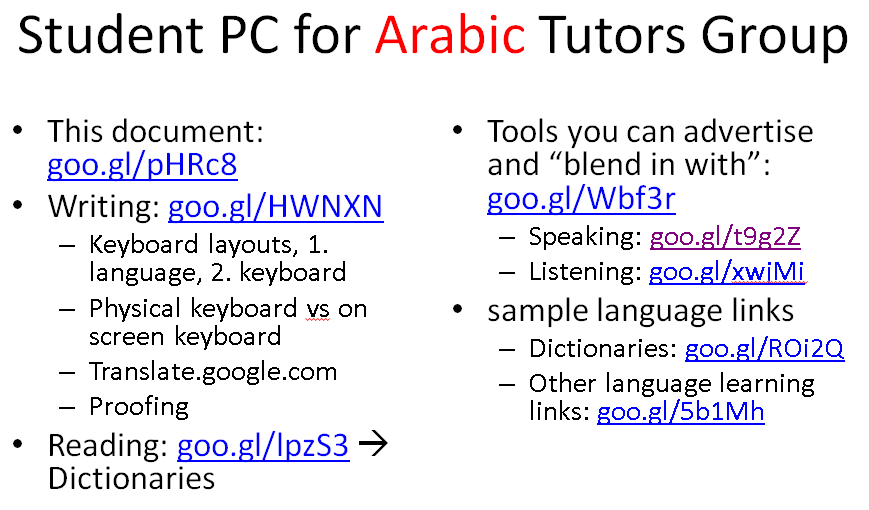
How the LRC provides volunteer tutoring services
2012/10/10
Leave a comment
- The volunteer tutor student gets a tutor calendarto publicize her services (non-personal information only) online.
- The LRC assistants at the LRC reception desk will train and set up the tutor initially. If the volunteer tutor needs more practice in using her NINERMAIL calendar than her initial training provided her with, she can come in and log in for the LRC assistants at the LRC reception desk and the LRC assistants will guide her. During LRC opening hours, at any time we have 3 computers and 2-3 LRC assistants staffing the LRC reception desk which is right next to the group rooms where the volunteer tutors work, so there should be minimal delay and overhead with maximum administrative benefit.
- From then on, the volunteer tutor is in charge of her own tutor calendar. If the volunteer tutor needs to announce changes, the volunteer tutor goes to NINERMAIL, section: calendar, and
- for single cancellations, deletes her appointment, like so: http://plagwitz.blob.core.windows.net/content/lrc/owa-cancel-by-rightclick-delete-appointment.html
- for changing the schedule, opens her old appointment (series), cancels it (only future occurrences) and creates her new altered (recurring) appointment, like so: https://thomasplagwitz.com/2012/01/10/how-to-make-changes-to-a-meeting-request/
- The volunteer tutor logs in and out of her tutor calendar appointment, whenever she starts/ends her tutoring hours, so that the LRC assistants at the reception desk can check her in and out of the LRC (LRC Assistants have a special program for this), and so that she can enter a summary of whom she tutored and on what. A the end of the term, the LRC coordinator can provide tutor supervisors with a report on the tutoring log collected this way.
- To maximize learning and minimize missed connections, bottlenecks and delays throuhg intermediaries – including tutor supervisors and LRC staff -, the volunteer tutor – the authoritative source of her tutoring time – can communicate directly through http://mail.uncc.edu/owa/calendar/LRCTutor01@uncc.edu/Calendar/calendar.html (sample only, for actual Tutor## see https://thomasplagwitz.com/?tag=lists+resources), with her stakeholders:
- the tutees who need to know her tutorung times, can communicate directly via
- the tutor supervisors, who, if they do not approve of the live or end-of-semester report tutor schedule, can let the tutor know, by asking her to change her time, deny her credit, not rehiring her…
- Currently, all tutoring is walk-up only. Enabling tuteees to sign-up for tutor help to avoid pile-ups is still TBA. If you would like to see sign-up tutoring implemented, please drop us a line explaining how this would be helpful for you.
- As far as the LRC is concerned:
- Tutors have to be within the within the opening hours of the LRC: http://mail.uncc.edu/owa/calendar/LRCRoomCOED434@uncc.edu/Calendar/calendar.html.
- The LRC being increasingly busy with classes, exams, self-access assessments and distance education sessions these days, we also require all tutors to include one of the group rooms in the box “resources:” LRCRoomCOED433c, LRCRoomCOED433d of their tutor calendar meeting request. Doing so will secure the tutor and tutee a convenient work place.
- Summaries of our tutor training in LRC language learning technology facilities are available here: https://thomasplagwitz.com/?category_name=service-is-tutoring+training.
How to link your LRC tutor calendar and Moodle metacourse from your Moodle course
2012/09/26
Leave a comment


How to access most important LRC calendars from quick links on LRC home page
2012/03/08
Leave a comment
- Go to http://lrc.uncc.edu
- access like so:


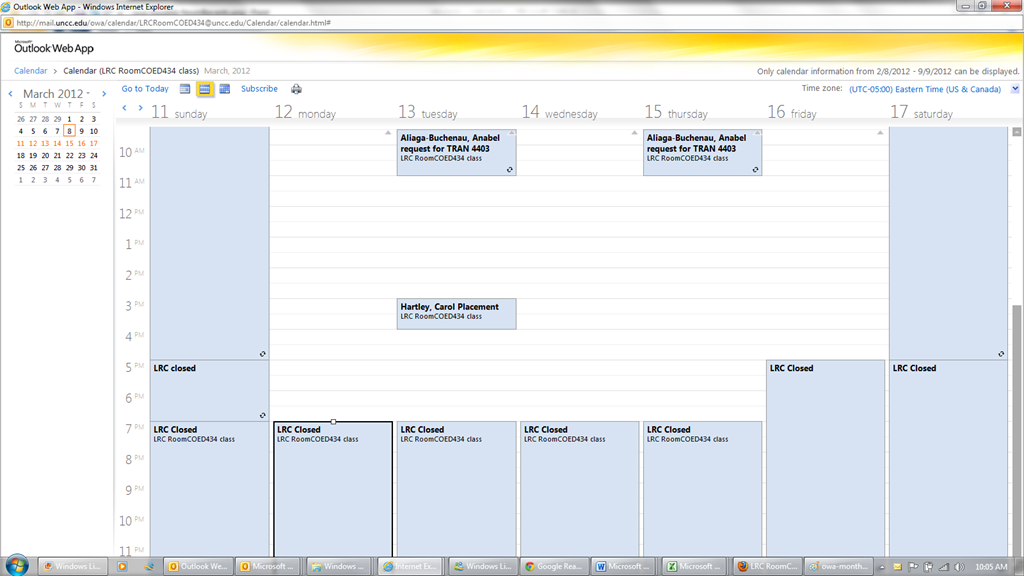
- The default calendar view in OWA is monthly:
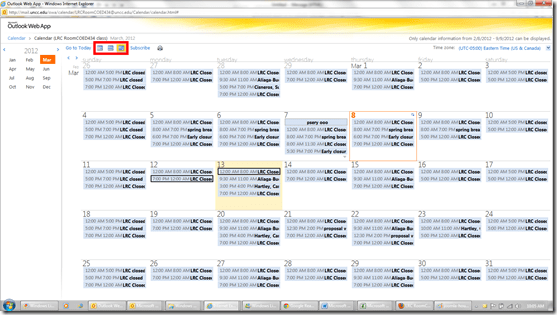
- From the top menu icons, you can easily change to weekly and daily views:

- The calendars are edited directly by the service-providing party, to stay up to date with the frequent changes in tutor availability (see #1 on Seven ways to think like the web; #4, getting them to stick to our “disciplined naming conventions” remains a work in progress).
- Thanks to Joomla’s Publish/Unpublish feature, we also stand a chance keeping up with the frequent changes in tutors being sent to the LRC or not, by entirely hiding non-applicable calendars (so that students do not have to think about what we mean by “no time slots = sorry, currently no tutor”):




Questions? Read the About. Or just ask me a quick Our Databases: Resources with calendars -- Language learning material Moodle Sites, multimedia files -- films


FAQs for LRC student staff or for students or for teachers. To search our FAQs, in the browser addressbar, add after "https://plagwitz.wordpress.com/feed/?tag=faqs+/" "+TAG1" (from tag cloud below) OR "https://plagwitz.wordpress.com/feed/tag=faqs
&category_name=" "CAT1" (from category hierarchy below). OR search both categories and tags, and multiple TAGs/CATs (connect with "," for OR-search, with "+" for AND-search), like so: https://plagwitz.wordpress.com/feed/?tag=TAG1+TAG2+...TAGn&category_name=CAT1
+CAT2+...CATn"
Other ways to find help
If you cannot find it here, look there: 5,500 Language-Learning Links and Programs for learning or teaching 150 languages
Shortcuts:Our Lists, Our Maps, LRC Staff Moodle Site,LRC Project Moodle Site, 49erexpress, UNCC Moodle, Student Recordings: s:claslcslrcsanakostudent
Learning usage samples: Sanako oral exam, Kaltura webcam presentation, Dictation with speech recognition, Sanako written exam, Chinese and Japanese interactive stroke-order practice
Test the Sanako Installer, Webbrowser Popup Konfigurator for XP, or Windows7, faster LRC TeacherPC Log-in Let MS facilitate diacritics writing by installing for you US-International keyboard layout
This is my personal blog (Google+). The views expressed on these pages are mine alone and not those of my employer. The information in this weblog is provided “AS IS” with no warranties, and confers no rights.
 Thomas' Work Space