Archive
Archive for the ‘documentation’ Category
How to fix exception: Sanako Graph Data not installed
2013/07/05
Leave a comment
- Problem: When trying to administer an oral exam, using model imitation, source: file, I could not, but rather I got this error
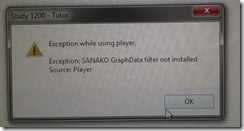
- Root: The same feature had worked in the morning – however, then the Sanakorecorder interfered with the Sanako tutor. Turned out that the Sanako tutor had been installed over a Sanako Student recorder which caused the tutor pc to connect to itself (distracting, also potentially a liability since it eats up licenses if not managed). In between morning and afternoon exam, the student recorder was uninstalled, but without the required functionality testing afterwards. So this exam had to become the test.
- Workaround: Reinstall the student recorder. We used the “test the Sanako installer” program on my home page to not delay the exam too much.

- Solution: do not install the Sanako tutor over a student installation in the first place.
- Either remove the Student recorder after imaging the teacher station with the student image,
- or better, image the PC without the added baseline task “Student recorder”.


Status of the language lab and purpose of the LangLabEmailer
2013/06/07
3 comments
- Status of the language lab: Modern language labs – digital audio labs with integrated computer classroom management systems, like the Sanako Lab 300 and Study 1200 –
- are great tools for driving the use and benefit of computer technology into the face-to-face language teaching classroom,
- but for years have been sorely lacking integration with the rest of the digital campus workflow, mostly through the web-based LMS
- Sanako once had a Blackboard integration that allowed to bring media files stored in Blackboard to the file, but not upload student assessments into the gradebook.
- I once ran a Sanako Lab 100 that acknowledged that need by providing USB thumb drives for students, and a mechanism to load class recorded files to them at the end of class.
- Online components being developed by language lab vendors seem to be lacking the face-to-face teaching component.
- Synchronous distance education software (like Adobe Connect, Blackboard Wimba, or Saba Centra) – if not just used like a giant loud speaker in supporting lecture presentations, interspersed with calling up individual students for responses – seems currently best positioned to bring some of the benefits of computer technology to the synchronous teaching arena, but in a different (not applicable to what is still the non-distance norm in language instruction), actually more challenging non-face-to-face setting, and – first and foremost – without special consideration (and tools, like a remote controllable dual track recorder) for language learning.
- Purpose of this software:
- The LangLabEmailer combines knowledge of
- how teaching and learning is done in modern language departments
- including common issues in the lab (late students)
- needs outside the lab
- grading from home
- documenting longitudinal language development for eportfolio initiatives
- how (some: you can help us!) digital audio labs save assessments,
- how AD tracks ownership,
- how MS-Exchange can be automated.
- how teaching and learning is done in modern language departments
- in order to
- let the language lab classroom activities (summative assessments, but also formative in the widest sense made so easy by digital audio labs) break out of their isolation in the lab and enter the learning workflow,
- by automatic immediate (we have set to 16 times daily) distribution of assessment files (recordings and writing)
- to teachers
- and – without or with added teacher feedback, including aural – to students via campus email ;
- in 30000 digital audio lab equipped classrooms in the world
- minus the ones that do not have MS-Exchange infrastructure
- plus the ones from other vendors than Sanako – for the above number of classrooms is from SANAKO –, if you share your lab’s configuration back.
- The LangLabEmailer combines knowledge of
- Next: Features. Or Langlabemailer (table of contents).
What are the features of the LangLabEmailer?
2013/06/07
Leave a comment
- Ver 1.0.1.0
- emails as attachments new (hitherto unsent) audio recording or writing assessment or assignment files from the language lab student collection file share to originating student and teacher
- attempts to automatically
- skip sending small files created during microphone and similar systems tests
- reroute email address for files of late students that have been collected under teacher login (simple delimited list, manually editable), but renamed to valid address
- reroute files that have been sent under position number rather than student names (including at least to one student of a student pair or group recording)
- puts meaningful course name in the email subject to easily integrate with email workflow that teachers and students will already be familiar with
- provides options to
- exclude files from sending
- language lab manager: using file name patterns and extensions
- teacher:
- by marking individual files as _sent or, preferably, put them in the subfolder
- not sending or delay sending until after grading (with inserting feedback, written or voice-insert recorded aural feedback)
- send to students only
- and more…
- Not implemented yet:
- Full Support for Sanako ver 6 save files under “last name, first name”
- Send to teacher only
- Support of Exchange Online.
Which prerequisites you need for the LangLabEmailer
2013/06/07
Leave a comment
- MS-Exchange (2007 and up) email-server (on-premise; sorry, no Exchange online yet) with Active Directory;
- A login to an on-campus domain-joined office PC (tested on Windows 7);
- MS-.Net 4.5 (how to find out which);
- Preferably a digital audio lab file saving scheme that uses the username (more robust and flexible than always going via file ownership).
- Next: Download. Or Langlabemailer (table of contents).
How to install the LangLabEmailer
2013/06/07
Leave a comment
- After clicking the button:install,
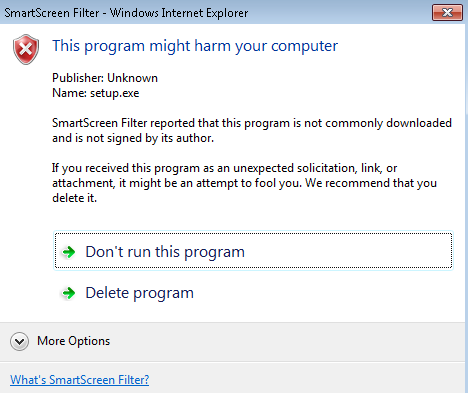
- On IE9 and up (on Windows 7 and reportedly even more so on Windows 8), you may have to bypass Smartscreenfilter warnings like so:
- (True, I do not intend to quit my day job, but maybe you know me from, at least from this blog I hope
 ,so:) click on “Actions”:
- Click on “more options”:
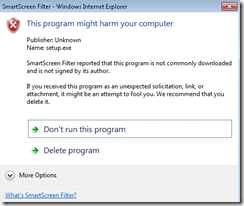
- Then click on: ”run anyway”:
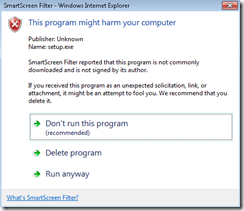
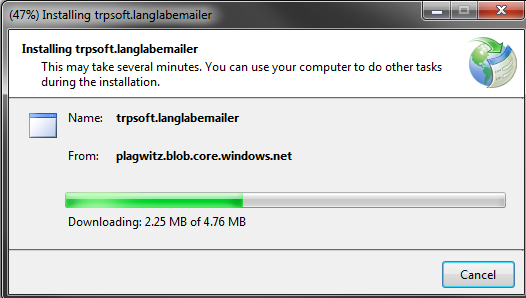
- Then follow the prompts like so:
-

-
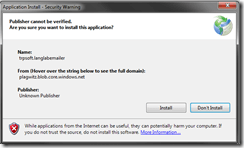
-

-

-
Next: Configure. Or up:Langlabemailer table of contents.



How to uninstall the LangLabEmailer
2013/06/06
Leave a comment
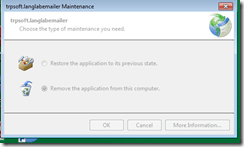
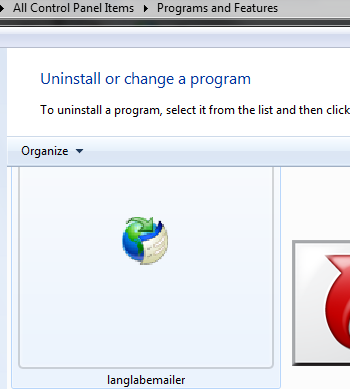
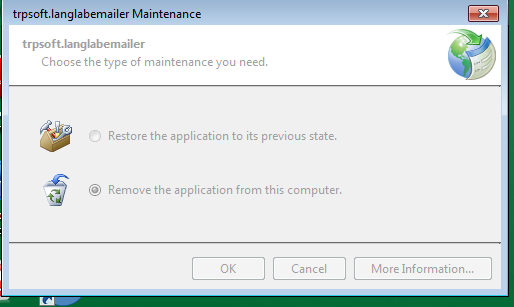
- Either from the control panel / add remove programs:
 .
. - To get these options:
 .
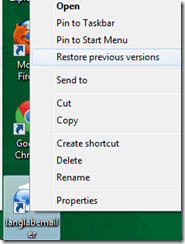
. - To restore, you can also right-click on the desktop icon:

- Next: Requests. Or Langlabemailer (table of contents).

How to update the LangLabEmailer
2013/06/06
Leave a comment
- LangLabEmailer updates automatically if an update is available when you start it.
- Your langlabemailer.exe.config should not be affected by an update. you can access and back up the previous version by restoring, the previous version from the context menu of the desktop shortcut:
 .
. - You may need to reapply changes after an update (automatic on application run that need not, but may overwrite your local settings, but will keep a backup (look for ".pre" files in a subdirectory of the data directory (= directory with the langlabmailer.exe.config and without the many other (MANIFEST, DLL) files).
- Next: uninstalling. Or up Langlabemailer (table of contents)



Questions? Read the About. Or just ask me a quick Our Databases: Resources with calendars -- Language learning material Moodle Sites, multimedia files -- films


FAQs for LRC student staff or for students or for teachers. To search our FAQs, in the browser addressbar, add after "https://plagwitz.wordpress.com/feed/?tag=faqs+/" "+TAG1" (from tag cloud below) OR "https://plagwitz.wordpress.com/feed/tag=faqs
&category_name=" "CAT1" (from category hierarchy below). OR search both categories and tags, and multiple TAGs/CATs (connect with "," for OR-search, with "+" for AND-search), like so: https://plagwitz.wordpress.com/feed/?tag=TAG1+TAG2+...TAGn&category_name=CAT1
+CAT2+...CATn"
Other ways to find help
If you cannot find it here, look there: 5,500 Language-Learning Links and Programs for learning or teaching 150 languages
Shortcuts:Our Lists, Our Maps, LRC Staff Moodle Site,LRC Project Moodle Site, 49erexpress, UNCC Moodle, Student Recordings: s:claslcslrcsanakostudent
Learning usage samples: Sanako oral exam, Kaltura webcam presentation, Dictation with speech recognition, Sanako written exam, Chinese and Japanese interactive stroke-order practice
Test the Sanako Installer, Webbrowser Popup Konfigurator for XP, or Windows7, faster LRC TeacherPC Log-in Let MS facilitate diacritics writing by installing for you US-International keyboard layout
This is my personal blog (Google+). The views expressed on these pages are mine alone and not those of my employer. The information in this weblog is provided “AS IS” with no warranties, and confers no rights.
 Thomas' Work Space