Archive
Room and Equipment handling using MS-Exchange Resource Mailboxes with Autoprocessing: AutoAccept and ForwardtoDelegates
- Autoprocessing: AutoAccept automates managing (blocking, sharing information on the block, unblocking) resources for users (those that can BookInPolicy, or AllBookInPolicy).
- At least as long as the policies that resource mailboxes allow you to define and the user groups that can be and have been set up in your MS-Exchange environment.
- AdditionalResponse can aid in avoiding some of the problems, if the requesters collaborate.
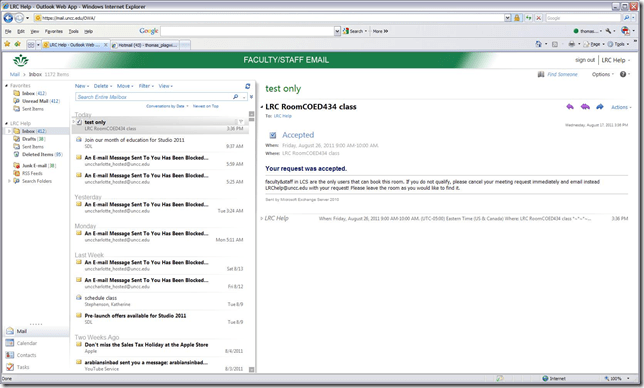
- Here is an example of an automated autoaccept message with an additional response:
- Forwardtodelegates
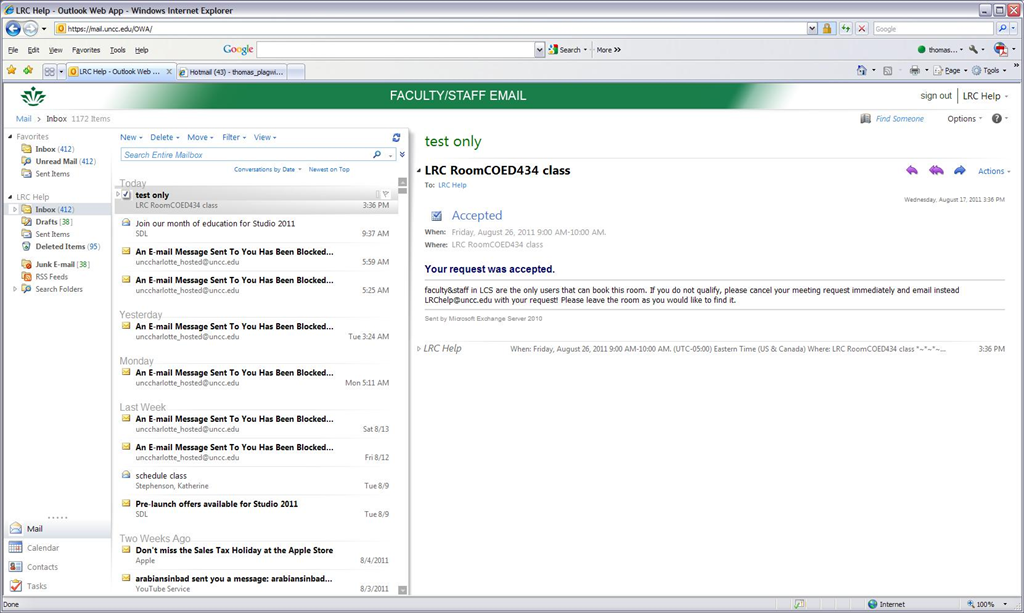
- forwards requests, saving delegates the effort to monitor the resource mailbox and calendar, like so:

- Not only that, it seems to also forward accepted requests, useful for creating a paper-trail, e.g. for future reporting needs (Q:can the entire history of a request, including all changes be monitored this way?).

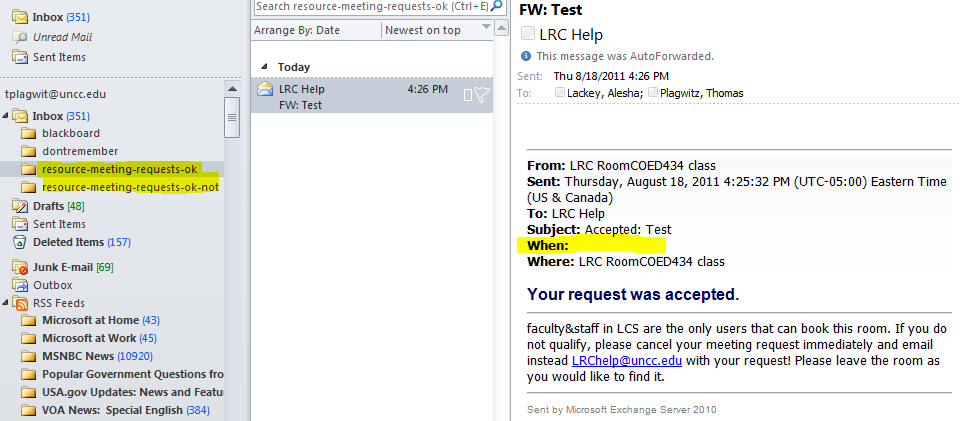
- This forwardtodelegates seems to work reliably, and you can filter notifications with a rule into the “digital paper-trail” folder:

- I notice a few gotchas with forwardtodelegates , however:
- Not all requesters will have their requests forwarded: If your requester is a delegate, or her account even only linked to that of a delegate, it seems no notification message is forwarded to delegates (at least for in-policy requests).
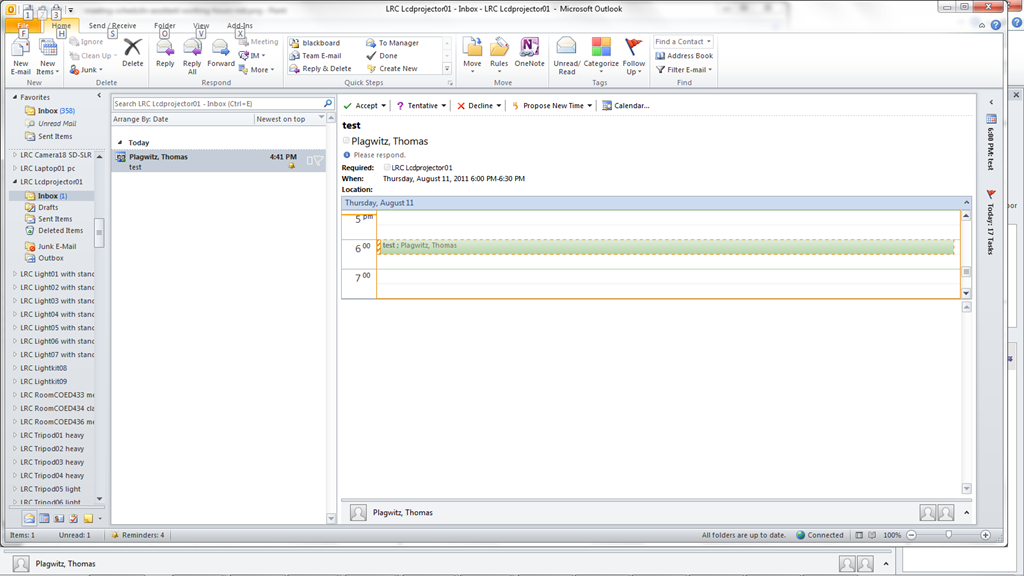
- As you can see in the above screenshots, the forwardtodelegates seems to omit meeting time requested (bug?) which you can track down by opening the calendar of the resource and search for the the meeting title, both of which are included in the notification message.
- forwards requests, saving delegates the effort to monitor the resource mailbox and calendar, like so:

SDL-Trados Studio 2009 Online Training Links
SDL maintains an repository of archived online webinars on Trados here.
SDL maintains a list of upcoming free webinar events here. Here is a sampling of their upcoming live trainings (as of August 2011) here:
Friday 19
Ask the expert – A session dedicated / to the most frequently asked questions / on SDL Trados Studio 2009
15:00 – 16:00 London / 16:00 – 17:00 Paris
Thursday 25
Tips and tricks to get you more productive / with SDL Trados Studio 2009
09:30 – 10:30 London / 10:30 – 11:30 Paris
Type: Product info & demo
Friday 26
An introduction to SDL Trados Studio 2009 for translators
10:00 – 11:00 London / 11:00 – 12:00 Paris
Type: Product info & demo
For what you can expect from these webinars, please note that they also offer full training courses, but these are not free.
Our Office 2010 & Office365/Live@Edu/Live not yet @Edu/Ninermail Upgrade: A running log
- Just logging some notes, observations, issues, step-by-step instructions…
- Office 2010ff install (office2010-full-install-labadmn.wmv [all links are to the folder only, choose screencast by name):
- 0:00-2:00: you can easily install Office 2010 from the ISO file without physical CD media, if you first install the free Magic Disc, then from the system notification tray, mount the ISO file to the , open the pseudo-drive from Explorer, which starts the installer through Autorun
- 2:00-4:00: since we do not want frozen imaged lab computers to ask for the installation media “on first run”of Office features, we choose button:customize, tab:installation options: “run all from Computer” (top – level selection is sufficient, rest of video is looking around), then button:upgrade
- Lots of waiting ensues…
- At the end, 28:55, “Microsoft office professional plus 2010 encountered and error during setup”, also the installer complains once about another instance running, then 38:12 asks for rebooting,
- Office 2010 first run (office2010first-run-excel-web-app-test.wmv):
- after reboot, the installation seems to have completed
- changing Office update policies seems to be not allowed
- file /save&send / save to web / windows live / log in / browse to a folder / give a filename:

- type something, save and exit
- in web browser, open windows live:
- log in, go to menu:SkyDrive, browse to the folder, find the file, click on it to view in browser,
- from top menu, choose edit in browser, type something, save,
- from top menu choose edit in excel, wait for download to open, type something, save&close,
- go back to web browser, open the update document from the right users (lab staff).
- sharing with windows live
- first uncc-LRC needs to make some friends:
- eventually, we want the staff of the uncc-LRC be able to use these online extensions of the most common tools in our work environment, MS-Windows and MS-Office. For this, we need to wait until live@edu/ninermail is up, so that we can invite lab staff using their @uncc.edu email addresses
- for testing purposes, I have invited myself and the lab coordinator using their personal Hotmail/live addresses
- friends need to accept the invitation email – and even on Hotmail/live mail, look for them in their Junk mail folder (this has been one of the unresolved mysteries of inter-office politics at Microsoft since at least 2007).

- second, in SkyDrive, share your files with these friends, and with the right permissions
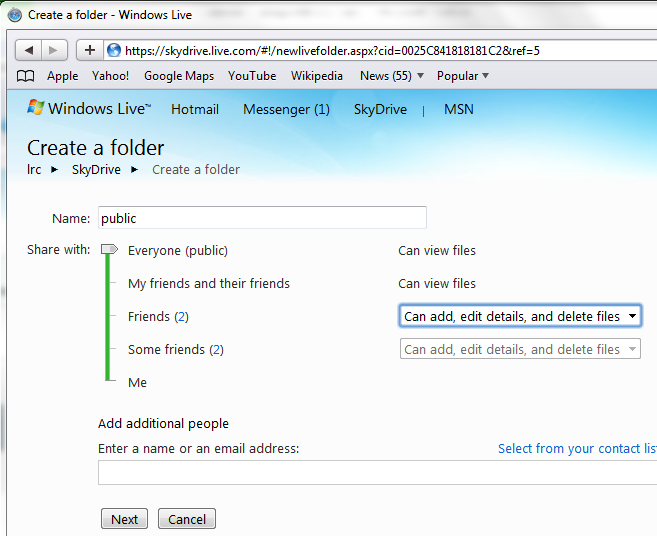
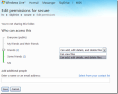 a sharing policy, per folder, needs to be decided upon
 - uncc-non-secure permissions: all view, friends edit:

- uncc-secure-settings: only friends view and edit (shall we limit editing to some friends? permanent staff?)
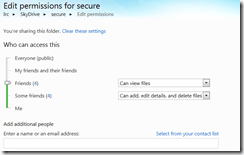
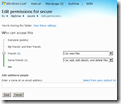 note that some granularity of permissions is already supported, like
- folder:”secure”- “friends”:”can add,edit,delete”
- folder:”secure”- “friends”:”can read”
- folder:”secure”- “some friends”:”can add,edit,delete”
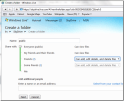 note that you can give read, but not write access to files beyond the circle of your friends (“friending” within the organization should, however, become are more acceptable option when/if live@edu will allow for @uncc.edu accounts, and interesting, since it offers disintermediation for office network admin tasks).
 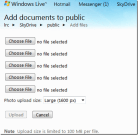 you can add files through a standard web-interface, or a more advanced Active-x control (looks like your mileage may still widely vary outside of Internet Explorer which is even more confusing when the ActiveX interface is offered in Firefox, but shows glitches). Note, however, that opening a local file in Office 2010 and save&share to SkyDrive is more attractive – however, will you in MS-Office see the folders that are merely shared with you to add to? Does not look like it. Stay tuned…
 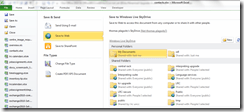 . one can still upload the spreadsheet from the web browser, then, also from a web browser, click “open in excel”. From then on, one can open it ore easily from the excel File / history shortcut. I am still working on figuring out how to map SkyDrive folders to local drives (it worked for one set, but other mappings run into problems: Is this because MS allows only one windows live identity to be mapped to your local windows account?)
 - To publish (possible embed in a web page) spreadsheets with Excel Web App, you can choose:
- SkyDrive menu: add files
- add an existing file
- or SkyDrive menu: “new”
- Excel web app ribbon menu: “Open in Excel”
- Copy/Paste your content and Save, Close
- Excel Web app menu “
 Share”/ “Embed”:i
 - Adjust your options in this sharing dialog:

- To embed, take the html-code (you can increase the max width beyond 640 outside of this dialog) and paste it into your web publishing program
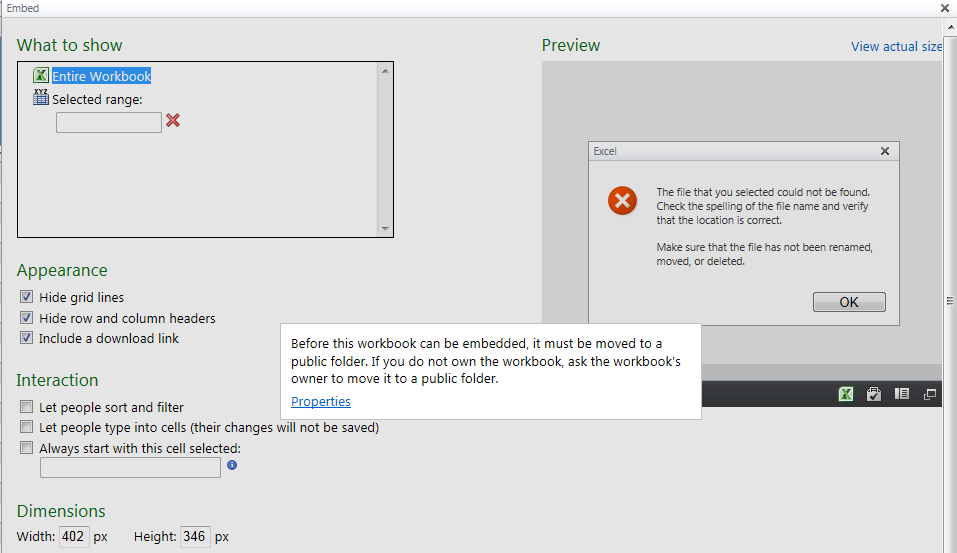
- Gotcha: To be embeddable, the spreadsheet needs to be in a public folder, or else:

- To move the file, use the “move”option in the file details pane to the right:
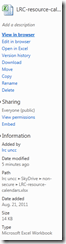
- This setting should make it work:

- And interestingly, it does, automagically: You do not have to update the embed code. It seems the link within the embed code goes to a “file” which has the “folder” it is in not as a path (in the link), but as an attribute:
- To move the file, use the “move”option in the file details pane to the right:
- SkyDrive menu: add files
- to share a file: Examples for MS-office live file collaboration
- MS-Excel
- Do not use the “embed” link from SkyDrive, e.g. https://r.office.Microsoft.com/r/rlidExcelEmbed?su=10634757809471938&Fi=SD25C841818181C2!133: this opens in read-only even if I am logged in (in Firefox and in Excel)( as a friend with editing rights)
- use the “edit” link from SkyDrive, e.g https://skydrive.live.com/edit.aspx?cid=0025C841818181C2&resid=25C841818181C2%21133: “edit in browser” attempts first opening in browser (Firefox – not asking for permissions, since I am logged in as friend with editing permissions), unsupported features redirect to excel 2010, opening in “protected view“ – but can enable editing.
- Note that when opening in excel 2010, you lose the concurrency that excel web app offers – thus, only 1 LRC assistant can have the online spreadsheet open to make update to the film collection (we have one barcode scanner equipped PC only anyway, so use this one for editing the film-collection.xlsx)
- MS-PowerPoint
- here is a folder link from where you can click on ""open in PowerPoint":
https://skydrive.live.com/redir.aspx?cid=0025c841818181c2&resid=25C841818181C2!115 - this may take time:
- here is the ""edit in browser"" link https://skydrive.live.com/edit.aspxcid=0025C841818181C2&resid=25C841818181C2%21146
- here is a folder link from where you can click on ""open in PowerPoint":
- MS-Excel
- to delete a file on SkyDrive:
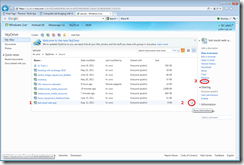
- in detail view, hover over the file row
- click on the blue info button at the right end of the file row
- in the property pane that opens up on the right, click “delete”.
- MS-Word
- Just in case you were wondering about the underlying WEBDAV: You cannot paste the “open in word” link into a MS-Word 2010 file open dialogue (you used to be able to paste WebDAV links form the Blackboard Content System into MS-Word’s File-Open, but those were fully qualified URIs to MS-Word-files without JavaScript trickery), or else:

- As of 9/27/2011, I also now managed to get in to SkyDrive with my university credentials, for how, see here: Skydrive@uncc.edu
- first uncc-LRC needs to make some friends:
- Natural language features testing in MS-Office 2010 is being logged here.








How to set up PowerPoint show on dual screen computers
Before trying to show your PowerPoint on the classroom projector, with your PowerPoint file open on the teacher computer, go to the dialogue: “Set up Show” and choose from the dropdown: “secondary monitor”, click “OK”, like so:

Then proceed as normal.
Multi-monitor setups
Bill Gates has been quoted not too long ago praising his IT staff for equipping him with a “three screens, synchronized to form a single desktop” office computer.
Multi-monitor user interfaces are increasingly deemed useful, if not necessary, to handle the richer data flows created by computers (The following slideshow contains samples of such systems I have collected over recent years, not a few are from Language centers).


.jpg?psid=1 "View album")

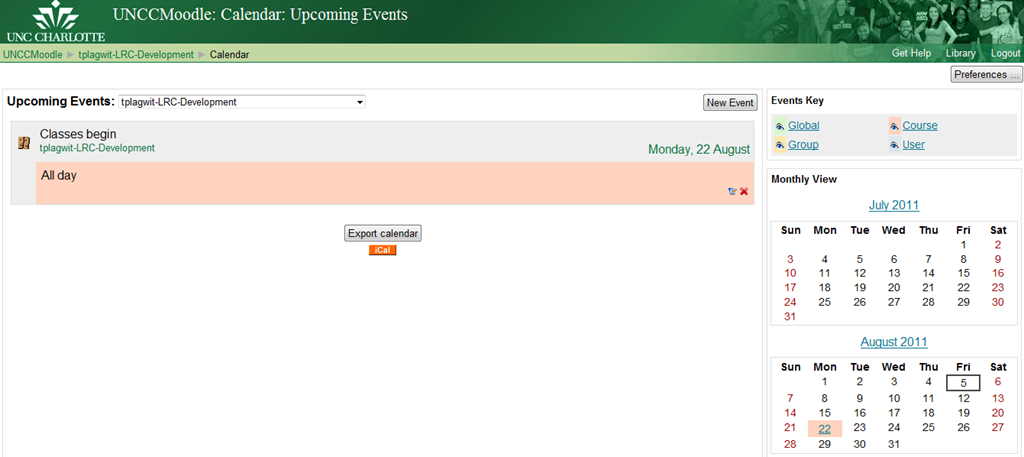
Calendaring: How to use your Moodle course calendars to keep your students up to date
- UPDATE: this now stopped working here. Clicking on the link from IE9, using “open with”: MS-Outlook 2010 fails with “the requested information store could not be found in the active profile”. I have not found a way to feed the Moodle ical link manually into MS-Outlook 2010 (Shared Calendars / Add Calendar / From Internet) or OWA different problem). Stay tuned…
- Easy if you use standard Moodle assignments: “Adding closing dates to course activities — assignments, quizzes etc. will cause them to show up in the calendar block as course events. “
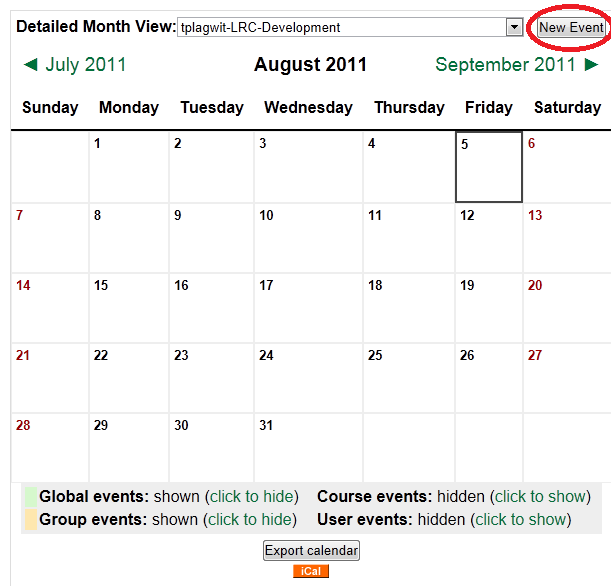
- Other assignments you have to add manually, like so:
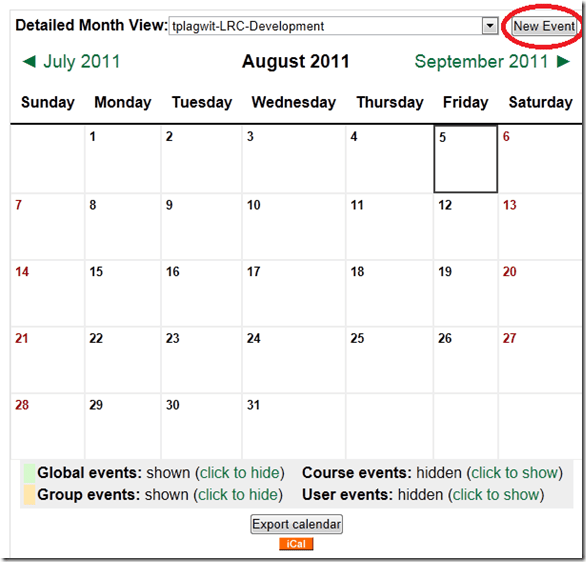

- Resulting in this:
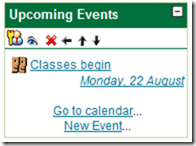 or this:
- Editing your calendar in other applications and importing, even synching it with Moodle is not currently (2.1) supported.
- More on Calendar you can find in the official 1.9 Moodle calendar doc and FAQ.


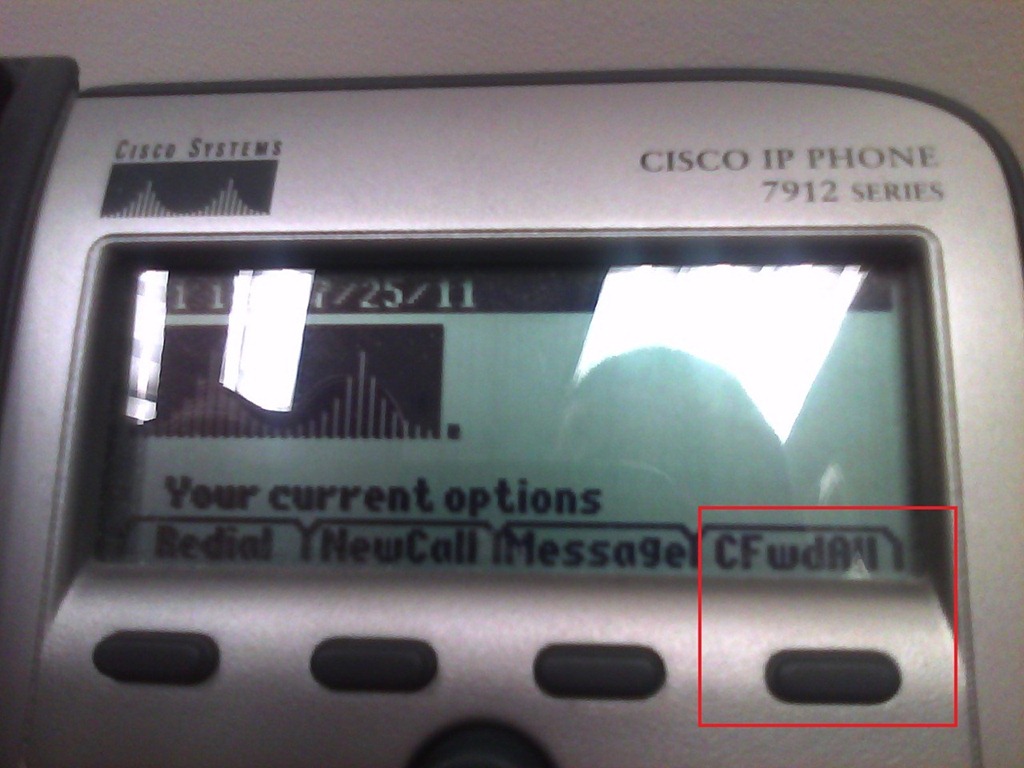
How to do Call forwarding on the Cisco IP Phone 7912
Press button “CFwdAll“:
Type the phone number:
 .
.
To un-forward, press button “CFwdAll” again.


Questions? Read the About. Or just ask me a quick Our Databases: Resources with calendars -- Language learning material Moodle Sites, multimedia files -- films


FAQs for LRC student staff or for students or for teachers. To search our FAQs, in the browser addressbar, add after "https://plagwitz.wordpress.com/feed/?tag=faqs+/" "+TAG1" (from tag cloud below) OR "https://plagwitz.wordpress.com/feed/tag=faqs
&category_name=" "CAT1" (from category hierarchy below). OR search both categories and tags, and multiple TAGs/CATs (connect with "," for OR-search, with "+" for AND-search), like so: https://plagwitz.wordpress.com/feed/?tag=TAG1+TAG2+...TAGn&category_name=CAT1
+CAT2+...CATn"
Other ways to find help
If you cannot find it here, look there: 5,500 Language-Learning Links and Programs for learning or teaching 150 languages
Shortcuts:Our Lists, Our Maps, LRC Staff Moodle Site,LRC Project Moodle Site, 49erexpress, UNCC Moodle, Student Recordings: s:claslcslrcsanakostudent
Learning usage samples: Sanako oral exam, Kaltura webcam presentation, Dictation with speech recognition, Sanako written exam, Chinese and Japanese interactive stroke-order practice
Test the Sanako Installer, Webbrowser Popup Konfigurator for XP, or Windows7, faster LRC TeacherPC Log-in Let MS facilitate diacritics writing by installing for you US-International keyboard layout
This is my personal blog (Google+). The views expressed on these pages are mine alone and not those of my employer. The information in this weblog is provided “AS IS” with no warranties, and confers no rights.
 Thomas' Work Space