Archive
Sanako Study-1200 slow spanning 2 screens with different resolutions
- UPDATE2: 2013-09: apparently new video driver crashes with autoscan window, this time even on primary screen alone?
- UPDATE: 2011-01:Problem seems to have disappeared (windows update?)
- Symptom: This is on a Dell Optiplex 760 (B6CCLK1) which has no problems with Sanako’s screen sharing application, as long as you do not attempt to span the windows across two screens with different resolution which makes even the mouse jerky. Not sure, but do not remember having this problem across two screens with the same resolution. Actually, the Sanako subwindow (remote ctronl specifically) slows down the computer even if it is only on th secondary screen.
- Solution: Relatively easily fixed, if you can afford upgrading not only the screen, but also the LCD projector that hangs on one of the screens…
- Workaround: Do not span sub-windows of Sanako Study-1200 across screens. This problem can become so bad that the Sanako sub window becomes completely unresponsive and cannot be moved or closed (neither with the close button in the upper right nor with ALT-F4). Try CTRL-ALT-ESC then and kill the process. You could also try and upgrade the video card driver which may be the true culprit. However, on the Sanako sub windows seem to display the problem (screensharing with remote control, chat also). E.g. Internet Explorer windows do not have the same problem when spanned across screens.
LRC Outlook/Exchange 2010 Calendaring: What happens after the meeting request? Automated or manual responses and reminders
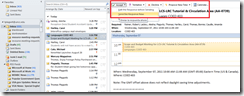
- If you have been invited to a meeting, e.g. a co-taught class in the LRC, you will see in your inbox an email-like meeting request with pre-set answer options:
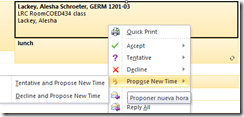
- Wait, there is more: Proposing:
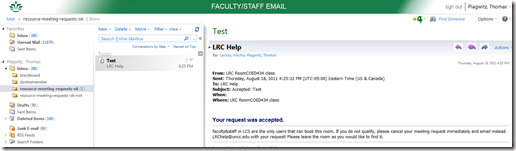
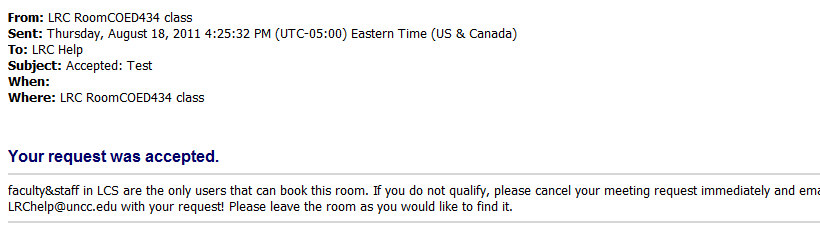
- If you followed the instructions in TBA:request meeting, you should immediately get an acceptance response from the resource:

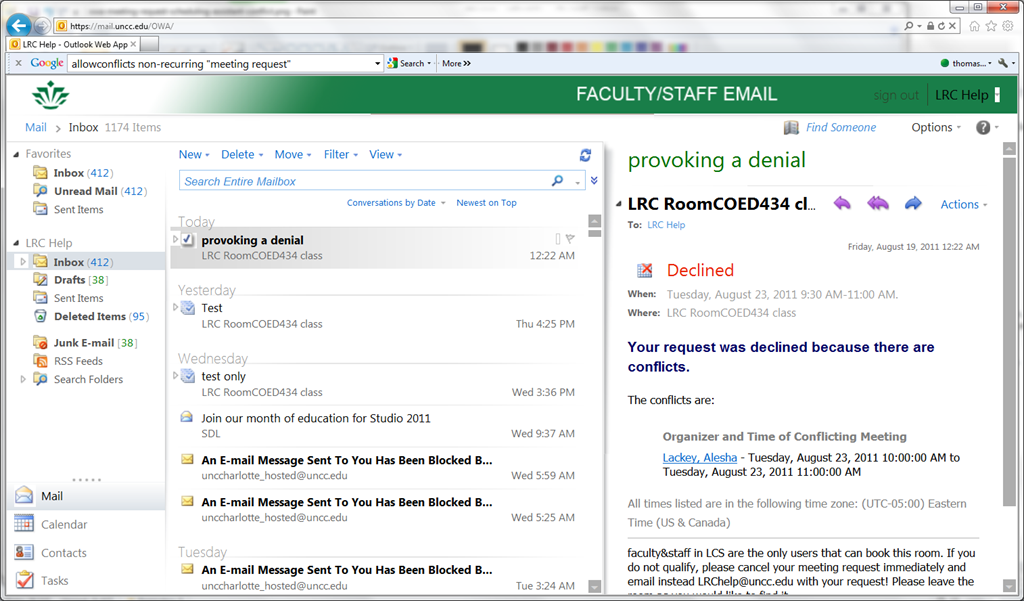
- If something went wrong, read the denial response for how to overcome the issue:
- there are resource specific policies, like maximum booking duration, listed here: TBA: list resources
- if there is a conflict with a prior booking of the resources, please go back to the meeting request scheduling assistant and find a time when the resource is available.
- if you requested a recurring/repeating meeting, like for a weekly class meeting in the LRC, there may be individual conflicts. Note that we have set the resource scheduling options for the non-conflicting instances of your request to be accepted (in most cases). For how to deal with the conflicting instances, study the conflict information in the denial response.
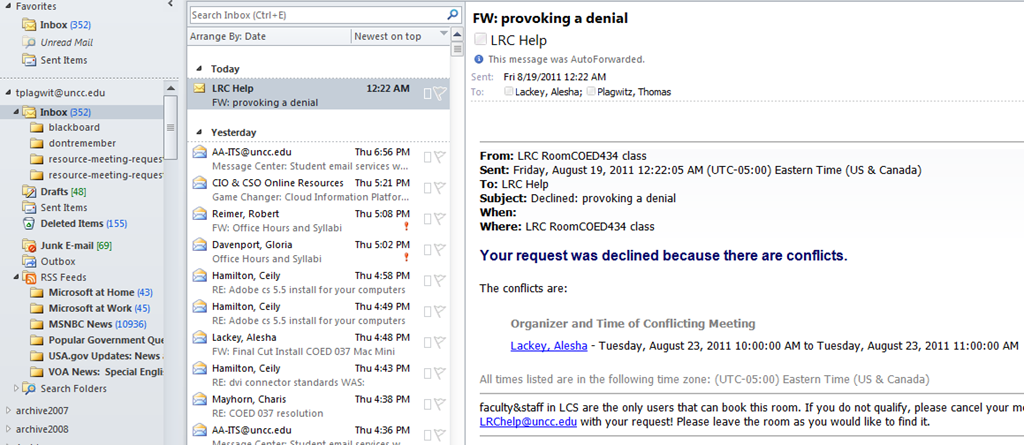
- Note that the LRC calendars are set up so that the LRC staff is copied (as delegates) on LRC resource requests (as a backup for issues and paper trail for reporting):


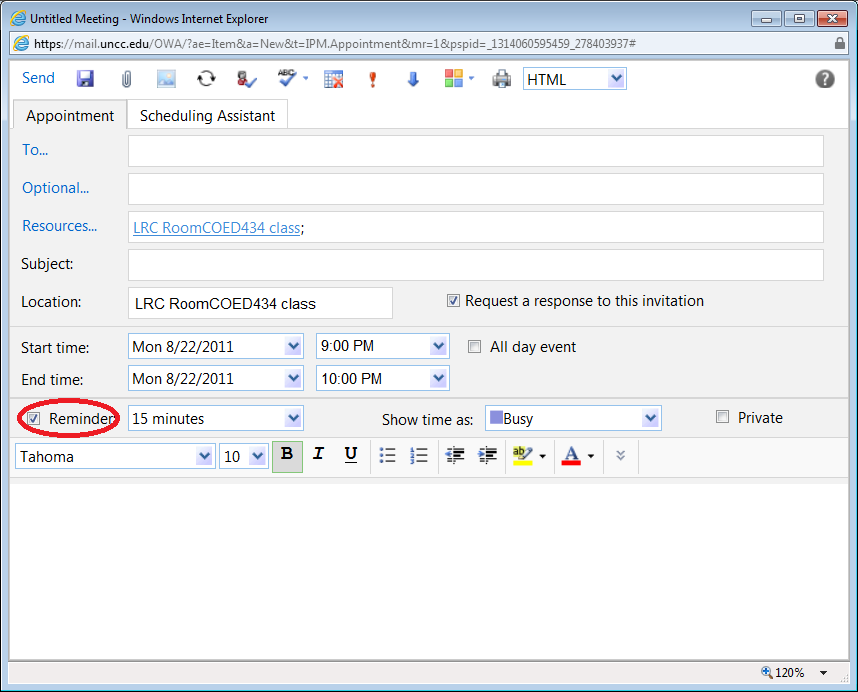
- If you find you get too many meeting reminders that you do not need, when requesting a meeting, turn the default reminder option off:

- The reminder can also be set to off as default in the calendar settings for a resource.



Our Office 2010 & Office365/Live@Edu/Live not yet @Edu/Ninermail Upgrade: A running log
- Just logging some notes, observations, issues, step-by-step instructions…
- Office 2010ff install (office2010-full-install-labadmn.wmv [all links are to the folder only, choose screencast by name):
- 0:00-2:00: you can easily install Office 2010 from the ISO file without physical CD media, if you first install the free Magic Disc, then from the system notification tray, mount the ISO file to the , open the pseudo-drive from Explorer, which starts the installer through Autorun
- 2:00-4:00: since we do not want frozen imaged lab computers to ask for the installation media “on first run”of Office features, we choose button:customize, tab:installation options: “run all from Computer” (top – level selection is sufficient, rest of video is looking around), then button:upgrade
- Lots of waiting ensues…
- At the end, 28:55, “Microsoft office professional plus 2010 encountered and error during setup”, also the installer complains once about another instance running, then 38:12 asks for rebooting,
- Office 2010 first run (office2010first-run-excel-web-app-test.wmv):
- after reboot, the installation seems to have completed
- changing Office update policies seems to be not allowed
- file /save&send / save to web / windows live / log in / browse to a folder / give a filename:

- type something, save and exit
- in web browser, open windows live:
- log in, go to menu:SkyDrive, browse to the folder, find the file, click on it to view in browser,
- from top menu, choose edit in browser, type something, save,
- from top menu choose edit in excel, wait for download to open, type something, save&close,
- go back to web browser, open the update document from the right users (lab staff).
- sharing with windows live
- first uncc-LRC needs to make some friends:
- eventually, we want the staff of the uncc-LRC be able to use these online extensions of the most common tools in our work environment, MS-Windows and MS-Office. For this, we need to wait until live@edu/ninermail is up, so that we can invite lab staff using their @uncc.edu email addresses
- for testing purposes, I have invited myself and the lab coordinator using their personal Hotmail/live addresses
- friends need to accept the invitation email – and even on Hotmail/live mail, look for them in their Junk mail folder (this has been one of the unresolved mysteries of inter-office politics at Microsoft since at least 2007).

- second, in SkyDrive, share your files with these friends, and with the right permissions
 a sharing policy, per folder, needs to be decided upon
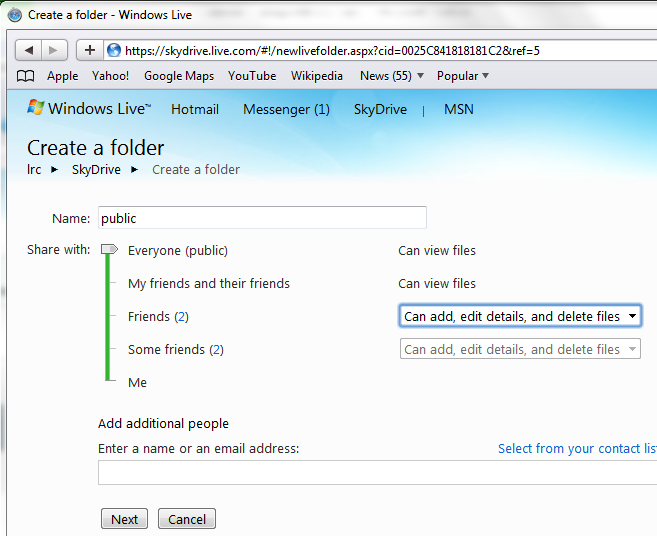
 - uncc-non-secure permissions: all view, friends edit:

- uncc-secure-settings: only friends view and edit (shall we limit editing to some friends? permanent staff?)
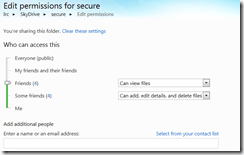
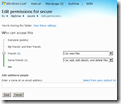 note that some granularity of permissions is already supported, like
- folder:”secure”- “friends”:”can add,edit,delete”
- folder:”secure”- “friends”:”can read”
- folder:”secure”- “some friends”:”can add,edit,delete”
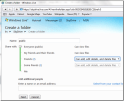 note that you can give read, but not write access to files beyond the circle of your friends (“friending” within the organization should, however, become are more acceptable option when/if live@edu will allow for @uncc.edu accounts, and interesting, since it offers disintermediation for office network admin tasks).
 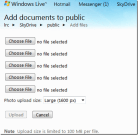 you can add files through a standard web-interface, or a more advanced Active-x control (looks like your mileage may still widely vary outside of Internet Explorer which is even more confusing when the ActiveX interface is offered in Firefox, but shows glitches). Note, however, that opening a local file in Office 2010 and save&share to SkyDrive is more attractive – however, will you in MS-Office see the folders that are merely shared with you to add to? Does not look like it. Stay tuned…
 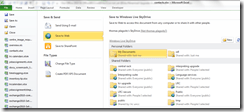 . one can still upload the spreadsheet from the web browser, then, also from a web browser, click “open in excel”. From then on, one can open it ore easily from the excel File / history shortcut. I am still working on figuring out how to map SkyDrive folders to local drives (it worked for one set, but other mappings run into problems: Is this because MS allows only one windows live identity to be mapped to your local windows account?)
 - To publish (possible embed in a web page) spreadsheets with Excel Web App, you can choose:
- SkyDrive menu: add files
- add an existing file
- or SkyDrive menu: “new”
- Excel web app ribbon menu: “Open in Excel”
- Copy/Paste your content and Save, Close
- Excel Web app menu “
 Share”/ “Embed”:i
 - Adjust your options in this sharing dialog:

- To embed, take the html-code (you can increase the max width beyond 640 outside of this dialog) and paste it into your web publishing program
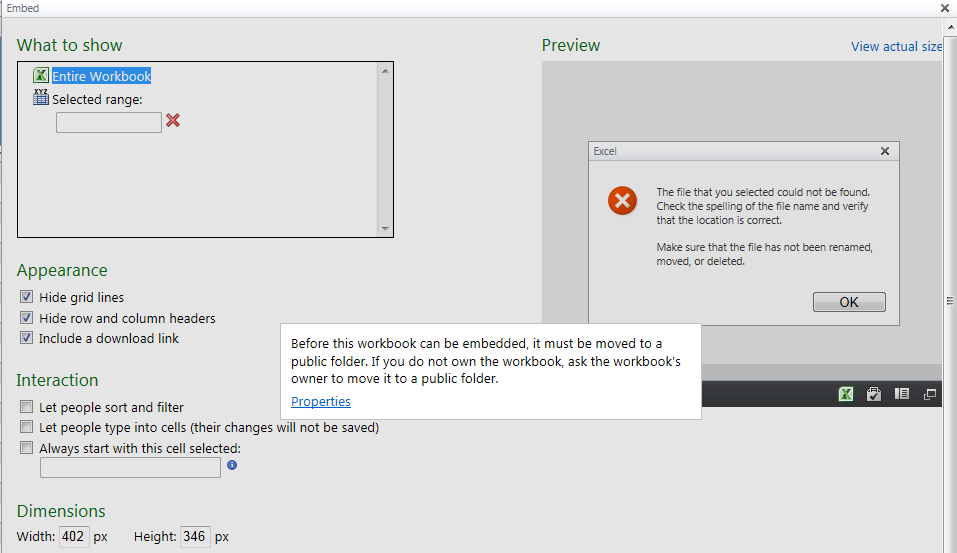
- Gotcha: To be embeddable, the spreadsheet needs to be in a public folder, or else:

- To move the file, use the “move”option in the file details pane to the right:
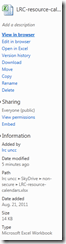
- This setting should make it work:

- And interestingly, it does, automagically: You do not have to update the embed code. It seems the link within the embed code goes to a “file” which has the “folder” it is in not as a path (in the link), but as an attribute:
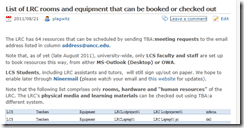
- To move the file, use the “move”option in the file details pane to the right:
- SkyDrive menu: add files
- to share a file: Examples for MS-office live file collaboration
- MS-Excel
- Do not use the “embed” link from SkyDrive, e.g. https://r.office.Microsoft.com/r/rlidExcelEmbed?su=10634757809471938&Fi=SD25C841818181C2!133: this opens in read-only even if I am logged in (in Firefox and in Excel)( as a friend with editing rights)
- use the “edit” link from SkyDrive, e.g https://skydrive.live.com/edit.aspx?cid=0025C841818181C2&resid=25C841818181C2%21133: “edit in browser” attempts first opening in browser (Firefox – not asking for permissions, since I am logged in as friend with editing permissions), unsupported features redirect to excel 2010, opening in “protected view“ – but can enable editing.
- Note that when opening in excel 2010, you lose the concurrency that excel web app offers – thus, only 1 LRC assistant can have the online spreadsheet open to make update to the film collection (we have one barcode scanner equipped PC only anyway, so use this one for editing the film-collection.xlsx)
- MS-PowerPoint
- here is a folder link from where you can click on ""open in PowerPoint":
https://skydrive.live.com/redir.aspx?cid=0025c841818181c2&resid=25C841818181C2!115 - this may take time:
- here is the ""edit in browser"" link https://skydrive.live.com/edit.aspxcid=0025C841818181C2&resid=25C841818181C2%21146
- here is a folder link from where you can click on ""open in PowerPoint":
- MS-Excel
- to delete a file on SkyDrive:
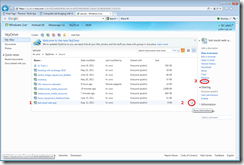
- in detail view, hover over the file row
- click on the blue info button at the right end of the file row
- in the property pane that opens up on the right, click “delete”.
- MS-Word
- Just in case you were wondering about the underlying WEBDAV: You cannot paste the “open in word” link into a MS-Word 2010 file open dialogue (you used to be able to paste WebDAV links form the Blackboard Content System into MS-Word’s File-Open, but those were fully qualified URIs to MS-Word-files without JavaScript trickery), or else:

- As of 9/27/2011, I also now managed to get in to SkyDrive with my university credentials, for how, see here: Skydrive@uncc.edu
- first uncc-LRC needs to make some friends:
- Natural language features testing in MS-Office 2010 is being logged here.








Computer Lab Imaging with Ghost Console and Deepfreeze Console
0. As of Winter 2011 Novell – AD and Deepfreeze 7 upgrade, flagged for updating: TBA.
1. DEEPFREEZE console
1.1. Unfreeze the image source client
2. Client PREPARE THE IMAGE
2.1. Login as labadmin,
2.1.1.NAL [tba], labtools, icon Microsoft Update (be sure to use icon in launcher it will disable policies that won’t allow it otherwise use windowsupdate.com
2.1.2 Remove the machine from the domain: My Computer / System Properties / Computer Name / Button: Change / Member of: Workgroup: LRC (if it asks for a user/pwd, leave both blank and click OK), restart as prompted using Ghost Console / Add to workgroup
2.2. Login as ITSadmin (work station only)
2.2.1.Create user testuser (Administrator), will be based on past default user template
2.3. Log in as testuser
2.3.1.Document what you are doing by running c:\temp\labscreencastfullhighaudio.wme / menu button: start encoding / when done, menu button: stop encoding, rename output file to not overwrite existing output,
2.3.2.Make changes ß centre_image_request_list_allda
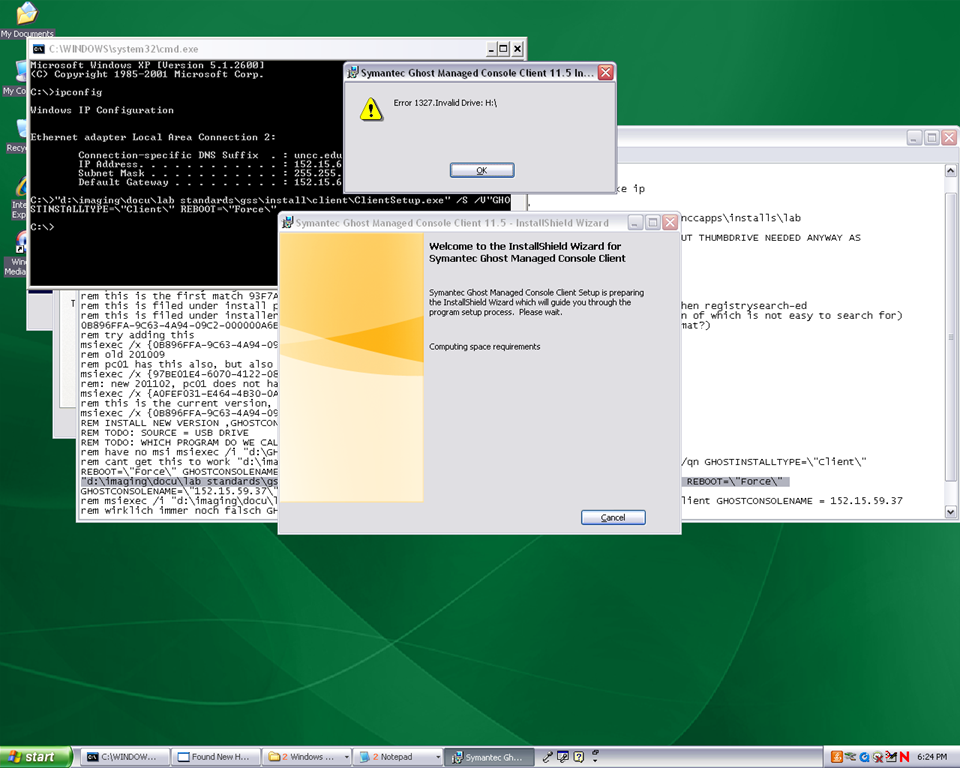
2.3.2.1 if software installs complain about missing H: (home) drive, plug in a thumbdrive and change its driveletter to H:
2.3.3.Clean before making testuser default user:
2.3.3.1. control / internet options / clean history and temp files
2.3.3.2. recycling bin: empty
2.3.3.3. right-click start button: / menu item:properties / button:customize / tab:general / button:clear list + tab:advanced: clear list
2.3.3.4. C: / properties /disk cleanup, all, except: “Compress old files”, “cached installers”, “Office setup files”
2.3.3.5 Firefox: menu: tools / clear recent history / time range: “everything”/ check everything and click button “clear now:” 
2.4. Log in as itsadmin
2.4.1.Document what you are doing by running c:\temp\labscreencastfullhighaudio.wme / start encoding / rename to not overwrite existing output,
2.4.2.Manage testuser – default user transition
2.4.2.1. USERS
2.4.2.1.1. Make testuser default user:
2.4.2.1.1.1. Unhide: explorer / tools / folder options / tab:view / show hidden files and folder, unhide protected operating system files
2.4.2.1.1.1.1. make a backup of old documents and settings/default user (entire directory, not only ntuser.dat): zip onto thumbdrive with date/version number )
2.4.2.1.1.2. xp copy profile windowskey+pause/break /tab:advanced / section:user profiles / button:settings, select the profile [you cannot copy the active profile, so log in as itsadmin], button: copy to, new window: copy to, section:copy profile to, button:browse, select c:\documents and settings\default user, button:ok
2.4.2.1.1.3. [not even the ntuser.dat seems necessary, since even the ntuser.dat gets updated by copy profile] c:\document and settings\testuser\ntuser.dat [+dolater:subfolders?]: back up ntuser.dat to ntuser.old, then copy into default user
2.4.2.1.1.4.Re-hide: explorer / tools / folder options / tab:view / do not show hidden files and folder, hide protected operating system files
2.4.2.1.2. Remove other accounts:
2.4.2.1.2.1. system / advanced / user profiles / clean profiles: delete all accounts except default user (it if shows) and itsadmin
2.4.2.1.2.2. administrative tools / computer management / treenode:local users and groups management / delete non built-in users and non-administrative users
2.4.3.Uninstall deepfreeze (by re-running the installer from unccapps/installs / df#wks.exe) (this will restart the computer; log in again as itsadmin)
2.4.4.delete c:\nalcache
2.4.5.backup the c:\temp \*.wmv screencasts onto a thumbdrive
2.4.6.do this as last step: run c:\windows\system32\trend\ImgSetup.exe, which gives a message: “this program has been configured to start whenever the system is restarted.”
2.4.7.if sysprep required (deploying to non-uniform hardware, e.g. dell optiplex 760 vs 780), run
2.4.8.Reboot to login screen
3. Ghost console configuration
3.1. Ghost console: upload/backup and download/deploy/clone the image
3.1.1. configuration resources / images / right-click: new / image pointing to a file with the NAME that includes today’s date in the format MMDDYY
3.1.2 task: “CAPTURE IMAGE” (not run): open
3.1.1.1. ISource machine: set to machine you have created the image on
3.1.1.2. Image: set to config resource that you have just created
3.1.1.3. [IF NOT CHECKED]check tab:general /checkbox: Remove machine from Domain before taking an image. You must remove the computer from its domain if you are going to roll out the image file to a number of computers. [except if using sysprep].
3.1.1.4 button: save, button:execute

4. DEEPFREEZE console
4.1. UNFREEZE ALL CLIENTS [LRC must be closed]
5. Ghost console configuration
5.1. Deploy task:
5.1.1.“DEPLOY IMAGE TEST”:
5.1.1.1. [ITEM IS ONLY FYI]tab:general / check: clone, but uncheck: configuration [tba: NOT unchecked now?] , refresh configuration, refresh inventory [tba: why?]
5.1.1.2. [ITEM IS ONLY FYI]tab: clone: check “use Ghost walker to perform a sid change”
5.1.2.configuration task “ADD TO DOMAIN”
5.1.2.1. [ITEM IS ONLY FYI] Alternative individually: ghost console / default configuration / right click computer / properties/ configuration / edit default configuration / tree: workgroup/domain membership
5.1.2.2. [ITEM IS ONLY FYI]alternative via batch configuration template: task “Add to AD group” to add to AD [for lcs? Is this why we do this separately from the domain?]: tab:general, check configuration , target machine group: browse for your default group / coed434, tab;configuration: browse for “add machines to ad” – based on template “add machines to ad”, check allow template settings, tree: workgroup/domain membership / check apply member of , check uncheck computer name which is already set, no description , workgroup/domain: its.uncc.edu, container:unccharlotte / labs / clas / lcs / workstations, uncheck: Move computers that are currently in a container.
6. Ghost console: TEST DEPLOY/ADD AD with 2 computers:
6.1. Test: template task: download/deploy to 2 clients
6.2. Test: on client:
6.2.1.Are clients joined to domain [cannot log in with domain account if not; global test: tba]
6.2.2.logging in (creating profiles based on default user) as staff and labstudent: language & translation apps coming up?
7. Ghost console : PRODUCTION DEPLOY/ADD AD
7.1. checks: are you deploying the right image? Are all computers turned on? Cancelling a Ghost deploy task is a pain, if it does not reboot to the login screen, run a token task like deepfreeze-boot-unfrozen
7.2. Clone/Download, Add to Domain/AD
7.3. Test the clients are joined to domain
7.3.1.For all: ghost console / default configuration / right click computer / properties/ configuration
8. Clients
8.1. Login as labadmin staff account (domain account ß uncheck “workstation only”, to freeze with this default)
8.2. DEEPFREEZE: install from novell-delivered application, from Ghost console: deepfreeze7-install, reboot to frozen install: from Ghost console:deepfreeze7-bootfrozen
9. DEEPFREEZE console
9.1. Test the clients are frozen (exclamation point denotes "not sure")
9.2 Add your scheduled maintenance window, again, to avoid domain trust issues .

Questions? Read the About. Or just ask me a quick Our Databases: Resources with calendars -- Language learning material Moodle Sites, multimedia files -- films


FAQs for LRC student staff or for students or for teachers. To search our FAQs, in the browser addressbar, add after "https://plagwitz.wordpress.com/feed/?tag=faqs+/" "+TAG1" (from tag cloud below) OR "https://plagwitz.wordpress.com/feed/tag=faqs
&category_name=" "CAT1" (from category hierarchy below). OR search both categories and tags, and multiple TAGs/CATs (connect with "," for OR-search, with "+" for AND-search), like so: https://plagwitz.wordpress.com/feed/?tag=TAG1+TAG2+...TAGn&category_name=CAT1
+CAT2+...CATn"
Other ways to find help
If you cannot find it here, look there: 5,500 Language-Learning Links and Programs for learning or teaching 150 languages
Shortcuts:Our Lists, Our Maps, LRC Staff Moodle Site,LRC Project Moodle Site, 49erexpress, UNCC Moodle, Student Recordings: s:claslcslrcsanakostudent
Learning usage samples: Sanako oral exam, Kaltura webcam presentation, Dictation with speech recognition, Sanako written exam, Chinese and Japanese interactive stroke-order practice
Test the Sanako Installer, Webbrowser Popup Konfigurator for XP, or Windows7, faster LRC TeacherPC Log-in Let MS facilitate diacritics writing by installing for you US-International keyboard layout
This is my personal blog (Google+). The views expressed on these pages are mine alone and not those of my employer. The information in this weblog is provided “AS IS” with no warranties, and confers no rights.
 Thomas' Work Space