Archive
Archive for January, 2012
Deutschland Radio
2012/01/12
Leave a comment
On popular request: Deutschland Radio still does live streaming, but their on demand archive is also very good. Unlike Deutsche Welle which has discontinued live streaming geared neither towards expats, nor language learners though.
Categories: audience-is-students, audience-is-teachers, e-languages, German, Media
dradio, links, radio
Treffpunkt Deutsch Companion Website with Online Exercises
2012/01/11
Leave a comment
- This first-year German textbook comes with a Companion Website with free online exercises, organized by chapter, on the publisher’s website (different from the Quia.com –based workbook and lab manual exercises).
- From the instructor guide: “The Companion Website is a robust online resource designed to give students a chance to practice and further explore the vocabulary, structures, and cultural themes introduced in the text. For each chapter, students will find self-grading practice exercises on vocabulary and grammar topics as well as Web-based reading and writing activities. Web links to carefully selected sites in Germany, Austria, Switzerland, Luxemburg, Liechtenstein, and South Tyrol (Italy), accompanied by interesting activities, provide additional interaction with the cultures of these German-speaking areas of Europe. Also available on the Website are the audio components of the Student Text and the SAM, as well as an interactive vocabulary flashcards tool. ”
- These exercises include vocabulary practice, even flash cards.
- The auto-correction feature provides:
- some useful feedback for further study,

- summary grades

- and an email to teacher function that should facilitate Syllabus integration of this useful resource:

- some useful feedback for further study,


How to batch convert image files with IrfanView
2012/01/11
Leave a comment
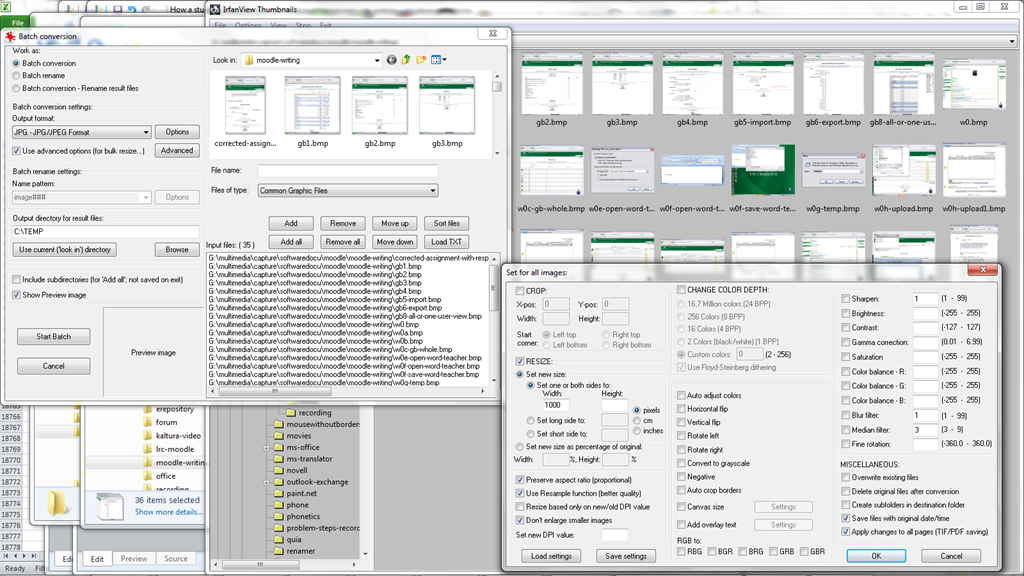
- Had to make a large number of screenshots recently without being able to set the most convenient file format.
- Fortunately, IrfanView has powerful conversion options:

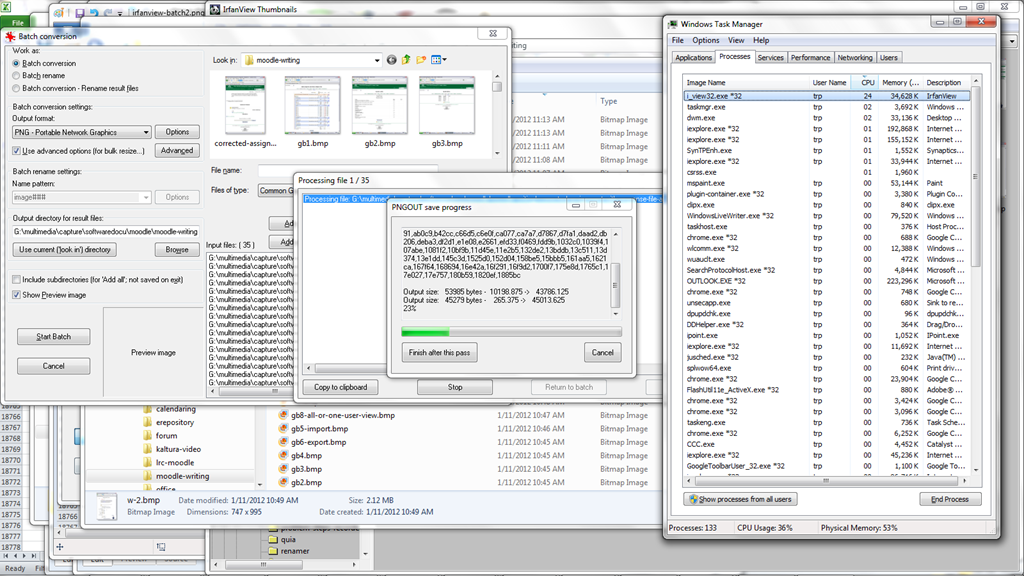
- and makes batch-converting easy:

- Limitation: IrfanView uses only one processor core here (Windows7 home):


UNCC LCS Language Placement Exam Information
2012/01/11
Leave a comment
- Short URL of this page for over the phone inquiries: http://goo.gl/ezQLu.
- The dates for the language placement exam are listed
- on the LCS department webpage. If you have trouble locating this page, use this canned Google search “placement exam site:uncc.edu”;
- on the calendar of the LRC main classroom (where the exam is held).
- The requirements, limitations and step-by-step procedure off the exam are explained here: https://plagwitz.wordpress.com/2011/06/08/uncc-lrc-language-placement-test-cape-online-placement-exam-step-by-step/
How to record your speech with Audacity
2012/01/11
Leave a comment
- For a cut-and-dry recording session, the LRC has a simple instruction on
- For more advanced editing with Audacity, I have a detailed screencast here.
How to make changes to a meeting request to update/alter a reservation
2012/01/10
2 comments
- You can easily release a reservation of an LRC room or resources, completely or partially (e.g. some of the time when you return an item earlier than anticipated), from your calendar in OWA/NINERMAIL:
- By opening the meeting request
- In (staff:)OWA,
- go to your calendar
- find and open your meeting
- make changes to the meeting, e.g. start and end time
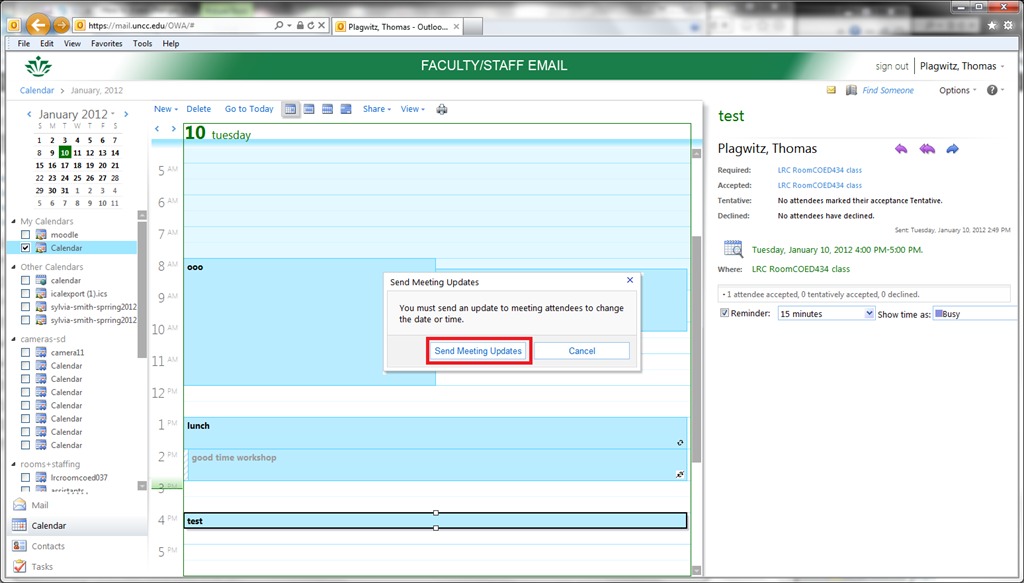
- click “Send Update”
- (students:)NINERMAIL: looks like you have to cancel the meeting and recreate it with new times. This may change once we get the calendars used by students set up to autoaccept.
- More conveniently, without opening:
- right-click on and choose delete the appointment (if necessary, the system is smart enough to ask you whether you want to delete an entire series of appointments or only this occurrence; on cancelling, see also here).
![owa-update-recurring2_thumb[1]](https://thomasplagwitz.com/wp-content/uploads/2012/01/owa-update-recurring2_thumb1_thumb.png?w=559&h=302 "owa-update-recurring2_thumb[1]")
- Or to release the reservation partially (= reduce the time), drag the upper or lower margin to the new desired start or end time.
![owa-update-recurring_thumb[2]](https://thomasplagwitz.com/wp-content/uploads/2012/01/owa-update-recurring_thumb2_thumb.png?w=572&h=309 "owa-update-recurring_thumb[2]")
- If you are working with a meeting request (which by definition has more than the organizer as participants, unlike appointments you make for yourself on your calendar; be wary of making changes to meeting requests which you are not the organizer of (= you did not initially create the meeting request)), the system offers you – and should should accept – to notify the other participants automatically.

- Which in this case is not a person, but only (unless other people have been included in the resource booking which can be done) a resource mailbox which, if configured to autoaccept, may still respond to you like so, in this case with an acceptance, since you can not cause a conflict when releasing a resource that had been reserved for you):

- This also only affects the occurrence you are currently working with, as you can see from the stricken-out recurrence icon that results:
![owa-update-recurring1_thumb[2]](https://thomasplagwitz.com/wp-content/uploads/2012/01/owa-update-recurring1_thumb2_thumb.png?w=600&h=324 "owa-update-recurring1_thumb[2]")
- This flexibility is one of the main reasons (= better resource utilization) why we introduced this system: so that users who want to visit the LRC with their class/borrow a resource on short (often happens, depending on pedagogy, with a couple off days or less ) notice don’t have to be turned away with no good reason.
- Just do not try updating from the publically viewable web calendars, those are for “view”-ing only, including by students:
![owa-update-don-not-do-this-from-the-publically-viewable-web-calendar_thumb[3]](https://thomasplagwitz.com/wp-content/uploads/2012/01/owa-update-don-not-do-this-from-the-publically-viewable-web-calendar_thumb3_thumb.png?w=570&h=325 "owa-update-don-not-do-this-from-the-publically-viewable-web-calendar_thumb[3]")
- right-click on and choose delete the appointment (if necessary, the system is smart enough to ask you whether you want to delete an entire series of appointments or only this occurrence; on cancelling, see also here).
![owa-update-recurring2_thumb[1]](https://thomasplagwitz.com/wp-content/uploads/2012/01/owa-update-recurring2_thumb1.png "owa-update-recurring2_thumb[1]")
![owa-update-recurring_thumb[2]](https://thomasplagwitz.com/wp-content/uploads/2012/01/owa-update-recurring_thumb2.png "owa-update-recurring_thumb[2]")

![owa-update-recurring1_thumb[2]](https://thomasplagwitz.com/wp-content/uploads/2012/01/owa-update-recurring1_thumb2.png "owa-update-recurring1_thumb[2]")
![owa-update-don-not-do-this-from-the-publically-viewable-web-calendar_thumb[3]](https://thomasplagwitz.com/wp-content/uploads/2012/01/owa-update-don-not-do-this-from-the-publically-viewable-web-calendar_thumb3.png "owa-update-don-not-do-this-from-the-publically-viewable-web-calendar_thumb[3]")
Evaluating Student Writing with Adobe Acrobat Pro
2012/01/09
Leave a comment
- Interesting article on how audio comments (which save grader time) get through through to students better, by an language teaching practitioner in the EDUCAUSE Quarterly Magazine 2011.
- Using simple standard and readily available tools: your version of Adobe Acrobat Professional is ready for your use under Novell Applications.
-
Thinking through the observation that students tend to read only the bottom line grade of a returned paper, and do not even bother looking at the teacher’s comments, and that forcing them to the latter by assigning them to revise their papers is less popular, leads one to the question: what more advanced technology is available to take advantage of the teachable moments when writing? Maybe a blend of automated corrective feedback by natural language processing tools like the MS-Office proofing tools and – for the demise of the advanced real-time online collaboration platform Google Wave – a face-to-face writing tutorial emporium where a tutor monitors the writing progress of many students using screensharing applications of classroom management systems like NetOp School or Sanako Study 1200, like here (in a better resolution than this thumbnail, obviously, but you get the idea):
Categories: grading, Writing
adobe-acrobat, audio, netop-school, sanako-study-1200, screensharing
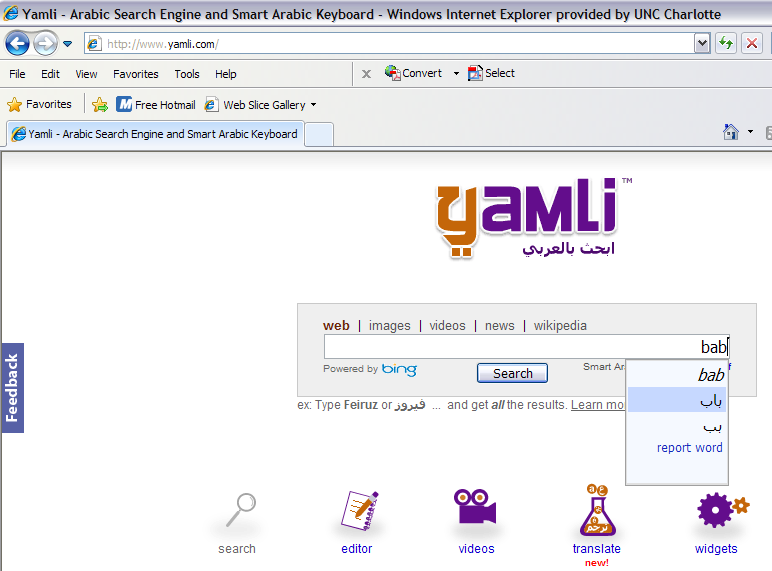
Transcribe sounds into Arabic letters on the web using Yamli
2012/01/06
Leave a comment
How do you compare this to Microsoft Maren and Google Arabic keyboard input?


Questions? Read the About. Or just ask me a quick Our Databases: Resources with calendars -- Language learning material Moodle Sites, multimedia files -- films


FAQs for LRC student staff or for students or for teachers. To search our FAQs, in the browser addressbar, add after "https://plagwitz.wordpress.com/feed/?tag=faqs+/" "+TAG1" (from tag cloud below) OR "https://plagwitz.wordpress.com/feed/tag=faqs
&category_name=" "CAT1" (from category hierarchy below). OR search both categories and tags, and multiple TAGs/CATs (connect with "," for OR-search, with "+" for AND-search), like so: https://plagwitz.wordpress.com/feed/?tag=TAG1+TAG2+...TAGn&category_name=CAT1
+CAT2+...CATn"
Other ways to find help
If you cannot find it here, look there: 5,500 Language-Learning Links and Programs for learning or teaching 150 languages
Shortcuts:Our Lists, Our Maps, LRC Staff Moodle Site,LRC Project Moodle Site, 49erexpress, UNCC Moodle, Student Recordings: s:claslcslrcsanakostudent
Learning usage samples: Sanako oral exam, Kaltura webcam presentation, Dictation with speech recognition, Sanako written exam, Chinese and Japanese interactive stroke-order practice
Test the Sanako Installer, Webbrowser Popup Konfigurator for XP, or Windows7, faster LRC TeacherPC Log-in Let MS facilitate diacritics writing by installing for you US-International keyboard layout
This is my personal blog (Google+). The views expressed on these pages are mine alone and not those of my employer. The information in this weblog is provided “AS IS” with no warranties, and confers no rights.
 Thomas' Work Space