Archive
How to do model imitation recording exercises to improve language learner pronunciation in the LRC and beyond
- Sometimes teachers ask about support for voice recognition in the LRC. The term voice recognition or speech recognition (the former appears to be analogous to face recognition in authentication and other security contexts?) is usually reserved for software that can transcribe your voice into text – still no free option for this, AFAIK. Dragon naturally speaking is the oft recommended market leader outside of education (and within, Auralog Tell me more, see below). Update summer 2012: We are working on enabling the Speech recognition built into Windows 7 Enterprise for English, Chinese (Simplified and Traditional), French, Spanish, German, and Japanese.
- Often times, what is actually desired is a digital audio recorder with voice graph, ideally a dual track recorder.
- In the LRC student computers, we have for exactly this purpose a digital audio recorder as part of the SANAKO Study 1200language learning system
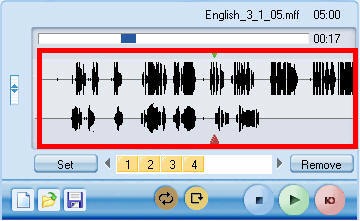
- It features a dual track recorder (allows to listen to teacher track which can be a prerecorded model to imitate on the left channel while recording the student track on the right channel of a stereo track) with a voice graph:
 . See this dual-track-voice-graph screencast demo from the vendor and also our student cheat sheet from the vendor documentation.
 - The Sanako is available in the LRC, as well as in many other educational institutions around the world, but neither free nor web-based (although a web-based version seems to be in the works). It currently requires MS-Windows to run.
- It features a dual track recorder (allows to listen to teacher track which can be a prerecorded model to imitate on the left channel while recording the student track on the right channel of a stereo track) with a voice graph:
- A popular and free audio editor (but not an SLA – specific application, let alone geared towards model imitation; also, for all practical ends and purposes, requires an extra download and installations of an MP3 encoder to be able to save recordings as compressed MP3) is Audacity. To use for model imitation exercises,
- the student can open a model track (mp3 recommended)
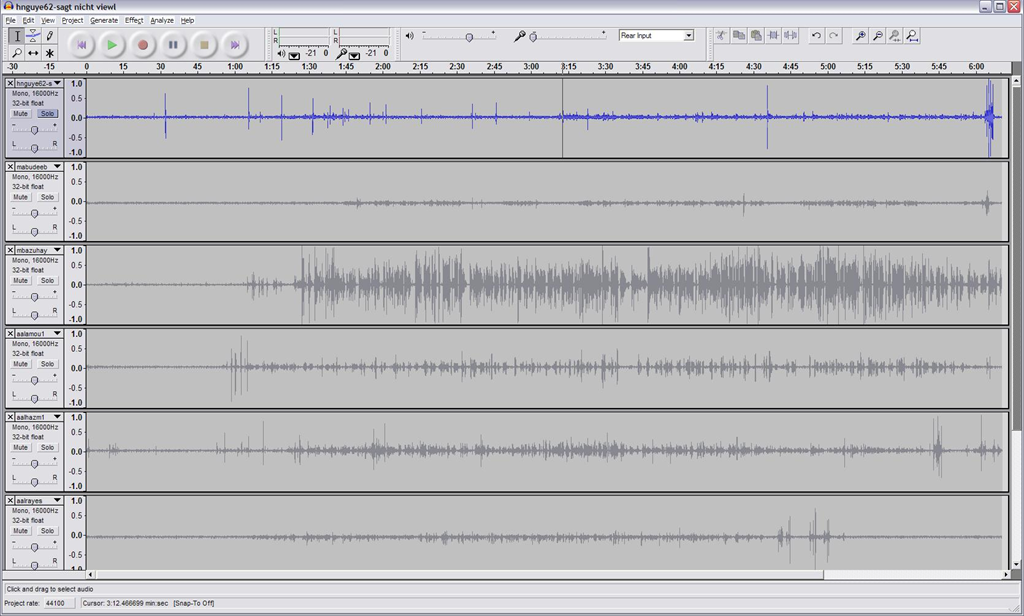
- and manage within the program the imitation portion, using the voice graph:

- then export back out as mp3,
- either her responses individually (see my demo screencast, requires Windows Media Player on Windows, which actually shows a question/response rather than a model imitation, but same principle),
- or, by deleting the model track, the response parts mixed down to one track,
- or also, if, like in my demo screencast, the timeline sequence of model (with pauses) and responses is carefully managed (so that model and imitation do not overlap), mixed down to one track.
- In one language program, I have worked extensively with Auralog Tell me more
- which was (not exclusively, but arguably too much) based on this pedagogic concept of having students compare the voice graph of their imitation with the model voice graph (while it do did not allow for teachers to upload their own content, and was certainly not free).

- To my knowledge, Auralog Tell me more does not allow for adding teacher-produced content as models.
- I did like the self-reflective and repetitive practice element. However, I found that students – apart from intonation and (not useful for not pitch based languages) pitch -, did not benefit as much as one might have expected from viewing the voice graph, indeed tended to get overwhelmed, even confused by the raw voice information in such a voice graph.
- And automated scoring of pronunciation (or speech recognition” – not free form, but on a level that has been commoditized in operating systems like Windows 7, the level of voice-directed selection between a limited set of different options, like menu options, and in the case of Auralog, choosing between different response options) seemed iffy and less than transparent in Auralog Tell me more, even though this is their primary selling point. E.g. when I made deliberate gross mistakes, the program seemed to change its standards and wave me through ( English pronunciation example; also observed by me when testing Auralog with East Asian speakers of English).
- which was (not exclusively, but arguably too much) based on this pedagogic concept of having students compare the voice graph of their imitation with the model voice graph (while it do did not allow for teachers to upload their own content, and was certainly not free).
- In the LRC student computers, we have for exactly this purpose a digital audio recorder as part of the SANAKO Study 1200language learning system
- A voice graph is not the same as a more abstract phonetic transcription (although I do not know whether language learners can be trained in phonetic symbol sets like the IPA). There are now experimental programs that can automate the transcription of text into phonetic symbol sets for e.g. Portuguese or Spanish. Maybe you will find that practice with recording and a phonetic transcription of the recorded text is more useful for your students’ pronunciation practice than a fancy voice graph.


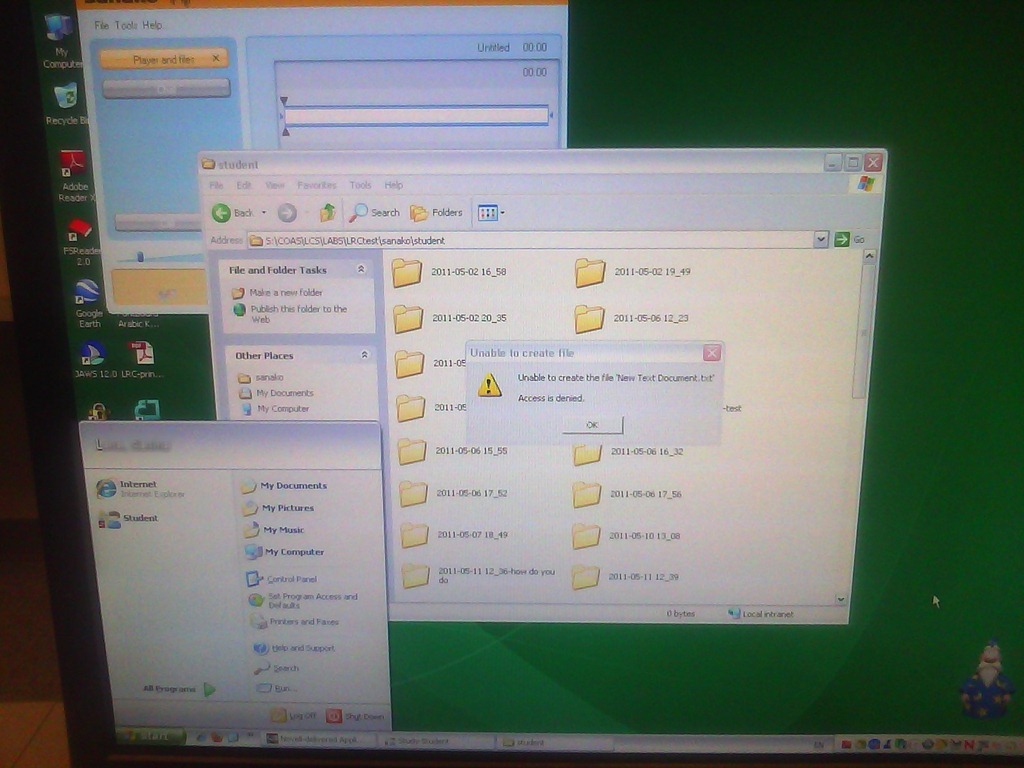
Things to check when your Study1200 cannot record students anymore
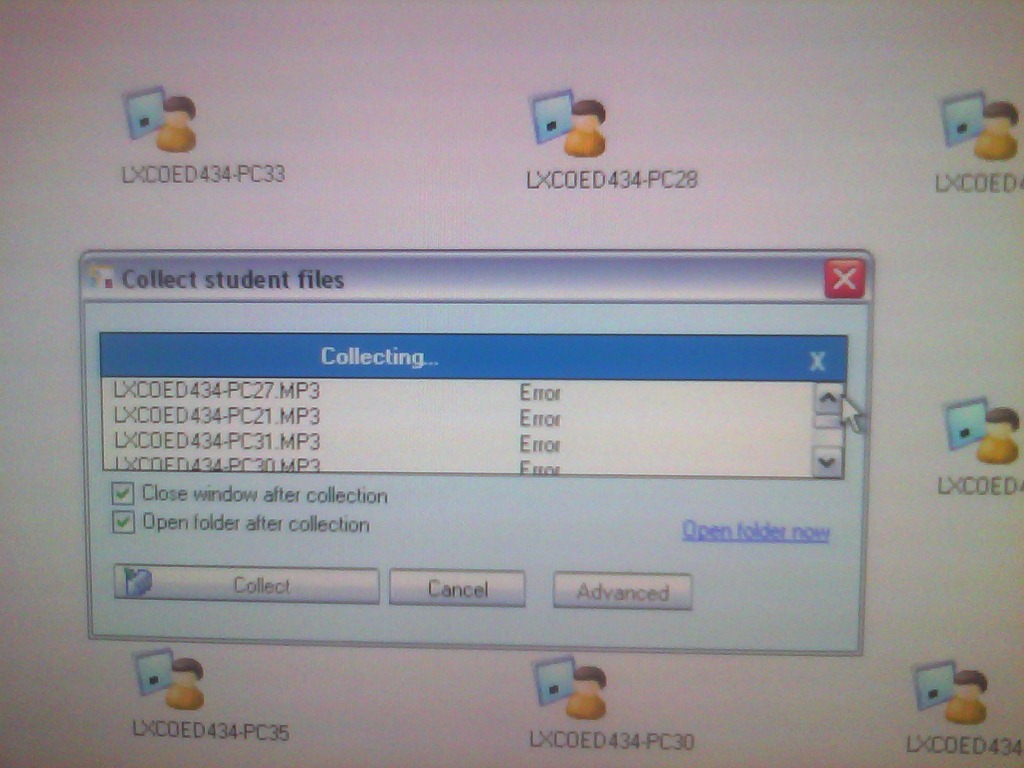
- Symptom: All your exam recordings fail to collect:

- Cause: Student do not have write permissions to the collect folder anymore, a prerequisite for the Sanako Study1200:
- Resolution: Have write permissions reinstituted?
CAOS ereserves not compatible with Sanako Study1200 Webbrowser
- Last week I noticed in the LRC that I cannot open the ereserves with language learning audio files to my students by using the Study1200 Webbrowser’s “follow” feature .
- While sending the audio listing page still works, including the login page which the students get redirected to, and which, upon successful login, redirects them to the listing;
- Getting to the actual audio file launcher page fails, since this is a popup window which the Sanako Webbrowser first blocks, while redirecting the launcher of the popup to the home page
- No pressing of modifier keys seems to be able to bypass the popup blocker. Is there a setting in the Study1200 Webbrowser to modify this behavior.
How to launch a webpage to students from Sanako Study 1200
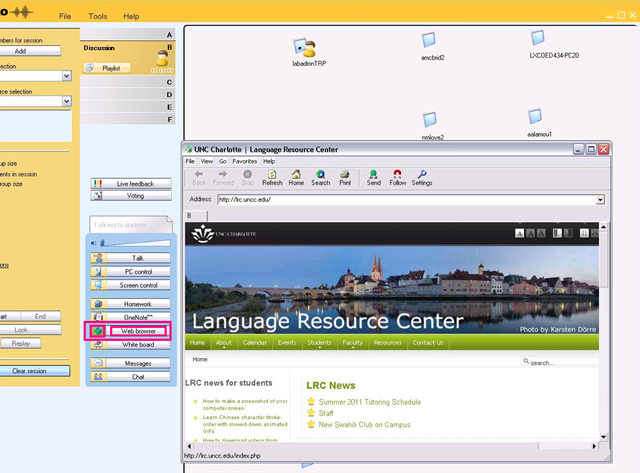
- On the center buttons “Web browser”, use
- either the large grey rectangular right area to launch to all students in class
- or the small square colored (here brown) left area, to launch only to students in the brown group, like so,
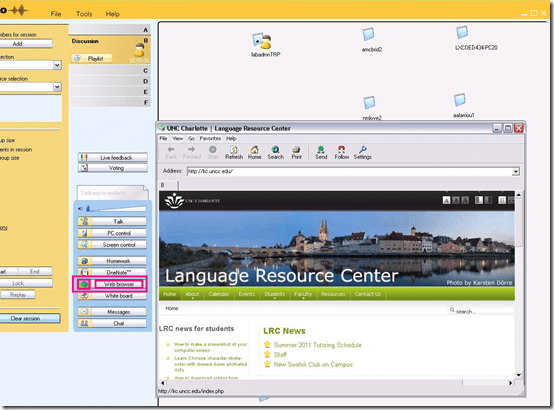
- unfortunately, you will have to click through number of errors on most web pages – the students do not see these

- eventually, the start page will show in your Sanako web browser

- then you can browse to a page from the address bar, click “send”, which will open it on the student computers
-

- clicking “follow”
 is like always clicking “send” after browsing to a new webpage. It allows you to guide the students through a number of web pages.


How teachers can grade student recordings done with the LRC Sanako Study-1200 in their Office
-
Teacher on their office PC (MAC users talk to http://helpdesk.uncc.edu) can press
 windows-key+e, and in the window, that opens,
 -
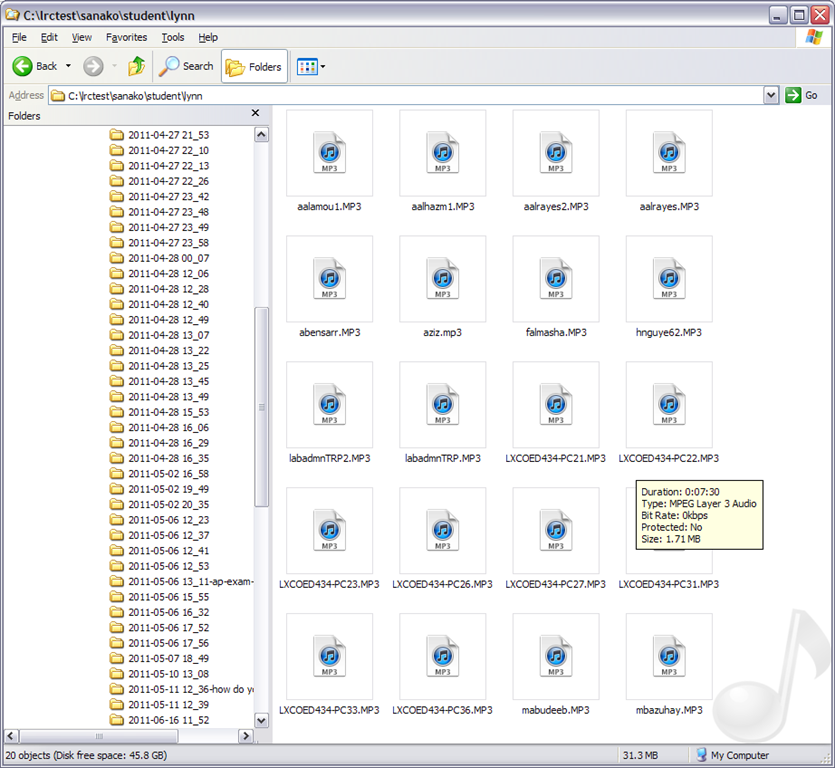
browse to the student mp3 recordings with date and time in the folder name on s:\coas\lcs\labs\lrctest\sanako\student (no S: drive on office PC? talk to http://helpdesk.uncc.edu, but in the meantime, trywindows-key+r, paste = \\DATASERV1\DVOL1\coas\lcs\labs\lrctest\sanako\student”, click “OK”),
-
open the student recording file, either by double-clicking to, presumably, open it in Windows Media Player, or, preferably, by selecting multiple files, right-clicking and choosing “Open with” to open them for comparative grading (read some tips) in Audacity.

Speaking/Listening Assessments and Oral Exams: A comparison what the LRC has to offer
- Moodle:
- I proposed for installing one of the free audio recorder plug-ins into our Moodle, but we are not there yet.
- However, we do have a new video recording assignment (which is based on Kaltura).
- Format: free form, according to your written instructions in the assignment. Students can review and repeat the recording as often as they wish.
- The video overhead is minimal since it is streamed, and video is better for authentic language assessments – unless you specifically prepare your students for phone interviews: then just have students step out of the viewing angle of the webcam).
- thanks to Moodle, the familiar interface and the underlying LMS support infrastructure, it is easy
- for the teacher
- to create and assign a video-assignment
- to grade it from the gradebook
- for the students to take it and submit it.
- for the teacher
- LRC Support:
- Since our PCs have no built-in or added webcam (proposed), we can currently only use our 5 iMacs for Moodle video assignments. Since the MACs do not have headsets (but built-in microphones), the audio quality is not as good as on the PCs. Since 5 seats are not sufficient for class-size activities/exams, it is best to use this as a homework assignment
- I list all necessary steps for a video assignment
- Additional support is available through the campus Moodle support team.
- Sanako
- Sources
-
Dual-track comparative recorder:
- the teacher can prepare an input track (or provide one live. Preparing is easy, and worth your while, since easily reusable. I can help you)).
- the students records on her own track
-
Pair and group recording:
- Sanako makes it easy to pair or form groups of students and to record free-form conversations.
- These recordings can be either controlled remotely by the teacher or locally by the user
-
- Control
- Remote-controlled recording under exam conditions,
- responding to a listening cue within a preset (or live) pause in the teacher track
- model&imitation: for phonetics and pronunciation exercises,
- question&response for a wide variety of activities as commonly used in SLA textbooks and classroom, including practicing grammar structures or vocabulary recently
- question&response&model response: the teacher can also include after the pause in the teacher track a model answer for the students to compare their own output to.
- automatically saved with student names to be accessed from the teacher office desktop
- easy comparative grading using Audacity (see below)
- responding to a listening cue within a preset (or live) pause in the teacher track
- Remote-controlled recording under exam conditions,
- User-controlled recording is also possible, using the student recorder in manual operation mode
- which has more language learner features (bookmarks, voice graph, dual band recording), and a simpler interface than a full blown audio editor like Audacity (see below).
- The task how to save and sent the assignment to the teacher is here left to the user.
- LRC support:
- I can help you
- creating an audio recording with your content and speaking cues and pauses – using Audacity (see below)
- conducting the remote-controlled exam
- Up to 20 seats can take an oral exam simultaneously, until we get more Sanako licenses. However, we found a way to split classes into 2 halves and have consecutive exams (we can play audio on the other students’ headsets to provide for exam conditions). The LRC main classroom is equipped with 30 seats for 2 consecutive exams with Sanako headsets.
- Sources
- Voicethread is a popular online recorder, especially for educational institutions that have no onsite support.
- Visual and audio cues can be provided by the teacher.
- Pairing of students has been attempted via sharing and responding/commenting to the partner’s submission. This is not a realistic conversation.
- Recordings are stored in the cloud.
- There is no integration with the SIS (accounts – getting students set up with accounts that can communicate back with the teacher is a challenge) and LMS (the Moodle integration is superficial).
- Voicethread is not free. The ELTI, however, has a subscription. LCS does not.
- LRC Support:
- We support Voicethread exercises with new and improved headsets.
- Help is available through the vendor.
- Audacity:
- for teachers and LRC staff and other language professionals:
- best free audio editor, also good for comparative grading. I routinely make my audio exam recordings with Audacity.
- LRC support: I have tips and tricks how you can use it in your teaching preparation and grading.
- for language learners: not the recommended option, since Audacity has not a feature set geared towards language learning nor support for language assessment workflows:
- Language learners do no need an audio editor for speaking exercises, they need a recorder. If you are a language learner, it is not pedagogical to be able to technically edit and refine your audio recording. Rather rehearse, reflect on and repeat your audio recording, until you are happy with your language output.
- Audacity is too technical: It involves too many steps, options and settings for the students to record, save, export and name the audio and to get it to the teacher, and (if it is not uploaded into a Moodle assignment, which could then be a Kaltura assignment anyway, see above), too tedious for the teacher to manage and grade files.
-
LRC Support:
- If your students are technically inclined, we do have Audacity installed in the LRC.
- Your students should not find it difficult to read the documentation. Here are my posts on Audacity.
- for teachers and LRC staff and other language professionals:
Sanako Study-1200 Oral Exams: More result examples
- Study 1200 will automatically save the exam recordings of each of your students under a distinct name (you can choose student email name or seat number) in a location which you can access from your office desktop:

- You can load this recordings in Audacity to grade them, including skipping past the questions and increasing the play speed, but not the pitch, and easy comparison of students like in the picture below:
-


How to do Sanako Oral Exams with large classes, but few licenses: A workaround using partial classroom layouts
When you open the Study1200 tutor, a dialogue comes up which lets you select you the “classroom layout’. What this actually means – since the physical classroom (LRC layout) is obviously immutable –, is: which computers do you want the Study1200 to connect.
The “template classroom” (this happens to be just the default name within Sanako) tries to connect all students logged in on computer in COED434 to the teacher from the “corridor” (= where Study1200 leaves all computers that it knows of, but that you do “into” want to let into the classroom; the corridor has link in the bottom center of the Study1200 teacher window, and it flashes if there is a change “in “ the corridor Stuy1200 wants to make you aware of) that the Study1200.
However, beyond the 20th client (first come, first serve), this will fail because of licensing restrictions, and a grey exclamation mark will appear in the classroom layout in the Study1200 window for these student icons.
The “left-half”and “right-half” layouts that I created load only the computers in either the left or right half of the COED434 classroom (each without the wall/window-facing computers at the very edges) into the classroom layout (other logged-in students will remain in the “corridor”, linked in the bottom center of the tutor interface, if you want to add select students – note that the student icon will not appear on screen in their approximate physical position in the classroom.
You can also bring up the dialogue from which you can choose classroom layout after the initial startup of the tutor: Go to top menu: file / classroom layout. A 45-second screencast of this switching our classroom layouts in Sanako Study 1200 is available for download (requires Windows Media player).
In the screencast, you can see how the visual layout on screen reflects the physical layout in the classroom (the number labels on top of our computer monitors appear (optionally) in seat numbers): rotate by 90% clock- or counterclockwise (I wish we would have not only more licenses, but also a higher screen resolution. Stay tuned).
This technique of splitting the classroom, unloading and loading half of it at a time, you can exploit for administering oral exams consecutively with class sizes (current maximum is 25/30, depending on level) that exceed the number of licenses we have (currently 20 + teacher).
This technique of excluding computers from connecting to the teacher we could also use to merge the listening station computers, even though they have a different audio hardware configuration (analog headsets only, no Sanako headsets with built-in sound card and disabled on board sound) into the main software image without consuming valuable licenses – not without other problems.


Questions? Read the About. Or just ask me a quick
Thank you for your response. ✨

FAQs for LRC student staff or for students or for teachers. To search our FAQs, in the browser addressbar, add after "https://plagwitz.wordpress.com/feed/?tag=faqs+/" "+TAG1" (from tag cloud below) OR "https://plagwitz.wordpress.com/feed/tag=faqs
&category_name=" "CAT1" (from category hierarchy below). OR search both categories and tags, and multiple TAGs/CATs (connect with "," for OR-search, with "+" for AND-search), like so: https://plagwitz.wordpress.com/feed/?tag=TAG1+TAG2+...TAGn&category_name=CAT1
+CAT2+...CATn"
Other ways to find help
If you cannot find it here, look there: 5,500 Language-Learning Links and Programs for learning or teaching 150 languages
Shortcuts:Our Lists, Our Maps, LRC Staff Moodle Site,LRC Project Moodle Site, 49erexpress, UNCC Moodle, Student Recordings: s:claslcslrcsanakostudent
Learning usage samples: Sanako oral exam, Kaltura webcam presentation, Dictation with speech recognition, Sanako written exam, Chinese and Japanese interactive stroke-order practice
Test the Sanako Installer, Webbrowser Popup Konfigurator for XP, or Windows7, faster LRC TeacherPC Log-in Let MS facilitate diacritics writing by installing for you US-International keyboard layout
This is my personal blog (Google+). The views expressed on these pages are mine alone and not those of my employer. The information in this weblog is provided “AS IS” with no warranties, and confers no rights.
 Thomas' Work Space