Archive
UNCC LRC Language Placement Test: Web-CAPE Online Placement Exam Step-by-Step
- “The Online Placement Exam is designed to help you determine the first course you should take, based on your ability. This multiple-choice [no speaking, listening or writing required] exam presents questions of different ability levels, adapting the next question’s level according to your answers. The number of questions you will be required to complete depends upon your ability to use the language. The duration of the test varies, but it usually takes 15-20 minutes to complete [but can be finished after only 4 questions, and we will give you up to an hour time to complete the exam]”.
- The proctored exam takes place in the LRC (COED434). The exam schedule is published in the LRC COED434 calendar. Read more on how to view the LRC calendar from within the new NINERMAIL.
- When taking the exam during the proctored session in the language center [do not take the exam on your own], to sign up for the test, you have to go to: https://www.aetip.com/student/RegisterStudent.cfm (note: the “s” behind “http” is required), this now forwards to:https://www.perpetualworks.com/secure/register/student/, for which sthe shortcut is: http://goo.gl/PBjhhS:

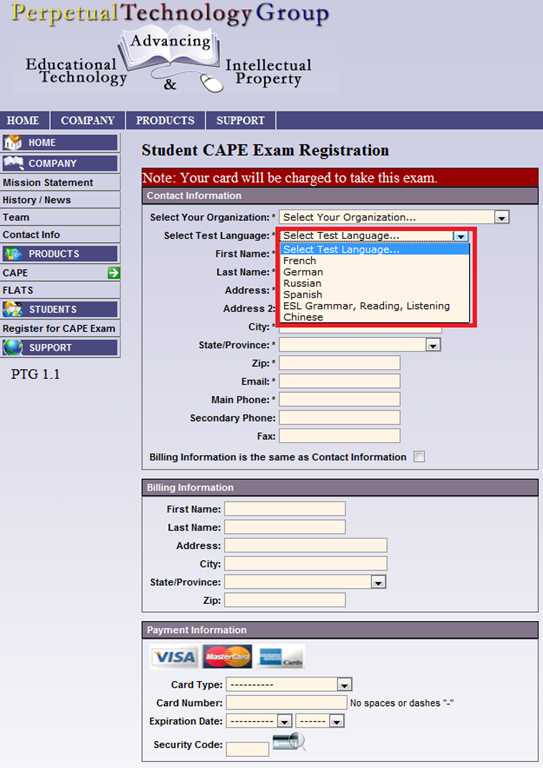
- First chose UNCC (Avoid the common error of choosing another University of the UNC system, you will not be able to take the test if you do):

- Then choose your language – note that UNCC only allows testing in French, German and Spanish.

- Fill out the other form fields with your information.
- Finally, you need one of these credit cards, and the proper billing info, to take the test:

- Next, you will have to enter your NINERNET student id number.
- The exam results will eventually go to your file. However, they will have to be post-processed by the department. Do not take the exam without coordinating with the Department of Language and Culture Studies, or else your exam results will get lost!
- Remember that you can repeat the placement test, even though the number of retries per languages is limited to two (your score will get invalidated after that!).
- Remember also that is not advisable to study for (let alone cheat during) a placement exam, or else you will get placed into a course that is not right for you.



How to self-enroll in a Moodle course
If a Moodle course is set to allow for self-enrolment (both regular and Project courses here can be), if you go for the first time to this such a course – e.g. by clicking on a link to the course (which we don’t show you here, since we want to give only a select user group to self-enroll in our course) – you will be taken to a logon page (if not already logged into Moodle), and, upon successful login, be immediately offered to self-enroll. Click the “Yes” button and you are taken to your course, like is done in this screencast on self-enrolling in Moodle.
Moodle metacourses, part II: The technology
One of the most missed business requirements for a LMS in version 1 of Moodle has been lack of support for sharing files across courses. This has been addressed by the e-Repository API in version 2 of Moodle, which, however, we will not have in the foreseeable future. In version 1, metacourses have been the most widely used workaround.
The technical concept behind a metacourse in Moodle seems to be best described like so: “A child course gives its [student - TBA:teachers need to be added manually, but fortunately do not change as frequently as students] enrolments [= access to] to the parent course” or meta course, which has no enrolment of its own. In practice, this can go either way: Using metacourses, one can “populate many [meta]courses [= building blocks of content (e.g. chapters, weeks, can even be separate, but required courses with different teachers – TBA: then exclude the teacher role from being added with enrolments, in Admin/Users/User Policies , flexibly combinable to make up a specific version of your regular course] from one enrollment or one [meta]course from many enrollments [= many sectional regular courses that need access to the same content]”. Either assign to many metacourses [= building blocks] 1 child course each, or vice versa assign 1 metacourse many child courses [=sectional regular courses].
For base Moodle version 1.9 administration information, simply watch the first half-minute of this screencast, or read this extract from the Moodle documentation:
“To change a course to a meta course, set "Is this a meta course?" question to yes in the course settings.”

(Note that this option will disappear as soon as the course has an enrolment!)

In your metacourse “you can link [=”associate”] to or unlink from (add or delete) "child" courses by the course Administration menu. This icon and link only appears in meta courses: “

How to make a metacourse visible: “Making a metacourse visible before the metacourse is properly setup can cause Moodle to return ‘This course does not allow public access'(…) Verify that the linked "child" course(s) exists. “
Note: Metacourses may be set to inactive and unavailable to enrolled students until the teacher activates the metacourse.
Note: It takes some time for the meta-enrollment to apply (time depends on the setting for the cron-job).
How to handle metacourse teacher role enrollments: Certain roles can be excluded from being passed on as enrollment from child courses to metacourses. For our shared resource courses, this does not make sense (in the contrary, since any teacher from the child course may want to manage resources contained in the metacourses – this does not to be coordinated between teachers of similar child courses.).
TBA: How to handle metacourse enrollments across terms: Our metacourse shells will stay across the term, while enrollment will be automatically dropped with the child courses “going out of scope”.
How to manually add a user to your course.
Less than intuitive, but you have to go via “Assign roles”. Here are the steps:
- Go to “Assign Roles” in your bottom left hand course menu
- Choose a role you want to assign
- Search, add and assign the role to a user. This will also add the user to the course.
- Check results by going to “Participants” in your bottom left hand course menu
Here is the screencast of adding users to your Moodle course.
How can I change the volume on my SANAKO headsets?
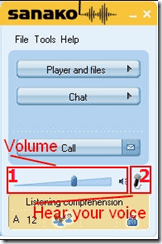
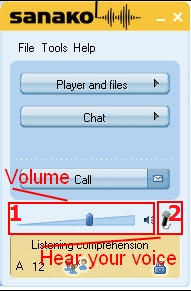
- Q: How can I change the volume on my headsets? Hear my own voice on the headsets? A:Use the Sanako Student Player 1. Volume Slider and 2. (for Sidetone = echo of your speaking) Headset Icon:
-
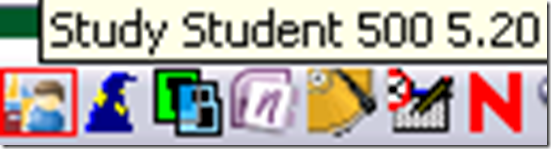
- Q: Where is the Sanako Student Player? A: Show Sanako Student by clicking on the notification bar icon:
How to use Wimba classroom for online tutoring
1. Before entering the Wimba online tutoring room, both teacher and student first run the Wimba Setup Wizard.
2. To enter the Wimba online tutoring room:
2.1. Teachers go to http://wimba.uncc.edu, and log in with their ninernet credentials
2.2. Students Click on the respective teacher link in the online tutoring schedule (SEPARATE HANDOUT), or build your URL from this:
2.2.1 room owner is student: http://67.202.211.176/launcher.cgi?room=stu_[replace […] by Ninernet username]
2.2.2 room owner is staff: staff: http://67.202.211.176/launcher.cgi?room=mtg_[replace […] by Ninernet username]
3. Text messaging: Teacher and user can type text messages in the text box in the lower left of the Wimba room.
4. Audio connection: Teacher and student have to hold the “Talk” button with your mouse (or change the options) when you talk. They can control that their audio is being recorded by monitoring the meter.
5. Screen sharing (e.g. for viewing the Centro online learning pages together):
5.1. is initiated by the teacher (through Remote AppShare Request).
5.2. The student gets to authorize it (by clicking “OK” in a window and dragging a frame around the portion of his screen she wants to share).
5.3. Both parties can end screen sharing as they wish.
6. Both teacher and student are advised to have a phone ready as backup. Note that, unless the student releases it, only the teacher phone number is available to the student.
7. In case of technical problems, make sure you have run the Wimba Setup Wizard and consulted the CTL Wimba FAQ.
8. Report remaining technical problems to http://helpdesk.uncc.edu or Faculty can call (704) 687-310, Students can call (704) 687-6400. After hours, get help at technicalsupport@wimba.com or call 866-350-4978.
Speaking dictionary/pronunciation help, Part 1–the pedagogy
On the LRC PC’s, you can copy foreign language text to the clipboard (or with non-western languages to an MS-Word file) and have a wizard (right click, choose: “Read Clipboard”) pronounce for you, like so:

The following languages are supported:
| Language | Demo |
| American English | |
| French | Le Monde |
| German | |
| Italian | |
| Japanese | Japanese |
| Korean | |
| Portuguese (Brazilian) | |
| Russian | Gazetta |
| Spanish | El Pais@10:34 |
Note 1: In reality, the audio quality is smoother than in these demos which needed to be recorded over the network using MSTSC, because of Windows Media Encoder not being able to capture the special video overlay of the MS-Agent technology.
Note 2: Deskbot has problems understanding the Windows clipboard text encoding of some non-western languages. For these languages, instead of simple double-clicking the deskbot wizard to have him read out the clipboard (which would result in gibberish), paste your text into a MS-Word document and have deskbot read this document for you instead: Use the Deskbot option “Read Word document” (allowing Word to translate the character encoding into a format Deskbot can understand enough to aurally (even if not visually) display).
Listen to the Deskbot’s self-introduction when you log in to learn how to change the default language to the language you study.
You can also change other settings (in the LRC automatically limited to your current user session) by right-clicking the deskbot notification-area icon 
Or if you want to configure your own Windows XP computer to support foreign language text-to-speech, the procedure and settings we recommend are documented in Part 2.
Speaking dictionary/pronunciation help, Part 2 – The technology: Installation & configuration of the free Windows XP text-to-speech wizard
- MS-Speech synthesis which comes free with Windows XP is a mature technology which gets even better if combined with free downloadable voice/language combinations and a simple interface.
- Since 2005, I have set up the following text-to-speech environment in language learning centers, wherever I could: The pleasant, speedy interface and convenient integration into the computing productivity environment (Clipboard, Internet Explorer) seems to lead to higher usage than online speaking dictionaries. And the price is hard to beat (all components are free on Windows XP).
- The Deskbot pronunciation – most of my own testing has been for German and English, but I rely on the feedback of native speaking other teachers and tutors for other supported languages – is good on a word level . The prosody of sentence pronunciation leaves a lot to be desired, but is a start nevertheless.
- If you want to install the Deskbot Text-to-speech wizard for your users, or for your own testing and language learning, here are the steps and settings we recommend:
- Use these installers:
-
Language TTS Engine Language Add-On American English tv_enua.exe already installed British English lhttseng.exe already installed Dutch lhttsdun.exe agtx0413.exe French lhttsfrf.exe agtx040C.exe German lhttsged.exe agtx0407.exe Italian lhttsiti.exe agtx0410.exe Japanese lhttsjpj.exe agtx0411.exe Korean lhttskok.exe agtx0412.exe Portuguese (Brazilian) lhttsptb.exe agtx0416.exe Russian lhttsrur.exe agtx0419.exe Spanish lhttsspe.exe agtx0C0A.exe - Move the Deskbot near the lower right corner notification bar to have it not clutter the user interface.
- Do not automatically read clipboard when changed
- Do NOT play animation sound effect: effects wear out quickly and become distracting or annoying.
- Default set to American male: or whatever in your shared environment is the language all learners understand .
- You have to click “set” to actually effect a change, and close the options dialogue.
- Set read random greeting at startup: in a shared computer setting, you can on startup.
- Have the Deskbot introduce himself with basic usage instructions: In order to have this feature self-advertise in the LRC, beyond my face-to-face-classes in the language center, I have the Deskbot read out an informational welcome message every time it starts up (you could use this feature also to have the Deskbot issue a random greeting in your target language).
- Show balloon – useful since words scroll in as spoken.
- In the Speech control panel, you can set the speed to slow – useful for language learners.
- MS Agent Options: TBA
- You can view the Deskbot install process in sequence as a screencast:
- Or you can view the configuration options screens with recommended settings in this screenshot gallery:


- For my own – and maybe your – reference, here is a raw screencast of the most recent installation and configuration of Deskbot multilingual text-to-speech engine for MS-Windows.
-
time
content
0,00
Base install begin
2,50
Deskbot – including its installer – cannot handle the character encoding of some non-western languages that it speaks (Japanese, Korean, Russian). In order to have Deskbot speak these languages, you have to use the Deskbot option “Read Word document” (allowing Word to translate the character encoding into a format Deskbot can understand enough to aurally (even if not visually) display).
4,13
fine tuning for language learning purposes in deskbot options and speech control panel after install
6,09
“advanced character options”: set the speaking speed
Returning to the base installation of some more languages
8,04
more deskbot options
10,34
test of Spanish pronunciation with elpais.com
- In a computer lab environment with Faronics Deepfreeze and Symantecs Ghost imaging, you will also want to copy these settings to the Default user, and make sure that the deskbot startup items gets added to all users or HKLM registry hive (the interface does not allow for installing for all users).


Questions? Read the About. Or just ask me a quick Our Databases: Resources with calendars -- Language learning material Moodle Sites, multimedia files -- films


FAQs for LRC student staff or for students or for teachers. To search our FAQs, in the browser addressbar, add after "https://plagwitz.wordpress.com/feed/?tag=faqs+/" "+TAG1" (from tag cloud below) OR "https://plagwitz.wordpress.com/feed/tag=faqs
&category_name=" "CAT1" (from category hierarchy below). OR search both categories and tags, and multiple TAGs/CATs (connect with "," for OR-search, with "+" for AND-search), like so: https://plagwitz.wordpress.com/feed/?tag=TAG1+TAG2+...TAGn&category_name=CAT1
+CAT2+...CATn"
Other ways to find help
If you cannot find it here, look there: 5,500 Language-Learning Links and Programs for learning or teaching 150 languages
Shortcuts:Our Lists, Our Maps, LRC Staff Moodle Site,LRC Project Moodle Site, 49erexpress, UNCC Moodle, Student Recordings: s:claslcslrcsanakostudent
Learning usage samples: Sanako oral exam, Kaltura webcam presentation, Dictation with speech recognition, Sanako written exam, Chinese and Japanese interactive stroke-order practice
Test the Sanako Installer, Webbrowser Popup Konfigurator for XP, or Windows7, faster LRC TeacherPC Log-in Let MS facilitate diacritics writing by installing for you US-International keyboard layout
This is my personal blog (Google+). The views expressed on these pages are mine alone and not those of my employer. The information in this weblog is provided “AS IS” with no warranties, and confers no rights.
 Thomas' Work Space