Archive
LRC learning resources Moodle metacourses: Our list
UPDATE: The LRC Metacourses are being rolled over to MOODLE2. Metacourses having only an OldID are currently still unavailable in Moodle2. And the student enrollment needs to be updated manually until the end of add/drop. On the upside, teachers do not need to make course available to students anymore. The LRC can do this (Metacourses for languages saying #Ref are waiting to be rolled over, tell me if you need them)..
The following LRC Moodle metacourses for teaching materials are available to LCS and ELTI (including LRC-Resource with training materials for using language learning technology in and outside of the LRC, as well as for independent study languages).
The naming scheme follows the course abbreviations taught in the departments that the LRC supports:
These courses appear in the Training branch of the Moodle-courses tree-menu on the left (for all study programs you teach in):

The metacourse for a language (or field of study) is accessible to all students studying this language during the term of their study.
How students can record their picture or photo presentations with PowerPoint 2010
- The screencast shows the necessary steps:

- inserting a photo album,
- presenting while recording the presentation with narration
- saving as a show (.ppsx) – make sure you have ribbon:”Slide show”/ “Play narrations” checked:

- to prepare an assignment for a Moodle single-file-upload (How a student takes a Moodle Simple file upload assignment).

Pictolang, another flashcard site for vocabulary learning
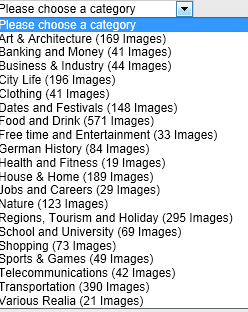
- Distinguishing mark: Pictolang is based on the Culturally authentic Picture Lexicon. Here is an overview of the currently available languages and imagery:
-
Language Region # Images German 2631 Mandarin China 2336 ESL North America 2074 Russian 1420 French France 1231 Spanish Southern Cone 1022 Spanish Mexico 1000 Spanish Central America & Caribbean 872 Spanish Peninsular 579 Arabic 287 Special Collections 151 Ukrainian 139 Japanese 106 French Canada 47 Arabic Oman 11 - You can focus vocabulary your study on specific topics, which will likely integrate it better with your core textbook material (often divided into topical chapters).

- Suitable for self-study, the use of CAPL makes this an especially interesting tool for preparing work/study/travel abroad. It also allows for playing a classroom flashcard game in language culture and area studies, where the teacher can provide context and background information in the images from the target culture.

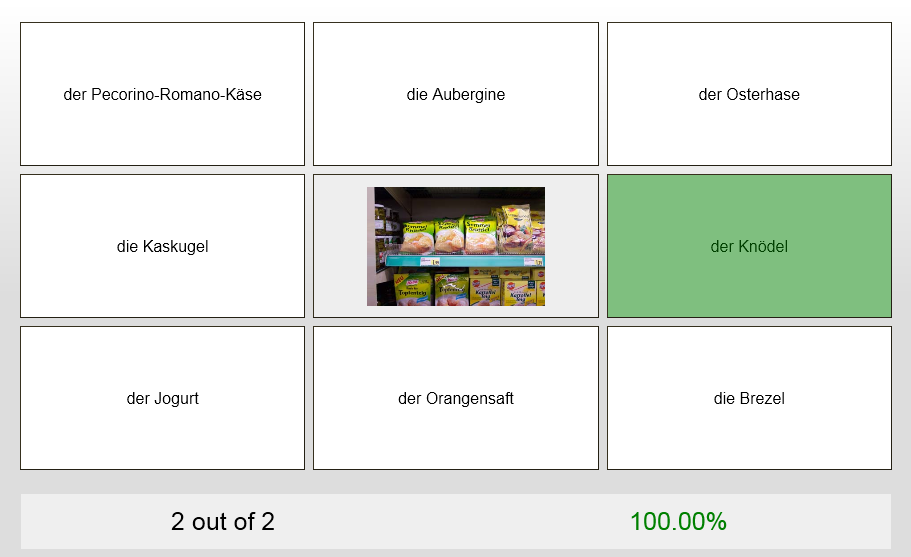
- Example o the Word Match Game right answer feedback:
- Wrong answer feedback:


A classroom-management-system-based emporium to improve tutoring support for Hybrid Spanish students
- “[T]o bridge the gap between students’ demand for introductory Spanish courses and adequately staffing”, UNC-Charlotte – using, among others, a UNC-Chapel Hill pilot as a model, which, however, served a different student population and was soon faded out again – introduced a hybrid model for 1st year Spanish:
- Weekly contact hours were cut in half (effectively doubling student numbers per teacher ) ,
- and attempted to be replaced by more extensive assignment of homework exercises/quizzes from the online textbook component
- for lack of own technical resources (p.54), not that the components were designed for a hybrid purpose – but always nice to see language teachers adopt technology for ROI in creative ways when they have to.
- for the same reason of incapability of “adequately staffing”, so that teachers do not have to operate the computers, only those activities from the online components were chosen that could be automatically graded (while the continued reliance of online quizzes on right/wrong black/white schemes instead of at least considering editing distance (maybe reasonably also for foreign language diacritics), not to mention attempts on a truly semantic understanding of student input, makes one wonder if this subset of assignments could effectively and should be left to auto grading).
- and other, auxiliary syllabus guidelines, like:
- taking more advantage of the online textbook component for
- heavier formative testing
- outcome testing
- requiring “oral testing administered two or three times a semester” (p.46, 64)
- increased focus on taking advantage of contact hours by communicating, what is now often deemed flipped classroom pedagogy and used to be called homework preparation
- taking more advantage of the online textbook component for
- tutoring, for students that could not handle the cut in face-to-face time with teacher (note, tutors were from the grad student teacher pool – not all teachers were grad students)
- face-to-face:
- online, during off-hours (weekends):
- seems a welcome extension, and a convenient time-saver
- however, little adoption
- additionally, hindered by a technology change from Wimba to Centra.
- also hybrid? The LRC
- could be host to an emporium like Virginia Tech’s: computerized for access to online assignments, but under tutor guidance;
- could provide the Sanako classroom management and digital audio lab system for making this learning experience even ore efficient. The tutor on teacher station can monitor many students (simultaneously or automatically cycling through student stations at an interval of choice, while stopping interactively where desired) via screen sharing. Interact with any student computer via remote control, with the student over headphones, without disrupting,
- easily escalate presentation of tutor or model student screen and audio discussion of endemic problems to either student group as a whole or subset (meaningful as long as 2 or more students overlap in their assignment activity and have similar issues) via the Sanako – and of course also use the classroom projector.
- Hybrid Spanish clearly constitutes a radical program change, dictated by shortness of funds and requiring measures to efficiency and effectiveness of instruction, upholding of standards, and management of attrition.
How to switch the input language in Respondus Lockdown browser, e.g. to Arabic
- Short answer:
- Right-click the Language bar on the taskbar and choose “Restore the Language bar”, like so:

- This makes the language bar a floating toolbar on top of the screen, like here:
 . This floating toolbar you can still access when in Lockdown browser.
 - The language bar can be temperamental, you may need to bring it up again, try switching back and forth between input fields.
- Long Answer:
- Respondus Lockdown browser blocks many functionalities, including the shortcut combination to change input languages (usually LEFT ALT + SHIFT) and access to the Language bar on the task bar.
- This is not an issue when your quiz is in a western language and you have US- international keyboard layout configured as your default (which lets you type most Western diacritics without need for keys blocked by Respondus Lockdown browser )
- It is an issue with e.g. Arabic. You cannot even temporarily set Arabic to your default input language before starting lockdown browser, since then you cannot log in (with MS Maren IME, you can override the Arabic default to enter your username in western characters, but not the password. Respondus Lockdown Browser is built on Internet Explorer, but it does not share the cookies, so being logged into your LMS in Internet Explorer does not carry over to your Lockdown Browser session).
- Workaround: See above.


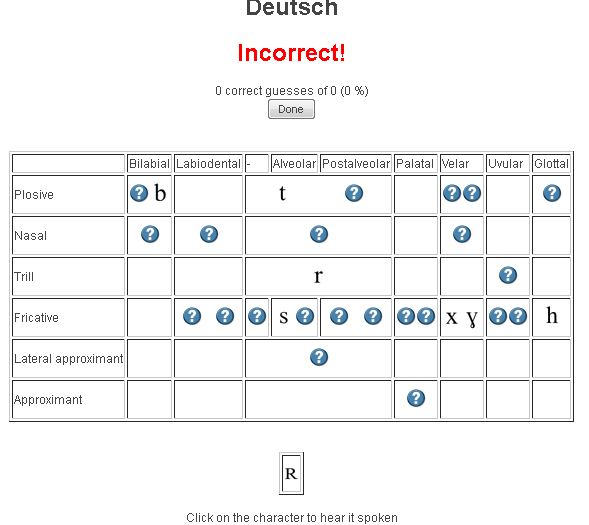
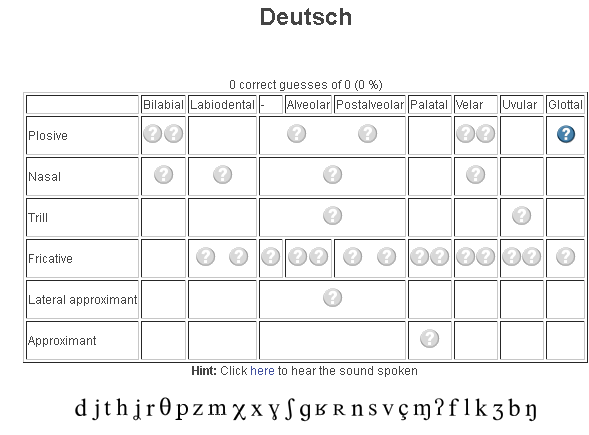
Ipatrainer.com community provides free phonetic transcription tables with sounds and exercises
- This is looking good, but …
- There seem to be some coding issues, I am getting server errors 500 after registering.
- The site is advertisement-based.
- There is no content beyond the IPA sound which would put these bare basics in phonetics into language learning context and practice.
- Site Contains:
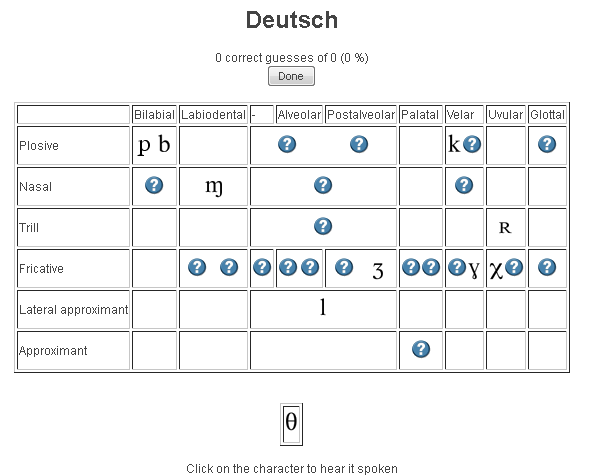
- tables for teaching your language – complete with phonetic symbols and sound samples

- and exercises for your students (e.g. Memory games, Identifying characters


 , places,
  and sounds.
- tables for teaching your language – complete with phonetic symbols and sound samples
- You can
- Create your own, after free registration,
- or assign one of the ones from many other teachers.
- Most popular ones are listed here: http://www.ipatrainer.com/user/site/?language=, and if the use numbers are accurate, there must be really some serious IPA learning going on here…
- I see no way to browse other tables without having the username of the teacher who created and assigned it.
- There is also a phonetic writer.
- And a user forum, in its infancy.



How to download Centro Spanish Textbook audio
The audio is in (compressed) mp3 format. Just right-click on any audio link and choose save target/link as (or similar, depending on browser), like so: 
Example from Centro – Puntos de partida: Online Laboratory Manual, 8th Edition (you need access privileges to follow this link, but you can send links around, users can open them, provided their webbrowser is already logged into the centro site – getting access and finding you way around the website is the real issue. Webspiders are prohibited, though – and even Downthemall saves only files without extensions: rename them to .mp3 or save them manually as .mp3 in the first place, as shown above. Does not work as above? Try a different web browser.


Questions? Read the About. Or just ask me a quick Our Databases: Resources with calendars -- Language learning material Moodle Sites, multimedia files -- films


FAQs for LRC student staff or for students or for teachers. To search our FAQs, in the browser addressbar, add after "https://plagwitz.wordpress.com/feed/?tag=faqs+/" "+TAG1" (from tag cloud below) OR "https://plagwitz.wordpress.com/feed/tag=faqs
&category_name=" "CAT1" (from category hierarchy below). OR search both categories and tags, and multiple TAGs/CATs (connect with "," for OR-search, with "+" for AND-search), like so: https://plagwitz.wordpress.com/feed/?tag=TAG1+TAG2+...TAGn&category_name=CAT1
+CAT2+...CATn"
Other ways to find help
If you cannot find it here, look there: 5,500 Language-Learning Links and Programs for learning or teaching 150 languages
Shortcuts:Our Lists, Our Maps, LRC Staff Moodle Site,LRC Project Moodle Site, 49erexpress, UNCC Moodle, Student Recordings: s:claslcslrcsanakostudent
Learning usage samples: Sanako oral exam, Kaltura webcam presentation, Dictation with speech recognition, Sanako written exam, Chinese and Japanese interactive stroke-order practice
Test the Sanako Installer, Webbrowser Popup Konfigurator for XP, or Windows7, faster LRC TeacherPC Log-in Let MS facilitate diacritics writing by installing for you US-International keyboard layout
This is my personal blog (Google+). The views expressed on these pages are mine alone and not those of my employer. The information in this weblog is provided “AS IS” with no warranties, and confers no rights.
 Thomas' Work Space