Archive
Archive for the ‘Mandarin’ Category
How to use a drawing tablet and Windows XP writing pad IME to write Japanese and Mandarin characters with autosuggest
2012/02/04
2 comments
- Our small group work spaces each now have a Wacom Bamboo drawing tablet installed.
- You can use these tablets in conjunction with the Windows XP writing pad IME to input Mandarin/Kanji character strokes and receive autosuggest options you can pick you character from which make not only writing faster, but also reward you for remembering your characters, expose you to more and help you identify the correct one from a list of options.
- Here is what the Windows XP writing pad IME and Wacom tablet looks like in action:
 (behind the pen: our Japanese tutor).
 - Here is how to access Windows XP Japanese IME keyboard and handwriting:
- Open the application you want to write in, e.g. MS Word (the language input option is specific to the current window and defaults to”English-US international” in the LRC if you open a new window).
- In the taskbar, in the language toolbar section, select Japanese or Chinese or Korean.
- If only the language identifier is showing in the language toolbar, right-click on it and choose “Show additional icons”
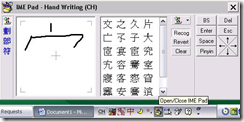
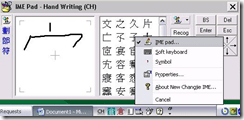
- Select as input method for the chosen language from icon “Options” or “Tools”” , the “IME pad” / “Handwriting”
- Prerequisites
- you need to have the handwriting IME installed for Japanese or Chinese or Korean in Control Panel / Regional and Language Options / Text Input, and East Asian language support).
- For simplified Chinese, the IME Pad may not be checked to be displayed by default. Access the Tools icon menu to check it.
- For both simplified and traditional Chinese, if checked, the IME Pad becomes a separate top-level ion in the language bar.
- Some screenshots may help:




Collections of online dictionaries
2012/01/30
Leave a comment
- Here you can haz dictionaries. And if you use them in the Language Resource Center, you even have the chance to run into someone who can show you how to use them well.
- http://linguistlist.org/sp/GetWRListings.cfm?WRAbbrev=Dict
- http://lexicall.widged.com/repository/listing.php?category=words
Categories: all-languages, Arabic, English, Farsi, French, German, Greek (ancient), Greek (modern), Hindi, Italian, Japanese, Korean, Latin, Mandarin, Polish, Portuguese, Russian, Spanish, Swahili, Vocabulary, websites, Yoruba
dictionaries, links
How a teacher creates audio recordings for use with Sanako Student Voice Insert mode
2012/01/24
Leave a comment
- One of the Sanako Student player’s useful features geared toward language learning activities, is that it can save the teacher the time and effort for inserting pauses into their audio recordings, so that students can record responses into them.
- Meaning the teacher can just press the red speak button
 and record through the entire file in one sitting.
 - The teacher can still help students finding their way around the file, especially where to insert their own audio recording responses, by adding aural cues.
- This can be done in minimal time: I once saw a teacher use a bicycle bell – and why not, if it saves time.
- A spoken instruction “Respond”/”Answer in 10 seconds” is not more difficult to spot (unless only the voice graph is being browsed) and might be even better.
- If you have spare time:
- You can post-edit the file with audacity, generating and inserting sinus tones.
- You can use the Sanako player to insert bookmarks instead of cues.
- Meaning the teacher can just press the red speak button
- As long as students have been instructed to how to use voice insert recording mode with the Sanako student recorder.
- This is for self access of students to teacher recorded files – be it during class or homework.
- If you want to record students under exam conditions, a similar insert recording feature is available within the activity: Model imitation, but not with a pre-recorded file, only when the live teacher is the program source students listen to for cues.

Categories: Arabic, audience-is-teachers, documentation, English, Farsi, French, German, Greek (modern), Hindi, Italian, Japanese, Korean, Listening, Mandarin, Polish, Portuguese, presenter-computer, Russian, service-is-learning-materials-creation, software, Spanish, Speaking, Student-Computers, Swahili, Yoruba
audio, recording, sanako-study-1200, student.exe, voice-insert
How a student reviews a Moodle MS-Word file upload assignment for writing
2012/01/18
1 comment
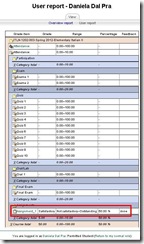
- The student can see the submitted grade in her user report:
- She can view the assignment:

- from where she can open the corrected MS-word file
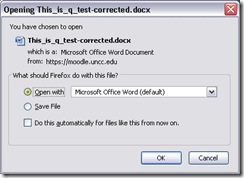
- for more detailed corrective feedback:


Categories: Arabic, audience-is-students, documentation, e-languages, English, Farsi, French, German, Italian, Japanese, Korean, Latin, Mandarin, Polish, Portuguese, Russian, Spanish, Writing, Yoruba
moodle, MS-Word, track-changes
Sanako comparative recording exercises using Moodle
2012/01/13
Leave a comment
- Comparative recordings are one of the best-established practices in SLA with technology. We can implement them here using:
- The Sanako Study 1200 language lab software installed in LRCRoomCoed434 facilitates comparative recordings by students, based on a teacher-provided model audio, with its student dual track recorder software.
- Moodle’s Simple file upload assignment aids in managing the workflow,
- from delivering the audio file with the model recording to the student
- to organizing, assessing and grading the student input.
- For the teacher
- to create such an exercise, she
- creates an audio recording that serves as a model for the student pronunciation – a special application of our Audacity recording introduction. It is advised, however, to insert clear cues for the student to start his repetition.
- creates a Moodle’s Simple file upload assignment to which she attaches the audio recording
- continue with How a teacher grades a Moodle simple file upload assignment
- to create such an exercise, she
-
For the students to take such an exercise:
- How a student takes a Moodle Simple file upload assignment
- TBA: Sanako Student Recorder
Categories: Absolute-Beginner, Arabic, audience-is-teachers, Beginner, documentation, e-languages, English, Farsi, French, German, Greek (modern), Intermediate, Italian, Japanese, Korean, Mandarin, Polish, Portuguese, Russian, software, Spanish, Speaking, Student-Computers, Yoruba
moodle, sanako-study-1200, student.exe
How to do model imitation recording exercises to improve language learner pronunciation in the LRC and beyond
2011/11/22
Leave a comment
- Sometimes teachers ask about support for voice recognition in the LRC. The term voice recognition or speech recognition (the former appears to be analogous to face recognition in authentication and other security contexts?) is usually reserved for software that can transcribe your voice into text – still no free option for this, AFAIK. Dragon naturally speaking is the oft recommended market leader outside of education (and within, Auralog Tell me more, see below). Update summer 2012: We are working on enabling the Speech recognition built into Windows 7 Enterprise for English, Chinese (Simplified and Traditional), French, Spanish, German, and Japanese.
- Often times, what is actually desired is a digital audio recorder with voice graph, ideally a dual track recorder.
- In the LRC student computers, we have for exactly this purpose a digital audio recorder as part of the SANAKO Study 1200language learning system
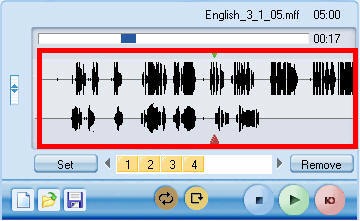
- It features a dual track recorder (allows to listen to teacher track which can be a prerecorded model to imitate on the left channel while recording the student track on the right channel of a stereo track) with a voice graph:
 . See this dual-track-voice-graph screencast demo from the vendor and also our student cheat sheet from the vendor documentation.
 - The Sanako is available in the LRC, as well as in many other educational institutions around the world, but neither free nor web-based (although a web-based version seems to be in the works). It currently requires MS-Windows to run.
- It features a dual track recorder (allows to listen to teacher track which can be a prerecorded model to imitate on the left channel while recording the student track on the right channel of a stereo track) with a voice graph:
- A popular and free audio editor (but not an SLA – specific application, let alone geared towards model imitation; also, for all practical ends and purposes, requires an extra download and installations of an MP3 encoder to be able to save recordings as compressed MP3) is Audacity. To use for model imitation exercises,
- the student can open a model track (mp3 recommended)
- and manage within the program the imitation portion, using the voice graph:

- then export back out as mp3,
- either her responses individually (see my demo screencast, requires Windows Media Player on Windows, which actually shows a question/response rather than a model imitation, but same principle),
- or, by deleting the model track, the response parts mixed down to one track,
- or also, if, like in my demo screencast, the timeline sequence of model (with pauses) and responses is carefully managed (so that model and imitation do not overlap), mixed down to one track.
- In one language program, I have worked extensively with Auralog Tell me more
- which was (not exclusively, but arguably too much) based on this pedagogic concept of having students compare the voice graph of their imitation with the model voice graph (while it do did not allow for teachers to upload their own content, and was certainly not free).

- To my knowledge, Auralog Tell me more does not allow for adding teacher-produced content as models.
- I did like the self-reflective and repetitive practice element. However, I found that students – apart from intonation and (not useful for not pitch based languages) pitch -, did not benefit as much as one might have expected from viewing the voice graph, indeed tended to get overwhelmed, even confused by the raw voice information in such a voice graph.
- And automated scoring of pronunciation (or speech recognition” – not free form, but on a level that has been commoditized in operating systems like Windows 7, the level of voice-directed selection between a limited set of different options, like menu options, and in the case of Auralog, choosing between different response options) seemed iffy and less than transparent in Auralog Tell me more, even though this is their primary selling point. E.g. when I made deliberate gross mistakes, the program seemed to change its standards and wave me through ( English pronunciation example; also observed by me when testing Auralog with East Asian speakers of English).
- which was (not exclusively, but arguably too much) based on this pedagogic concept of having students compare the voice graph of their imitation with the model voice graph (while it do did not allow for teachers to upload their own content, and was certainly not free).
- In the LRC student computers, we have for exactly this purpose a digital audio recorder as part of the SANAKO Study 1200language learning system
- A voice graph is not the same as a more abstract phonetic transcription (although I do not know whether language learners can be trained in phonetic symbol sets like the IPA). There are now experimental programs that can automate the transcription of text into phonetic symbol sets for e.g. Portuguese or Spanish. Maybe you will find that practice with recording and a phonetic transcription of the recorded text is more useful for your students’ pronunciation practice than a fancy voice graph.


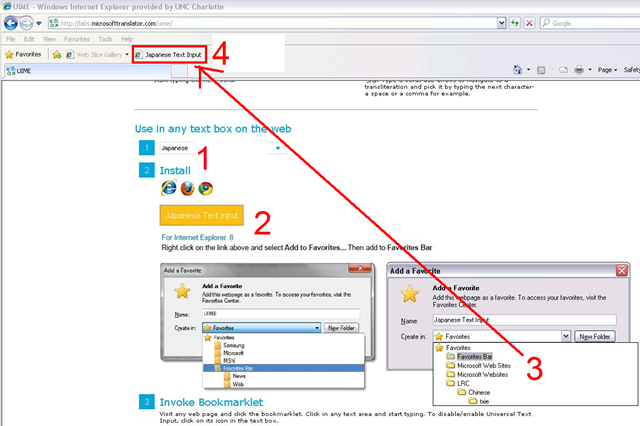
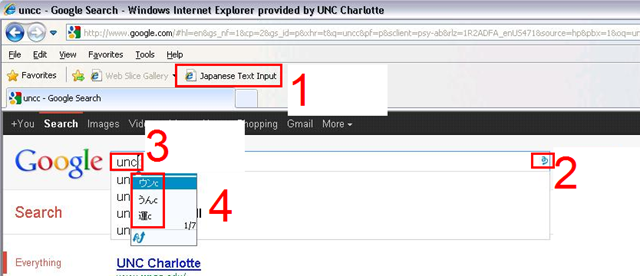
MS Universal Language Input Tool offers correction and transliteration on any web page
2011/11/10
Leave a comment
Using the UIME, you can “type any language with any keyboard on any web page, using only the Roman characters present on every keyboard.”

And you can install your favorite input language in your web browser, like so:
Categories: Absolute-Beginner, Advanced, Arabic, Beginner, e-languages, English, French, Greek (modern), Intermediate, Japanese, Mandarin, Russian, software, websites, Writing
character-input, ms-uime


Questions? Read the About. Or just ask me a quick Our Databases: Resources with calendars -- Language learning material Moodle Sites, multimedia files -- films


FAQs for LRC student staff or for students or for teachers. To search our FAQs, in the browser addressbar, add after "https://plagwitz.wordpress.com/feed/?tag=faqs+/" "+TAG1" (from tag cloud below) OR "https://plagwitz.wordpress.com/feed/tag=faqs
&category_name=" "CAT1" (from category hierarchy below). OR search both categories and tags, and multiple TAGs/CATs (connect with "," for OR-search, with "+" for AND-search), like so: https://plagwitz.wordpress.com/feed/?tag=TAG1+TAG2+...TAGn&category_name=CAT1
+CAT2+...CATn"
Other ways to find help
If you cannot find it here, look there: 5,500 Language-Learning Links and Programs for learning or teaching 150 languages
Shortcuts:Our Lists, Our Maps, LRC Staff Moodle Site,LRC Project Moodle Site, 49erexpress, UNCC Moodle, Student Recordings: s:claslcslrcsanakostudent
Learning usage samples: Sanako oral exam, Kaltura webcam presentation, Dictation with speech recognition, Sanako written exam, Chinese and Japanese interactive stroke-order practice
Test the Sanako Installer, Webbrowser Popup Konfigurator for XP, or Windows7, faster LRC TeacherPC Log-in Let MS facilitate diacritics writing by installing for you US-International keyboard layout
This is my personal blog (Google+). The views expressed on these pages are mine alone and not those of my employer. The information in this weblog is provided “AS IS” with no warranties, and confers no rights.
 Thomas' Work Space