Archive
How to stream video clips to students in classroom and at home, using Moodle Kaltura
- DVDs are getting a bit long in the tooth, not to mention VHS, and can form a real obstacle or time-consuming distraction in an educational setting, from handling the media to finding compatible software and/or hardware players for the media.
- Fortunately, there is a now a better way to make video clips available to students than uploading them to YouTube.com:
- university-supported,
- more compliant with copyright and fair use restrictions (which still apply)
- also requiring only a web browser (available on all campus computers, including teacher computers in classrooms, including those that have no (region-free) DVD-player installed)
- and a course enrolment. But access to a Moodle course can now be considered a given, both for teachers and students.
- Moodle Kaltura allows for easy
- uploading of a video file by the teacher
- viewing by the student (streamed – Flash required, not different from YouTube.com).
- View a screencast example how easy it is with Moodle Kaltura to upload and playback a video clip from a movie DVD.

- Not different from YouTube.com, you still need to edit out the segment from the DVD that you want to show in your class, uploading a full DVD I do not intend to test.
- From this example, you can also get an idea how long the server-side encode takes before the video an be streamed back to students: the short clip of a few minutes here starts playing back at 12:40. Naturally, a teacher would prepare their course, including all video uploads, before the term starts or possibly before the week starts, or, in extremis, before the class starts – in practice, only the – extremely unlikely – scenario where the teacher would try and upload the video during the class is not supported.
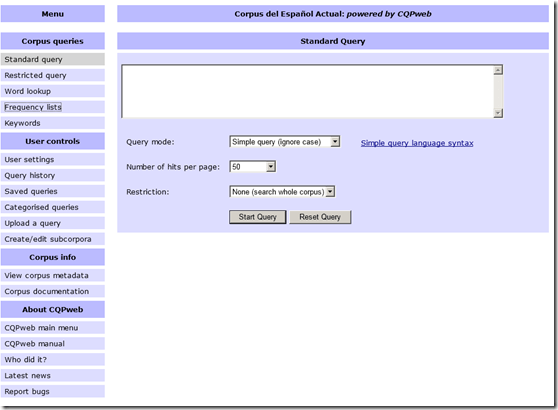
Corpus del Español Actual (CEA)
-
Link:
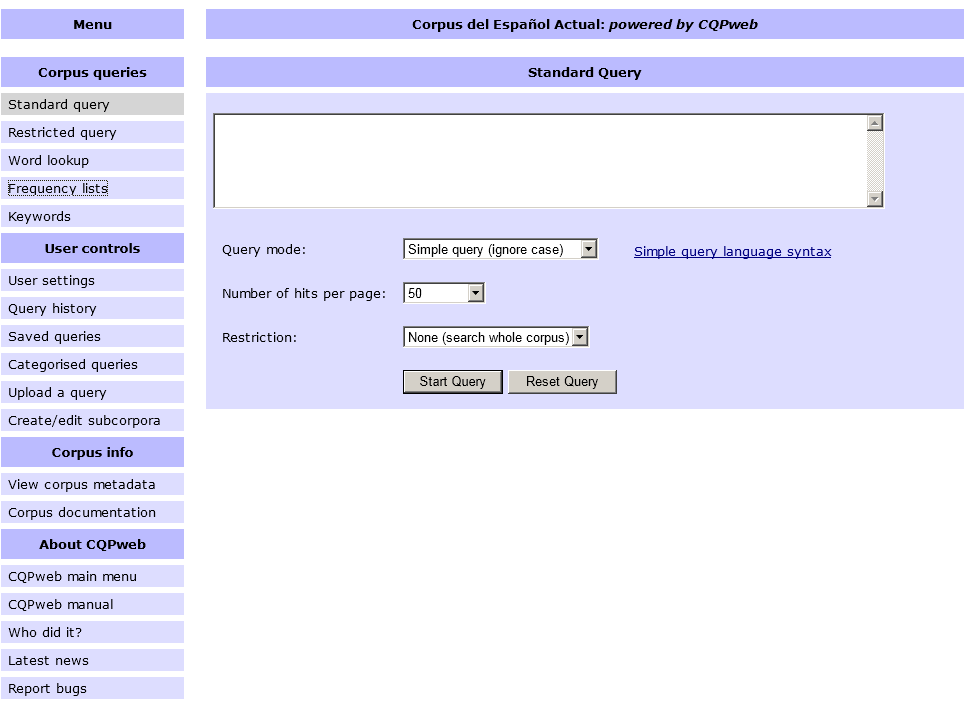
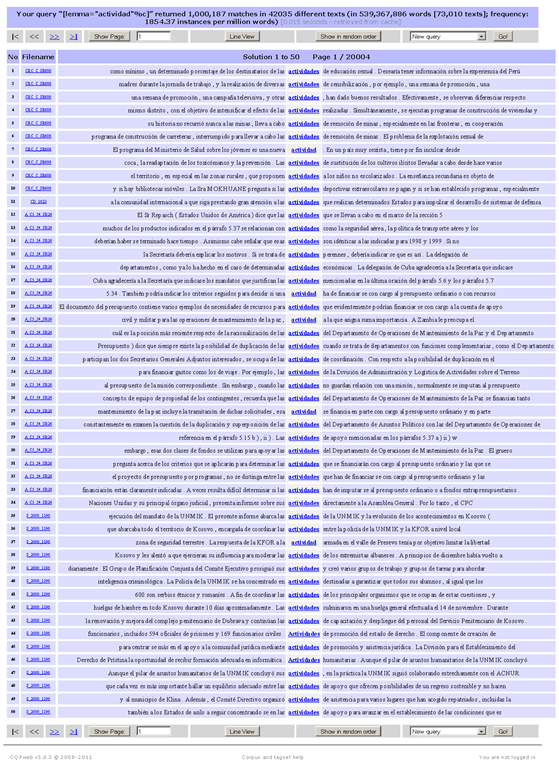
- Example of KWIC view result:

- Based on Europarl, Wikicorpus (2006!), MultiUN. From their metadata page:
Metadata for Corpus del Español Actual
Corpus name
Corpus del Español Actual
CQPweb’s short handles for this corpus
cea / CEA
Total number of corpus texts
73,010
Total words in all corpus texts
539,367,886
Word types in the corpus
1,680,309
Type:token ratio
0 types per token
Text metadata and word-level annotation
The database stores the following information for each text in the corpus:
There is no text-level metadata for this corpus.
The primary classification of texts is based on:
A primary classification scheme for texts has not been set.
Words in this corpus are annotated with:
Lemma (Lemma)
Part-Of-Speech (POS)
WStart (WStart)
The primary tagging scheme is:
Part-Of-Speech
Further information about this corpus is available on the web at:
- To use, “consult the IMS’s brief description of the regular-expression syntax used by the CQP and their list of sample queries. If you wish to define your query in terms of grammatical and inflectional categories, you can use the part-of-speech tags listed on the CEA’s Corpus Tags page.”
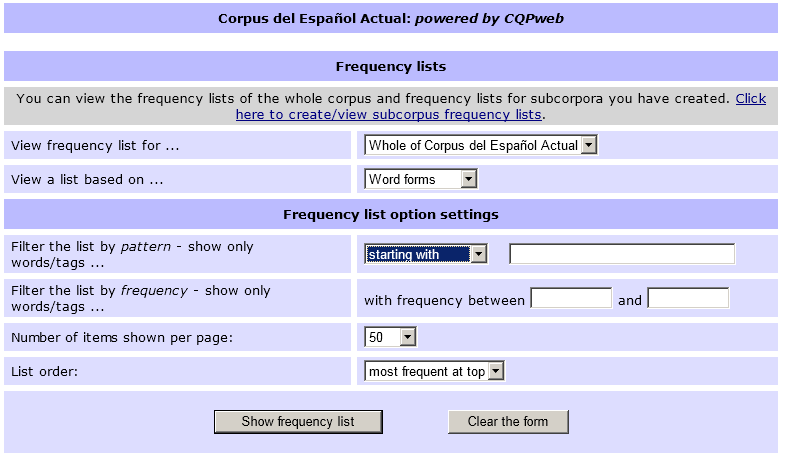
- Also provides frequency data (based on word forms or lemmas, and others – up to a 1000):

- Examples of a frequency query result (click for full-size image. Note that a lemmatized list was requested here which links all inflected forms back to the lemma, and vice versa, upon clicking the lemma, displays a KWIC view containing all forms subsumed under that lemma, see picture above):


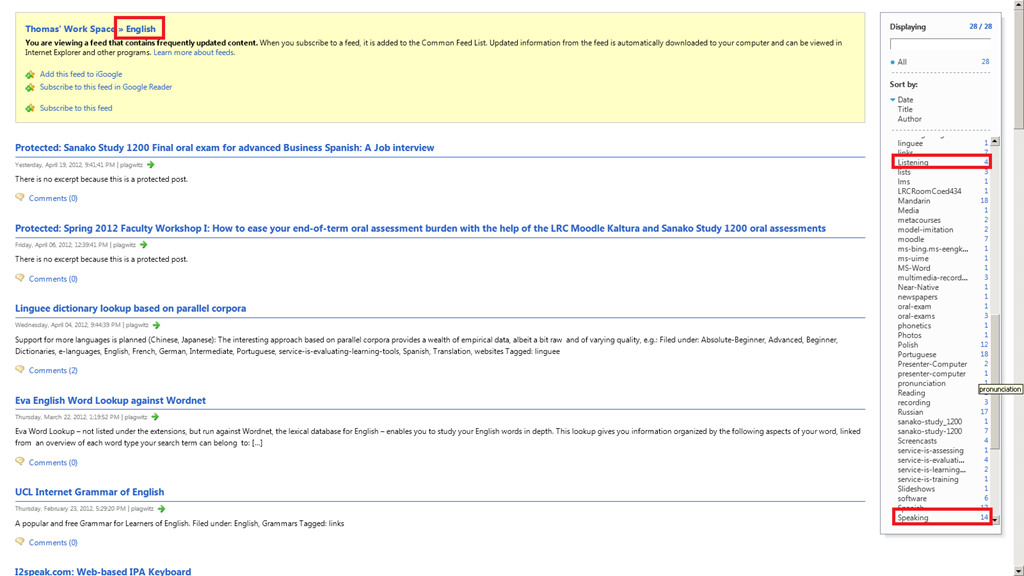
Is there a better way to do complex and/or multi-category searches against a WordPress.com blog but to rely on MS-Internet Explorer feed display?
- I am looking for posts on my blog that fall under the categories “English” (ESL teaching) and (“listening” OR “speaking-4-skills” – never mind the “-4-skills”, another oddity – you can change the slug of posts, but can you change the slug of categories and tags also?).
- https://plagwitz.wordpress.com/category/study-program-is-any/all-languages/english/feed or shorter https://plagwitz.wordpress.com/feed/?category_name=english, opened with MS-Internet Explorer’s feed display allows me to access the result of the 2 AND searches with 2 additional clicks
- :

- OR search works: https://plagwitz.wordpress.com/feed/?category_name=listening,speaking-4-skills
- AND search works, so I could provide 2 separate links:
- But I cannot find the syntax that would give me both AND and OR against categories, for the following return nothing (what is the operator precedence of “+” and “,”)
Linguee dictionary lookup based on parallel corpora
- Support for more languages is planned (Chinese, Japanese):
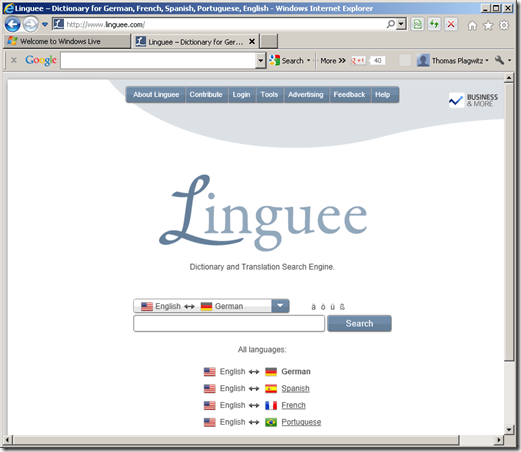

- The interesting approach based on parallel corpora provides a wealth of empirical data, albeit a bit raw and of varying quality, e.g.:



Find open access research on teaching modern foreign languages with Yazik Open
An inititative of an expert from the UK LLAS, Yazik Open has the potential to become a welcome addition to our SLA research search options, especially if you do not want to run into a pay wall after finding an interesting abstract.
The currently sole contributor seems to be admin – same problem I had when I started a language learning resource links database in 1998, when will this change?
The keyword list looks somewhat rudimentary – when I worked with LLAS on a language learning resource metadata schema, complexity led to a grinding halt.
So the need to bring some of the advances in technologically fostered collaboration and information exchange to domain-specific fields like SLA certainly remains to be felt here.
Eva English Word Lookup against Wordnet
- Eva Word Lookup – not listed under the extensions, but run against Wordnet, the lexical database for English – enables you to study your English words in depth. This lookup gives you information organized by the following aspects of your word, linked from an overview of each word type your search term can belong to:
- the coordinate terms (sisters)
- the derived forms
- the synonyms/hypernyms (ordered by estimated frequency)
- the hyponyms (troponyms for verbs)
- the holonyms, for nouns
- the meronyms, for nouns
- sample sentences, for verbs
- Below is what results look like for example search term “design”:


How a teacher uploads a video resource to Moodle using Kaltura
- Moodle Kaltura facilitates making segments of video (created from e.g. source DVD with the video editor of your choice) available for film studies classes, within the bounds of Fair Use and the Teach Act, since it makes video
- easily available (streamed to anywhere where Adobe-Flash runs),
- but only to those who have an account in the Moodle installation and are registered for the course
- In addition, access to the video segments can be restricted further (by choosing from the management options that Moodle affords),
- only to the teacher, for display during face-to-face teaching)
- only during a time window, for timed assignments.
- Here is a (somewhat longwinded, but authentic) demonstration of how to make a Kaltura video resource available through a Moodle course.
- The demonstration includes the server-side encoding which happens only once during teacher upload – you do not have to wait for it to finish, just if you want to check immediately, like I do on the example whether your upload went through.


Questions? Read the About. Or just ask me a quick
Your message has been sent

FAQs for LRC student staff or for students or for teachers. To search our FAQs, in the browser addressbar, add after "https://plagwitz.wordpress.com/feed/?tag=faqs+/" "+TAG1" (from tag cloud below) OR "https://plagwitz.wordpress.com/feed/tag=faqs
&category_name=" "CAT1" (from category hierarchy below). OR search both categories and tags, and multiple TAGs/CATs (connect with "," for OR-search, with "+" for AND-search), like so: https://plagwitz.wordpress.com/feed/?tag=TAG1+TAG2+...TAGn&category_name=CAT1
+CAT2+...CATn"
Other ways to find help
If you cannot find it here, look there: 5,500 Language-Learning Links and Programs for learning or teaching 150 languages
Shortcuts:Our Lists, Our Maps, LRC Staff Moodle Site,LRC Project Moodle Site, 49erexpress, UNCC Moodle, Student Recordings: s:claslcslrcsanakostudent
Learning usage samples: Sanako oral exam, Kaltura webcam presentation, Dictation with speech recognition, Sanako written exam, Chinese and Japanese interactive stroke-order practice
Test the Sanako Installer, Webbrowser Popup Konfigurator for XP, or Windows7, faster LRC TeacherPC Log-in Let MS facilitate diacritics writing by installing for you US-International keyboard layout
This is my personal blog (Google+). The views expressed on these pages are mine alone and not those of my employer. The information in this weblog is provided “AS IS” with no warranties, and confers no rights.
 Thomas' Work Space