Archive
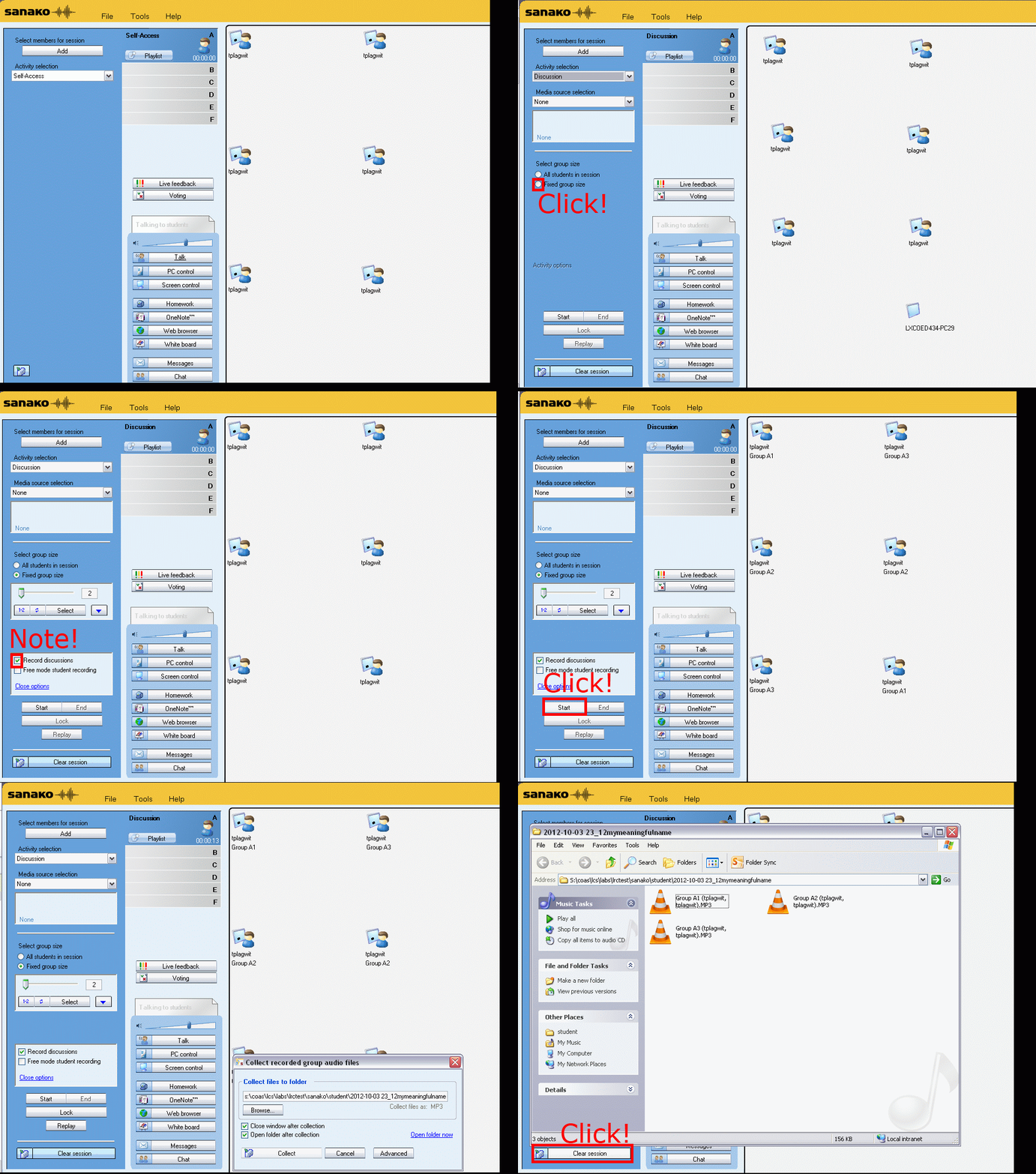
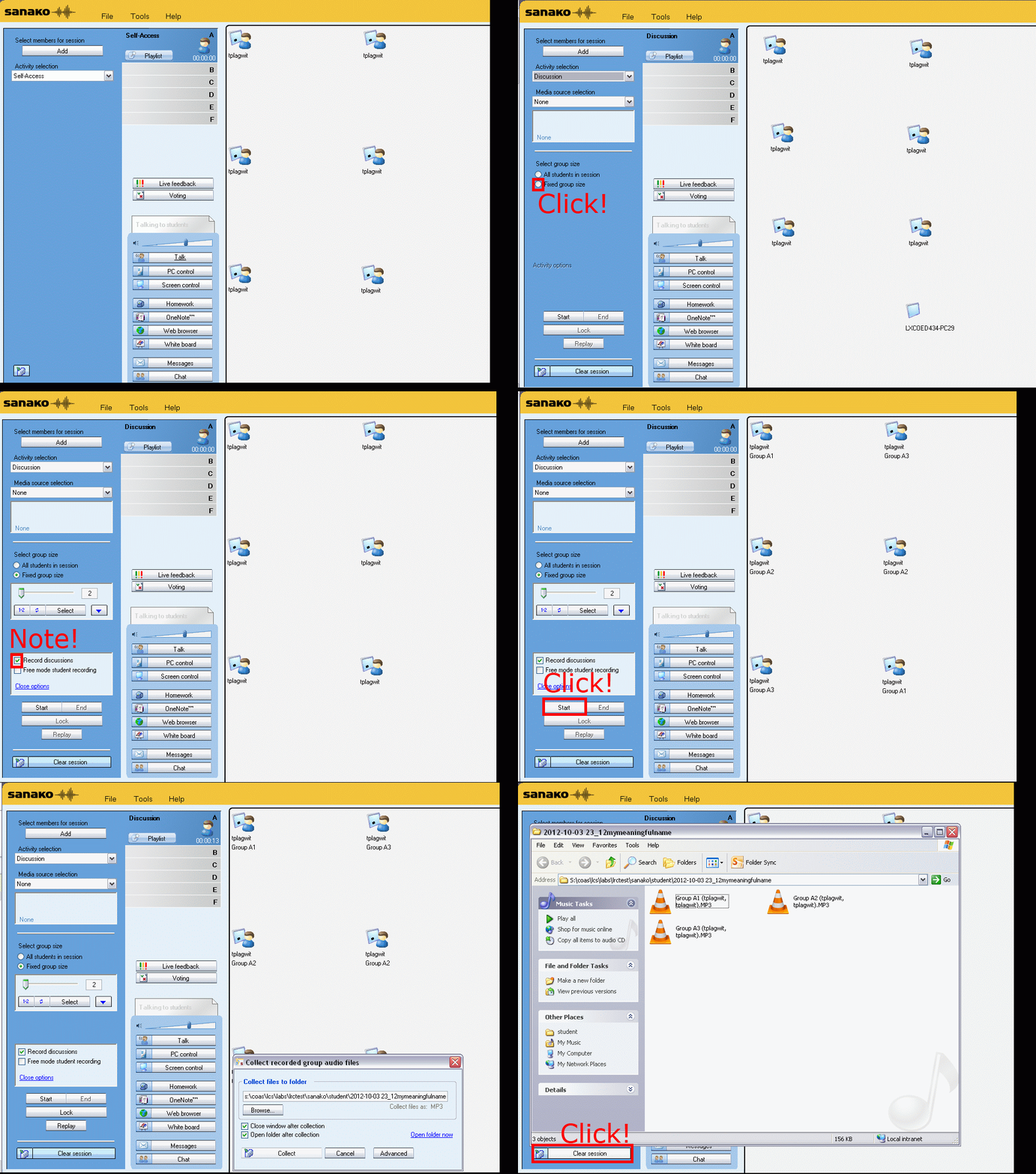
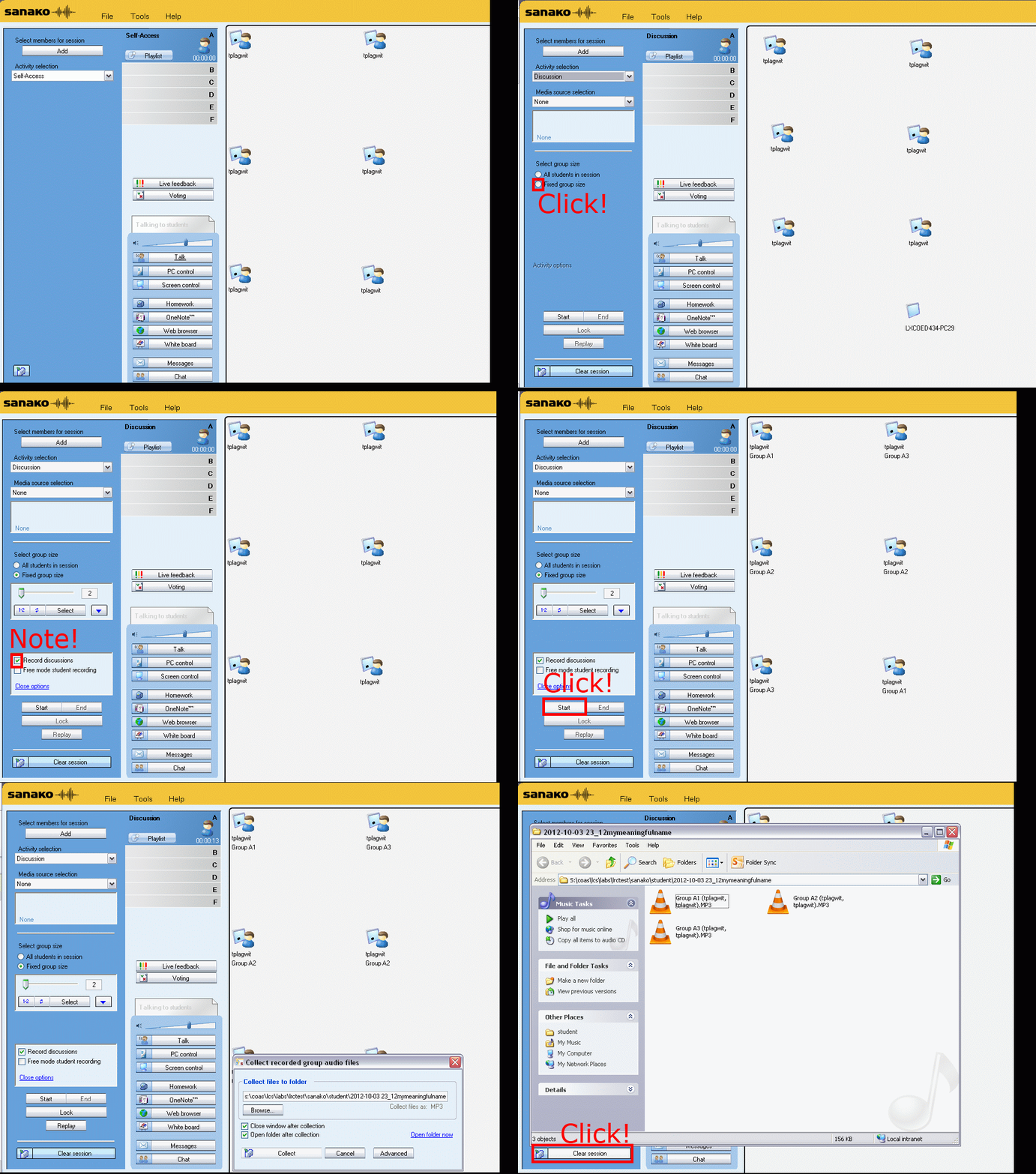
How teachers randomly pair and record students over their headphones with Sanako Study 1200–the ultimate training summary…
…thanks to animated gGIFs. Slower? 050ms, 075ms, 100ms, 200ms, 300ms, 400ms,500ms, 600ms, 700ms, 800ms,900ms, 1000ms. Load the speed of your choosing into the left screen of the teacher station before trying to pair your students, with the window active, press F5 to restart the animation from the beginning at any time:

Delete the Flash Global Settings if the iMacs webcam displays black frame only
- Problem: Safari and (not recommended after last testing round) Firefox both hung on iMAC6 when a student tried to do a Moodle Kaltura Webcam assignment and got to the built-in ISight camera display page.
- Cause: maybe a Flash security problem accessing the web cam? maybe security dialogue was not answered by the student correctly earlier, and the “preference”stored in her account?
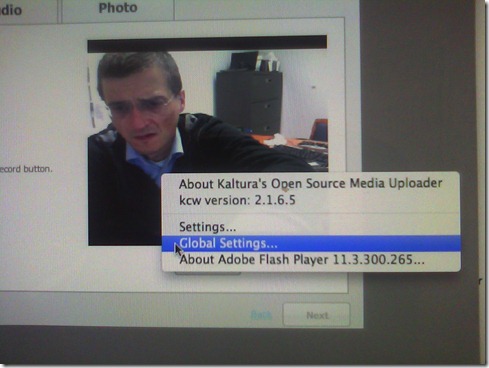
- Solution (presumably): System started working again after I deleted the Flash Global settings, by right-clicking on the webcam video preview window like so:
-
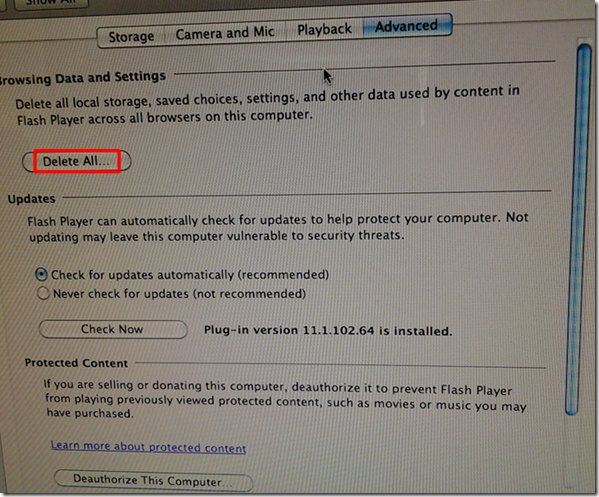
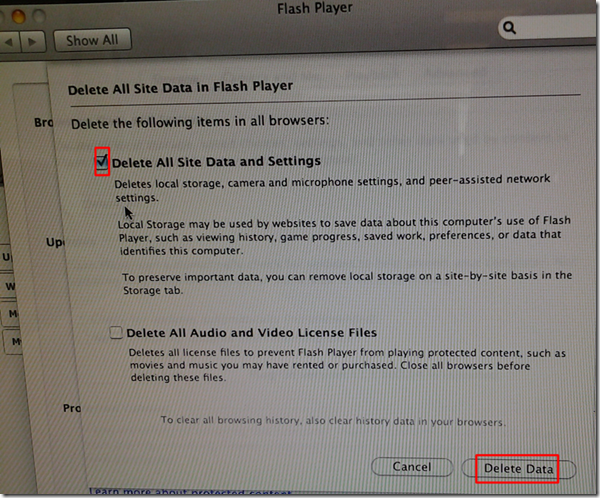
- Ceterum censeo that we need a computer management infrastructure if we want to use MACs for language learning technology. Faronics-Deepfreeze would have prevented this problem, provided we have a software imaging system (CASPER coming up apparently) that can let us start with a usable image, and the staff time to learn and configure 2 usable OS images and dual usable computer management infrastructures. TCO now > TCO dual OS infrastructure > TCO web cams for 45 PCs.


Why to save Audacity projects locally …
… with enough file space to avoid unspecific problems, including later parts of your recording becoming inaudible.
This problem was caused by attempting to save an Audacity project to a network share over a slow network and with limited storage space.
This Audacity project (.aup extension, with subfolders) had a size of a 200MB – the exported .mp3 likely less than 1% off that.
So always save Audacity projects you are working on on local hard drive or USB thumb drive.
How students upload a video file to Moodle using Kaltura
-
My closest related instruction so far has been for teachers, and the CTL also seems to have only instructions for how teachers upload videos for students. However, instructions for students are very similar, follow these steps:
-
Open the kaltura assignment and click “Add video submission”:

-
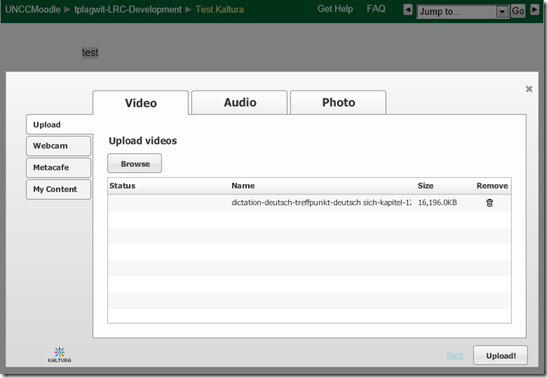
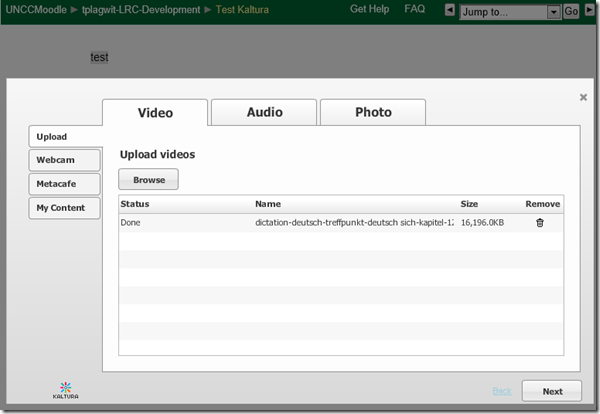
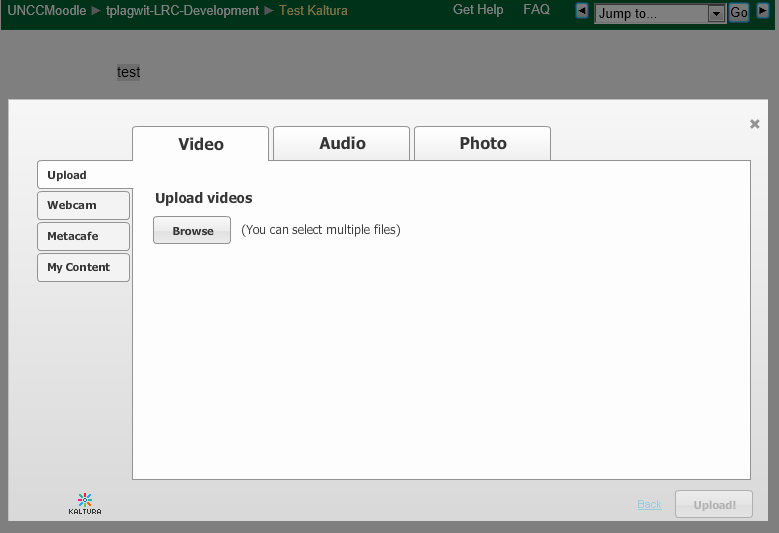
Under left tab “Upload”, Click “Browse”:

-
Browse to your video file (note the “files of type”allow only the upload of certain extensions) and click “Open”:

-
Click “Upload”
-
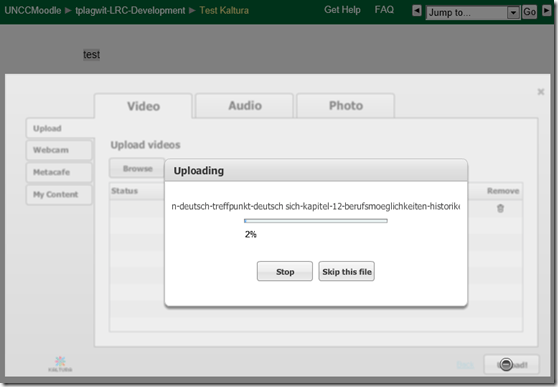
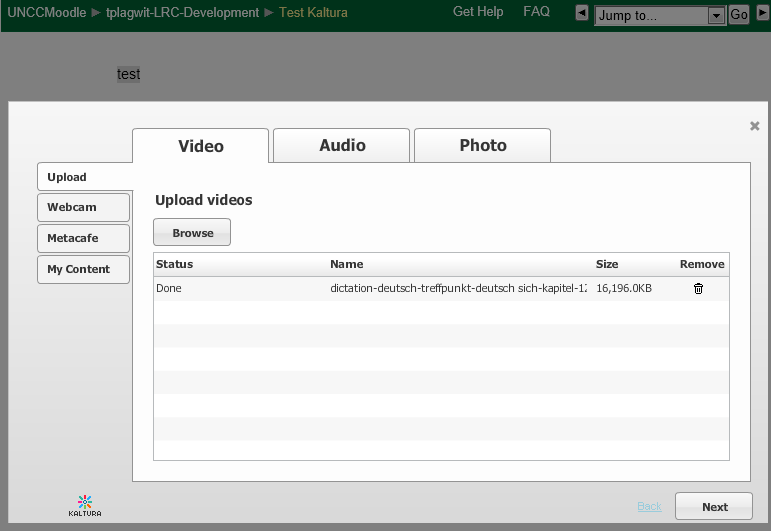
Wait for the upload to complete:
-
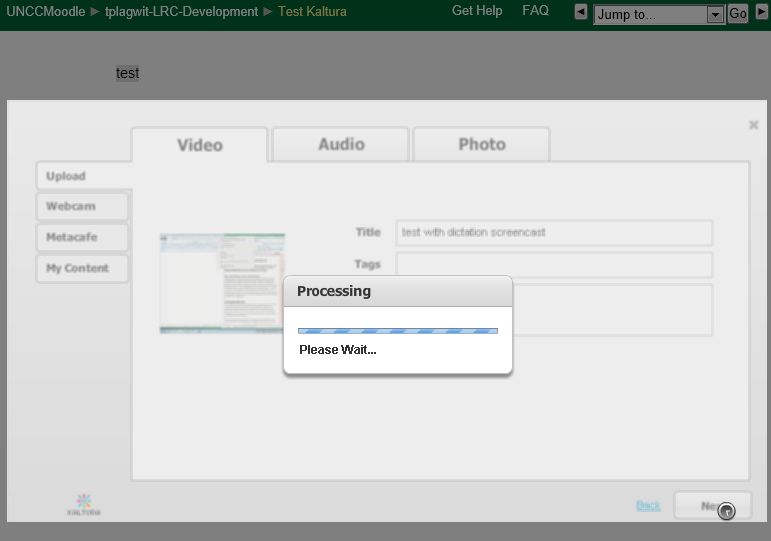
Click “Next” :
-
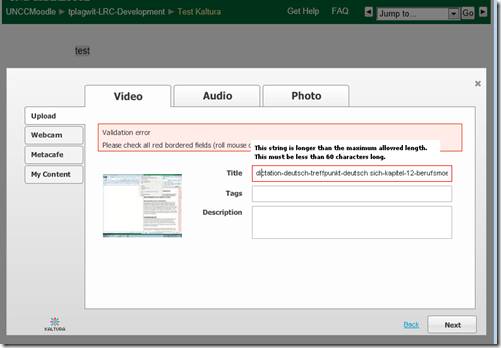
Add at least a “title”, and fix any errors you might get:
-
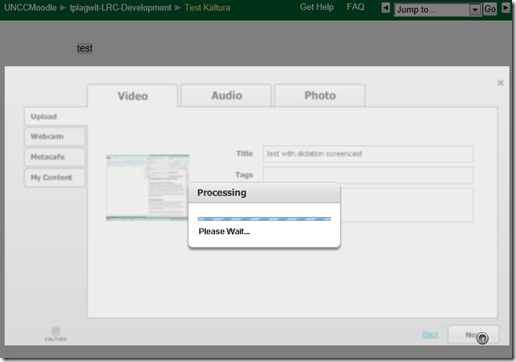
Click “Next”:
-
Click “Submit”:

-
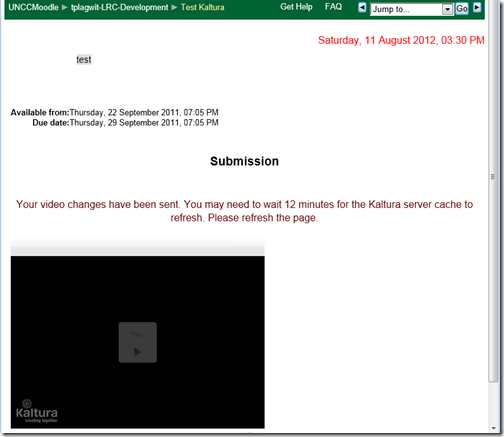
Look for the success message:

-
You will have to wait for the video preview to become available:
-
If you refresh the page, the wait time gets updated, take the amount with a grain of salt. Here I could already view…

-
Be aware that your video resolution will likely be downscaled (my 1280*1024 screencast in this example ended up pretty grainy).






SOLVED: How to record, in Adobe-Flash, video from my built-in iSight web camera on an 2010 iMac, combined with sound from an external cs100 PnP USB audio device
- Problem : Our new campus-wide Moodle Kaltura installation enables authentic oral proficiency examinations (we have no other Moodle Plugin for audio recordings). However, we still have no webcams on our mainstay PCs. We do have a few iMacs with built-in iSight webcams, but for providing students more privacy during their assignments in the language resource center, we need headphones. We have for spare some old headphones which we would like to use up, but they are analogue. These iMacs do not have an analog headset connector, only a line-in which would require a preamp. We have good sturdy USB headsets from Sanako, but these are too expensive to purchase for the iMacs that have no ways to secure them and little other specialized language learning use which we do not already get from the PCs (and more…).
- Workaround :
- Try an inexpensive USB audio device that has 3.5mm analog headset inputs.
- On my iMac 2010
- If in system preferences / sound/ I direct input and output to the USB PnP device
- test passes playing system sounds
- in audacity (if you CRANK the microphone sensitivity to the max!)
- recording test passes: The headset loudspeakers and micro work (not well, but they work, as a tab on the microphone indicate: there is static, and the recording volume is still softish, but better than the built in webcam microphone)
- in Kaltura,
- Flash only brings up the security dialogue (in Safari 5 and current Firefox ESR and Chrome) for allowing the web application accessing to the built-in iSight web camera, but no options to choose a separate audio device
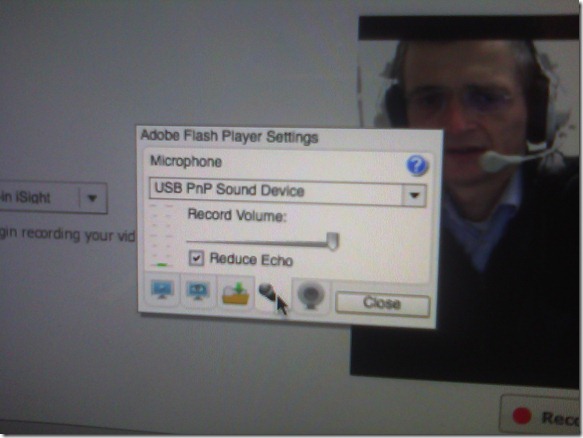
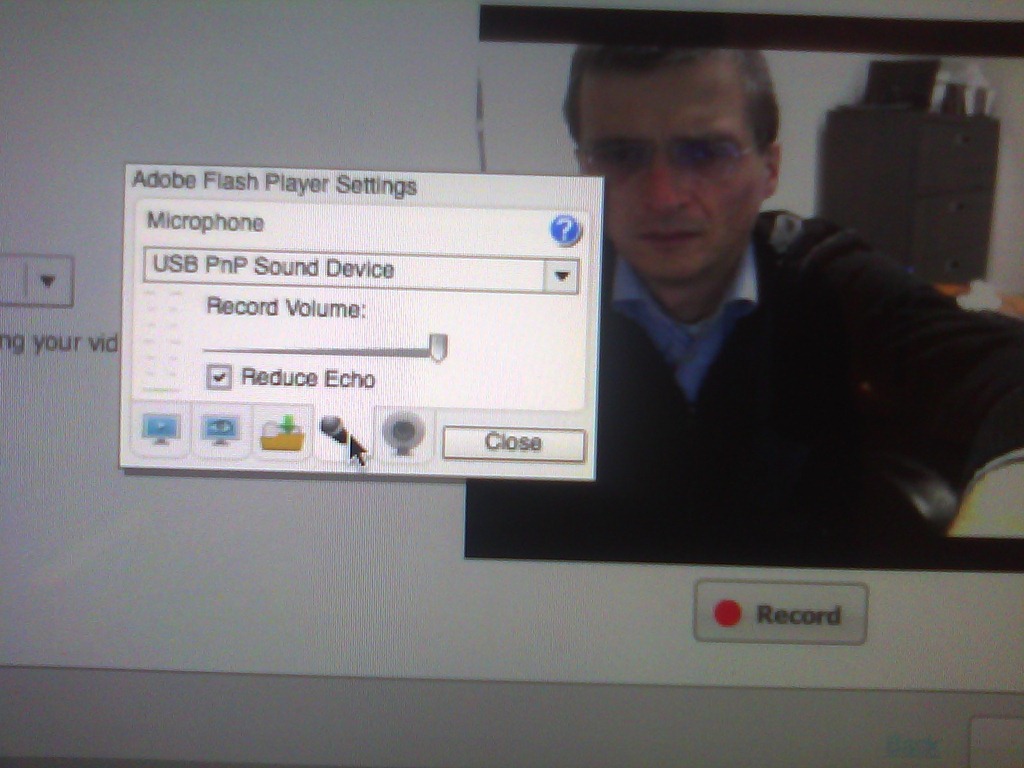
- However, if you control-click on Flash’s a video preview window for the web camera, and click on “settings” (not “global settings”, although that is useful for always allowing access from certain URLs like your LMS) .
- Click on the microphone icon :

- Make sure the USB PnP device is selected.

- You can bring up the settings dialogue, make sure the USB PnP device is chosen for audio and CRANK up the microphone input sensitivity! Then test the volume levels with the built-in volume meter (should show lots of green bars when you speak. You may have to adjust the Califone headset microphone arm so that the microphone is very close in front of your mouth. ) Unlike in the picture, do not choose “reduce echo ”.
- Remaining
- Questions :
- Can this sensitivity setting be permanently stored for all users in the iMac software image, or do our students always have to adjust the microphone sensitivity?
- It remains to be seen whether this inexpensive and unsecurable device survives long when being used by our student population.
- Problem : The review video function of the Moodle Kaltura Flash video remains very temperamental on the Mac OS X (In my testing, one of the numerous problems we had with Moodle Kaltura on the iMacs popped up again: when starting to review the recording, the time counter goes, but the video stalls for a few seconds – afterwards everything seems to play fine, but this is enough to confuse the heck out of my users) . While we made another small step of progress towards enabling Moodle Kaltura webcam recordings in the language resource center, it seems easier to just get web cameras for the PCs.
- Questions :


Making audio cues for model imitation/question-response oral exams with Sanako Study 1200
We can easily record and post-process audio files in the LRC for use with the Sanako Study 1200 oral exam activities.
This can work not only for outcome exams (course- or chapter-wise), but also or formative assessment:
Think converting your textbook-based “drills” into Sanako, like repetitively recapitulating the newly acquired vocabulary item “donut” with different cues:
Example: “What can you do with [student can enter her favorite new vocabulary item for the current class] on [teacher can ask for one social web service after the other that her students likely are familiar with]?”. In response, student has to practice vocabularry item by forming sentences that fit the vocabulary item that fit like in the whiteboard example.
We can add to these recordings the features explained in the slide below.
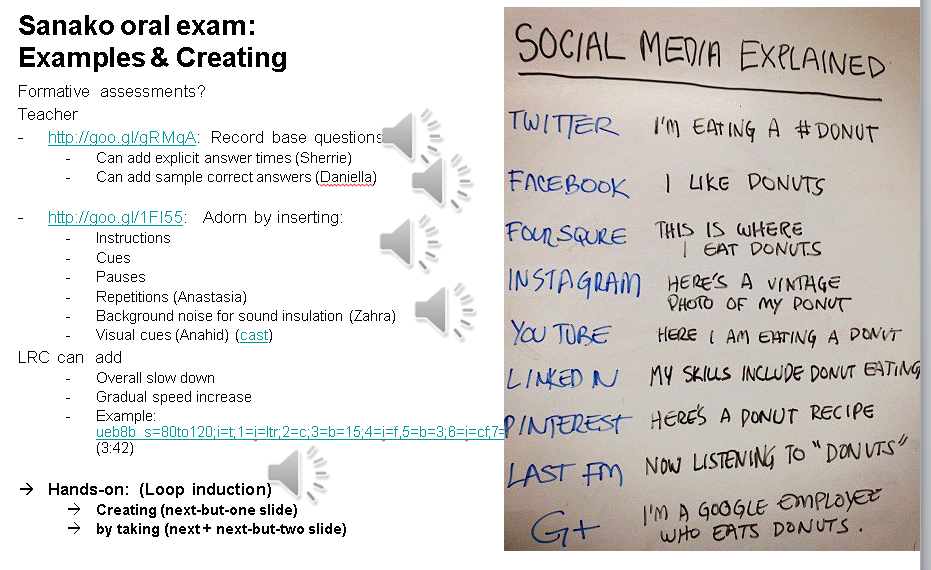
I’d be happy to play you examples from this slide – and more – in the LRC (not to be published here so that the exam files can be reused).
How to use the MS-Office Labs Community Clips Screen Capture Tool
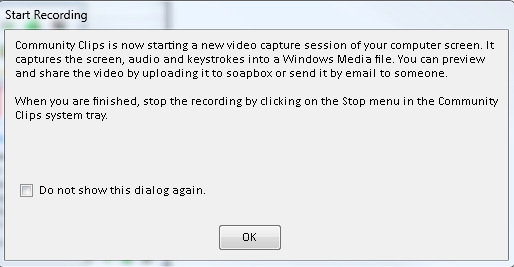
- I seem to remember this initiative of having MS-Office users sharing tips and tricks using screencasts has been faded out – but the screen capture tool is still available, and it is not restricted to recording MS-Office applications.
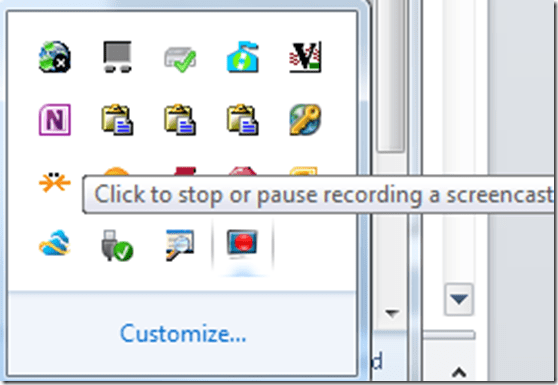
- After download and install (here on Windows 7),

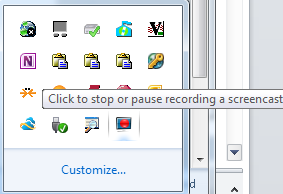
- click the community clips system tray icon to easily start a screen capture:
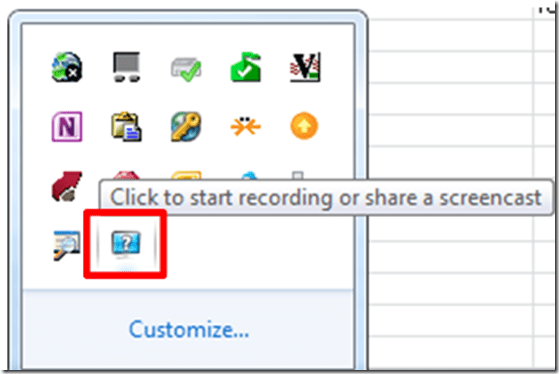
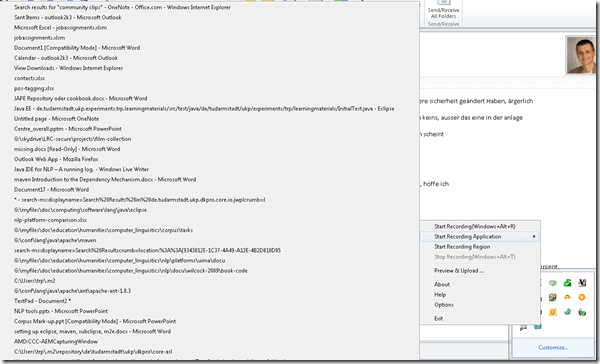
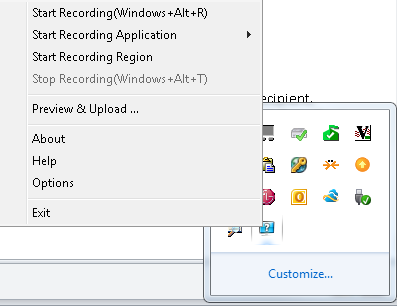
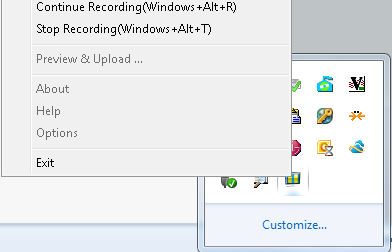
- Or access the context menu with advanced options:

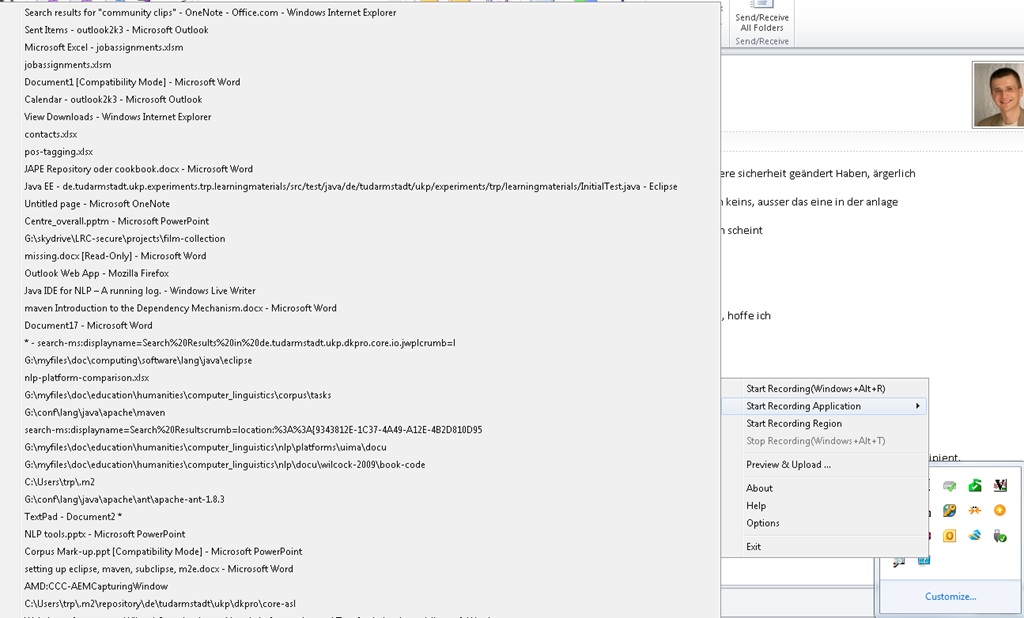
- including restricting recording to specific windows:
- It does not start up very fast:

- It flashes a frame around the recorded area.
- This is a test…


- The preview starts automatically:
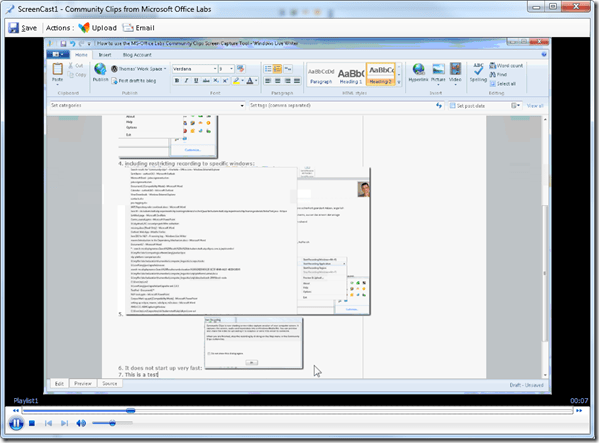
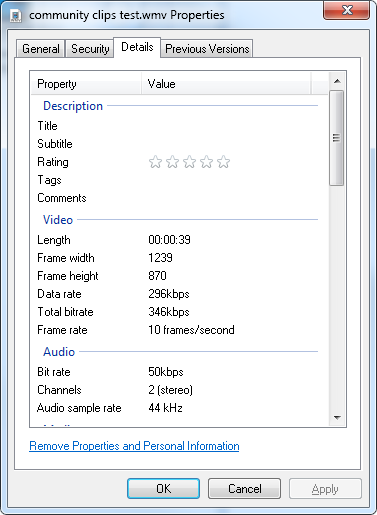
- About the file quality:

- Both the save and the email option
 work, only the built-in upload fails, likely due to the demise of MS-Soapbox:
  , but can be easily uploaded to other services, e.g. MS-SkyDrive
 - Unfortunately, like the Windows Media Encoder clips, it won’t preview without download on SkyDrive – unlike the (newer) MS-PowerPoint 2010-recorded screencasts:

- Still, the MS-Office Labs Community Clips Screen Capture Tool seems to have a friendlier interface than Windows Media Encoder, and is as free.






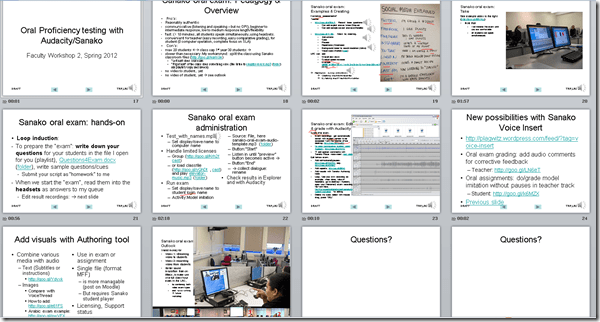
Spring 2012 Faculty Workshop II: Oral Proficiency testing with Audacity/Sanako
- View screens (best viewed side by side, but note that left and right screen are not synchronized):
- for full slide show (note the included short links for convenient further reading), left screen

- for Sanako interface and full audio track, right screen
 .
.
- for full slide show (note the included short links for convenient further reading), left screen
- Table of contents:
- Overview of a Sanako Oral Exam
- Examples of Exam teachers’ exam question recordings
- Example of a Sanako Exam
- Loop induction
- creating an exam question recording
- by taking a Sanako exam as a student
- Step-by-Step of administering a Sanako oral exam
- Grading Sanako oral exam student files
- Sanako voice insert for
- facilitating recording oral assignments for student without hard-coded pauses
- commenting on student responses during grading
- Sanako voice insert for
- Sanako authoring tool for providing visual on top of aural cues to students



Questions? Read the About. Or just ask me a quick Our Databases: Resources with calendars -- Language learning material Moodle Sites, multimedia files -- films


FAQs for LRC student staff or for students or for teachers. To search our FAQs, in the browser addressbar, add after "https://plagwitz.wordpress.com/feed/?tag=faqs+/" "+TAG1" (from tag cloud below) OR "https://plagwitz.wordpress.com/feed/tag=faqs
&category_name=" "CAT1" (from category hierarchy below). OR search both categories and tags, and multiple TAGs/CATs (connect with "," for OR-search, with "+" for AND-search), like so: https://plagwitz.wordpress.com/feed/?tag=TAG1+TAG2+...TAGn&category_name=CAT1
+CAT2+...CATn"
Other ways to find help
If you cannot find it here, look there: 5,500 Language-Learning Links and Programs for learning or teaching 150 languages
Shortcuts:Our Lists, Our Maps, LRC Staff Moodle Site,LRC Project Moodle Site, 49erexpress, UNCC Moodle, Student Recordings: s:claslcslrcsanakostudent
Learning usage samples: Sanako oral exam, Kaltura webcam presentation, Dictation with speech recognition, Sanako written exam, Chinese and Japanese interactive stroke-order practice
Test the Sanako Installer, Webbrowser Popup Konfigurator for XP, or Windows7, faster LRC TeacherPC Log-in Let MS facilitate diacritics writing by installing for you US-International keyboard layout
This is my personal blog (Google+). The views expressed on these pages are mine alone and not those of my employer. The information in this weblog is provided “AS IS” with no warranties, and confers no rights.
 Thomas' Work Space