Archive
Looking forward to the Digital Humanities Unconference at UNC Charlotte
- Why I come to THATCamp Piedmont:
- I am looking for practitioners of NLP in a language and literature teaching context since I am working on Using NLP tools to automate production and correction of interactive learning material (presented at Calico 2012)
- for the Learning Exercise Creation Engines (presented at EUROCALL 2007) I developed.
- A little about myself:
- My Ph.D. thesis expanded the close reading of textual variants in the German editorial schools of Hans Zäch and the use of the computer-generated textual concordances in the interpretation and selection of textual variants into a corpus linguistic-inspired approach, that traced Leitmotifs in the work (partially first digitized by myself) of the foremost Swiss-German classic as a digital corpus using Regular Expressions programming.
- I have since applied my corpus linguistic approach to
- the use of machine translation software
- the automation of learning material creation (glossing, question generation, differentiation) on the basis of natural language processing of textual (film subtitles, news) corpora.
Using NLP tools to automate production and correction of interactive learning materials for blended learning templates in the Language Resource Center. Presentation Calico 2012, Notre Dame University
View screencast  here.
here.
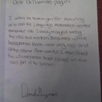
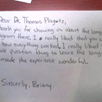
Students of the Oaklawn Language Academy visited the LRC …
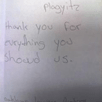
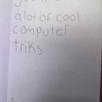
… and sent us a thick envelope chock-full of these very sweet handwritten thank-you notes.
I have twin nieces their age, so I know that it can take a bit to get them to write these notes (I am looking at you, Miss M…!  ).
).
The little man on the screen they mention, that can talk in tongues is the Microsoft-Deskbot, and the headphones they mention were connected to a Sanako Study 1200 digital audio lab.
I hope we can upgrade all this to Windows 7 this summer, and that the Language Academy will be back next spring to admire it all…




Protected: Mock exam for Spanish combines various learning technologies in the LRC
Protected: Moodle-Kaltura webcam recording assignment results
IALLT 2011 Presentation on Batch-produced time-stretched audio for personalized language learning
Batch-produced time-stretched audio for personalized language learning has been accepted for inclusion in the program for IALLT 2011, June 21-25 at the University of California – Irvine and was presented on June 23:
Pervasive networked digital media (both digitized mass media and pod- and tube-casts) and the build-up of higher education technology infrastructure (classroom management systems, eRepositories, ePortfolios) during what might become the next bubble could form much improved learning environments, if it were not for the impedance mismatch of systems integration challenges. The current challenging financial times can remind us of the original promise of e-learning: increased efficiency. Rapidly expanding second language programs (here English, Spanish and Mandarin) need scalability through automation of learning material provision. Smaller or shrinking programs (here German, Russian, Farsi), where widely differing learner proficiency is increasingly becoming a problem when trying to form classes, need to cope with fragmentation of learning material provision in a “long tail”-economy. Both would benefit from a personalization of instruction that takes into account individual skills, needs and interests. This paper’s software can batch-produce from mp3 and wma input files a user-adjustable range of audio output speeds (see options GUI at https://plagwitz.wordpress.com/2010/08/06/language-learning-audio-stretcher/) and – for a more natural sounding output than the time-stretching mechanisms commonly built into current media players – differentiate between language and pause segments in the input when time-stretching (see samples at https://plagwitz.wordpress.com/2010/11/03/language-learning-audio-stretcher-ii-samples/). The paper will demonstrate such time-stretched audio in a variety of languages and from both SLA and authentic materials and its use, as one step towards more comprehensible input of level “i+1” in a more personalized language learning provision.

I am grateful for being able to attend so many interesting workshops, posters and presentations on new developments in teaching material production, online distance education, ePortfolios, learning center design and management.
As well as the booths of professional organizations, educational software and content vendor.`

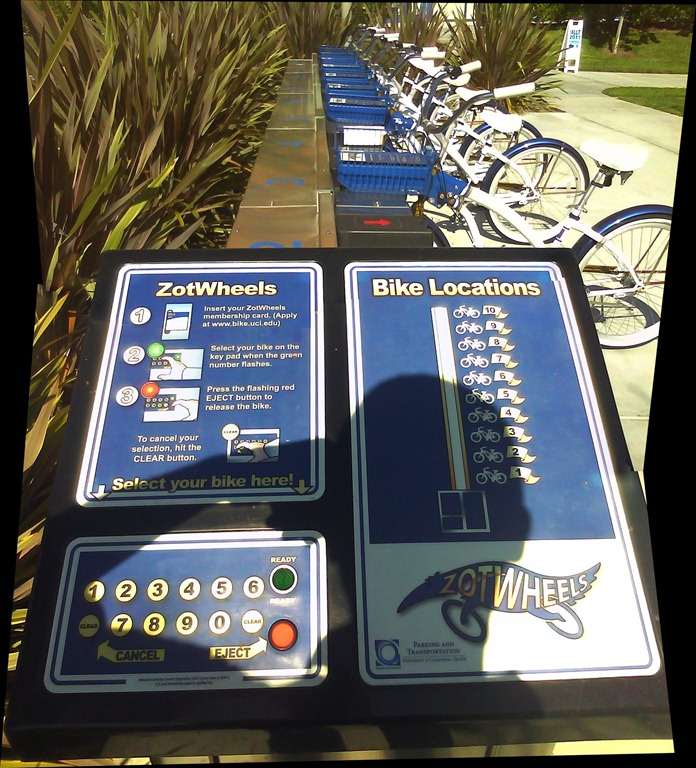
And another idea worth emulating were the ZotWheels bike rent stands  .
.
Poster on time-stretching audio @ NEALLT 2011
A wealth of authentic audio materials on the Internet are still out of reach for language learners, and an abundance of textbook materials not as personalized to the learners’ needs as they should since their audio speed cannot be adjusted in a naturalistic way. This poster presents a software that can batch-produce from mp3 and wma input files a user-adjustable range of audio output speeds and – for a more natural sounding output than the time-stretching mechanisms commonly built into current media players – differentiate between language and pause segments in the input when time-stretching: Time-stretching audio POSTER (big)


Questions? Read the About. Or just ask me a quick Our Databases: Resources with calendars -- Language learning material Moodle Sites, multimedia files -- films


FAQs for LRC student staff or for students or for teachers. To search our FAQs, in the browser addressbar, add after "https://plagwitz.wordpress.com/feed/?tag=faqs+/" "+TAG1" (from tag cloud below) OR "https://plagwitz.wordpress.com/feed/tag=faqs
&category_name=" "CAT1" (from category hierarchy below). OR search both categories and tags, and multiple TAGs/CATs (connect with "," for OR-search, with "+" for AND-search), like so: https://plagwitz.wordpress.com/feed/?tag=TAG1+TAG2+...TAGn&category_name=CAT1
+CAT2+...CATn"
Other ways to find help
If you cannot find it here, look there: 5,500 Language-Learning Links and Programs for learning or teaching 150 languages
Shortcuts:Our Lists, Our Maps, LRC Staff Moodle Site,LRC Project Moodle Site, 49erexpress, UNCC Moodle, Student Recordings: s:claslcslrcsanakostudent
Learning usage samples: Sanako oral exam, Kaltura webcam presentation, Dictation with speech recognition, Sanako written exam, Chinese and Japanese interactive stroke-order practice
Test the Sanako Installer, Webbrowser Popup Konfigurator for XP, or Windows7, faster LRC TeacherPC Log-in Let MS facilitate diacritics writing by installing for you US-International keyboard layout
This is my personal blog (Google+). The views expressed on these pages are mine alone and not those of my employer. The information in this weblog is provided “AS IS” with no warranties, and confers no rights.
 Thomas' Work Space