Archive
LRC Outlook/Exchange 2010 Resource Calendaring: How LRC staff can group calendars in Outlook 2010
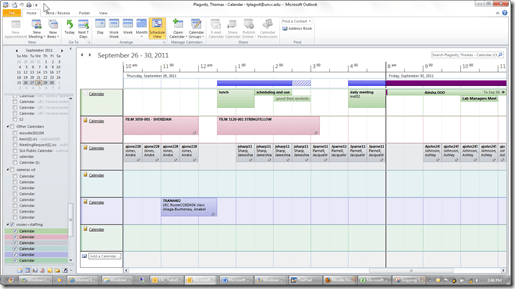
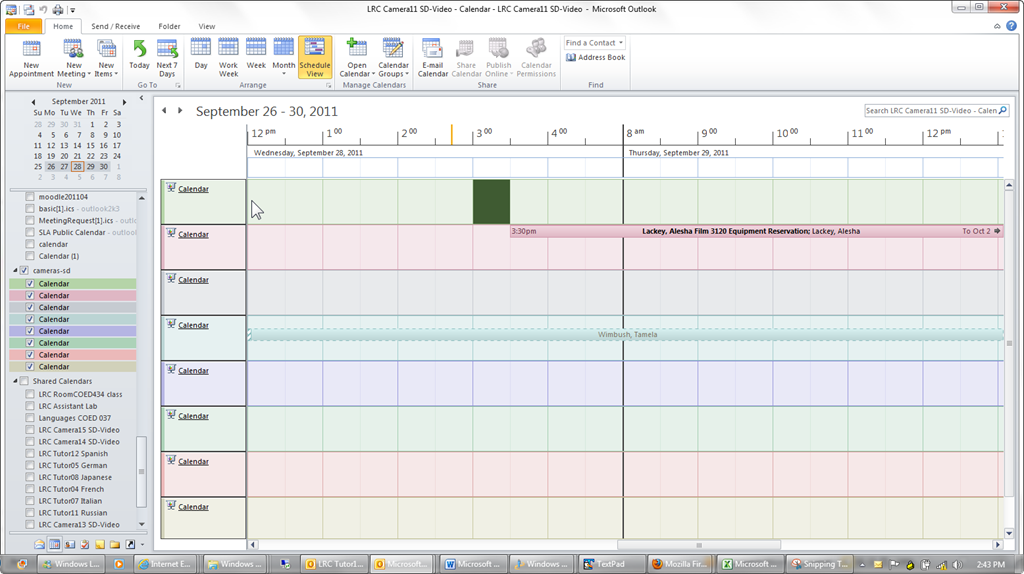
- You can save the currently loaded calendars as a preset or “group” from the ribbon in the calendar view of outlook 2010, like so:

- The group and its members will be added to your calendar tree, and you can load all members with one click, like so:

- Then you can create multiple presets which correspond to your typical workflows: E.g. when you do not have to check the availability of equivalent sets of equipment, you may want to have an easy overview of staffing in the LRC:
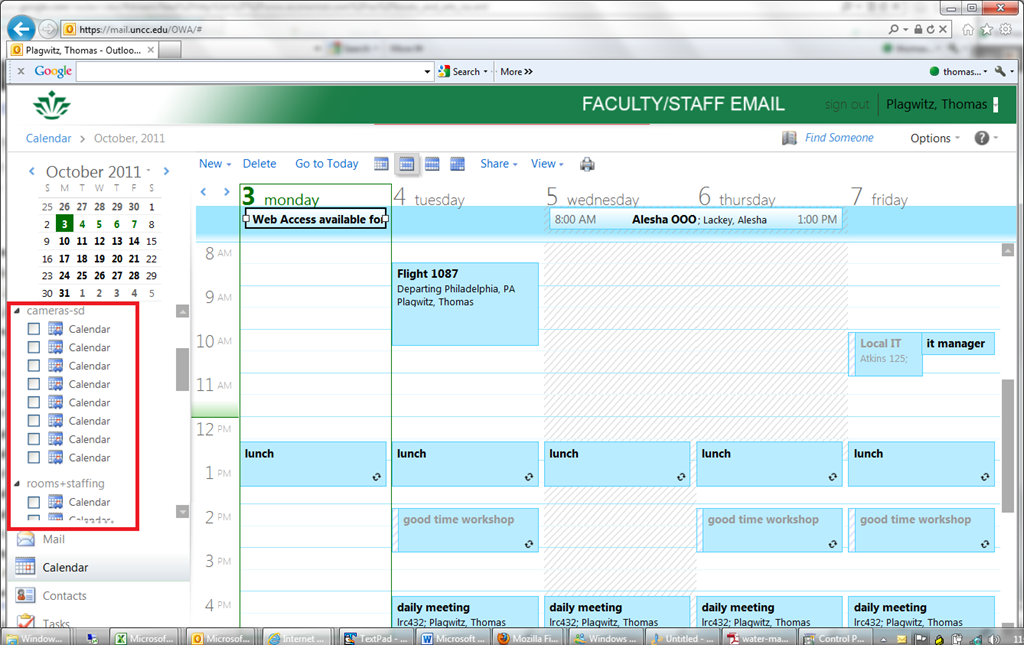
- Note that – while we have to load individually the calendars of other mailboxes we own –, calendar groups we create in Outlook are automagically mirrored in OWA
- But the calendar names get lost in the process? And: the batch select checkbox is missing. And: only up to 5 calendars can be viewed in OWA simultaneously. And: OWA does not support overlay mode for calendars.):

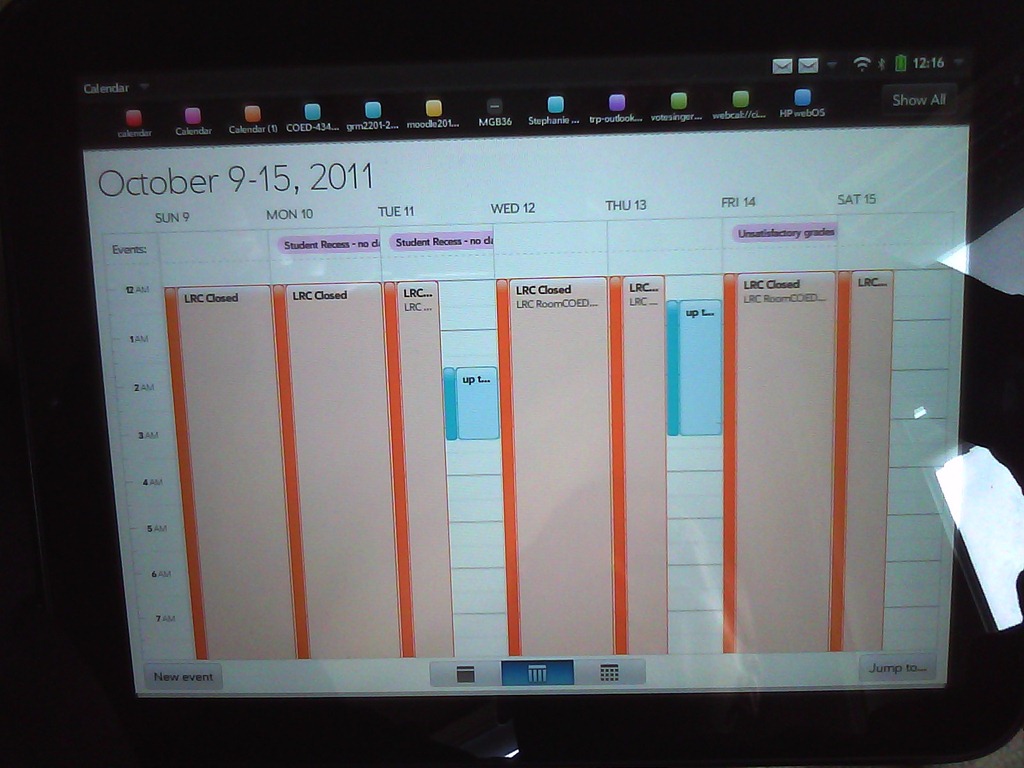
- It would be great if calendar groups, with the help of ActiveSync, even worked their way through to mobile devices, but apparently they do not:



LRC Outlook/Exchange 2010 Resource Calendaring: How to display a Room/Staff/Tutor calendar aggregate at the reception desk using live@edu
- The LRC needs an overview aggregate calendar of its many rooms and services for clients in the entrance area. This should be always on display on the higher one of the reception area dual screen computers when screens are in extended mode
- From the calendar mailbox in OWA , these calendars can and have been published to the internet.
- LRC assistants can load and bookmark multiple (published or shared) calendars in their OWA, but there are limitations
- We do not want to clutter LRC Assistants OWA with LRC calendars more than we have to.
- OWA displays calendars (currently = 2011) only side-by-side, there is no overlay (=aggregate) mode like in Outlook 2010, and only up to 5 simultaneously, again unlike Outlook 2010 (30) (Students do not have Outlook (although it is being considered installing it on student staffed computers).
- A standard web browser allows for display of only one (HTML) calendar at a time in a web browser.
- ICS compatible applications like live@edu
- LRC assistants can load and bookmark multiple (published or shared) calendars in their OWA, but there are limitations
- can display many (=aggregate) ICS-based calendars in overlay mode.
- In addition, it is easy to change the display color (like in Outlook 2010) and display color (unlike in Outlook 2010, for me at least).
- In live@edu, this looks promising:

- To display more meaningful/less misleading subjects than “Busy” for pseudo-rooms (“offices” like LRC assistants or language tutors), add a subject (office name “LRC Assistant”or max class-level tutored).
- To have LRC assistants easily and consistently load this aggregate calendar view,
- we need to give tutors the password to uncc-lrc credentials – being “friends” not enough (which makes their own access to SkyDrive which we finally achieved yesterday useless – unless they log in as themselves and as uncc-lrc in 2 different browsers)
- However, I have not found a way to aggregate calendar ics files and display them without password (ideally in Joomla)
- Workaround: use a AutoIT auotmation script that runs when LRC Assistant logs in form the All users Startup Folder.

Exchange 2010 and Live@edu: How to use resource calendar publishing to implement a help desk timetable and signup sheet
- Calendar sharing with students that have only cloud accounts in live@edu requires them to be mail-enabled users in on-premise AD and only works if a users privileged to share shares with individuals through the GUI (in our circumstances: no groups, no PowerShell access).
- Workaround to share resource calendar information is: publish calendars to the internet. This needs careful consideration of privacy issues, but Exchange 2010 provides you with a number of helpful options, including “availability only”.

- If you publish, you can easily generate the links from the resource mailbox name, and manage large sets of calendars e.g. in an MS-Excel Web app.
- As you can see in the below LRCTutor12 calendar subscribed to in either OWA or Windows Live, the Exchange 2010 ICS does not seem to provide the calendar name, users have to update it manually (maybe use the resource mailbox account name from the calendar URL).
![student-internet-calendar-in-owa-error_thumb[2]](https://thomasplagwitz.com/wp-content/uploads/2011/09/student-internet-calendar-in-owa-error_thumb2_thumb.png?w=526&h=287 "student-internet-calendar-in-owa-error_thumb[2]")
![student-internet-calendar-in-windows-live-works_thumb[2]](https://thomasplagwitz.com/wp-content/uploads/2011/09/student-internet-calendar-in-windows-live-works_thumb2_thumb.png?w=545&h=342 "student-internet-calendar-in-windows-live-works_thumb[2]")
- If you “hack” resource calendars to be a help desk timetable (support personnel, like lab assistants/tutors, one calendar per language, sharing the support role), and have personnel update their availability with late-breaking changes through their Outlook calendars (“cancel this occurrence”) and automatically get these changes pushed out to all users over the internet.
- You can also “hack” a signup sheet “on steroids”:
- enforce a MaximumDurationInMinutes suitable for a sign-up appointment duration)
- set the AutomateProcessing option to AutoUpdate,
- accept the meeting requests of lab assistants/tutors at term start, so that they appear as solid blocks in the calendar, and advise clients trying to sign-up that only 1 client can sign-up during any given solid block with the office.
- Then ignore meeting requests of clients during the term (but communicate the rule to clients: only one client can sign up for support from the “office” during any given time slot. There is in my knowledge no way to set a number in Exchange 2010. Neither MaximumConflictInstances nor ResourceCapacity are applicable). The client meeting requests will remain tentative and appear hatched in the calendar for any other client to see.
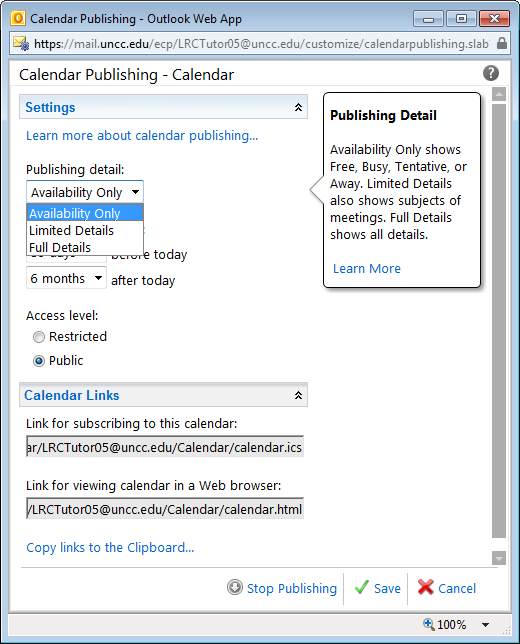
- It is advisable to publish the calendar not with “Availability” only, but with “Limited Detail”, so that additional information (office hours dedicated to specific support topics/clinics, specific requests by clients) can be passed back and forth between support personnel and clients (and anything is better than “Free/Busy” which is especially misleading for such office calendars). Note that even if OrganizerInfo is included on-premise, it seems not included on calendars published to the internet (option “public”; “restricted” has not been tested), which makes Limited Detail possible in our environment.
- Publishing the calendar to the internet with “Full details” could be used for passing additional information, like special handling instructions to student workers,
- like this:
 (this is the publically viewable HTML – oddly)
 - This notes passing does not work with cloud-accounts that are subscribed to the calendar ICS that are not mail-enabled in AD: no notes field gets through to them in OWA)
- But the one-size-fits-all approach is unsatisfactory. If the group of student workers is small, it could (once mail-enabled in AD) be shared the calendar with instead.
- incidentally, what happens with the organizer field under “full details”
- Ìt appears that a calendar can not simultaneously be published "public" and "restricted" (need to know the obscure URL), let alone with different levels of information included.
![student-internet-calendar-in-owa-error_thumb[2]](https://thomasplagwitz.com/wp-content/uploads/2011/09/student-internet-calendar-in-owa-error_thumb2.png "student-internet-calendar-in-owa-error_thumb[2]")
![student-internet-calendar-in-windows-live-works_thumb[2]](https://thomasplagwitz.com/wp-content/uploads/2011/09/student-internet-calendar-in-windows-live-works_thumb2.png "student-internet-calendar-in-windows-live-works_thumb[2]")

MS-Exchange 2010 and OWA: Set Resource Calendar Response messages for Automateprocessing
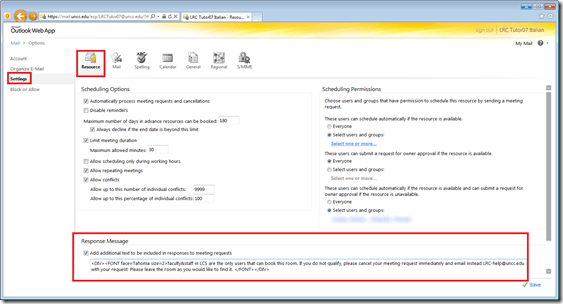
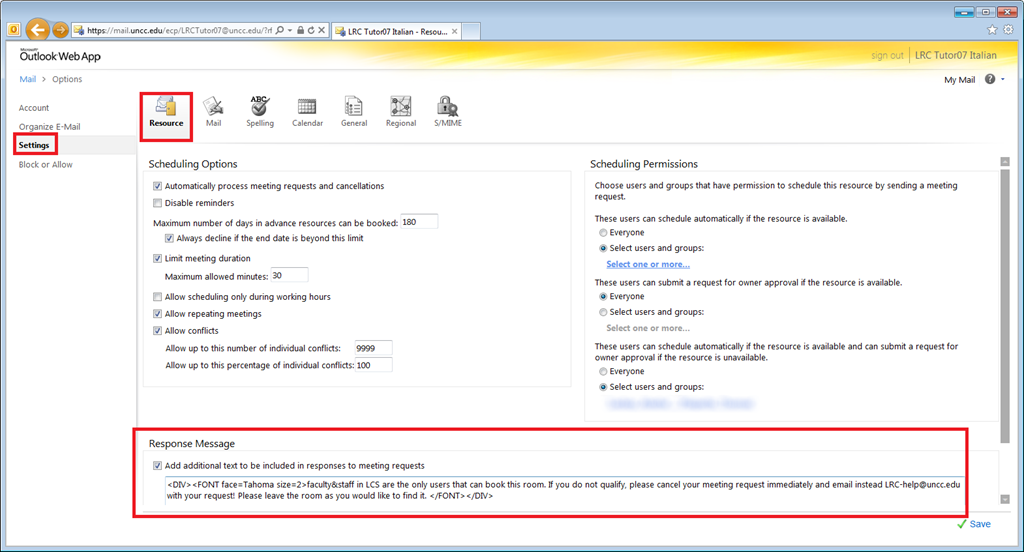
- You do not need your Exchange Admin to manage and change the ResponseMessages that your Resources Mailbox Assistants sent out by your Calendar Assistants.
- In OWA, impersonating the mailbox, in the upper right corner, go to “Options” / menu item: “see all options”, and then:
Our Office 2010 natural language features upgrade: A running log
- Just logging some notes, observations, issues, step-by-step instructions… – other than non-natural-language, most collaboration features, which are being logged here.
- Office 2010 proofing tools (proofing-tools2010-install.wmv),:
- again, we select custom install, “run all from Computers”
- install is extensive, but uneventful
- Office 2010 proofing tools (proofing-tools2010-first-run-German-set-language.wmv), first run:
- German is not autodetected. You have to set the language of the selected text manually, and first find the button on the ribbon:reviewing
- While choosing the language, you can see from the checkmark which languages now have proofing tools installed
- Foreign Language Support
- One of the strongest benefits of upgrading to MS-Office 2010 in the language center is the improved foreign language support licensing for so called “Language Packs”, and that we have a complete set of licenses to the MS-Proofing Tools.
- In addition MS-Office supports free download of so called “Language interface packs” which seem essentially downscaled language packs for LCTL (usually come only with (see feature list) a spell checker and help in the language). Compare: “If a language is available in a language pack or as a fully localized version, it is not available as a language interface pack”.
- Unfortunately multi-user (= learner of different language) support is not the primary usage scenario of these tools. It is, however, possible, to set the language to a default (e.g. Spanish, Arabic or Chinese, depending on your environment). Switching to another language is relatively easy for a user
- changing the screen-tip language: http://skydrive.live.com/embedicon.aspx/screencasts/office-2010-switch-screentip-language.wmv?cid=4fa3329905d7e1ce&sc=photos
Reception area PCs: Remaining issues with the software image
- That’s a new one:
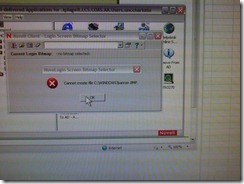 . likely fixed by logging in with an admin account first before freezing.
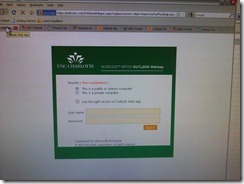
 - IE8 windows in kiosk mode where clients need to log in (and out, using the built in links not by closing the browser)
- 49erexpress , the rest is linked there and opens in a new window which can also be closed, as long as the login dialogue stays up
- mail.uncc.edu
- Moodle
- Safari
- default dialogues need to be changed
- no “not default browser”:
- close w/o saving settings/tabs
- no “not default browser”:
- should start and load the UNCC-LRRC calendar (could be home page)
- default dialogues need to be changed
- Chrome
- business chrome install, but interferes with zoomit shortcuts
- Firefox
- is missing tab 49erexpress: use this also for lrc assistants
- LRC Moodle
- LRC lists
- loads its required tabs twice – probably related to “save and quit” feature which needs to be set to “quit” and “never ask again”.
- Spreadsheet opens read-only.
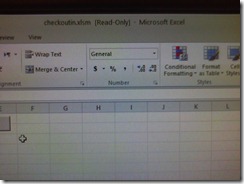
- Trying to set the file attribute to read/write fails

- Trying to set the file attribute to read/write fails
- not needed, store in outlook, also we do not output code to spreadsheet anymore anyway to discourage manual copy: Writable spreadsheet is not useful anyway on a frozen PC
- w/o thawspace: implement one in Deepfreeze (which requires alteration of the DFWks.exe installer) (and during creation of the image, fake the drive letter from which the spreadsheet autoloads, with a removable drive).
- Better would be Faronics Igloo which would with install of deepfreeze redirect spreadsheet folder to thawed virtual partition, but is not available
- Deepfreeze did install and could be frozen, but does not accept its password for thawing locally and needs to be thawed from the Deepfreeze Console. Password has been updated.
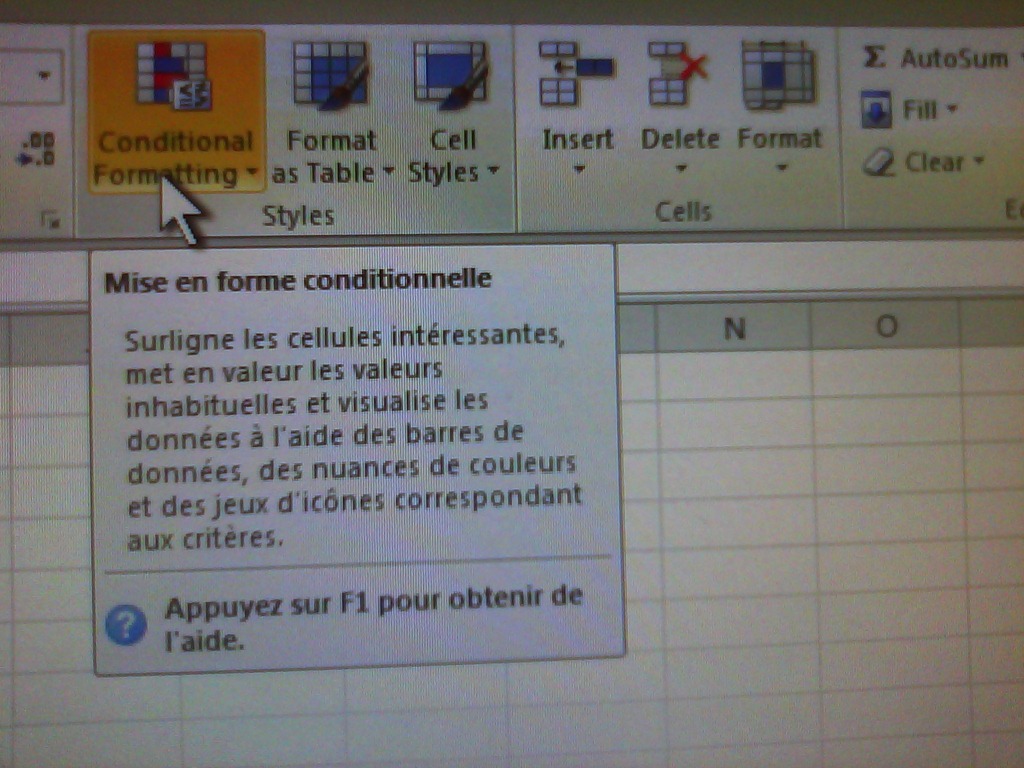
- The MS-Office tooltips are set to French – this is for testing:

- Internet Explorer managed to sneak in Bing as the default search provider;

- When starting MS-word, there is a DOCUMENT Recovery pane.
- in explorer, protected operating files are not shown, but hidden files
- label screens on lrc assistant side.
- LRC assistants use Firefox, clients use Internet explorer (full-screen – use ALT+TAB to switch windows)
- show on 2nd screen:
- SAFARI with UNCC-LRC calendar
- Moodle Spanish announcement (?)
- Printers
- department: optional
- Ricoh: default



Moodle Metacourses, part IV: The support workflow: Transcoding audio learning materials
The MS-WMA-Voice codec features very acceptable audio quality for spoken language learning materials in a highly compressed format. It allowed me to reduce our existing audio files collection size by about 50%.
Expression Encoder 3 crashed a few times during encoding this queue of 3.500 audio files. In addition, it took a long time to reload the .XEJ project files of such a size. It is, however, easy enough to inspect the XEJ in an XML editor:

And even easier to delete the finished media files form the queue using a text editor: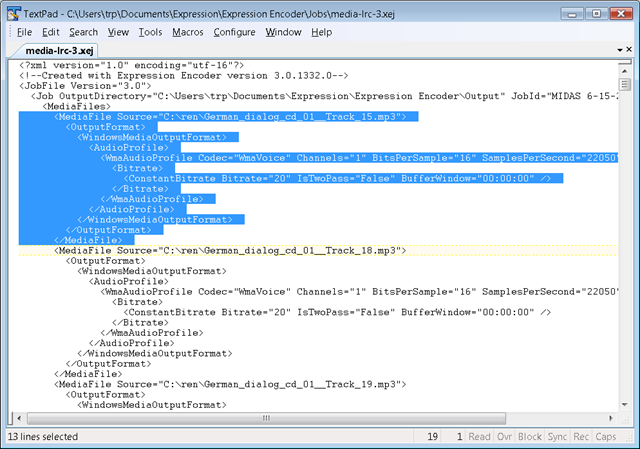
I am wondering whether this queuing could be streamlined (recovery automated, and the need for human interaction be reduced) using the PowerShell Module for Automating Expression-Encoder, but so far the process is good enough.
Room and Equipment handling using MS-Exchange Resource Mailboxes: To train in Outlook Desktop or in OWA ?
-
While Outlook desktop is a more powerful calendaring tool than OWA (cf. viewing calendars in overlay mode), we decided to first focus on getting everybody to be functional with meeting requests in OWA, since
-
faculty will want to use this system from their home computers where the outlook desktop configuration, if it exists at all , is probably even more lacking. Students could, but are not likely to have outlook desktop either
-
both faculty and students (both for rooms and for equipment) will walk up to the LRC reception desk needing help, and then only OWA is available
-
it is actually part of both equipment check-out and check-in procedure (if not for rooms, then for equipment) that I am designing that faculty and students open up from OWA (on the web browser that the lab assistant is not using: internet explorer, Firefox, Safari should gives us always 2 options on either operating system) that the meeting that they have made (or if not made, make one on the fly), and that the lab assistant enters a code (generated on the PC at the reception desk) into their appointment and sends the update for them to see them through;
-
we can also serve as backup on our office computers for the reception desk (unstaffed or understaffed), if clients use OWA
-
Essentially, it is not a PC Environment anymore (although it could be if our Remote Desktop infrastructure were much stronger).


Questions? Read the About. Or just ask me a quick Our Databases: Resources with calendars -- Language learning material Moodle Sites, multimedia files -- films


FAQs for LRC student staff or for students or for teachers. To search our FAQs, in the browser addressbar, add after "https://plagwitz.wordpress.com/feed/?tag=faqs+/" "+TAG1" (from tag cloud below) OR "https://plagwitz.wordpress.com/feed/tag=faqs
&category_name=" "CAT1" (from category hierarchy below). OR search both categories and tags, and multiple TAGs/CATs (connect with "," for OR-search, with "+" for AND-search), like so: https://plagwitz.wordpress.com/feed/?tag=TAG1+TAG2+...TAGn&category_name=CAT1
+CAT2+...CATn"
Other ways to find help
If you cannot find it here, look there: 5,500 Language-Learning Links and Programs for learning or teaching 150 languages
Shortcuts:Our Lists, Our Maps, LRC Staff Moodle Site,LRC Project Moodle Site, 49erexpress, UNCC Moodle, Student Recordings: s:claslcslrcsanakostudent
Learning usage samples: Sanako oral exam, Kaltura webcam presentation, Dictation with speech recognition, Sanako written exam, Chinese and Japanese interactive stroke-order practice
Test the Sanako Installer, Webbrowser Popup Konfigurator for XP, or Windows7, faster LRC TeacherPC Log-in Let MS facilitate diacritics writing by installing for you US-International keyboard layout
This is my personal blog (Google+). The views expressed on these pages are mine alone and not those of my employer. The information in this weblog is provided “AS IS” with no warranties, and confers no rights.
 Thomas' Work Space

