Instant language services support on office and classroom IT lab computers using MS-Messenger
1. If you have Windows XP on your office computer, we can use MS-Messenger “Application Sharing” to provide immediate live assistance with computer problems in remote parts (also useful for collaboration with colleagues on documents, including web pages, when a phone call is too little and a meeting is too much).
1.1. click "Start", "Run", type (or copy/paste): "C:\Program Files\Messenger\msmsgs.exe", click “OK”
2. Initial setup (you have to do this only once)
2.1. “Add a .net passport to your windows XP user account”:
2.1.1. Email account
2.1.1.1. 
2.1.1.2. Users of http://hale-translation.groups.live.com/, http://hale-interpreting.groups.live.com/, or the Interpreting online calendar (http://calendar.live.com) can re-use their windows live account
2.1.1.3. Other users can use existing hotmail/windows live accounts or create a new hotmail/windows live account (you may want to create a separate account for work related messaging)
2.1.2. On your office computer, also check the checkbox to “Associate your account with your windows user account”, like here: 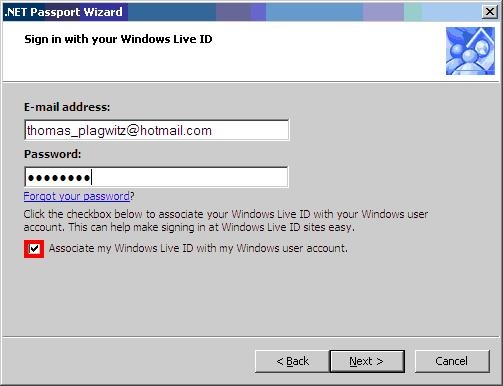 , when asking for help on a student computer, uncheck this
2.2. Add Thomas_plagwitz@hotmail.com as a contact (initially, I will have to accept this before you can contact me):
2.2.1. Click on “I Want To … Add A Contact”
2.3. click "Start", "Run", type (or copy/paste): "C:\Program Files\Messenger\msmsgs.exe", click “OK”
2.4. Start a conversation by double clicking on the user icon (“Thomas Plagwitz” or whoever) in your contact list
2.4.1. Right Menu: Section: “I want to” / “Start Application Sharing”
2.4.2. 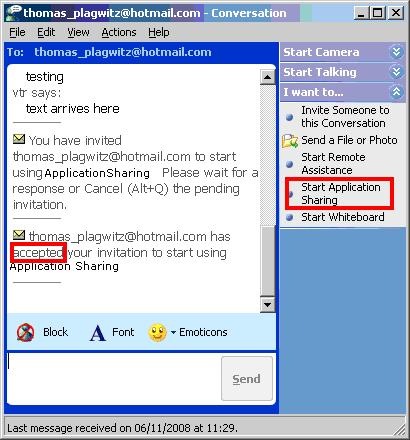
2.4.3. All is well if the other party has “accepted your invitation”, like above – allow some time for the screen sharing to start up on old computers.
2.4.4. When a dialogue comes up which asks you which application to share, use “Desktop”, like below – this will allow the other party to see your screen.
2.4.5. 
2.4.6. At the end of the session, “Unshare” your desktop, or simply end the “conversation”


Questions? Read the About. Or just ask me a quick Our Databases: Resources with calendars -- Language learning material Moodle Sites, multimedia files -- films


FAQs for LRC student staff or for students or for teachers. To search our FAQs, in the browser addressbar, add after "https://plagwitz.wordpress.com/feed/?tag=faqs+/" "+TAG1" (from tag cloud below) OR "https://plagwitz.wordpress.com/feed/tag=faqs
&category_name=" "CAT1" (from category hierarchy below). OR search both categories and tags, and multiple TAGs/CATs (connect with "," for OR-search, with "+" for AND-search), like so: https://plagwitz.wordpress.com/feed/?tag=TAG1+TAG2+...TAGn&category_name=CAT1
+CAT2+...CATn"
Other ways to find help
If you cannot find it here, look there: 5,500 Language-Learning Links and Programs for learning or teaching 150 languages
Shortcuts:Our Lists, Our Maps, LRC Staff Moodle Site,LRC Project Moodle Site, 49erexpress, UNCC Moodle, Student Recordings: s:claslcslrcsanakostudent
Learning usage samples: Sanako oral exam, Kaltura webcam presentation, Dictation with speech recognition, Sanako written exam, Chinese and Japanese interactive stroke-order practice
Test the Sanako Installer, Webbrowser Popup Konfigurator for XP, or Windows7, faster LRC TeacherPC Log-in Let MS facilitate diacritics writing by installing for you US-International keyboard layout
This is my personal blog (Google+). The views expressed on these pages are mine alone and not those of my employer. The information in this weblog is provided “AS IS” with no warranties, and confers no rights.
 Thomas' Work Space