Archive
How to install and use a free dictionary/encyclopedia app in MS-Word 2013
Installing is easy (our example is Wikipedia): Right-click a word, pick “define” from the context menu, the click download in the side pane for the app you choose.

Usage is also easy: To look up phrases, select, right-click and choose define: 
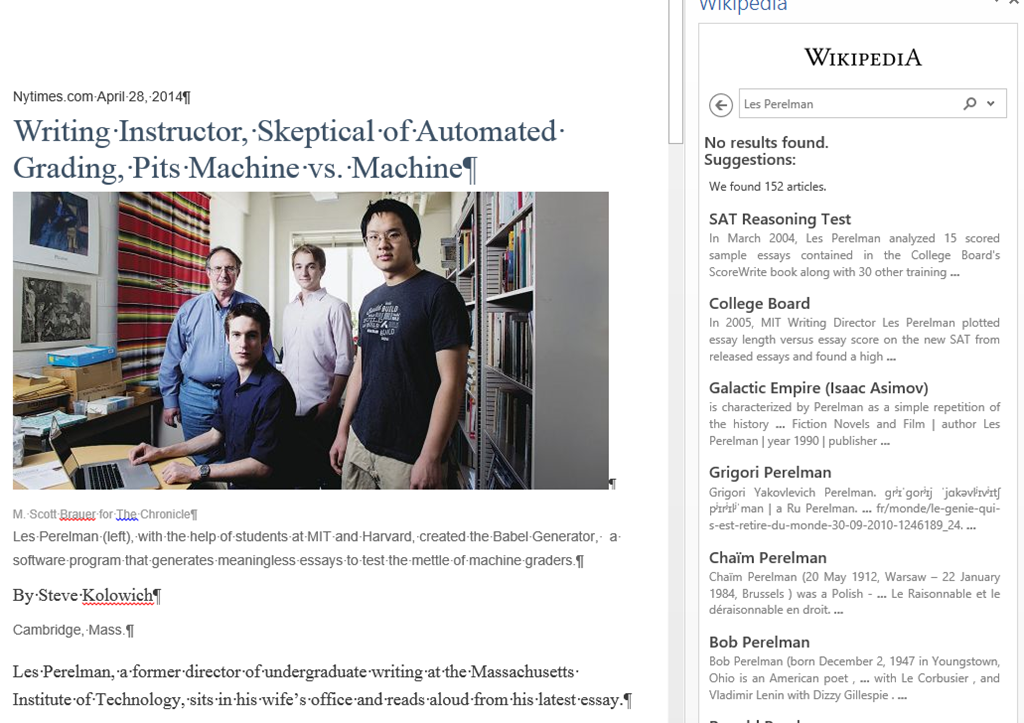
To look up individual words, you can also just double-click the word: 
You can also click “Expand”: 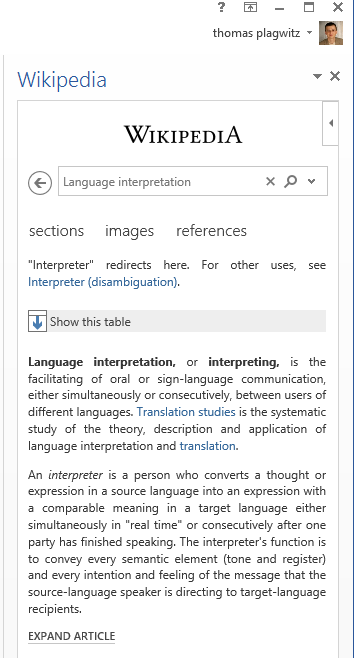
To install more dictionaries after the first one, click Insert / Apps for Office. 

You can search for your L2 (too many to list): 
It works for base forms: 
But I cannot lemmatize (ouch): 
I found out that when I go to Insert/ My Apps/ See all :  , I can show more than one app in the side pane.
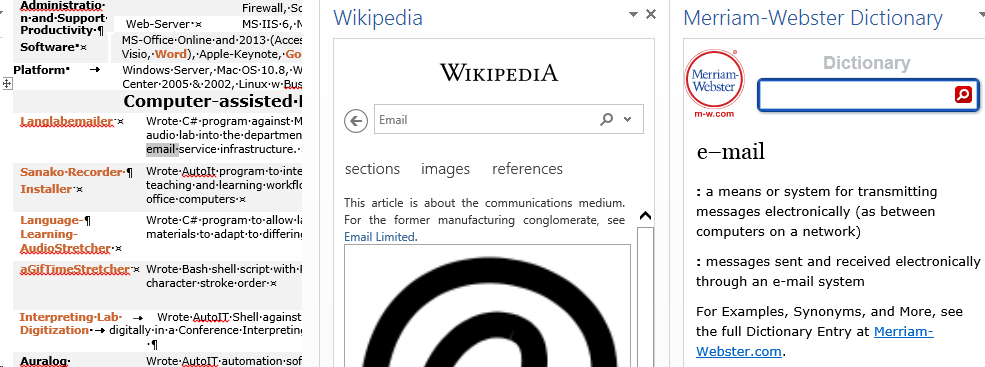
However,how o I change the default lookup that happens on double click on a word?
Use parentheses to search in MS-OneNote for a string that includes punctuation
The default is OR search around punctuation characters. Before parenthesis:

After:

Pretty obvious, but took me a while to figure out…
Software-based laser pointer in PowerPoint
- You can activate software laser pointer in PowerPoint by pressing CTRL and P (= Pointer) while displaying your slideshow. Then you can draw on your show to highlight points, just like with a laser pointer – but unlike that, it cannot run out of battery power!
- Other keys you can press:
- Erase = E (unlike with a laser pointer, you have to),
- deActivate = CTRL and A.
- Other advantages: unlike some other screen drawing tools that freeze the screen (MS-ZoomIt notably), the software laser pointer:
- allows you to proceed through the PowerPoint presentation normally;
- can be saved as ink annotations, and will show up if you convert your PowerPoint to a video or play it with narrations.
Save the web, with Clip to OneNote
No, I don’t mean save from proprietary vendors or from spies  – I mean: save it to your personal storage during web browsing, like so:

The essence of http://blogs.office.com/2014/03/17/onenote-clipper-clip-the-web-right-to-onenote/. https://www.onenote.com/Clipper/OneNote should be useful not only for personal research on the web.
Why meeting organizers should cancel meetings from their calendar and not by email
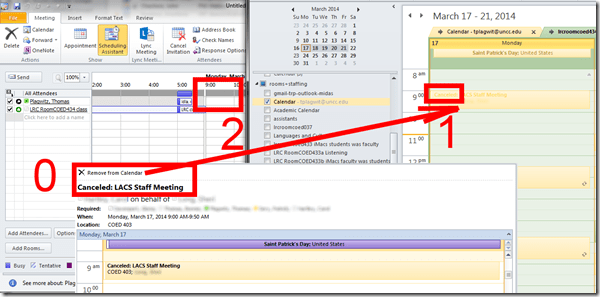
- Because cancelling from the calendar like in video2 here sends the meeting participants not only a (0)message, which includes a handy “Remove from calendar” button,
- but also – in case they fail to see the message – a (1) “Cancelled” indicator on their calendars,
- while third parties who want to schedule a meeting with the meeting participants, see those participants (including an Rooms that “participate”) as (2) free/available during the time slot of the cancelled meeting,
- as you can see in this example:

Have patience if you see “No free/busy information could be retrieved” on Room mailbox
When trying to schedule a room, I am now seeing this: 
When ctrl-right clicking: 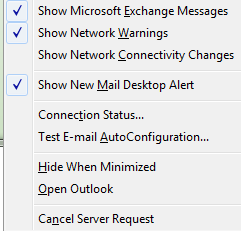 , I get this as my connection status:
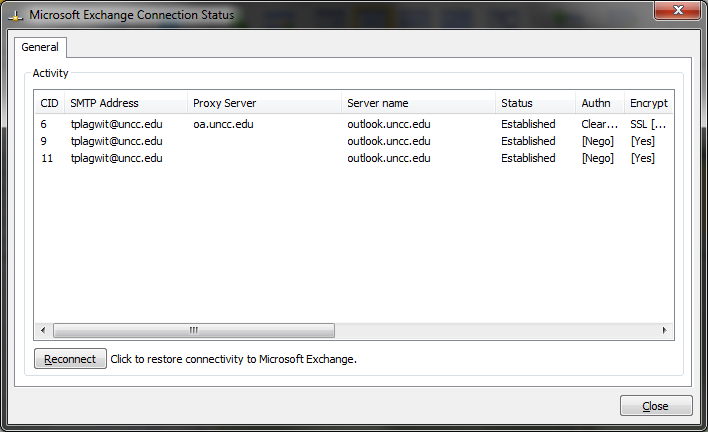
Becomes available after a long while:

What can I tell my users how long is the wait currently usually is?
What a delegate in MS-Outlook/MS-Exchange is and does
- Definitions:
- I would say: S/he can act on your behalf, while you keep in the loop and others see who s/he is acting on behalf of which disintermediates (e.g. saves tags like “This message is sent on behalf of [you]”: The message will appear to originate from you, as it ought to – imagine e.g. that users want to search their email for “from:[you]”).
- Looking for guidance, I find Cornell.edu has generally good instructions for their similar Outlook/Exchange environment, so I also quote them:
- “Just as an assistant can help you manage your paper mail, your assistant can use Outlook to act on your behalf”.
- “If your manager has granted you delegate access, you have the ability to act "on behalf of" him or her. Depending on exactly how much access they’ve given you, you may be able to respond to meeting requests, send out meeting invitations, and handle their email messages.”
- Find more information on delegates here for the source.
- Sounds interesting? Next steps:
- How you can set up a delegate
- what does the delegate see/do
Notes on how to act as a delegate in MS-Outlook on Exchange
- In Manage another person’s mail and calendar items, you can learn form the source, how to:
- Cornell.edu has generally good instructions for their similar Outlook/Exchange environment, so I just quote them :
Create meeting requests on behalf of your manager: You must be viewing your manager’s calendar in order for the meeting request to appear to come from them rather than you. (How do I view my manager’s calendar?)
If you have more than one calendar open (many people leave both their own calendar and their manager’s calendar open), click anywhere in your manager’s calendar before creating the meeting request.
Notice that in the Scheduling Assistant, your name will not appear. Instead, your manager’s name is included. Which is what you want. So that’s good. Respond to meeting requests on behalf of your manager: [with delegate access,] You can respond to these messages in exactly the same way you would respond to an invitation sent to you.


Questions? Read the About. Or just ask me a quick Our Databases: Resources with calendars -- Language learning material Moodle Sites, multimedia files -- films


FAQs for LRC student staff or for students or for teachers. To search our FAQs, in the browser addressbar, add after "https://plagwitz.wordpress.com/feed/?tag=faqs+/" "+TAG1" (from tag cloud below) OR "https://plagwitz.wordpress.com/feed/tag=faqs
&category_name=" "CAT1" (from category hierarchy below). OR search both categories and tags, and multiple TAGs/CATs (connect with "," for OR-search, with "+" for AND-search), like so: https://plagwitz.wordpress.com/feed/?tag=TAG1+TAG2+...TAGn&category_name=CAT1
+CAT2+...CATn"
Other ways to find help
If you cannot find it here, look there: 5,500 Language-Learning Links and Programs for learning or teaching 150 languages
Shortcuts:Our Lists, Our Maps, LRC Staff Moodle Site,LRC Project Moodle Site, 49erexpress, UNCC Moodle, Student Recordings: s:claslcslrcsanakostudent
Learning usage samples: Sanako oral exam, Kaltura webcam presentation, Dictation with speech recognition, Sanako written exam, Chinese and Japanese interactive stroke-order practice
Test the Sanako Installer, Webbrowser Popup Konfigurator for XP, or Windows7, faster LRC TeacherPC Log-in Let MS facilitate diacritics writing by installing for you US-International keyboard layout
This is my personal blog (Google+). The views expressed on these pages are mine alone and not those of my employer. The information in this weblog is provided “AS IS” with no warranties, and confers no rights.
 Thomas' Work Space